Performance management turns a record of goals and progress into a fair, defensible rating. Run as an annual event, though, it leaves the record missing when the rating gets written, and the results show it. In a survey of 230 HR leaders, 66% trusted their ratings while only 27% could prove one with goal evidence.
Performance management is how an organization connects what people do to what the company is trying to achieve: setting expectations, tracking delivery, giving feedback, and evaluating results in a continuous loop rather than a once-a-year verdict. When it works, the rating at the end of the period is the natural summary of a record everyone could already see. When it doesn't, the rating is written from memory — and memory is where bias and recency take over.
That gap between the two versions is measurable, and it's the thread running through this guide. Drawing on the Performance Rating Benchmark Report — an independent survey of 230 People and HR leaders at technology companies — the sections below cover what performance management is, how the cycle runs, the frameworks organizations use, who owns each part, why so many programs can't defend their ratings, and how to build one whose scores actually can be proven. It sits alongside the wider practice of goal setting, because a rating is only as good as the goal record beneath it.
What Performance Management Is
Performance management is the continuous process of aligning individual work with organizational goals and evaluating how well that work delivers. It spans setting expectations, tracking progress, coaching through feedback, evaluating outcomes, and feeding what's learned into the next cycle. It's broader than the annual review, which is just one moment inside it.
The distinction that carries the most weight is between performance management as a system and the performance review as an event. The review is where a rating gets recorded; the management is everything that produces the evidence behind it. Invest only in the event — a form, a cycle, a calibration meeting — and you get a rating with no record underneath it. Invest in the system, and the review becomes a summary of something already documented. That difference decides whether a score can be defended when someone challenges it.
It also helps to separate performance management from three things it gets confused with. Performance appraisal is the evaluation step alone — the backward-looking judgment. Talent management is the wider discipline of hiring, developing, and retaining people, of which performance management is one part. A performance management system is the software that runs the process, though the process exists whether or not a company has bought a tool for it.
This guide is about the process, with tooling as the layer that makes it hold together — and because the strongest version runs on the same rhythm as goals, much of what follows draws on OKR-based performance management, where reviews tie to the goal record rather than to memory.
Why Performance Management Matters
Done well, performance management pays off in four ways that compound. It creates alignment — every person can see how their work ladders up to a company priority through a clear alignment map. It drives accountability — clear ownership of measurable outcomes makes delivery visible rather than assumed. It enables development — regular feedback turns the review from an annual verdict into a running conversation about growth.
And it produces fair, defensible decisions — when promotions, raises, and ratings rest on a documented record, they hold up to scrutiny and feel legitimate to the people receiving them.
That last benefit is where the most programs fall short, and it reframes the whole exercise: the aim of performance management is a rating that can be both trusted and proven. The benchmark data shows how rarely those two travel together. A well-run process closes that gap; a poorly-run one widens it while looking, on the surface, like it's working.
The Performance Management Cycle
Organizations run performance management on a recurring cycle with four connected stages.
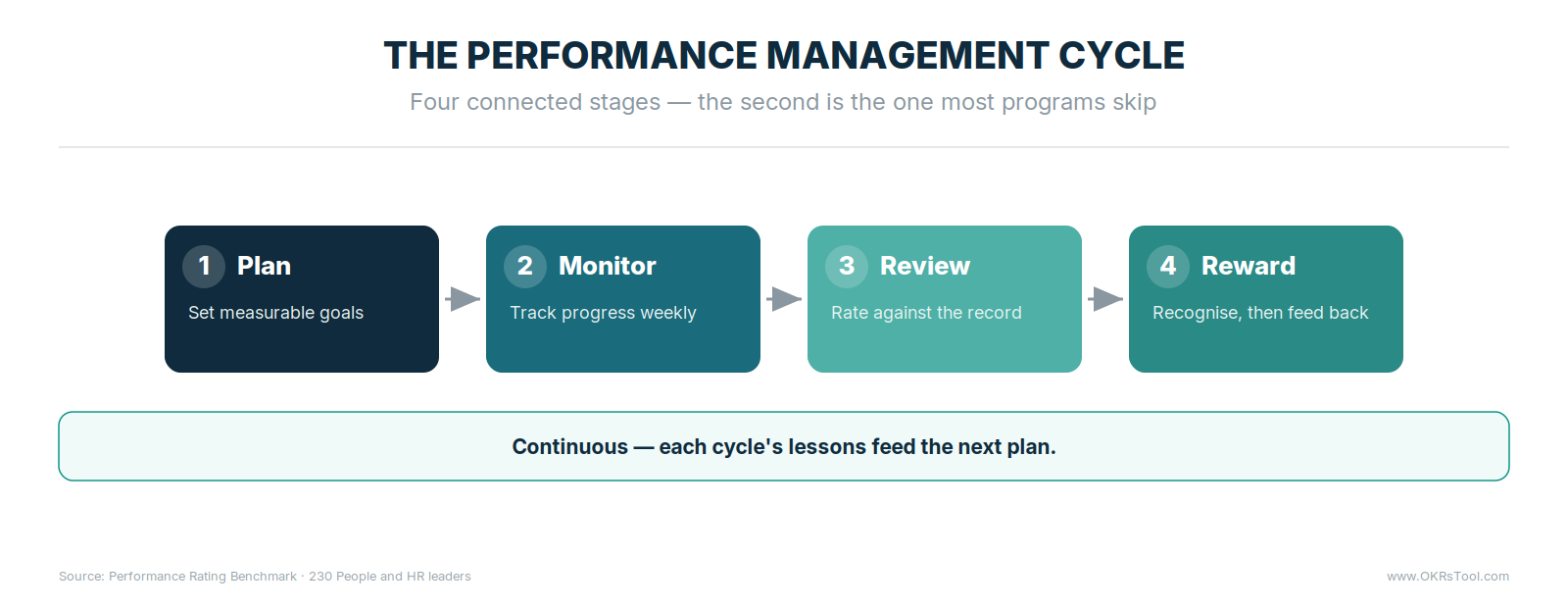
Planning sets goals and expectations for the period, ideally as measurable outcomes rather than vague responsibilities. The whole cycle is won or lost here: "improve onboarding" gives the reviewer nothing to measure, while "cut time-to-first-value from 14 days to 7" — an outcome-based key result — gives every later stage something concrete to track.
Monitoring tracks progress against those goals continuously, through regular check-ins rather than a single mid-point conversation. This is the stage organizations skip, and skipping it is the original sin of performance management — when progress isn't captured as it happens, the review has nothing to read from and the reviewer rebuilds the period from memory. Only 52% of leaders say a manager's recall covers the full review period evenly; for the rest, the score is written from the last month or two.
Reviewing evaluates delivery at the end of the period and produces the rating, ideally through transparent scoring against the goals set in planning rather than an overall impression. When the first two stages are done well, this one is largely mechanical — the record already says how the period went.
Rewarding connects the outcome to development, recognition, or compensation, then carries the lessons into the next planning stage through a structured retrospective. That's what closes the loop and makes the cycle continuous rather than a series of disconnected annual events.
The stages are simple; the failure is almost always in the second. A cycle that plans and reviews but doesn't monitor is an annual review wearing the language of a system. Each stage is broken down further in the performance management cycle guide, with the full workflow in the performance management process walkthrough and the underlying rhythm in the OKR cycle explainer.
Annual vs. Continuous Performance Management
Performance management has been shifting from an annual model to a continuous one, and the reason is structural rather than fashionable. The annual model concentrates everything into one high-stakes event: a form, a backward-looking rating, a conversation that covers twelve months from partial memory.
The continuous model spreads the same work across the period — ongoing goal tracking, feedback on a tighter cadence, and a rating that summarizes a running record.
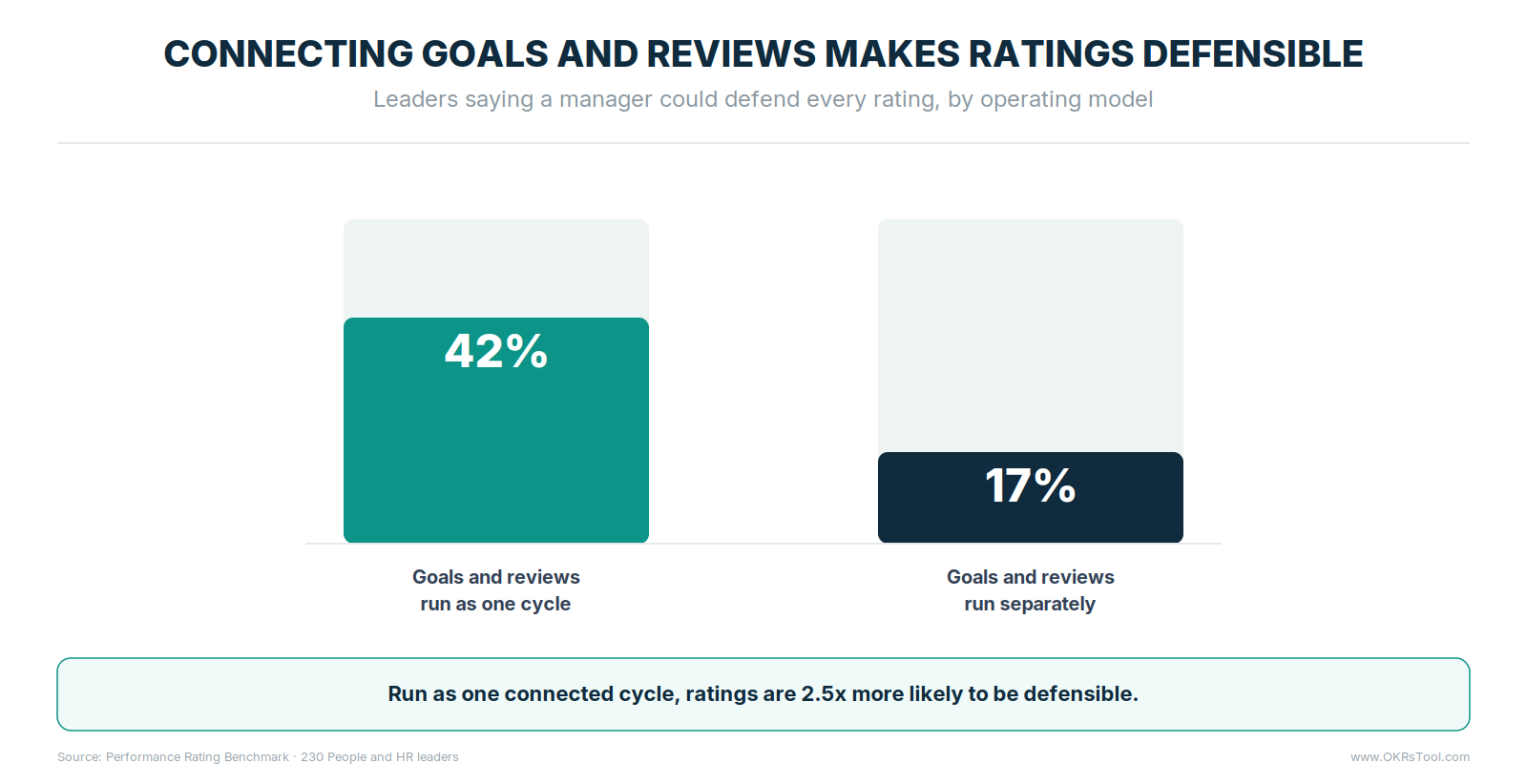
The benchmark data is decisive on which produces better outcomes. Teams that run goals and reviews as one connected cycle are more than twice as likely to say a manager could defend every rating — 42% versus 17% — and far less likely to have seen an unsupported one, 53% versus 74%. Yet 49% of organizations still review twice a year or less, the interval over which early-period work reliably disappears from memory, one of the clearest reasons OKRs fail as a review basis. Continuous performance management works because the rating summarizes a record built in real time, which is what makes the score provable rather than merely felt.
Common Frameworks and Methods
Organizations structure performance management through a few established frameworks, often in combination. The framework sets how goals are shaped and how delivery is judged; the right choice depends on how the organization runs.
Management by Objectives (MBO) is the oldest — top-down goals measured against delivery at period's end. Simple and familiar, but it tends toward an annual cadence and can reward hitting the number over doing the right thing.
OKRs pair an ambitious objective with a few measurable key results, and have become the dominant goal management framework for growing companies because they make delivery traceable and align naturally with a continuous cadence. Because every key result is measurable and owned, an OKR-based process produces exactly the record a defensible rating needs.
360-degree feedback gathers input from peers, reports, and managers rather than a single evaluator, reducing single-rater bias and surfacing behaviours a manager doesn't see. It works best as an input to a rating, layered onto a goal record rather than standing in for one.
Competency models rate people against defined competencies and behaviours rather than only outcomes, which suits roles where how the work is done matters as much as what gets delivered. The risk is subjectivity — without behavioural evidence, competency scores drift toward general impression.
Rating scales and calibration sit across all of these: the mechanics of turning performance into a comparable score, and the cross-manager calibration meetings that keep those scores consistent. Calibration only works when managers bring evidence; without a record, it becomes a negotiation of impressions.
The framework matters less than what feeds it. A rating built on any of these is only as good as the record behind it, and 87% of leaders already use goal achievement as a rating input in OKR-based reviews.
The problem is access, not intent: 35% say they have to reconstruct a person's goals at review time rather than read them from one place — whichever framework an organization runs, including how it handles KPIs alongside OKRs, the deciding factor is whether the goal record is live and connected when the rating gets written.
Who Owns Performance Management
Performance management works when each role owns its part, and reverts to paperwork when it's treated as HR's process that managers merely comply with.
HR and People Ops own the system — the cycle design, the cadence, the tooling, the calibration process, and the fairness of the whole. Their job is to make the right behaviour easy and the record trustworthy, leaving the actual reviews to the people who did the observing.
Managers own the practice — running check-ins, giving feedback in the moment through regular 1:1s, and writing ratings that point to evidence. They're where a well-designed system either comes alive or reverts to an annual scramble. The single highest-leverage thing a manager can do is keep the goal record current, since every other part of their role in the cycle depends on it.
Employees own their goals and their record — setting measurable objectives, updating progress honestly, and bringing their own evidence to reviews. A process that treats employees as subjects of evaluation produces compliance; one that gives them ownership produces engagement.
When these three align around a shared, visible record, performance management becomes a system rather than paperwork — and leadership accountability plus the culture around goals is what decides which.
Why Performance Ratings Often Can't Be Proven
The central failure of performance management is subtle: ratings are widely trusted, yet very few can actually be proven.
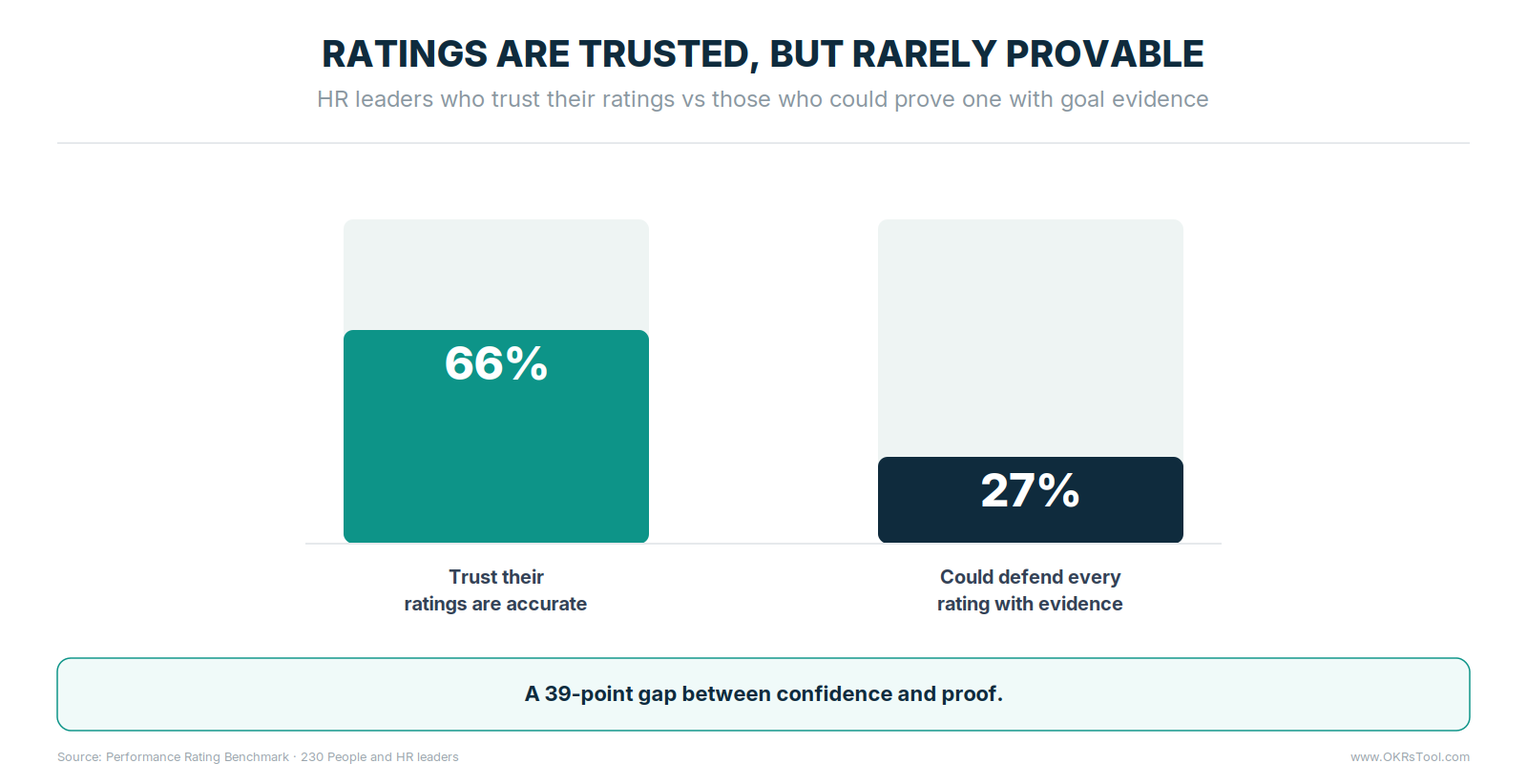
66% of leaders say their ratings are highly trusted; only 27% say a manager could defend every score with documented goal evidence, and 65% have personally seen a rating the goal evidence didn't support. The cause is structural: 61% of organizations run goals and reviews on separate calendars, so when the review happens the goal record has to be fetched or rebuilt rather than simply read.
Where the record is missing, bias fills the gap. 68% of leaders have watched a strong performer rated lower because their best work happened early and faded by review time — the recency effect — a known OKR mistake at review time. 62% say remote or hybrid staff are at least somewhat disadvantaged because out-of-sight work gets discounted — the proximity effect.
And 45% admit something other than goal delivery, from sandbagging to self-advocacy — recency, presence, or self-advocacy — is what actually moves the number, even though 60% say goal delivery is what should.
These get treated as manager-training problems, addressed with unconscious-bias workshops and better rubrics. The data suggests they're infrastructure problems. They recede when a time-stamped goal record replaces memory as the basis for the score, because a bias needs a gap to fill and a complete record leaves none. The same logic explains why tying ratings too tightly to goals can backfire into goal-gaming: the fix is a visible record, not a looser or tighter link.
Where Performance Management Actually Runs
Every gap above traces to one structural fact: for most organizations, the tools that hold the rating and the tools that hold the goal record are different tools.
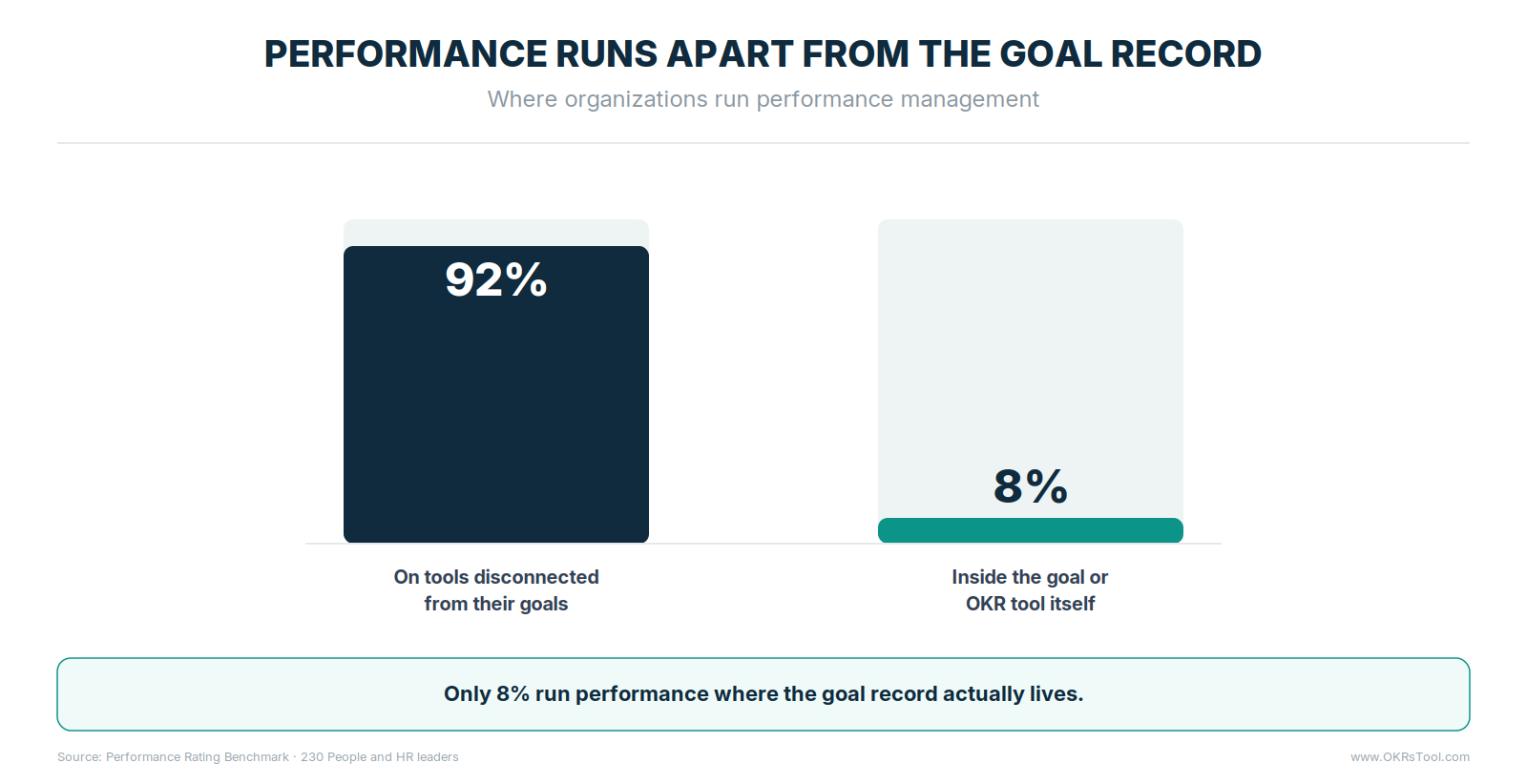
Performance runs on dedicated performance management software (37%), spreadsheets (29%), docs or HR forms (20%), nothing central (7%), and inside the goal or OKR software for just 8%. A spreadsheet doesn't remember what happened in month one; a review form doesn't track a goal between cycles.
The tools most organizations use are built to capture the rating, not to hold the record that justifies it, which is why 92% end up reconstructing at review time. This is the confidence gap in physical form — the record and the rating live apart because the systems that hold them are apart.
How to Build Performance Management That Works
A process whose ratings can be defended comes down to four operating disciplines, in order of impact.
None of these are exotic. They separate a program that produces confident ratings from one that produces provable ones, and the organizations that run them treat performance reviews as the summary of a record instead of a search for one. A shared performance dashboard on one platform is what makes that record visible to everyone at once — the 8% that the benchmark shows pulling away from the rest.
These disciplines are expanded in the performance management best practices guide, with rollout approaches in performance management strategies, worked cases in performance management examples, and role-level detail in how to manage employee performance and performance evaluation examples.
The System Behind a Rating You Can Defend
Strip performance management back to its purpose and it comes to one thing: a rating someone can stand behind when it's questioned. Every part of the system exists to serve that — the goals set in planning, the progress captured through monitoring, the score produced at review, then fed into OKR completion data, and the lessons carried into the next cycle.
When those run as one connected loop, the rating is the summary of a record. When they run as four disconnected events, it's a verdict written from memory, and the benchmark data shows how thin that verdict usually is: trusted by two-thirds of leaders, provable by barely a quarter.
The gap between those two outcomes comes down to one thing more than better managers or fairer rubrics: whether the goal record is continuous and connected when the rating gets written.
Teams that keep it that way — one calendar for goals and reviews, a named owner on every outcome — the accountability that makes delivery visible, progress captured as it happens — are more than twice as likely to say every rating could be defended, and they're the 8% running performance where the goal record actually lives. The other 92% reconstruct at review time and inherit the bias that fills the gap.
For a growing company, the move is straightforward and worth making before the next cycle: make the goal record continuous, require evidence for every rating, and put goals and reviews on one weekly rhythm. Do that and performance management stops being an annual scramble to remember what happened and becomes what it was meant to be — the running record that turns a year of work into a rating that holds up.
Data: the Performance Rating Benchmark Report, an independent survey of 230 People and HR leaders at technology companies of 50–200 employees.
Performance Management FAQ
What's the Difference Between Performance Management and a Performance Review?
Performance management is the continuous system — planning, monitoring, reviewing, and rewarding across the whole period. The performance review process is a single stage within it: the moment the rating gets recorded. A review without the surrounding system is a verdict written from memory; a review inside a well-run system is the summary of a documented record.
What Are the Stages of the Performance Management Cycle?
Four connected stages: planning (set measurable goals), monitoring (track progress through regular check-ins), reviewing (evaluate delivery and produce the rating), and rewarding (connect the outcome to development and compensation, then feed lessons into the next cycle). The monitoring stage is the one most programs skip, which forces the review to run on memory.
What Is Continuous Performance Management?
An always-on model that replaces the single annual review with ongoing goal tracking and regular feedback, so the rating summarizes a running record instead of reconstructing one. The benchmark shows teams running it are 2.5x more likely to have ratings a manager could defend — 42% versus 17%.
Which Performance Management Framework Is Best?
No single framework wins for everyone — MBO, OKRs, 360 feedback, and competency models each suit different organizations. What matters more than the choice is whether the goal record is live and connected when the rating is written. For growing companies on a continuous cadence, OKRs align most naturally because every key result is measurable and owned.
Why Can't Most Managers Prove Their Performance Ratings?
Because the goal record usually lives on a different system from the review. When 61% of organizations run goals and reviews on separate calendars, the reviewer reconstructs the period from memory — which is why 66% trust their ratings but only 27% could defend one with evidence. The fix is structural: keep the record continuous and run the review where the goals live.