
Best practices in performance management are usually listed as virtues — be fair, be frequent, be objective. The benchmark data turns them into something testable: the practices that matter are the ones that keep a rating tied to evidence, because 45% of leaders admit something other than recorded performance moved a score.
Every performance program has good intentions. Ratings are supposed to reflect the whole period, weigh real outcomes, and treat people consistently through a calibration that holds. Then the review arrives, recall does the work, and the score bends toward the last month and the loudest impression, the classic recency problem. The practices that hold up are the ones that close the distance between what a review is meant to do and what it actually does under time pressure.
The Performance Rating Benchmark Report, an independent survey of 230 People and HR leaders, measured that distance directly — and the widest gap of all belongs to recency. What follows are the habits that keep it from taking over, each one drawn from where the data shows reviews break.
Why Best Practices Fail at the Review
The reason most performance advice doesn't stick is that it targets attitude when the problem is structure. Telling a manager to "be objective" does nothing if the record they need to be objective about was never kept.
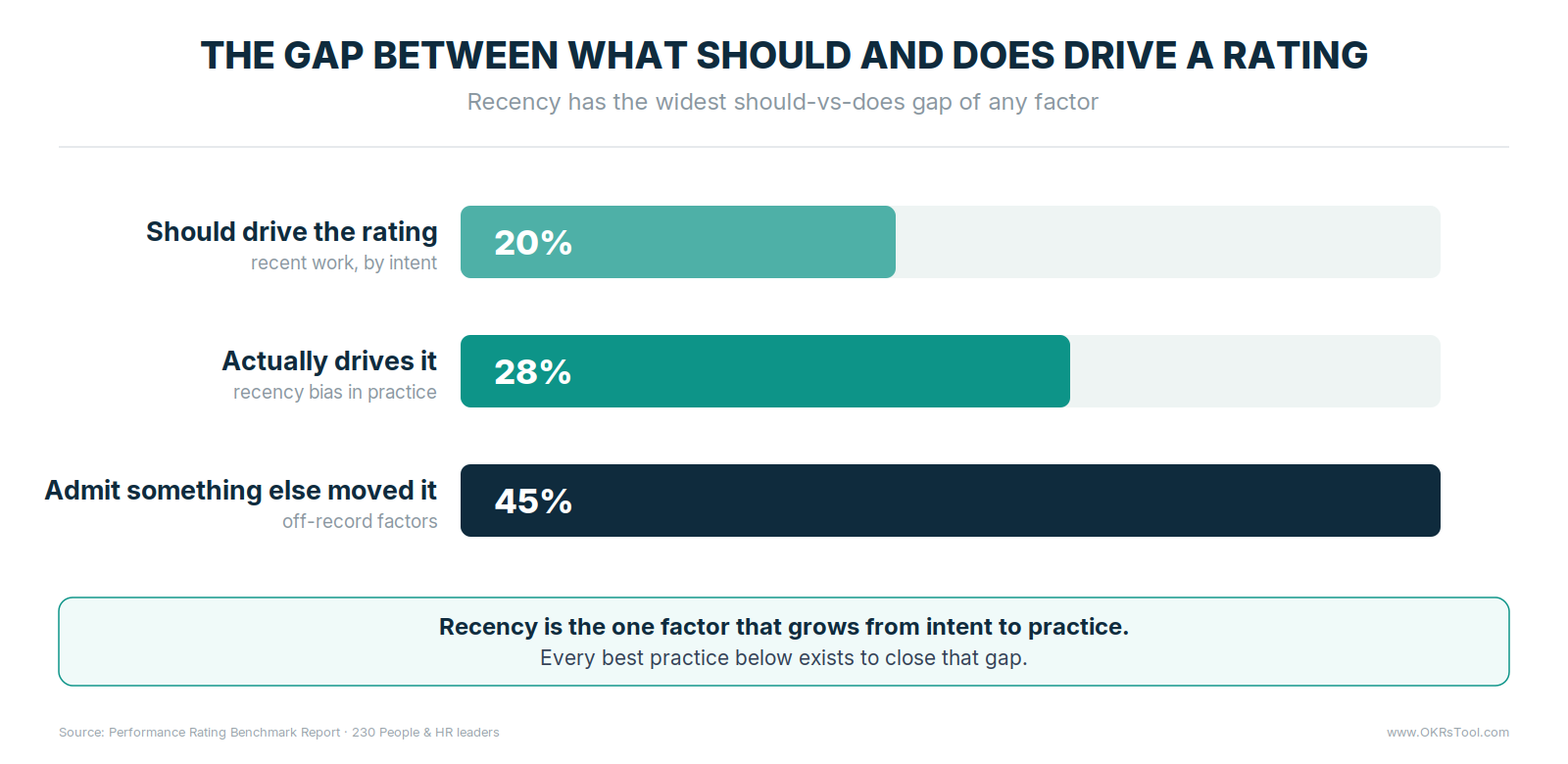
The numbers make the failure concrete. Only 20% of leaders think recent work should be the dominant factor in a rating, yet 28% say it actually is — the single largest gap between intent and practice of any factor measured. And 45% concede that something entirely off the record — a personality, a recent win, a good 1:1 meeting — moved a score it shouldn't have. Best practices earn their place by shrinking those two numbers, not by adding another value to a poster.
7 Best Practices That Actually Hold
Each habit below maps to a specific way the performance review drifts from evidence. They work in combination — no single one saves a rating on its own.
Keep a running record, not an annual reconstruction. The deepest fix for recency is a performance record that updates through the period, so the review reads history instead of recalling it. When progress is captured through weekly tracking at each check-in, December's rating can point to March, not just November. This is the practice that closes the recency gap the report singles out.
Tie every rating to a measurable goal. A rating is only as defensible as the goal beneath it. When each objective carries a key result with a number and an owner, the review has a factual spine, the way strong goal management intends; when goals are vague, the score fills the vacuum with impression. Measurable goals are what make "objective" more than an instruction.
Review on a frequency that matches the work. Long gaps force reliance on memory, and memory favors the recent. A shorter cadence — even a lightweight weekly check-in or monthly note — keeps the record warm so the formal review is a summary, not an excavation. The best-run programs treat frequency as a design choice, not an HR default.
Separate documentation from judgment. Capture what happened as it happens, without grading it in the moment. When the evidence is logged neutrally through the cycle, the manager's judgment at review time works from a fuller, less biased base — and calibration across managers has something real to compare.
Make feedback continuous, not annual. A rating should never be the first time someone hears where they stand. Regular 360-degree feedback through the period means the review confirms a picture already shared, which is both fairer and less prone to end-of-cycle surprise. Surprise at review time is a symptom of a broken practice upstream.
Watch for the visibility trap. Ratings track what a manager sees, and not everyone is equally visible. A shared record of goals and progress gives quieter or less-present contributors the same evidentiary footing, the kind of accountability that survives a distributed team, as the person in the room every day — a fairness practice that a memory-based review can't replicate.
Run performance where the goals already sit. The practice that enables all the others is architectural: keep evaluation and goals on one system, the way a connected performance process runs, so the record is a byproduct of normal work, not a separate chore.
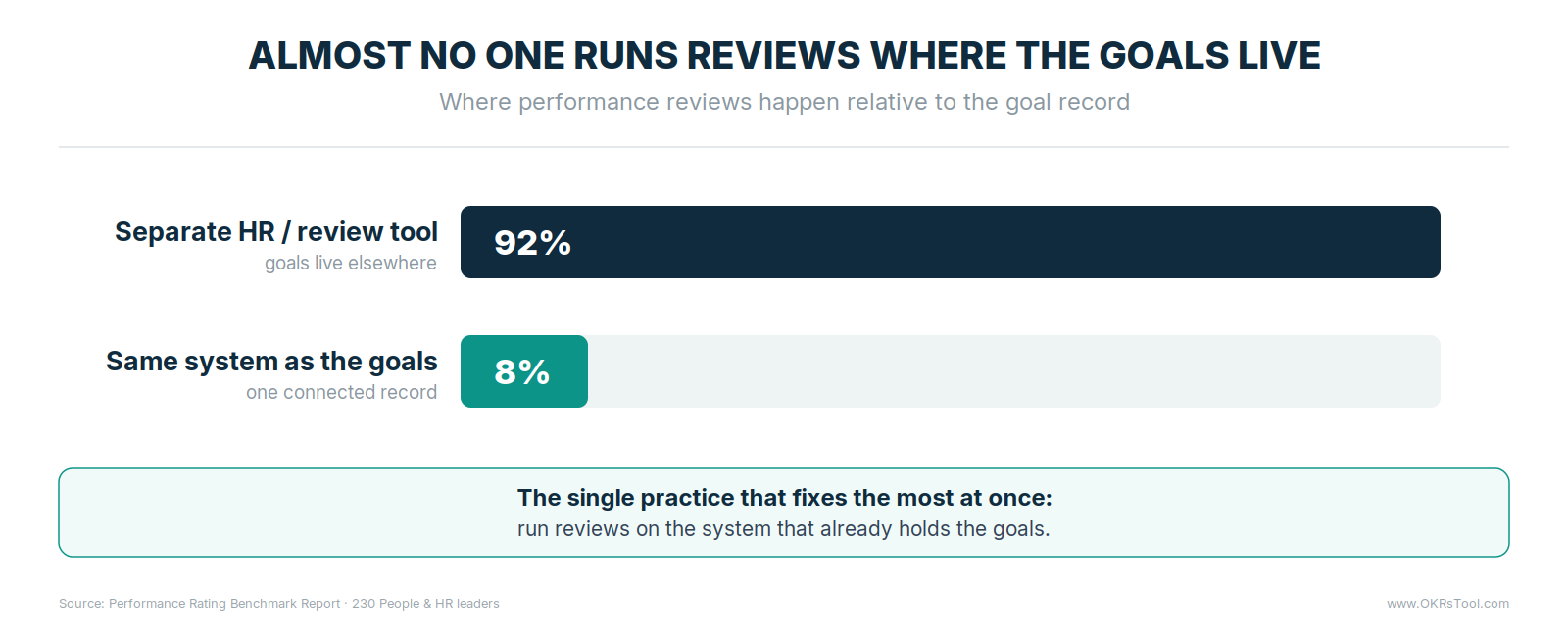
Yet only 8% of organizations actually do this — 92% run reviews in a separate tool, disconnected from the goals being evaluated. That gap is why so many of the other practices fall away over time: when keeping the record current means copying data between two systems, it stops happening the first busy week.
Collapse the two, and the running record, the measurable goals, and the continuous feedback all come nearly for free, because they live where the work already is. Running performance on the same platform as the goals is the practice that makes the rest sustainable.
Where to Start
No team adopts seven habits at once. The report points to the highest-leverage starting move: get the goal record current and connected first, because every other practice depends on evidence existing. A team that fixes only the record — measurable goals, updated at a real cadence, on the same system as the review — closes most of the recency gap without touching anything else. The rest are refinements on a foundation that has to come first.
Ranked by return, the order is: connect goals to reviews, make the goals measurable, shorten the review cadence, then layer on continuous feedback and calibration. Skipping to feedback rituals while the record stays broken is how programs end up with better-sounding reviews — a common OKR mistake in disguise — that are no more defensible than before.
Best Practices Are Just Evidence, Made Routine
Strip the language of virtue away and every durable performance practice reduces to one thing: making sure the evidence exists when the rating gets written. Fairness is evidence applied consistently. Objectivity is evidence weighed over impression. Frequency is evidence kept warm. The practices that fail are the ones that ask for those outcomes without building the record that produces them.
The 45% who admit an off-record factor moved a score are rarely careless managers. They're people working without a record, doing what anyone does in that situation — the same pattern behind most review drift — and filling the gap with what they can remember. Give them the evidence, kept current and close to the work, and the best practices stop being aspirations. They become the path of least resistance, which is the only place a practice ever really holds.
Data: The Performance Rating Benchmark Report, an independent survey of 230 People and HR leaders at technology companies of 50–200 employees.