Teams pour their energy into the planning session — wordsmithing the objective, arguing the target, getting the sentence right. Then they file the goal and look up a quarter later. The update logs tell a blunt story about what happened in between: a key result touched once hits its target 48% of the time. Touched steadily across the quarter, 72%. OKR completion was never set at the writing stage. It's set by what you do after.
Here's the uncomfortable part. You can write a flawless key result — clean baseline, sharp target, a segment, a deadline — and it will still die if nobody comes back to it. And you can write an ugly, plain one that hits, because someone tended it every week.
We analyzed 20,000 key results to see what actually drives OKR completion — what separated the goals that got done from the ones that didn't, and the dividing line wasn't in the wording. It was in the trail of updates each goal left behind.
That trail is the useful thing, because it starts early. An OKR that's going to fail tells you in its first few updates — sometimes in the very first one. Learn to read the log and OKR completion stops being a number you discover at the end of the quarter and becomes something you can see coming, and change, while there's still time.
The Second Update Is the Whole Ballgame
Nearly everything that predicts OKR completion happens after the goal is written, and the first fork is almost comically simple: does the key result ever get a second update.
A key result that's updated once and then never again hits its target 48% of the time. One that gets a second update or more: 64%. That single return visit — someone coming back to the goal a second time — is worth sixteen points of completion. Nothing about the goal changed. The sentence is identical, the owner is the same. The only difference is that somebody came back.
And it keeps climbing with every visit after that.

One update, 48%. Two, 59%. Three or four, 63%. Five to eight, 68%. Nine or more, 72%. The curve doesn't spike and flatten — it climbs the whole way, which means there's no point at which checking in stops paying off. Every return visit to a goal buys more of it. That's the mechanism under every completion statistic you've ever seen, laid bare: goals move when someone keeps showing up to move them.
Spread the Updates, Don't Cram Them
It's not just how many times a key result gets touched — it's when. And here the log catches a familiar bad habit red-handed.
Take two key results with the same number of updates. One has them spread across the quarter; the other has them crammed into a single day — the pre-review panic, everyone updating their goals the afternoon before the check-in meeting.
Spread out across 46 or more days, a key result hits 70% of the time. Crammed into one day, 48%. Same update count, twenty-two-point gap. A goal updated in a single burst was never really being tended — it was being back-filled, and back-filling doesn't move anything. The rhythm is what does the work, not the paperwork.
The First Check-In Already Knows the Ending
If you only read one signal in the log, read this one — because it shows up first, often within two weeks of the cycle starting.

At the first check-in, the only thing worth looking at is whether the number has moved off its starting point. A key result already moving hits its target 62% of the time. One still frozen at zero: 27% — less than half as often. Two goals can be worded identically, owned by equally capable people, and this one signal splits their odds in two.
A flat zero in week one isn't a slow start you'll make up later. It's the earliest reliable warning you'll get that the goal is heading for a miss, and the moment to look closer — is it mis-scoped, unowned, blocked, or just never actually begun?
Catch it here and you have a whole quarter to fix it. Notice it at the mid-cycle review and you're writing a post-mortem. One honest caveat: a zero first check-in doesn't cause the miss — often it just means the real work hadn't started, or the goal itself was vague to begin with. Treat it as a flag to investigate, not a death certificate.
A Goal Only One Person Sees Is the One That Dies
Completion has an ownership signature too, and it runs in two directions the log makes visible.
One person tending an objective, and it hits 45% of the time; two active people, 59%. Widen the lens to how many people ever update a given key result and the gradient is steeper still.
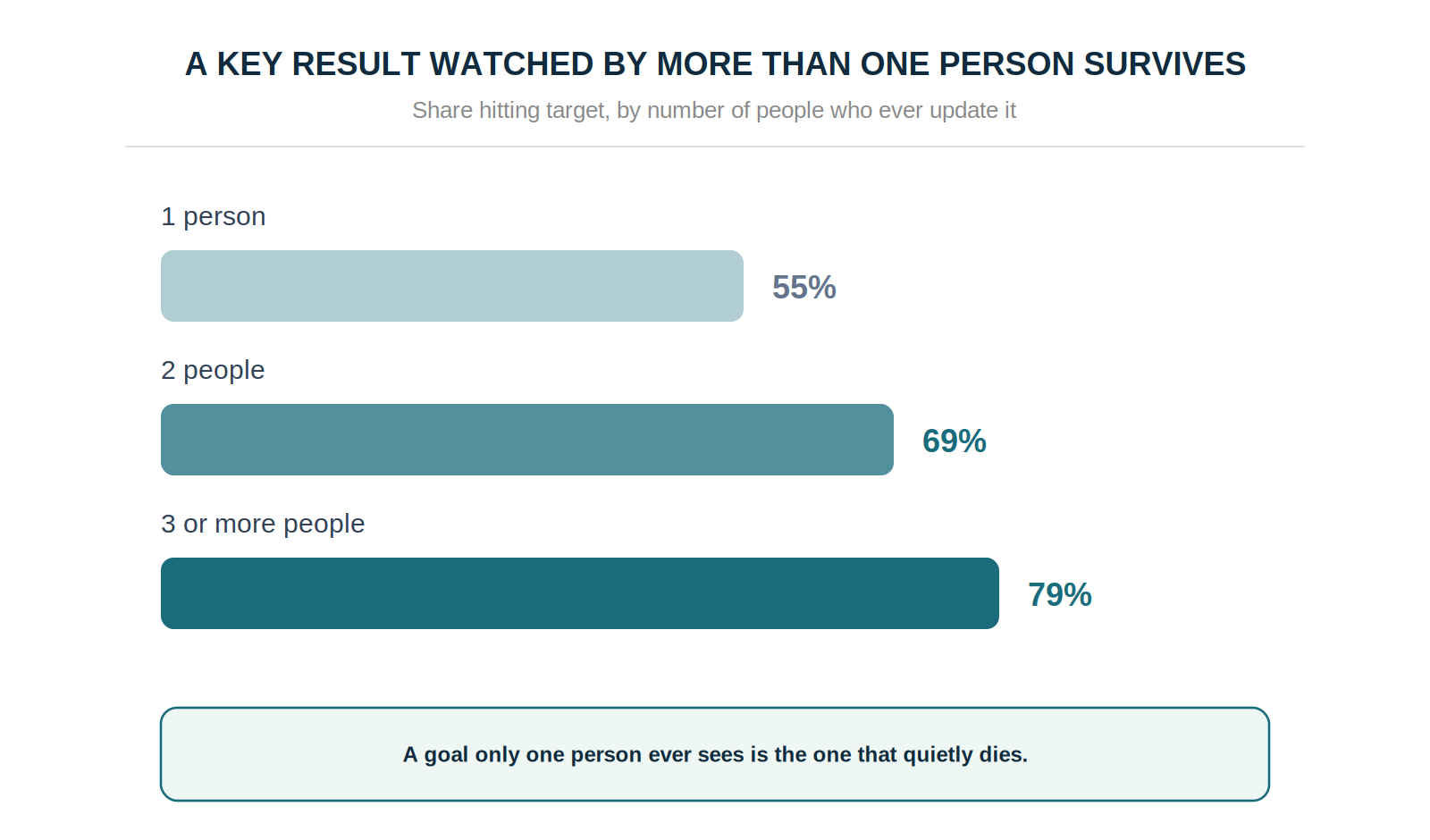
Watched by one person, a key result hits 55% of the time. By two, 69%. By three or more, 79%. This isn't an argument against single ownership — every key result still needs one name accountable for the score, and that principle is settled. It's an argument against invisibility.
A goal that lives where only its owner ever looks is the one that quietly slips when that owner has a busy fortnight, because no one else is positioned to notice. Ownership is who's accountable; visibility is who's watching — and the log says a goal needs both to survive. Put goals where a team can see them, not in a private tab.
This is exactly what we built Collaborators on Key Results for. You can now add collaborators to any key result, so more than one person can log progress on it — while ownership stays with a single named person. The accountability doesn't blur: one owner still owns the score. But the whole team contributing to a result can now update it directly, which is precisely the pattern the data rewards — one person on the hook, several people watching and moving it.

What This Means for OKR Completion
Read together, the six signals rewrite the job. If OKR completion were decided at the writing stage, the highest-leverage move would be a better planning session. The log says otherwise: the leverage is in the tending, and it's available all quarter long, not just in the week you set the goals.
Concretely, that means watching for five things while there's still time to act on them. A key result that never gets a second update. One whose updates are all crammed into a single day. One still at zero at its first check-in. One that only its owner has ever touched. One that hasn't moved in a stretch that used to move. None of these needs a sophisticated read — they're all sitting in the update history, visible weeks before the score is final.
The teams whose numbers climb over time — cycle after cycle — aren't writing better goals than everyone else. They're reading these signals early and doing something about them while the quarter is still live.
Completion Is Something You Do, Not Something You Wrote
The planning session gets the attention because it's visible, finite, and satisfying — a wall of clean goals at the end of an afternoon. But the update logs are unsentimental about it. A well-written key result touched once dies at nearly the same rate as a badly written one. A plain key result touched every week, watched by a few people, and rescued the first week it stalls gets done.
OKR completion isn't a property of the sentence. It's a property of the weeks after, and every one of those weeks leaves a mark in the log you can read early enough to change the ending. Stop grading the goals you wrote in January. Start reading the trail they've left since.
Data: OKRs Tool update-log analysis (~20,000 key results), The 2026 OKR Benchmark Report (200 organizations).