A performance management dashboard that scores competencies without showing delivery is measuring half the person. Behavioural ratings capture how someone operates; outcome data captures whether it worked. And most reviews are missing that second half — only 27% of people leaders say a manager could defend every rating with the goal evidence to back it, even though two-thirds trust the ratings.
Performance management dashboards share a blind spot. They show how someone operates — communication scores, collaboration ratings, leadership competencies — and what peers think of them. They show manager ratings and self-assessments. What they don't show is whether the person moved the metrics the organization actually needed moved.
A 4.2 on "execution and delivery" from a peer review is one signal. A 25% completion rate on the key result "generate $10,000 from inbound leads" is a different and far more concrete one. The two belong side by side in a single view, and in most systems they live in separate tools that never speak.
That separation has a measurable cost, and the Performance Rating Benchmark — a survey of 230 people and HR leaders — puts a sharp number on it. Ratings are trusted but rarely provable: two-thirds of leaders trust their ratings, yet only 27% say a manager could defend every one with the goal evidence to support it. 65% have personally seen a rating the goal record didn't back up, and 35% have to reconstruct an employee's goals from memory at review time.
When a performance system carries no delivery data, those gaps stay invisible, and the review becomes an exchange of impressions rather than a conversation grounded in evidence.
This guide covers the five layers a working performance management dashboard contains, why outcome data is the layer most often missing, and how to structure reviews that connect what someone delivered to how they delivered it.
Where Performance Management Dashboards Fall Short
Performance management dashboards typically fail in one of two ways:
They measure activity, not outcomes. Competency ratings, feedback scores, and participation metrics tell you how someone behaves at work. They don't tell you whether that behavior produced the results the organization needed. A highly collaborative employee who missed every Key Result is a different kind of problem than an abrasive one who hit them all.
They're disconnected from the goal system. In the majority of organizations, OKRs or goal-tracking live in one tool and reviews live in performance management software. By the time a manager sits down to review someone, they're working from memory rather than data, approximating OKR delivery rather than referencing it directly. The Performance Rating Benchmark found 92% of teams don't run performance inside their goal management system at all — the separation is nearly universal.
The cost is concrete: when goal delivery data isn't surfaced automatically in the review, the manager won't have it in front of them, and the conversation defaults to behavioural impression over evidence. It's why 68% of leaders have watched strong early-cycle work get forgotten by review time — the record wasn't there when it counted.
What a High-Performing Performance Management Dashboard Contains
Based on what we've built in OKRs Tool and the patterns across our benchmark research, a performance management dashboard that drives better decisions contains five layers:
1. OKR Delivery Score
The foundation. Before any behavioral assessment, the dashboard should show what the person actually delivered against their goals this cycle.
Not a subjective manager estimate of "how they did on their goals" — a data-driven score based on actual Key Result completion rates across the cycle.
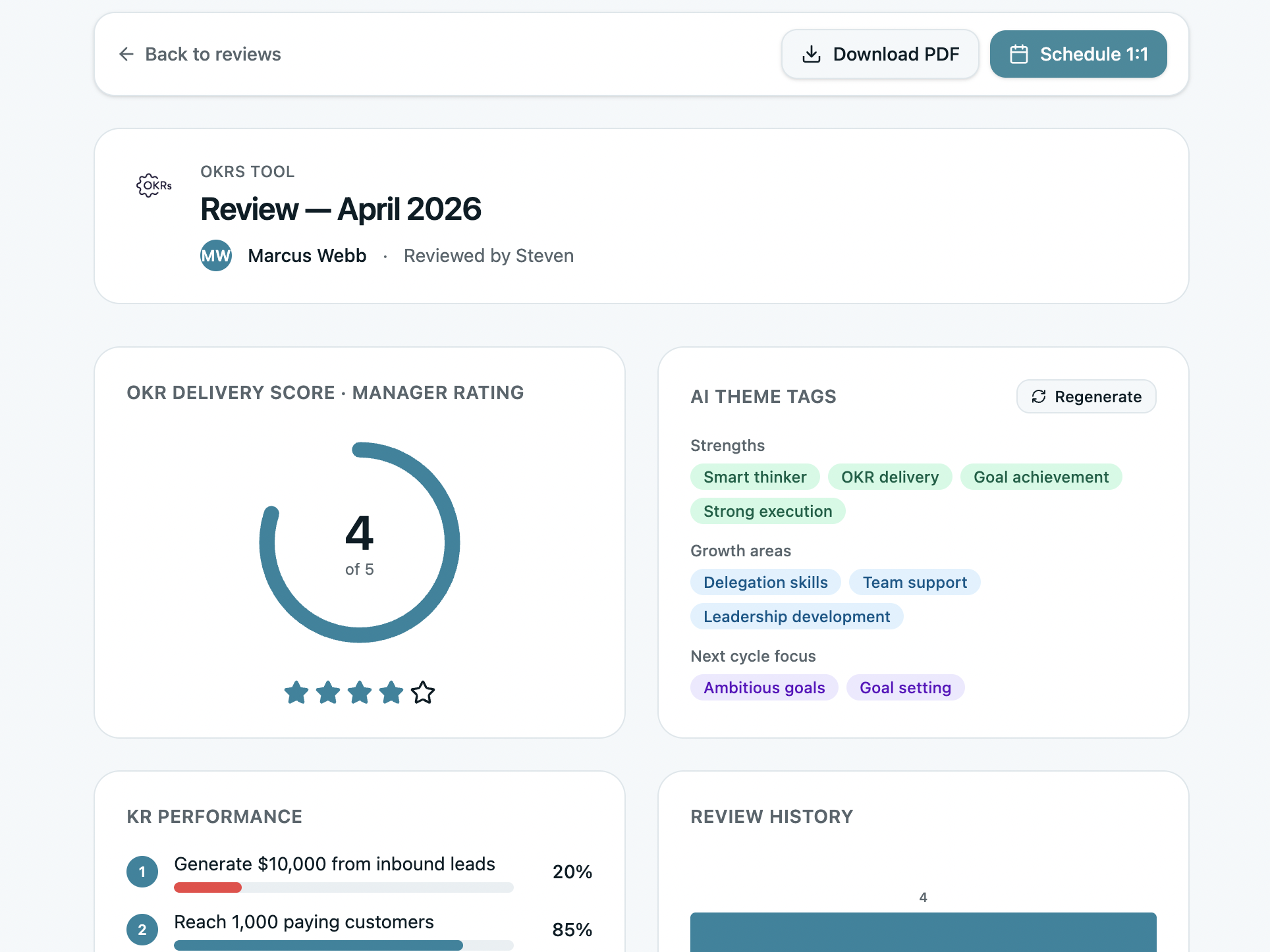
This breakdown matters because aggregate scores hide the story. A 4/5 delivery score with 100%, 25%, 93%, 36% across four KRs tells a different story than a uniform 64%. One KR was hit completely. One was barely started. The pattern — which KRs moved and which didn't — is the actual performance signal.
2. Competency Scores — Self, Manager, and Peer
Behavioral evidence from multiple perspectives: how the person assesses themselves, how their manager sees them, and what peers observe.
The multi-source view matters because single-source ratings systematically miss certain failure modes. Managers often don't see how someone operates in peer collaboration. Peers often don't see how someone takes direction from leadership. Self-assessments reveal calibration — whether the person has accurate insight into their own performance or a significant blind spot.
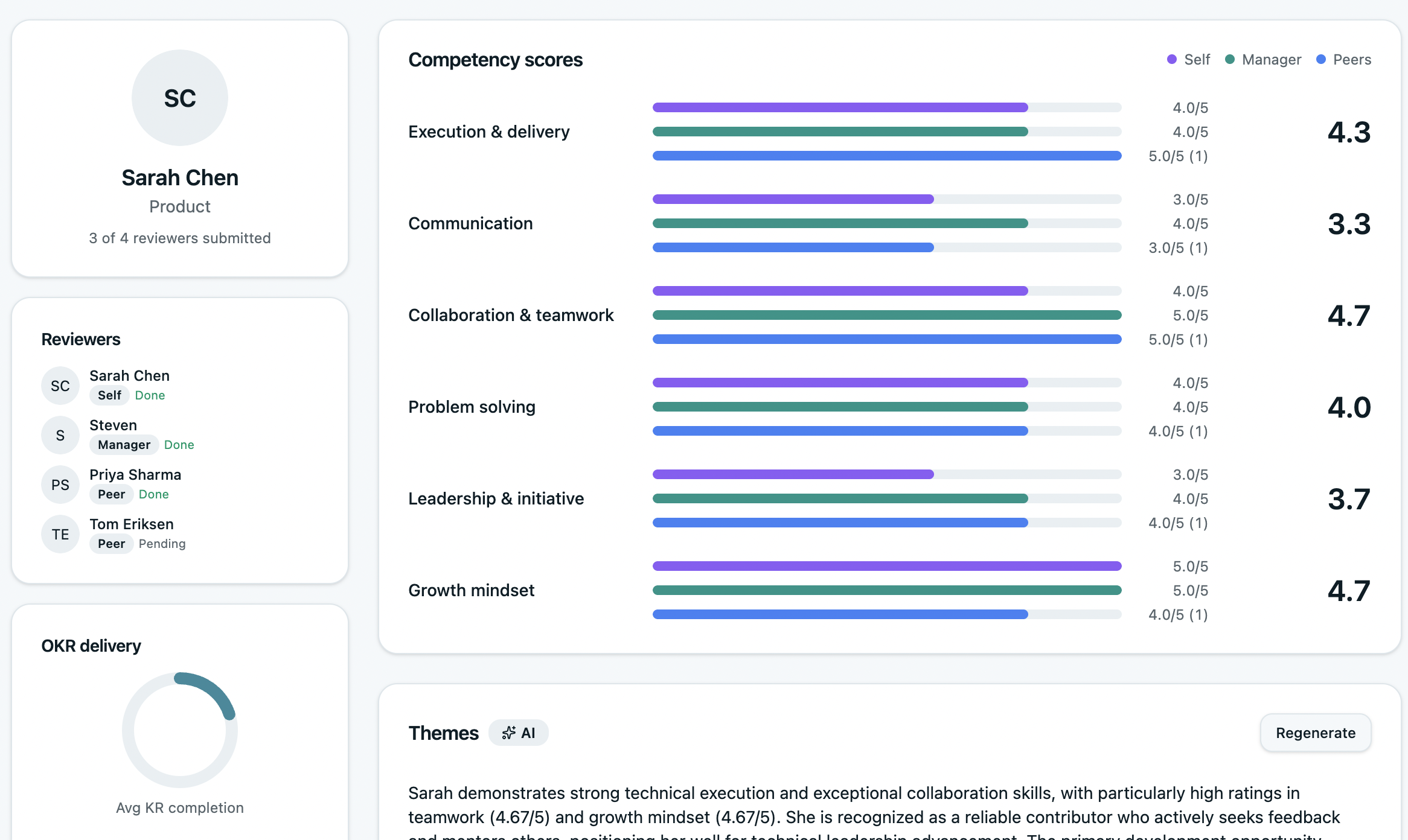
The competency scores alongside the OKR delivery sidebar on the left is the key design decision. The manager reviewing Sarah can see her KR completion rates at the same moment as her competency scores — making the connection between how she operates and what she delivers visible without switching views.
3. AI-Generated Themes — Strengths, Growth Areas, Next Cycle Focus
Synthesizing feedback from multiple reviewers into coherent themes is time-consuming and prone to recency bias when done manually. AI-generated themes surface patterns that individual managers might miss.
The OKRs Tool review generates three sets of AI tags: Strengths (what reviewers consistently praise), Growth areas (where feedback signals development needs), and Next cycle focus (what the person should prioritize in the next OKR cycle).
In Marcus' case, the screenshot produces a precise and useful performance read:
"Marcus demonstrates exceptional problem-solving capabilities and is highly valued as a collaborative team member. However, he struggles with work-in-progress discipline, taking on too many parallel initiatives."
That specific insight — the gap between strong delivery on some KRs (KR3 at 100%, "Reach 1,000 paying customers" at 93%) and weak delivery on others (25%, 36%) — becomes explainable. The cause is scope management rather than motivation. The AI theme connects the behavioral feedback to the outcome data in a way that makes the review conversation more specific and more useful.
4. Review History and Trend
A single review is a snapshot. A trend is a pattern.
The review history view shows how an employee's delivery score and competency ratings have changed across cycles — making it possible to distinguish a temporary dip from a sustained performance issue, and a recent improvement from a long-term trend.
This is particularly valuable for promotion and compensation decisions, where a single high-scoring review can be misleading if it's an outlier against a lower baseline.
5. Reviewer Completion Status
Practical but important: which reviewers have submitted, which are pending, and whether the review has enough data to be meaningful.
A 360 with two out of five reviewers submitted is incomplete. A dashboard that shows this clearly — as the OKRs Tool view does (4 of 5 reviewers submitted, Sarah Chen pending) — prevents managers from drawing conclusions from insufficient data.
The Connection Between OKR Delivery and Performance Review
The design decision that matters most in a performance management dashboard is whether the goal system and the review system are connected — more than the rating scale or the competency framework.
When they're separate:
- Managers approximate OKR delivery rather than referencing it
- Performance conversations are behavioral impressions, not outcome evidence
- High performers who had a bad quarter look the same as low performers who had a good one
- Development conversations can't distinguish capability gaps from execution environment gaps
When they're connected:
- OKR completion rates appear automatically in the review — no manual compilation
- The weekly check-in habit feeds directly into the review data — managers who review weekly have richer evidence
- Development areas are grounded in specific KR patterns, not general impressions
- The retrospective question "what should we do differently next cycle?" has a data answer, not a gut-feel one
The benchmark evidence on what this connection produces is direct. Teams with clear single ownership on every Key Result — the condition that makes individual delivery trackable — see 26% higher completion.
And in the Performance Rating Benchmark, teams that run goals and reviews as one integrated system were more than twice as likely to call their ratings defensible (42% versus 17%) and far less likely to have seen a rating the evidence didn't support. When ownership data feeds the review, accountability becomes visible and consistent rather than selective and memory-dependent.
What Good Looks Like: The Performance Management Dashboard Checklist
The Performance Review Template
The free template below mirrors the five-layer structure above — giving managers a structured, data-driven review format that works even without dedicated software.
What's inside:
When to Move to Dedicated Software
The template works well for teams running their first performance review cycles or organizations under 20 people. Beyond that, three limitations become friction:
No automatic OKR delivery data. The template requires the manager to manually compile KR completion rates before the review. In a weekly check-in system, that data already exists — it just needs to surface in the right place at the right time.
No trend visibility. A single spreadsheet review doesn't show how performance has changed across cycles. Identifying whether a gap is a development priority or a temporary circumstance requires historical context.
No reviewer coordination. Managing who has submitted, sending reminders, and aggregating multi-source scores manually is time-consuming and error-prone at scale.
OKRs Tool connects OKR delivery directly to performance reviews — KR completion rates populate automatically, 360 feedback is collected in the tool, AI synthesizes themes from reviewer input, and review history is tracked across cycles. The dashboard in the screenshots above is what your managers see when the goal system and the review system share the same data.
Delivery Plus Behaviour, in One View
A performance management dashboard that shows behaviours without outcomes gives you half a picture.
The organizations generating the highest returns from their people programs — and from OKRs specifically — are the ones that have made outcome data a first-class input into performance conversations.
OKR delivery scores alongside competency ratings. KR completion breakdowns alongside peer feedback. Historical trends alongside current ratings.
That connection — what someone delivered plus how they delivered it — is what makes performance conversations specific, fair, and genuinely useful for development, not only for scoring.
The template gives you the structure. The checklist gives you the signals to watch for. And when the team is ready for the system to do the heavy lifting, OKRs Tool connects both layers automatically.
Data: the Performance Rating Benchmark Report (230 People and HR leaders), the 2026 OKR Benchmark Report (200 organizations), and the Strategy Execution Benchmark 2026 (180 leaders).