Across 876 organizations, teams that kept their Key Results moving through the cycle hit their goals at 68% — nearly double the 35% rate of teams whose Key Results went quiet. The weekly check-in isn't a meeting. It's the behavior that separates the two.
Most advice about weekly check-ins is built on surveys — teams reporting how often they think they review.
We took a different route. We looked at the timestamps across 876 organizations, 7,419 objectives, and 20,952 Key Results. Not what teams say they do. What the logs actually show.
The pattern is sharp. Teams that kept their Key Results updated through the cycle completed goals at 68%. Teams that let those same Key Results go dark finished at 35% — half the rate.
The deciding factor is simple: whether anyone touched the numbers between the kickoff and the close.
The Behavior Behind the 43% Gap
Start with the number that matters most for this habit: teams reviewing their OKRs weekly complete 43% more of them than teams reviewing monthly or ad hoc. That's from the 2026 OKR Benchmark Report, and it's the clearest argument for a weekly cadence there is.
That figure tells you the outcome. The platform data tells you the cause — and it comes down to how much of the goal set stays alive.
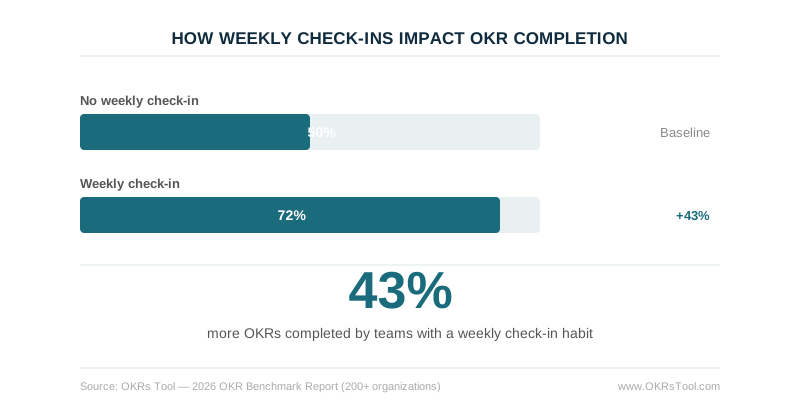
It comes down to frequency — how often the numbers actually get looked at. A goal reviewed every week gets caught when it slips. A goal touched once a quarter isn't being managed, it's being remembered.
The same split shows up at the objective level. High performers left just 4% of their objectives at zero progress all cycle. The strugglers left 31% frozen — nearly a third of their goals never moved, and nobody noticed until it was over.
This is the real job of the weekly review: it forces the numbers to be looked at while there's still time to act on them.
A Key Result drifting in week four is recoverable. The same drift found in week eleven is a write-off. A twelve-week cycle gives you eleven chances to catch it. Review monthly and you get three.
Why Goals Go Quiet
The fastest way for a goal to die isn't a dramatic failure. It's silence.
Goals don't usually get killed in a decision. They fade, because no rhythm keeps them in front of anyone. This quiet erosion is the most common way OKR adoption collapses — and it's almost entirely behavioral.
The clearest proof is in the gap between solo workspaces and real teams. A solo workspace logs one update for the entire cycle, then goes dark. A team logs 5.5.
That cadence tracks straight to results. Only 30% of solo workspaces touch a single Key Result all cycle. Add two people and the active rate more than doubles to 61%. A full team hits 91%.
Bigger teams don't try harder. They're just more visible — and visibility creates accountability.
When one person owns a goal alone, there's no one to report to, so it stalls. When a team shares it, the weekly review becomes the moment that keeps everyone honest. That's why team OKRs need the rhythm whether the group is one department or the whole company.
The 52% Problem Hiding in Your Key Results
There's a quieter reason goals go dark: a lot of them were never measurable to begin with.
Across 7,857 Key Results, 52% were KPIs or tasks in disguise — measuring activity, not change. Take "conduct five customer interviews." You can't review that week to week. It's either done or it isn't. No number moves.
The most common verb in underperforming Key Results was "conduct." In strong key results, it was "increase."
This is where the weekly review earns its keep. Ask "what moved, and by how much?" and a task-shaped Key Result has no answer. The gap becomes obvious fast.
Teams that connect goals to outcomes rather than outputs are 30% more likely to hit them. Catch the bad ones here, or they survive untouched until the OKR scoring conversation — when it's far too late to fix them.
Ownership Is What Makes a Review Produce Signal
A review only works if someone is accountable for each number in it.
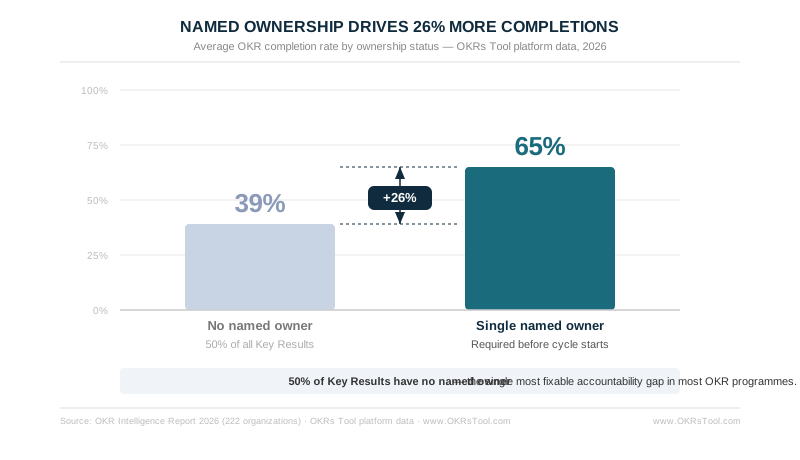
The benchmark data is blunt: 50% of all Key Results have no named, single owner. A goal owned by everyone is owned by no one. And it's exactly these unowned Key Results that go quiet first — nobody's week is incomplete until the number is updated.
Single ownership changes the math. Teams with one clear owner per Key Result complete 26% more than teams with shared or vague ownership.
The reason is mechanical, not motivational. KR ownership puts one name against every progress score, every week. Now the review has something real to surface: a specific person, a specific number, a specific reason it moved or didn't.
Without it, the meeting is a group shrug — and the accountability the data rewards never forms.
The Honesty Variable
Here's the uncomfortable part. A review only produces real signal if people tell the truth in it.
The research on what people actually do is sobering. The State of Goal Management found 92% of employees admit to at least one form of goal-gaming.
70% have reported a goal as healthier than they knew it to be — the watermelon effect, green on the surface, red underneath. And 43% cop to all three at once: sandbagging the target, inflating the status, writing goals to impress rather than to change anything.
None of that is irrational. It's the rational response to a culture that rewards a clean dashboard and punishes an honest red.
The benchmark data confirms the flip side: 72% of high-performing teams operate where missing a goal feels at least somewhat safe. Psychological safety isn't a soft value here. It's the precondition for an honest review at all.
So make surfacing a problem the win. An off-track Key Result raised in week four is a gift; the same result hidden until week eleven is a crisis. When the rhythm makes early honesty normal, the reasons OKRs fail stop compounding in the dark — and engagement survives the mid-cycle slump.
Keep It Under 30 Minutes
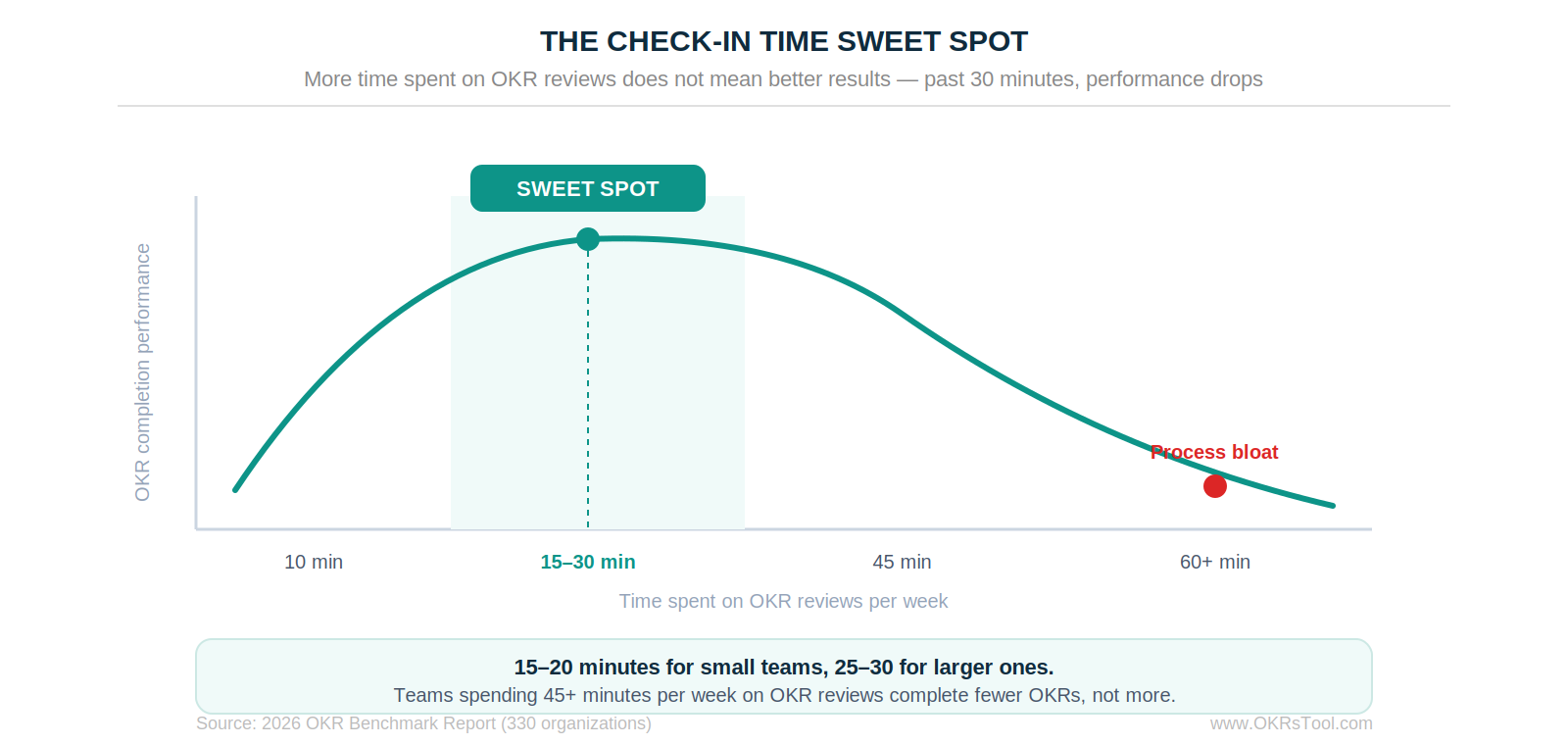
The most counterintuitive finding in the benchmark data: more time makes reviews worse.
Completion peaks when they run 15 to 20 minutes. Teams spending 45 minutes or more perform worse than teams keeping it short. Past a point, the meeting stops producing decisions and starts producing theatre — status replaces signal, and the OKR meeting becomes the work instead of steering it.
The agenda that produces the lift is four questions, in order, inside 20 minutes for a team of six to eight:
What moved — the number, not the story. What's blocked or at risk, and who acts. What the one or two priorities are this week. And whether every Key Result still has an owner moving it.
The Habit Compounds Across Cycles
The weekly rhythm doesn't just decide this quarter. It builds the muscle that makes every future quarter better.
The OKR maturity curve is consistent across the data. Teams in their first or second cycle complete 51% of their OKRs. By cycles three and four, 59%. By cycle five and beyond, 79%.
That's not luck or selection. It's accumulated discipline.
By cycle five, the end-of-cycle score is unsurprising — the team has watched it move the whole way. That's the real test: if the final number is a shock, the rhythm wasn't working.
Pair a consistent rhythm with honest retrospectives and teams complete 30 to 45% more OKRs the next quarter. That's how one weekly meeting turns into a compounding lead over the teams still stuck at 51%.
The Numbers That Get Touched Are the Numbers That Get Hit
Everything in the 876-organization dataset points to one finding: goals that get touched get hit.
Teams keeping Key Results alive finish at 68%. Teams letting them go quiet finish at 35%. Ownership, honesty, the 20-minute agenda, the maturity curve — all of it is just detail on how to keep the numbers moving.
It's also the cheapest edge there is. No budget, no transformation initiative — just the discipline to hold one short meeting a week and make it count.
The right OKR software removes what little friction remains: nudges so nobody chases updates, live progress so the data is current, at-risk flags so slipping numbers surface on their own — all in one live dashboard.
The teams hitting 79% aren't smarter than the ones at 35%. They just never let the numbers go quiet.
Data: OKRs Tool platform data (876 organizations, 7,419 objectives, 20,952 key results), The 2026 OKR Benchmark Report (200 organizations), and The State of Goal Management (210 employees).