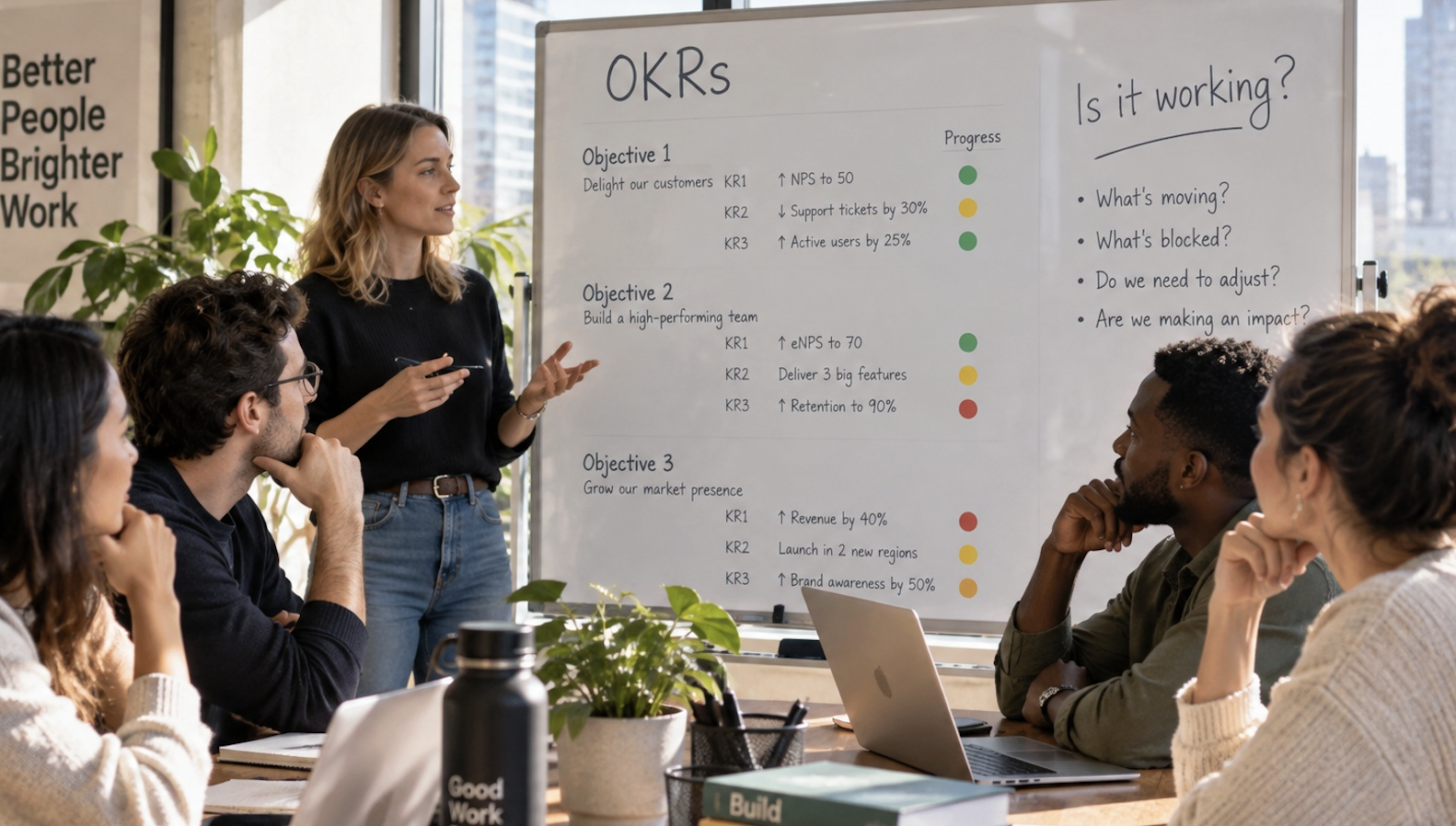
Most 1:1 templates are agenda lists. This one is an execution tool — built around the Key Results your team member is responsible for, the blockers slowing them down, and the three priorities that will move the needle before the next check-in. Every section connects back to what actually matters this quarter.
Teams with a weekly check-in habit complete 43% more OKRs than those reviewing monthly or ad hoc. The 2026 OKR Benchmark Report across 330 organizations is clear on why: when goals are visible every week and blockers get surfaced before they compound, the quarterly targets that seemed ambitious in week one become achievable by week twelve.
The 1:1 is the most efficient format for making this happen — 30 minutes, one manager, one team member, same time every week. But only if the agenda keeps the conversation on what matters. Most 1:1 agendas drift toward status updates and work-in-progress. This template keeps the focus on Key Results and what's blocking them.
The 7-Section 1:1 Template
Section 1: OKR Check-In (5 minutes)
Start every 1:1 by reviewing the team member's active Key Results. List each KR and its current status — on track, at risk, or off track.
This is the most important section in the template. It keeps the conversation anchored to what the person is actually accountable for this quarter — not what they've been busy with.
Questions to cover:
- Which Key Results moved since last week?
- Which are at risk and why?
- Is progress velocity on track to hit the target by cycle end?
Starting with OKR status signals that goals aren't a planning exercise — they're the job. Teams with named ownership per Key Result see 26% higher completion rates than those with shared or vague accountability. The weekly 1:1 is where that ownership becomes real.
Section 2: Wins (3 minutes)
What went well since the last check-in? One or two specific things — connected to Key Results where possible.
Starting with wins before blockers keeps the conversation psychologically safe and maintains the trust that makes honest feedback possible. The OKR Intelligence Report 2026 found that 93% of organizations modify their goals mid-cycle when something isn't working — a sign of healthy engagement, not failure.
Section 3: Blockers and Risks (5 minutes)
What is slowing progress? What needs a decision, a resource, or an escalation before next week?
Name the blocker specifically. Assign an owner and a next step before the meeting ends. A blocker without a named next step isn't a blocker — it's a complaint.
The OKR cycle data shows that Key Results behind in week six are recoverable. Key Results discovered off-track in week ten almost never are. The weekly blocker review is the early-warning system that makes course-correction possible while there's still time. The OKR Intelligence Report 2026 found that 7% of off-track Key Results are simply abandoned with no revision or escalation — the Invisible OKR pattern. The blocker section of the 1:1 is the structural prevention.
Section 4: Priorities This Week (5 minutes)
The one to three things the team member will work on before the next check-in — each one explicitly connected to a Key Result.
This is the section most 1:1 agendas skip. Without it, the conversation stays at the strategic level without producing a clear commitment to what happens next.
High-performing teams attach 2–3 initiatives per Key Result within the first week of the quarterly cycle. The priorities section applies the same logic weekly — not "what are you working on?" but "what specific work will move which specific Key Result?" The 2026 OKR Benchmark Report found teams that do this complete up to 50% more goals than those with extended or loose planning habits.
Section 5: Development and Feedback (5 minutes)
Two questions, one each direction:
- "What feedback do you have for me?" — creates a two-way dynamic and surfaces problems before they become resentments
- "What support do you need from me?" — keeps the manager in a coaching posture rather than a checking posture
Running development in the 1:1 rather than waiting for quarterly performance reviews produces more specific, more timely feedback. The 360 feedback data on what makes behavioral feedback useful applies here: specific, recent, and connected to observable behavior — not general impressions.
The OKR maturity curve shows what consistent development conversations produce over time: cycle 1–2 teams average 51% completion. Cycle 5+ teams average 79%. The compounding improvement comes not just from better goal-writing but from the weekly development loop that makes people better at execution cycle over cycle.
Section 6: Action Items (3 minutes)
Every 1:1 ends with named actions — owner and due date for each. No action items means no accountability.
Run through the full meeting and capture every commitment made. If something was discussed but no action was agreed, it either needs an action now or it shouldn't have been on the agenda.
The weekly check-in habit that drives 43% more completions works because the check-in creates explicit commitments. The action item section of the 1:1 does the same thing at the individual level. Teams that run structured end-of-cycle retrospectives complete 30–45% more goals the following quarter — the same discipline that makes action items in 1:1s compound into quarterly results.
Section 7: Notes (2 minutes)
Free space for anything that came up that doesn't fit the other sections — context, decisions, things to carry forward to the next OKR planning session.
OKR-Linked 1:1 vs Standard Status Update
The difference between a 1:1 that drives execution and one that consumes it:
How Often Should 1:1s Happen?
Weekly for direct reports — 30 minutes, same time every week. The consistency matters as much as the format. A 1:1 that moves around the calendar becomes the first thing dropped when the week gets busy.
For senior leaders managing department heads, bi-weekly is acceptable — but only if there's a separate weekly OKR check-in mechanism keeping Key Results visible.
The data on frequency is unambiguous: teams with a weekly check-in habit complete 43% more OKRs. The 1:1 is the most natural format for making that habit stick at the individual level.
How 1:1s Connect to OKR Best Practices
The 1:1 is the human layer on top of the OKR framework. The framework sets the direction. The cascade connects each person's work to company priorities. The alignment map makes those connections visible. The 1:1 is where the manager helps the team member navigate the gap between where the goal is and where it needs to be.
The OKR best practices guide covers the full execution stack — from how goals get written to how they get reviewed. The 1:1 template is the individual-level mechanism within that stack. Run the 1:1 consistently, and the OKR statistics take care of the rest.
1:1 Template in OKRs Tool
OKRs Tool's 1:1 feature connects the meeting directly to live OKR data — Key Results, status, and initiatives appear automatically before the meeting starts, without manual prep.

Action items assigned in the 1:1 flow directly into the following week's check-in — creating a continuous accountability loop from weekly meeting to Key Result progress to quarterly outcome. For teams also running performance reviews and retrospectives in OKRs Tool, the 1:1 data becomes part of the full performance picture.
Why the Format Matters Less Than the Consistency
The 1:1 is the smallest unit of execution in an OKR programme — 30 minutes, one person, one agenda. But it's also where the gap between strategic intent and daily work either closes or widens.
Teams that review Key Results every week, surface blockers before they compound, and leave every meeting with named action items don't outperform because they have better goals. They outperform because they maintain the connection between their goals and their work — week after week, for twelve weeks straight.
The template is the structure. The habit is what generates the 43% completion lift. Run it consistently, keep it short, and let the results compound.
Data: The ROI of OKRs: 2026 Benchmark Report (330 respondents), The 2026 OKR Benchmark Report (200 organizations), OKR Intelligence Report 2026 (222 organizations).