75% of organizations now formally link OKR outcomes to performance decisions — because competency scores describe how someone works and stop short of what they delivered. A 4.2 on execution and a Key Result that finished at 25% are both true at once, and only one shows up in a 360.
A 360 review tells you how someone is experienced by the people around them — their manager, their peers, the team they lead. It's the most complete behavioral picture a growing company can get, and for development conversations there's nothing better.
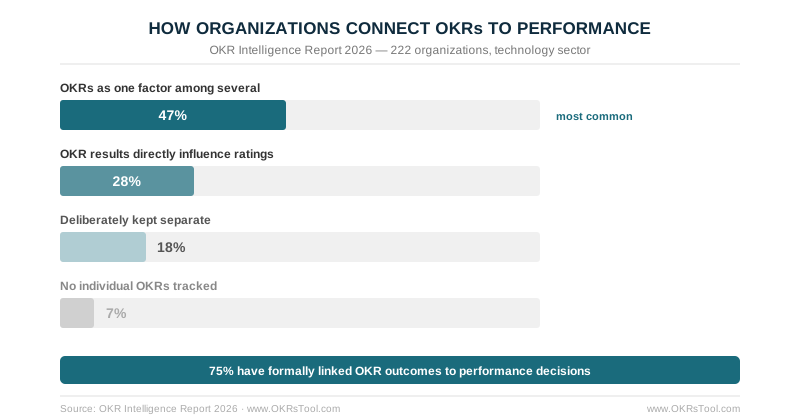
What it can't tell you is whether they delivered. That gap is why three-quarters of organizations have now formally linked OKR outcomes to performance decisions (OKR Intelligence Report 2026, 222 organizations) — and why the most useful reviews put competency scores and Key Result completion in the same view.
This guide covers how 360 feedback works, what a high-quality programme looks like, and the layer most reviews are missing.
What Is 360 Feedback?
360 feedback — also called 360-degree feedback or multi-rater feedback — is a performance assessment method that collects ratings and observations from multiple sources around an employee: their manager, their peers, their direct reports, and the employee themselves.
The term "360 degrees" reflects the all-direction view: rather than a single manager's perspective, the feedback captures how someone is experienced across the full range of their working relationships.
A standard 360 review covers:
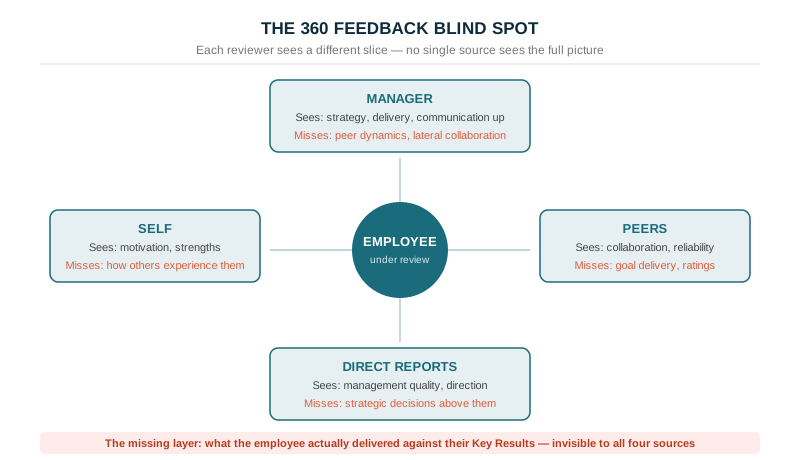
The multi-source view matters because each source systematically misses what the others see. A manager who gives a strong performance rating may not know their employee is difficult to work with laterally. A peer who loves working with someone may not see that the person consistently misses their Key Results. Self-assessments reveal calibration — whether the person has accurate insight into their performance or a significant blind spot in either direction.
How 360 Feedback Works
A typical 360 feedback cycle has five stages:
Stage 1: Define the Competency Framework
Before collecting feedback, agree on what you're measuring. Most 360 programmes rate employees across 5–7 core competencies — typically covering execution, communication, collaboration, problem-solving, leadership, and growth mindset.
Keep the framework consistent across OKR cycles. Changing competencies every review makes trend data meaningless.
Stage 2: Select Reviewers
Each employee typically has 4–6 reviewers: their manager, 2–4 peers, and (if they manage a team) 1–2 direct reports. The employee also completes a self-assessment.
The selection matters more than most programmes acknowledge. Reviewers should have enough working contact to give meaningful feedback — not just nominal colleagues. And the employee should have input into reviewer selection, which increases trust in the outcome.
Stage 3: Collect Ratings and Comments
Reviewers rate each competency on a scale (typically 1–5) and provide one or two specific observations. The specific observations are usually more valuable than the numerical scores — they contain the examples that make feedback actionable.
Keep the survey short. Industry consensus: 5–7 questions per rater type, maximum 20–25 questions total. Beyond that, rater fatigue degrades response quality.
Stage 4: Synthesize and Share
The manager synthesizes ratings from all reviewers into a coherent picture — identifying consistent themes, notable gaps between sources, and specific patterns worth discussing.
This is the step where most 360 programmes lose value. Synthesizing feedback from 5 reviewers manually is time-consuming and prone to recency bias. The reviewers who wrote longer comments, or the one peer who was particularly critical, tend to disproportionately shape the manager's narrative.
AI-synthesized theme generation addresses this: rather than the manager reading and reweighting 5 separate responses, an AI layer identifies patterns across all responses and surfaces consistent themes — strengths, growth areas, and next cycle focus — from the full dataset.
Stage 5: The Development Conversation
The 360 feedback lands in a conversation between manager and employee — not just a document shared and filed. The conversation should connect feedback themes to specific development commitments for the next OKR cycle.
The most effective development conversations are grounded in specific examples from the review cycle, not generalizations. "Three reviewers mentioned you take on too many parallel initiatives" is actionable. "Some people find you hard to work with" is not.
The Missing Layer: What 360 Feedback Doesn't Show
360 feedback captures behavioral evidence. It does not capture outcome evidence.
A 4.2 on "execution and delivery" from peer review is a behavioral signal. A 25% completion rate on the Key Result "Generate $10,000 from inbound leads" is an outcome signal. They measure different things — and both are necessary for a complete performance picture.
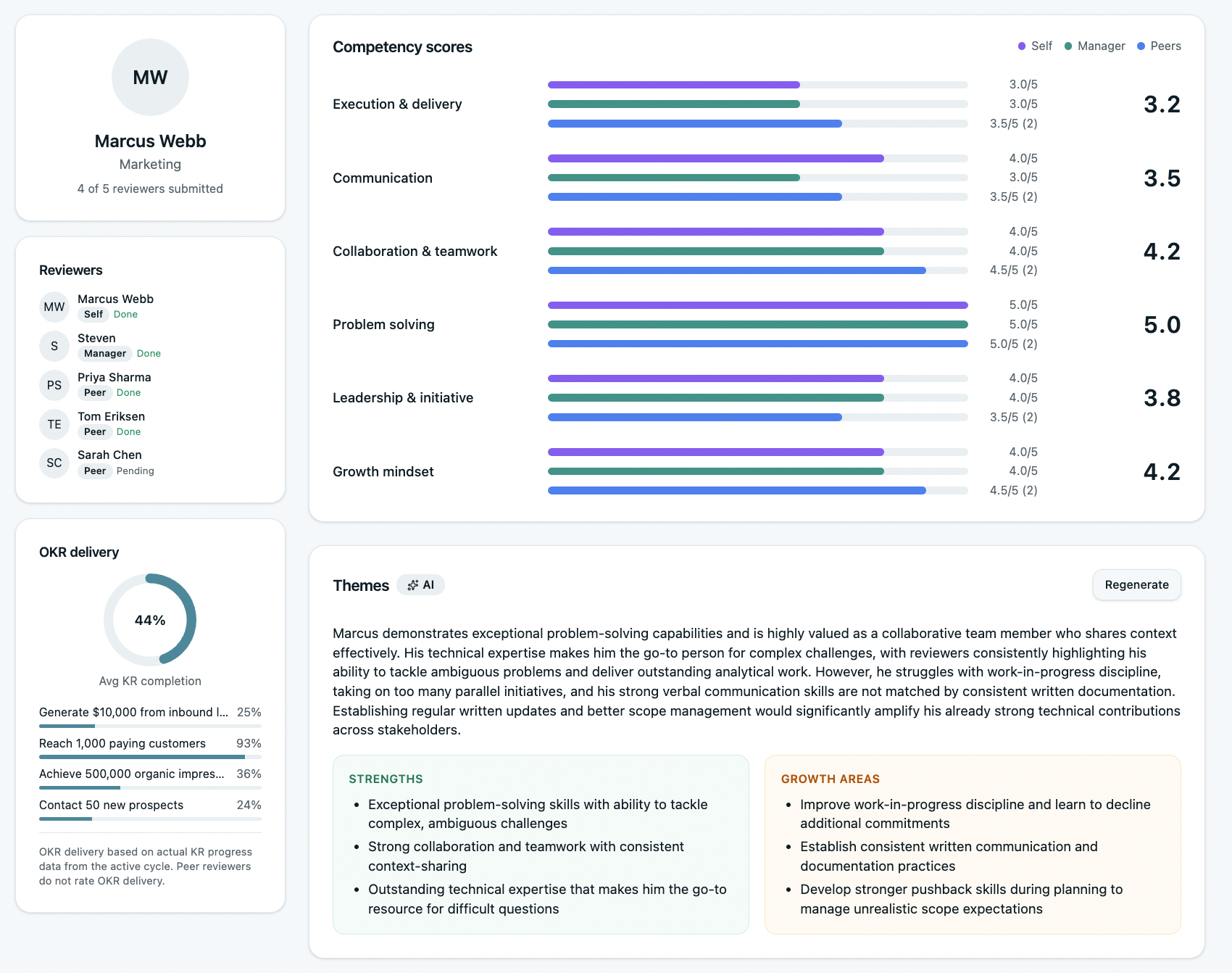
The OKR delivery sidebar in OKRs Tool's 360 review is the design decision that makes this connection structural. The manager reviewing Marcus can see his KR completion rates at the same moment as his competency scores — which makes the AI theme synthesis more specific and more useful.
The AI theme for Marcus reads: "Marcus demonstrates exceptional problem-solving capabilities and is highly valued as a collaborative team member. However, he struggles with work-in-progress discipline, taking on too many parallel initiatives."
That specific insight — the gap between strong delivery on some KRs (KR3 at 100%, "Reach 1,000 paying customers" at 93%) and weak delivery on others (25%, 36%) — becomes explainable through the competency data. It's not a motivation problem. It's a scope management problem. The 360 feedback and the OKR delivery data together tell a story that neither tells alone.
The 360 Feedback vs Performance Review Distinction
360 feedback and performance reviews are related but distinct:
The OKR Intelligence Report 2026 finding on this: 75% of organizations have formally linked OKR outcomes to performance decisions, with 47% using OKRs as one factor among several and 28% having OKRs directly influence ratings. The trend is clear — behavioral assessment alone is no longer sufficient. Organizations are connecting what people delivered to how they operated.
What a High-Quality 360 Feedback Programme Looks Like
Based on the OKRs Tool review structure and the OKR Intelligence Report 2026 data, high-quality 360 programmes share six characteristics:
1. Competency scores from three sources in one view. Self, manager, and peer scores visible side by side — making the gaps between sources immediately visible. A manager score of 3.0 on "Execution & delivery" alongside a peer average of 3.5 tells a different story than either score alone.
2. OKR delivery data alongside behavioral scores. The most important structural decision in a 360 programme is whether the goal system and the review system share the same data. When they're connected, outcome evidence sits alongside behavioral evidence in the same conversation. When they're separate, managers approximate OKR delivery from memory.
3. AI-generated theme synthesis. Synthesizing consistent themes from 5 reviewers manually takes 30–45 minutes per employee and introduces recency and salience bias. AI synthesis identifies patterns across all responses in seconds — producing specific, evidence-grounded themes rather than general impressions.
4. Review history across OKR cycles. A single review is a snapshot. Three reviews over three cycles reveal a trend. The ability to show whether a development area is improving, stable, or deteriorating is what makes 360 feedback a development tool rather than a performance verdict.
5. Reviewer completion visibility. A 360 with 2 of 5 reviewers submitted is incomplete. High-quality programmes surface completion status clearly — preventing managers from drawing conclusions from insufficient data.
6. A named development commitment per growth area. Every growth area identified in a 360 review should close with one specific, measurable commitment for the next OKR cycle: behavioral and outcome-based, co-created between manager and employee.
Common 360 Feedback Mistakes
Anonymity mismanagement. Reviewers who don't trust that their responses are genuinely anonymous give safer, less useful feedback. The programme design needs to communicate clearly how anonymity is protected — and mean it.
Too many questions. Beyond 25 questions per reviewer, response quality degrades. Rater fatigue produces generic ratings that cluster toward the middle. Keep it short.
Feedback without follow-through. The most common 360 failure: feedback collected, report shared, nothing changes. The development conversation is where value is created — the report is just the input.
Disconnected from goals. Giving behavioral feedback without reference to what the person was trying to deliver strips the context that makes feedback specific. "Struggles with scope management" is vague. "Struggled with scope management in a quarter where 3 of 4 Key Results came in below 40%" is a development conversation.
Infrequent cycles. Annual 360 reviews miss a full year of behavioral data. Growing organizations running quarterly OKR cycles benefit from quarterly or bi-annual reviews — short enough to reflect current performance, frequent enough to make development real.
No connection to OKR ownership. The OKR Intelligence Report 2026 found that only 15% of organizations bring new hires into OKR ownership within their first week. New employees without OKRs can't be given meaningful 360 feedback on goal delivery — the ownership gap and the review gap are the same problem.
360 Feedback and OKR Delivery: The Connection That Drives Development
The OKR Intelligence Report 2026 found that organizations connecting OKRs to performance decisions are more likely to respond to missed goals as learning events rather than performance verdicts — particularly in organizations using collaborative goal-setting processes.
That finding reflects the value of the combined picture: when a manager has both behavioral evidence (360 feedback) and outcome evidence (OKR delivery data) in the same view, the conversation changes.
A missed Key Result alongside strong peer feedback on problem-solving leads to a different development conversation than a missed Key Result alongside low peer feedback on execution. The first is an environment problem. The second is a capability problem. Without both data points, the distinction is invisible.
The performance management dashboard that connects these two layers is what makes performance conversations specific, fair, and useful — not just evaluative.
What Completes a 360 Review
Used well, a 360 surfaces blind spots no single-source review can reach and builds self-awareness that compounds across cycles. That's real value, and it's why the format has lasted.
The limitation is structural, not fixable by better questions: behavioral evidence describes how someone works, and says nothing about what landed. A missed Key Result next to strong peer ratings on problem-solving is an environment problem. The same miss next to weak execution ratings is a capability problem. Same number, opposite conversations — and you can't tell which you're in without both layers in front of you.
Data referenced: OKR Intelligence Report 2026 (222 organizations, technology sector, 51–200 employees). Independent research — no OKRs Tool customers included.