There's a standard startup OKR playbook — stay light, move fast, don't over-tool — and it works well at fifteen people. We compared 200+ startups against 420 companies of 50–200, and five of its most-repeated tips flip from smart to actively dangerous as a company grows. One of them, a tip you'll hear constantly, becomes the exact thing that sinks a bigger team. Below is which advice to drop, and when.
That playbook is real and it works at startup size. The trouble starts when the same advice built for founders of small teams gets handed to a Head of Ops at 80 people as if it still applied, because the data shows several of its core tenets invert the moment a company adds teams and layers. These aren't opinions; they're the two-band findings from the Growing Pains of OKRs report, read as a list of advice with an expiry date.
Across everything the two studies measured, the habits that scale well pull up with size while two pull hard the wrong way, and the five tips below sit on exactly those fault lines. If your team is in or past the 50–200 band, these are the ones to unlearn before they cost you a quarter.
1. "Keep It Light — Under 30 Minutes a Week"
This is the most-repeated OKR tip there is, and at startup size it's correct: the startup study found light-touch teams, under thirty minutes a week, beat the ones pouring in hours. At fifteen people the enemy really is process for its own sake.
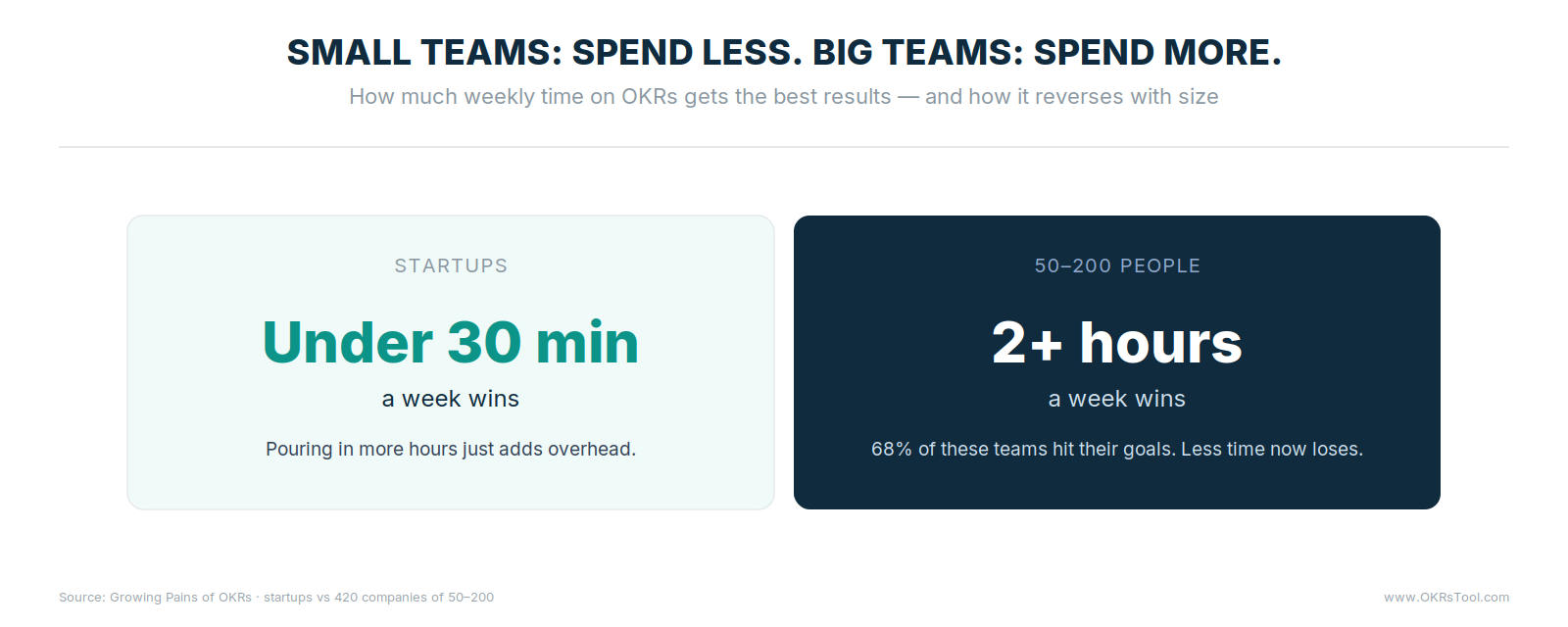
Then it flips completely. Among companies of 50–200, the teams spending the most time hit their goals most consistently — 68% of those investing two or more hours a week. OKRs have stopped being a personal focus tool and become the way a whole company coordinates across teams, and coordination takes real time.
The light-touch advice that made you fast at fifteen people is under-investment at a hundred and fifty. This is the single tip most worth throwing out the day you cross the OKR breaking point into real scale.
2. "Don't Over-Tool — A Spreadsheet Is Fine"
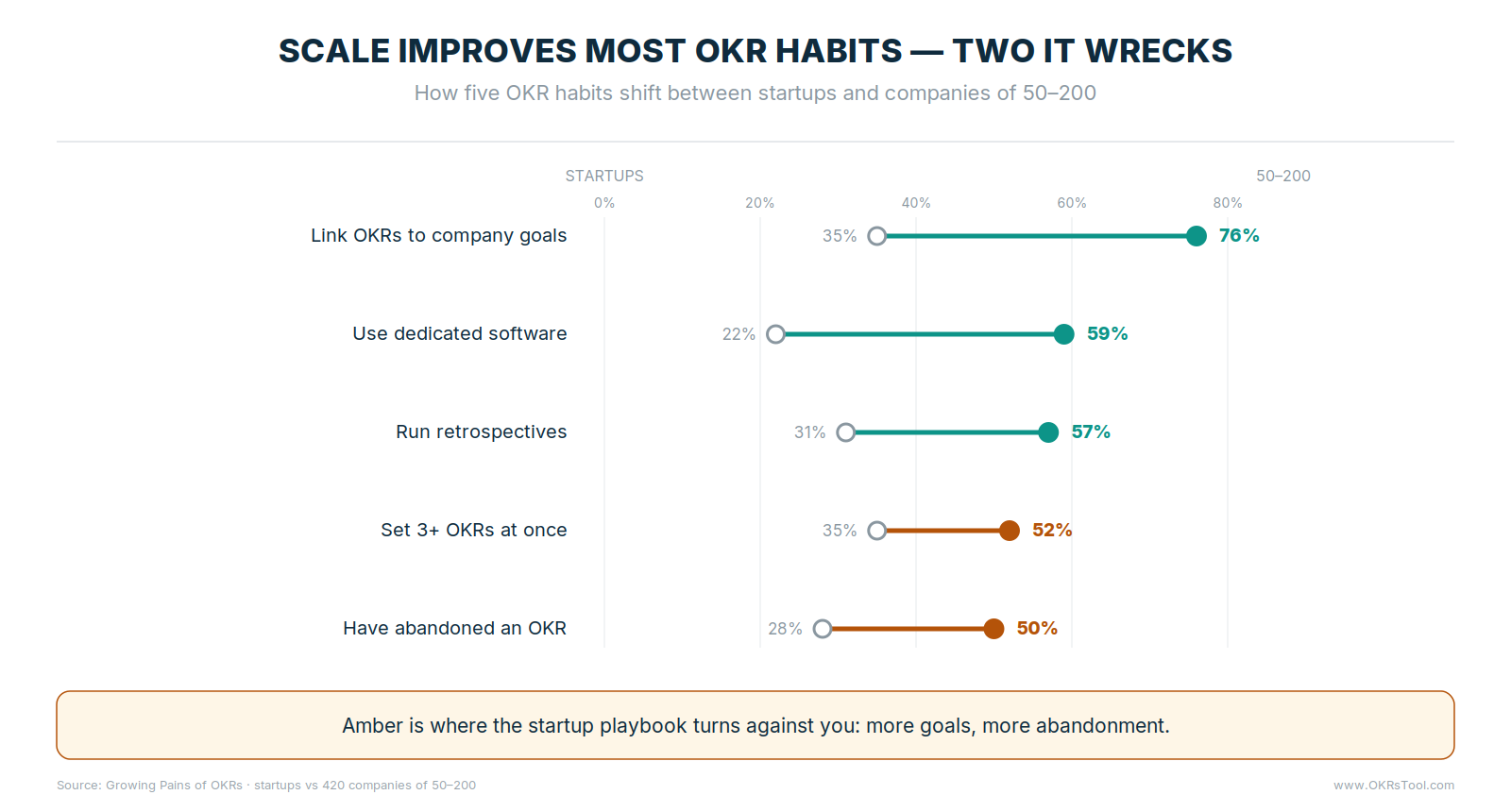
At startup size, true: 22% of startups use dedicated OKR software, and the rest get by in docs and sheets without much pain. A spreadsheet genuinely holds a small team's goals.
By 50–200, 59% have moved to a real tool — and the ones who waited learned why the hard way.
The switch almost always happens reactively: manual tracking works right up until there are more teams than one person can chase, and then rebuilding the picture before every leadership meeting — the kind of manual OKR reporting that eats a week — becomes someone's second job.
"Don't over-tool" turns into "don't fix it until it's already broken." The teams that scale cleanly switch tools while it's still painless, long before manual goal-setting becomes a second job, not mid-quarter under pressure.
3. "Move Fast — Skip the Hierarchy"
Startups skip laddering because at fifteen people everyone can see everyone's goals in a glance; a formal cascade is overhead you don't need. Only a third of startups link their OKRs to company goals, and they're mostly fine.
At 50–200 it's the opposite: three-quarters link their goals to company strategy, because the moment work spans many teams, any goal not wired into company-wide OKRs turns into misalignment you can feel. Skipping the hierarchy — the advice that kept you nimble — is how a bigger company ends a quarter with five teams rowing in five directions, a classic way OKRs fail.
Alignment is the single largest change in the whole study, a 41-point jump, and laddering goals to align a growing company is the habit startups most regret skipping. Build the alignment while the hierarchy is still trivial to draw.
4. "Stay Ambitious — Just Add the Goal"
At startup size, adding one more goal is survivable; focus is easy when there's one team. But three-or-more-OKR quarters jump from 35% of startups to 52% of larger companies.
Every new team brings new stakeholders and a fresh round of "can we just squeeze one more in," and the focus that was effortless at one team thins right as coordination gets harder.
The result is the second habit that moves the wrong way: teams that have abandoned an OKR somewhere climbs from 28% to 50%. More goals across more teams simply means more places for one to be dropped mid-cycle — the why OKRs die pattern with no decision.
"Just add the goal" at a hundred and fifty people is how a quarter ends with everything half-done. Saying no is the one discipline that has to scale faster than the headcount. Practise ruthless prioritization — set the right number of OKRs as a hard cap before more teams multiply the list past what anyone can run.
5. "The Founder Runs OKRs"
In a startup, the founder is the OKR champion, and that's correct — they hold the context and the authority. The startup study has the founder leading the rollout 31% of the time.
By 50–200 that drops to 25%, with the Head of Ops or Growth taking over at 36%. The baton passes from founder energy to operator muscle around exactly this headcount. The advice "the founder runs it" doesn't so much flip as expire — and the danger is leaving the handoff unplanned, where the founder gets pulled into a raise or a key sale and OKRs lose their champion before anyone names a replacement.
The teams that scale OKRs cleanly decide who owns the process on purpose, naming an OKR champion and the leadership accountability for it rather than discovering the gap mid-quarter.
What Still Holds at Every Size
Not all the startup advice expires. A few things held identically across both studies, which makes them the closest thing OKRs for startups and scale-ups share as universal law. A single named owner on every goal — surfaced by a steady weekly check-in — mattered at both sizes — and mattered more at scale, where owned-everywhere teams hit their goals nearly four times as often as partly-owned ones.
Rolling out fast still beat a slow rollout at every size, the mark of a strong first cycle. And the overhead of doing OKRs properly stayed a fixed cadence cost at every size, however hard you wish it away. Keep those; it's the five above that come with an expiry date.
The through-line is simple enough: advice built for fifteen people is a liability at a hundred and fifty, and the tips that made you fast and lean early are the exact ones that let goals drift once there are teams between you and the work.
If your company is in or near the 50–200 band, audit your OKR habits against this list, ideally on one platform that holds them, before the next planning cycle — most of what needs fixing is cheaper to fix now than after a quarter has slipped.
Data: the Growing Pains of OKRs report. It sets a study of 200+ early-stage startups beside one of 420 technology companies at 50–200 employees. No OKRs Tool customers in either sample.