We asked more than 400 operations and strategy leaders one open question: what would most improve how your company runs OKRs? They could have said anything — a better framework, clearer strategy, more executive buy-in. The runaway answer was the most practical thing possible: better, more regular tracking and check-ins. What they want is simply to see where their goals actually stand, week to week.
It's a telling result. Given a blank field and the freedom to ask for anything, leaders didn't reach for the grand or the strategic. They asked to simply know — week to week — whether their goals were moving. Better tracking was named roughly three times more often than any other improvement, including the things the OKR industry spends most of its energy on: writing sharper goals, buying better tools, winning leadership over.
It's the fix the practitioners name themselves — the thing they asked for, in their own words, when handed a blank field and told to write anything. Below is what they wanted, why tracking beats better goal-writing, and how to build a tracking habit that survives a busy quarter. It draws on the open responses in the Growing Pains of OKRs study of 420 companies at 50–200 people.
The Fix Leaders Asked for Most
When the improvement question came back, one request sat far above the rest: better and more regular tracking and check-ins.
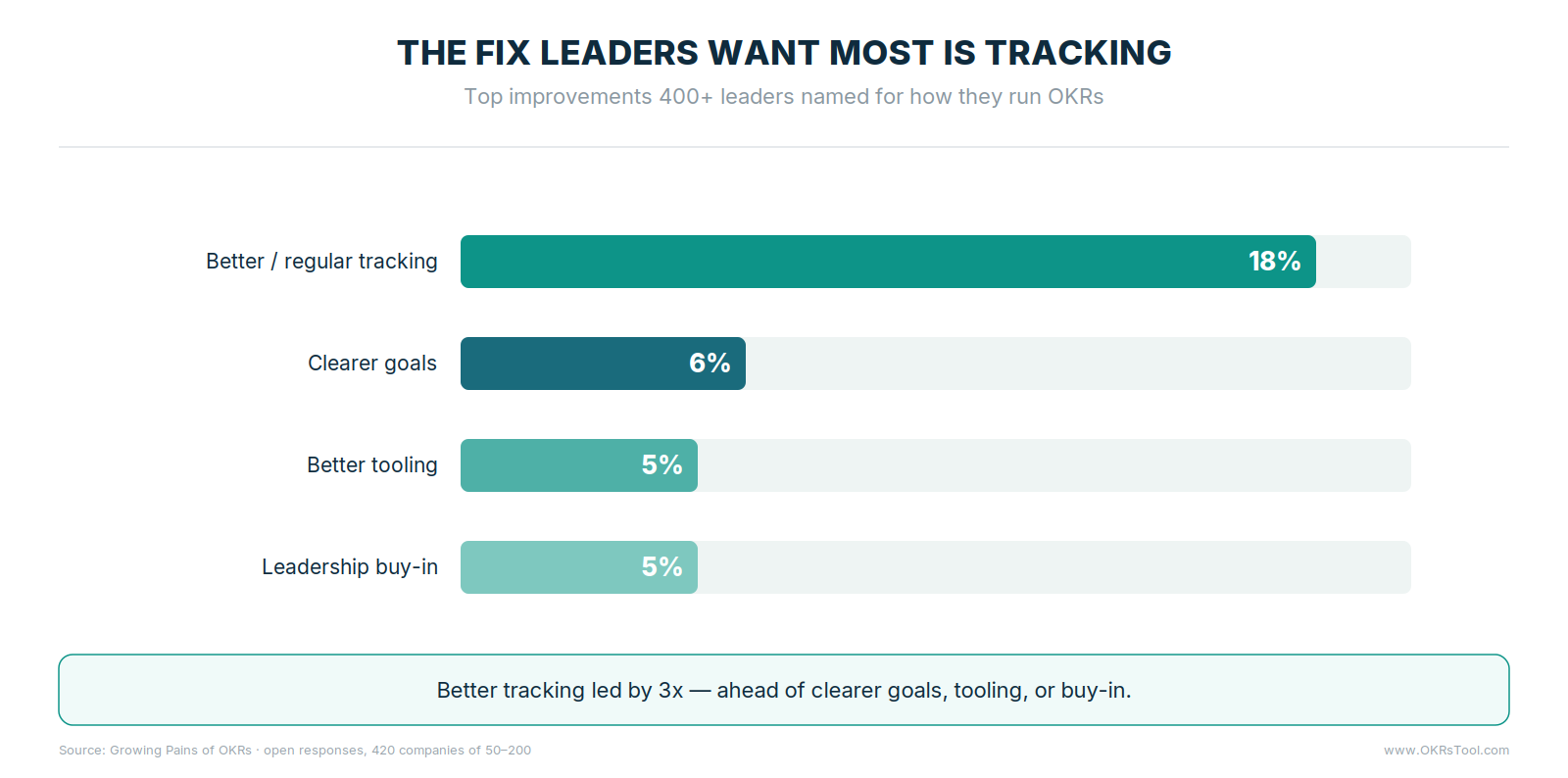
The surprise is what it beat. Leaders didn't ask for a better goal-setting framework or a clearer company strategy — those are what the market assumes teams are missing. What they wanted was far more grounded: a reliable way to see progress.
The verbatims are almost monotonous in their agreement — "regular weekly check-ins," "regular check-ins and progress tracking," "better tracking and clearer team alignment." Hundreds of leaders, independently, asked for the same unglamorous thing.
The Three-Part Wish
Read enough of the responses and a single compound answer emerges, stated almost word for word across dozens of companies: clearer goals, regular check-ins, and better tracking or accountability. Three parts, always the same three, in roughly the same order.
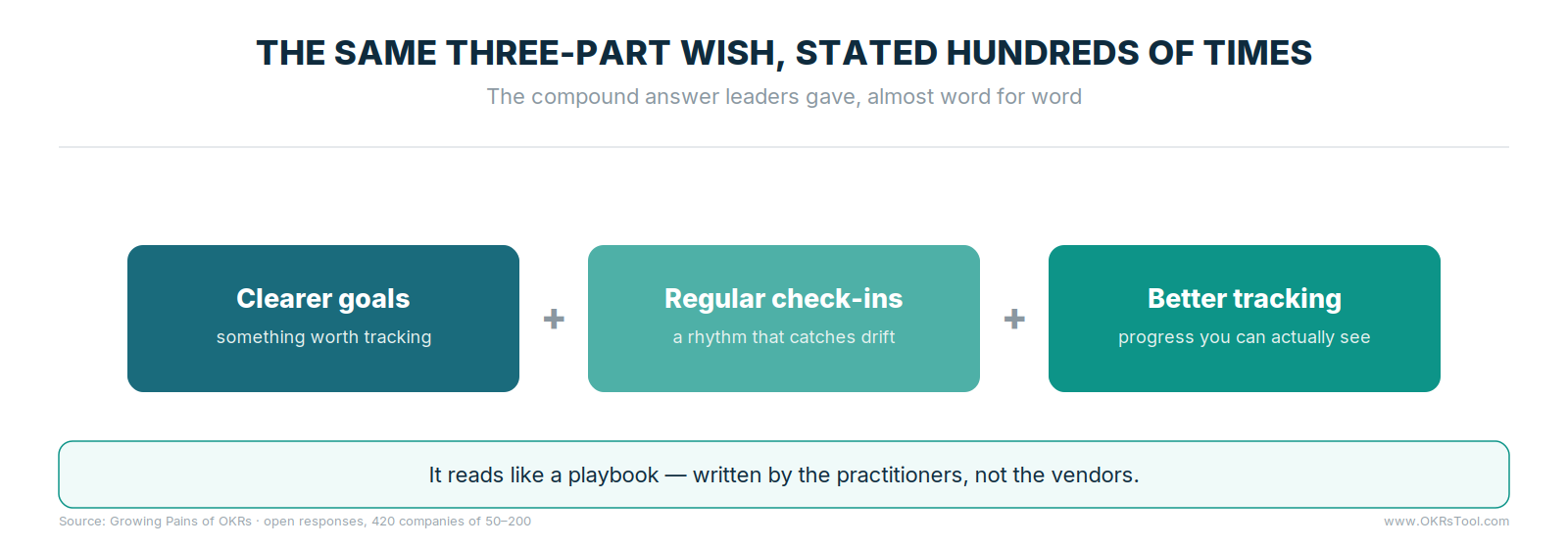
That trio is effectively a playbook written by the practitioners rather than the vendors. It describes a full loop: set goals clear enough to measure, check them on a cadence, and keep a visible record of where they stand.
One leader compressed the whole thing into a single line — "better tracking and clearer team alignment" — and another asked only for "regular check-ins and progress tracking." The market sells OKR philosophy; the people running OKRs are asking for the operating rhythm.
Why Tracking Beats Better Goal-Setting
The counterintuitive part is the inversion itself. The entire OKR content industry orients around writing goals — the verbs, the structure, the baseline-to-target formula. Leaders, given the choice, asked to track them instead. That inversion is the whole insight.
The reason is simple once stated: a well-written goal that nobody checks drifts exactly as badly as a sloppy one. The tracking is what converts a goal from a statement into a live commitment — a plan only becomes real once someone is watching it move.
A team that genuinely tracks a roughly-written goal every week will out-deliver a team that perfected its wording and then looked away. This is why obsessing over the wording of OKRs has limits: past a baseline of clarity, the next unit of effort is far better spent on the weekly check-in than on another round of polishing.
The Spreadsheet Trap
There's a specific place where the tracking habit goes to die, and one leader named it exactly. Asked what would most improve their OKRs, they wrote: "tying them to our actual work instead of a separate spreadsheet nobody checks."
That phrase — a separate spreadsheet nobody checks — is the entire problem in six words. Manual tracking starts fine and decays fast: someone has to open the sheet, chase the updates, and reformat it every week, and the first busy stretch is when that stops happening.
Leaders feel it directly, which is why several asked for "better tools and more regular check-ins" and "better automation and simpler tracking tools" in the same breath.
The request underneath all of them is the same: make the tracking happen without it depending on a person remembering to make it happen. That's the gap between a spreadsheet and real OKR software — not features, but whether the record stays current on its own.
How to Build a Tracking Habit That Sticks
Leaders already named the fix. The work is doing it without it becoming a full-time job. Four moves, each drawn from what the responses asked for.
Protect the weekly check-in like a standing meeting. It topped the improvement list for a reason. Fifteen minutes on three questions — progress, risks, next step — beats an hour nobody schedules, and the slot has to survive the frantic weeks to be worth anything. A dependable check-in rhythm is what the whole habit rests on.
Cut the goal list down. Clarity was the second-most-named fix, and it enables the tracking: a goal has to be a measurable key result before there's anything to track. A shorter list of sharp objectives stays current far more easily — a quiet win for goal management.
Hand tracking to software, not a volunteer. This request ran through nearly every answer: end the dependence on someone chasing updates by hand. When the nudge and the record are automated, nobody inherits tracking as a side job — and manual OKR reporting, the thing leaders most want gone, retires itself.
Use tracking to catch drift, not just log numbers. The real value of a current record is spotting the week a goal stops mattering. A mid-quarter checkpoint reconnects goals to what the company now cares about, keeping the record honest rather than a snapshot of a plan that's moved on.
Leaders Already Know the Fix
The striking thing about this data is that there's no mystery in it. Asked how to run OKRs better, 400 leaders didn't ask for insight they lacked — they named a capability they already understood and simply couldn't sustain by hand. Better tracking, regular check-ins, a record tied to the actual work: they know exactly what would help.
The gap is entirely in the doing. Tracking by hand asks a busy team to keep a sheet current through every fire drill of the quarter, and that's the part that fails. Hand the tracking to a system that runs the check-in, surfaces what's at risk on one platform, and keeps the record current on its own, and the fix leaders named 400 times stops being a wish and starts being the default.
They're already convinced tracking matters. What they need is a way to keep it running that doesn't rely on someone chasing it every week.
Data: the Growing Pains of OKRs study — open-ended responses from leaders at 420 technology companies of 50–200 employees. No OKRs Tool customers were included.