
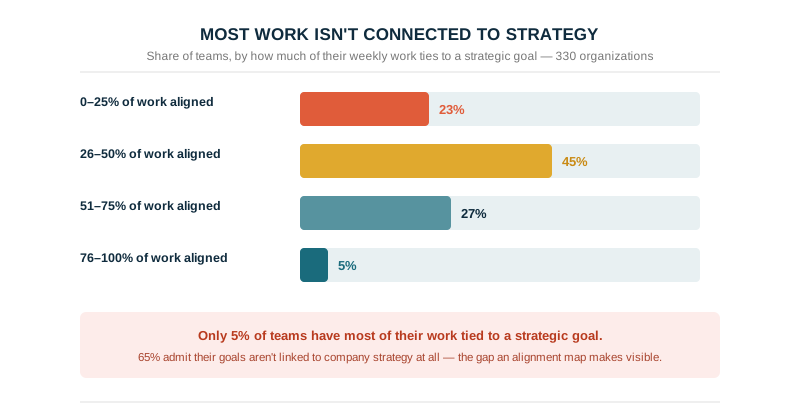
65% of teams admit their goals aren't linked to company strategy, and only 5% have most of their work tied to a strategic goal. An alignment map is how you see the gap — every OKR, every connection, and every orphaned goal, on one screen.
Ask ten people in a growing company how their work connects to the company's top priorities, and you'll get ten different answers — or ten blank looks. Not because they're disengaged, but because the connection was never made visible. The strategy lives in a leadership deck; the work lives in a hundred separate places; nothing draws the line between them, and the disconnect compounds as the company grows.
That missing line is expensive. When people can't see how their goals ladder up, they optimize for what's in front of them, and effort scatters. An alignment map draws the line — it shows how every OKR cascades from company objective down to team and individual, so everyone can see where they fit and leadership can see what's actually pulling toward strategy.
What an Alignment Map Shows
An alignment map is a single visual view of how your OKRs connect. Company objectives sit at the top. Team OKRs branch beneath them. Individual OKRs branch beneath those. The lines between them are the alignment — a clear picture of what supports what.
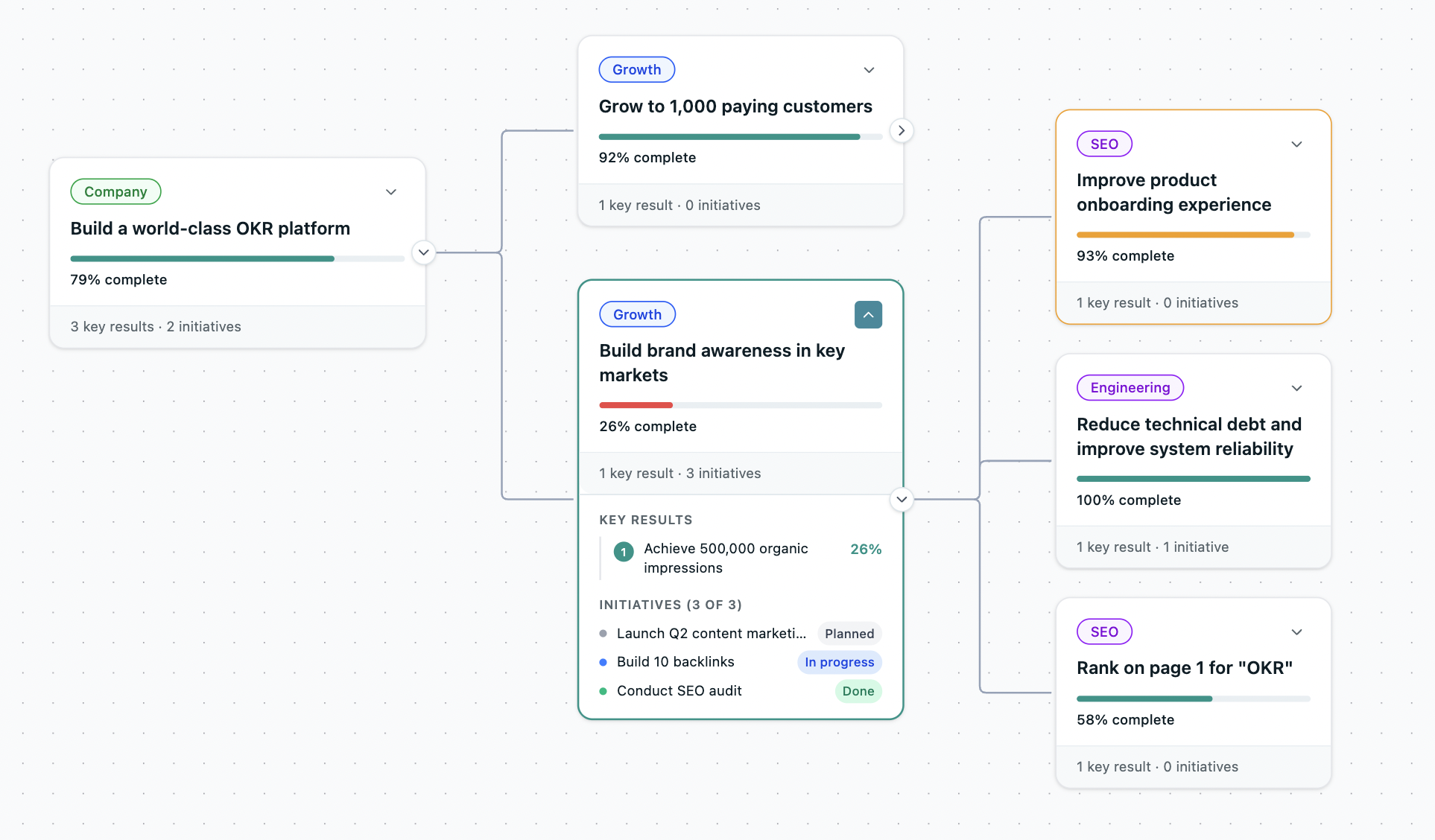
Read top-down, it answers a leadership question: is our strategy actually resourced? You can see which company-wide objectives have teams working toward them and which have none, and where the same objective needs cross-department effort to land. Read bottom-up, it answers an individual one: does my work matter, and to what? Both questions are hard to answer in a spreadsheet and obvious on a map.
The Orphaned Goal Problem
The most valuable thing an alignment map surfaces is what isn't connected. Every growing company accumulates orphaned goals — OKRs that don't ladder up to any company objective, and company objectives that no team is working toward. It's a failure that shows up whether you set goals top-down or bottom-up, because neither direction guarantees the connections actually hold.
Both are quiet failures. An orphaned team OKR is effort spent on something strategy didn't ask for — often a key result that measures activity no one prioritized. An unsupported company objective is a priority leadership named and then no one owned. Neither shows up in a status report, because each individual goal looks fine on its own — the problem is only visible in the connections, which is exactly what a map draws.
This is the strategy-execution gap made concrete. Across 330 organizations in the 2026 OKR Benchmark Report, 65% admit their goals aren't linked to company strategy, and only 5% have most of their weekly work tied to a strategic goal. That disconnect is what quiet misalignment looks like at scale.
Why Spreadsheets Can't Do This
Alignment is a relationship problem, and spreadsheets are bad at relationships. A goals spreadsheet can list every OKR in the company, but it can't show you the lines between them — you'd have to hold the whole hierarchy in your head to spot what's orphaned.
That's why alignment tends to decay silently. Nobody set out to disconnect their work from strategy; the connections just got harder to see as the company grew, until nobody could hold the full picture. A map fixes the visibility, not by adding discipline, but by making the structure impossible to lose track of. You see the orphaned goal because it's the one branch with no line running up — the kind of gap that clean company OKR examples always avoid, and one leadership accountability depends on closing.
How Teams Use the Alignment Map
The map earns its place at three moments in the cycle.
- Planning, it's a check before goals go live. Draft the team OKRs, open the map, and look for anything that doesn't connect to a company objective — that's the moment to fix an orphaned goal, before a quarter of effort goes into it. It also surfaces the reverse: a company priority with no team beneath it, which means it needs an owner or it isn't really a priority.
- Mid-cycle, it's a fast alignment gut-check. In a weekly check-in or a mid-quarter review, the map answers "is everyone still pulling the same direction?" in one glance instead of a round of status updates.
- Review, it's a record of where effort actually went. Which objectives had the most work laddering up? Which had none? That's a sharper input to next quarter's planning than any completion score — it tells you not just what got done, but whether the company worked on what it said mattered.
Alignment Is a Visibility Problem First
Most alignment advice is about process — cascading goals, alignment meetings, more communication. Those help, but they treat alignment as something you achieve through effort. The faster fix is usually visibility. People align their work when they can see what to align it to, and they drift when they can't.
That's the whole case for an alignment map. It doesn't make people care about strategy — most already do. It makes strategy visible enough to act on, which turns out to be most of the battle. The OKRs Tool platform builds the map automatically from your OKRs, flags what's orphaned, and updates as goals change — so the line from strategy to work stays drawn without anyone maintaining it, whether that's a champion or the whole leadership team. It's free for up to five users.
Data: The 2026 OKR Benchmark Report (330 organizations).