A robust foundation — but two gaps in the operating model.
Tinaba is an Italian fintech serving customers across digital payments and wealth management. By the time the team started looking at OKRs, the operating fundamentals were already in place — executive reporting, KPI tracking, and a well-established communication rhythm across executives, peers, and teams.
But two gaps remained. The team needed a concise and effective way to communicate the current state of progress. And they needed a clearer linkage between business initiatives and their impact on outcomes — the connective tissue that turns strategy into results, instead of leaving them disconnected across presentations, spreadsheets, and meetings.
Start lean. Prove the model. Then scale into it.
Tinaba started on the free plan. The first OKR cycle was deliberately top-down — centrally defined and managed by leadership, with subsequent updates also centrally driven. This let the team prove the framework worked for their context before opening it up.
Over the next two cycles, Tinaba evolved the practice: introducing a weekly business review where KR owners are now responsible for updating performance metrics themselves. Ownership moved from the center outward. With confidence in the model — and the need for APIs and capabilities only available on the higher tier — the team upgraded to the Expand plan.
Strategy, execution, and outcomes — in one shared framework.
What previously lived across presentations, spreadsheets, and meetings is now centralized in a shared framework that gives leadership and teams a consistent view of priorities and progress. More recently, Tinaba has started integrating business initiatives directly into OKRs Tool — strengthening execution tracking and alignment by linking the work to the outcomes it's designed to drive.
The most important shift, however, has been cultural rather than operational. The platform reinforced a mindset of ownership, transparency, and alignment across teams — and it changed the nature of weekly business reviews. Conversations are now focused on impact and outcomes, not purely status reporting.
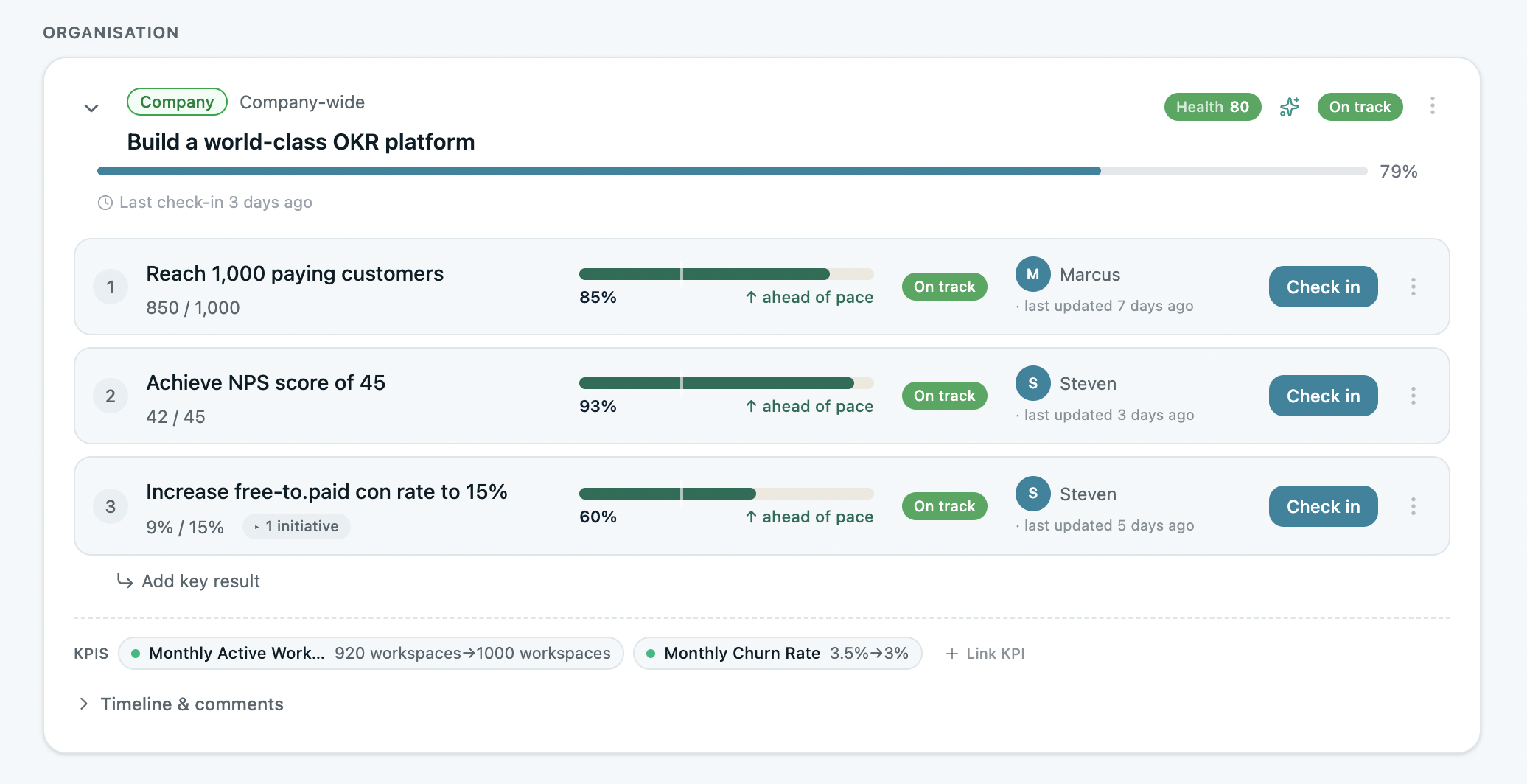
A look at OKRs Tool — the same view Alberto's team uses to track execution against outcomes
Cultural change first. Operational gains followed.
Tinaba didn't just centralize their tracking — they reshaped how the organization talks about progress. Strategy, initiatives, and outcomes now live in the same place. Ownership sits where the work happens. And looking ahead, Alberto sees the next frontier: OKRs Tool as the feedback layer for increasingly autonomous, agent-based operational processes via APIs — a continuous loop between execution, measurement, and strategic adaptation.
The most important impact, however, has been cultural before operational: the platform helped reinforce a mindset of ownership, transparency, and alignment across teams. It also made our weekly business reviews far more effective, enabling conversations to focus on impact and outcomes rather than purely on status reporting.
Looking ahead, we also see the potential for OKRs Tool to become the feedback component of increasingly autonomous, agent-based operational processes through APIs — creating a continuous loop between execution, measurement, and strategic adaptation.
