
Management by Objectives is the framework that taught organizations to manage by outcome rather than activity, and most of its logic survives intact. What hasn't survived is the machinery around it: an annual review cycle in a market that moves quarterly, and a compensation link that makes 89% of people pad their targets.
Management by Objectives asks a question that was genuinely new in 1954: what would happen if every person in the company knew, in measurable terms, what they were supposed to achieve? Peter Drucker's answer reorganised management around outcomes instead of supervision, and the idea was strong enough that seventy years later, a version of it runs in most large organizations.
The question worth asking now isn't whether MBO was right. It's which parts of it were the insight and which were the plumbing. The insight — explicit, measurable objectives connected to daily work — is more defensible than ever. The plumbing, an annual cycle reviewed by a manager and wired to your salary, is where modern teams keep breaking. This guide covers how Management by Objectives works, where it still fits, where it fails, and what the data shows about the framework that replaced it.
What Is Management by Objectives?
Management by Objectives is a goal-setting framework in which managers and employees jointly agree measurable goals for a defined period, then evaluate performance against them at the end of it. The period is almost always a year.
Drucker's premise was that people work better when they can see what they're aiming at. Define the target explicitly, make it measurable, connect it to something the organization needs, and performance sharpens on its own — no supervision required. Against the alternative of the time, which was managing by presence and activity, this was a substantial idea.
The process runs top to bottom. Leadership sets company objectives, those cascade into departmental goals, managers and employees agree individual objectives underneath them, and progress gets assessed in a formal review at year-end. The chain from company goal to individual objective is what gives MBO its coherence, and it's the part every framework since has kept.

The Five Principles of MBO
Five ideas define how Management by Objectives operates:
- Goals are set jointly. Objectives are agreed between manager and employee rather than assigned. Participation is meant to produce ownership.
- Objectives are specific and measurable. "Improve customer service" has no place in a functioning MBO system — every objective must be concrete enough to evaluate.
- Everything is time-bound. Goals belong to a defined period, and in most MBO programmes that period is the calendar year.
- Objectives link to strategy. Individual goals connect to team goals, which connect to company goals. The alignment chain is central to how MBO creates focus.
- Results are evaluated formally. The end-of-cycle review assesses what was achieved, and it usually feeds compensation and promotion decisions.
That last principle is the one that determines everything else. Once a goal decides your pay, the goal stops being a plan and becomes a negotiation.
What Management by Objectives Looks Like in Practice
The structure is easy to follow, which is part of why it lasted.
Read the right-hand column and the problem announces itself. Every measurement happens at the end. For twelve months, the honest answer to "how are we doing" is that nobody has checked.
Where Management by Objectives Still Works
MBO isn't obsolete, and the environments where it holds up have something in common: the year is a real planning unit rather than an accounting convenience.
It works when priorities are genuinely stable across twelve months, when work follows predictable process-driven rhythms, when goal-setting and performance management are deliberately the same exercise, and when the organization operates on long planning horizons — regulated industries, manufacturing, government. In those settings, quarterly pivots would be disruptive rather than useful, and annual planning does what it's supposed to.
The trouble is that most companies describe themselves this way and then behave otherwise. The test isn't whether your plan is annual. It's whether the objectives you set in January are still the right ones in June.
Where Management by Objectives Falls Short
For growth-stage companies, technology teams, and any business where priorities move inside a quarter, MBO has three structural problems. None of them is a failure of discipline.
The annual cycle can't see drift
The Strategy Execution Benchmark 2026, which surveyed 180 strategy and operations leaders, found 83% get no automatic signal when a strategic priority starts drifting — they find out by attending a review. Nearly half, 47%, name a scheduled review as their most common way of learning something is off track, and 21% say a priority is typically off course for a month or more before they personally know.
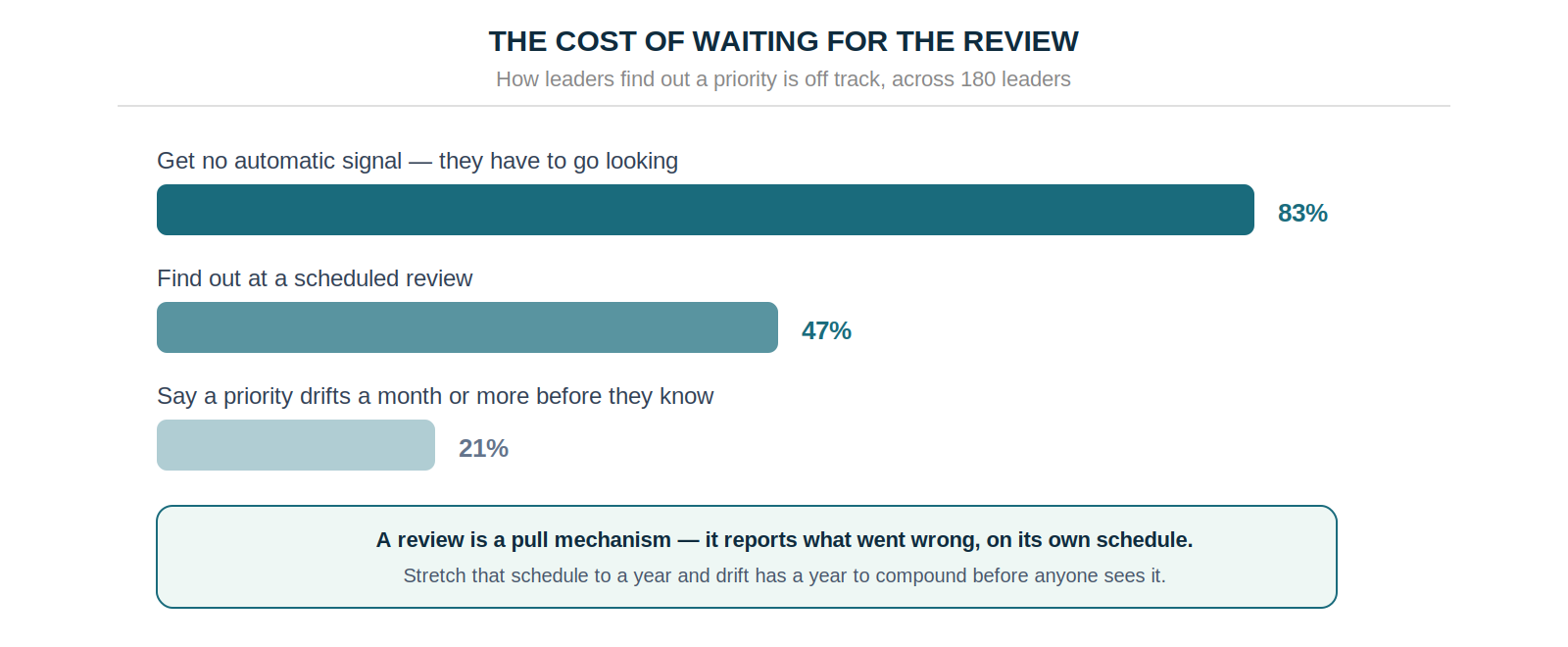
Those numbers describe organizations reviewing quarterly. Stretch the review to annual and the arithmetic gets worse: a goal set in January that stops making sense in March has nine months to consume budget and headcount before the framework notices. The visibility gap isn't created by MBO, but MBO's cadence is the widest possible version of it.
The compensation link manufactures sandbagging
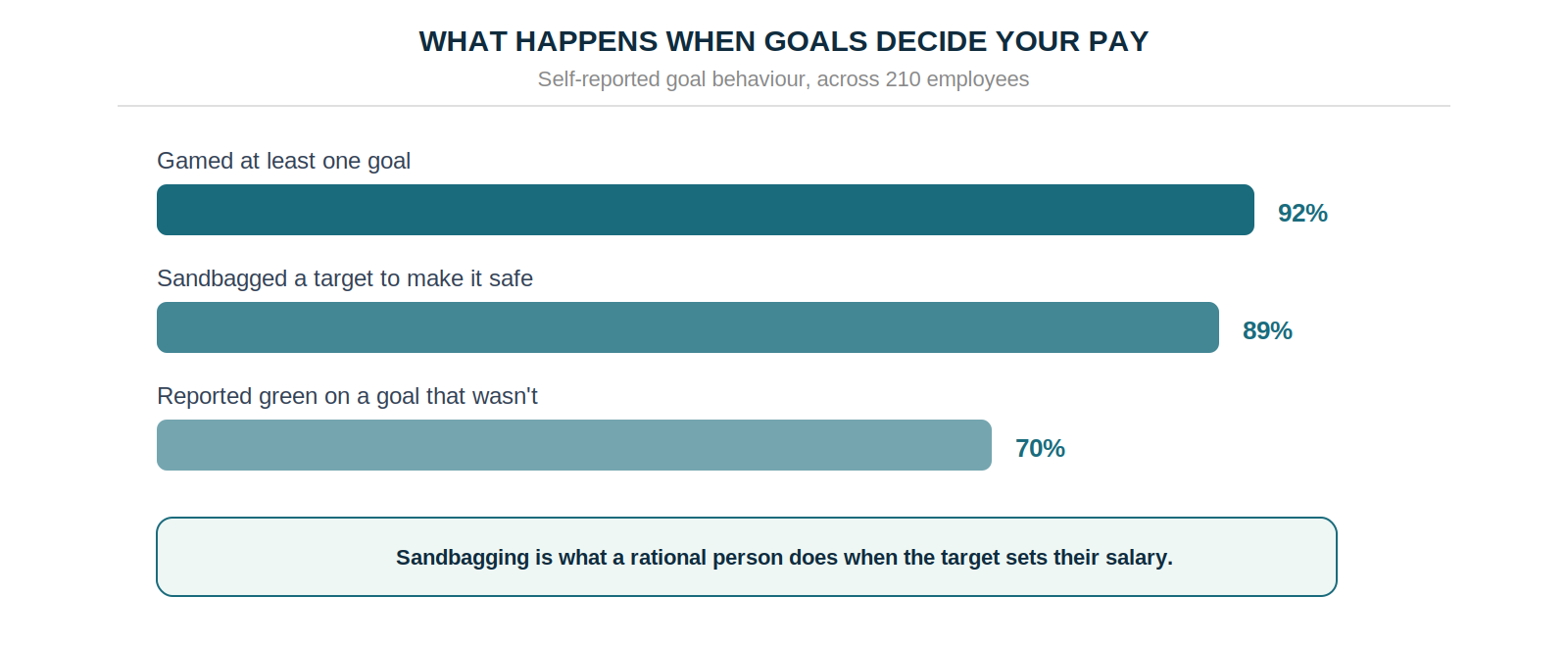
When objectives feed pay and promotion, setting an ambitious target is a decision to risk your own salary. The State of Goal Management, covering 210 employees, found 89% have sandbagged a target to make it safely achievable, 92% have gamed a goal at least once, and 70% have reported green on something that wasn't.
Read those as evidence of bad people and you'll design the wrong fix. They're evidence of a rational response to a system that punishes ambition. A framework built to drive performance ends up rewarding the person who negotiated the easiest number in January — and the watermelon goal, green outside and red inside, is the natural end state.
Goals stay invisible across the organization
In most MBO systems, objectives live in a manager-employee conversation and an HR platform. Adjacent teams can't see them. Nobody outside the pair knows what anyone is working toward, which makes cross-team conflict impossible to spot until it has already cost something.
This is why cross-department alignment is where MBO organizations tend to struggle hardest. The chain from company objective to individual goal exists on paper, but no one can see it end to end — and a cascade nobody can trace is a cascade nobody can correct.
MBO vs OKRs: What Actually Changed
OKRs didn't replace Management by Objectives so much as strip it for parts. Andy Grove built the framework at Intel because he wanted MBO's clarity without its cadence and without its compensation link — the two things this guide has just spent three sections on.
The compensation separation is the load-bearing difference. When missing a goal doesn't cost you money, you can set one you might miss — which is the only kind worth setting. The OKR Intelligence Report 2026, covering 222 organizations, found 93% adapt objectives mid-cycle when priorities shift, a move that's structurally unavailable to a framework whose goals were fixed in January and wired to a bonus.
Replacing the Annual Review With a Rhythm
Switching from annual to quarterly isn't the whole fix. A quarterly goal reviewed quarterly still leaves eleven weeks of silence — the same failure at a shorter interval.
What closes it is three layers running at once:
- Weekly check-in, 20 minutes. What moved, what's at risk, what needs a decision. This is the layer that produces the 43% completion lift, and it exists to catch drift while there's still quarter left to spend.
- Monthly business review, 60 minutes. A structured look at whether the cycle is still on track at the halfway point. Are the strategic assumptions holding? Does a key result need revising, escalating, or formally killing?
- Quarterly business review. The end-of-cycle retrospective. Score each key result honestly, name what drove the results, and decide what changes next cycle.
The MBR is the layer most teams skip and the one that makes mid-cycle adaptation governed rather than silent. Without it, the 93% who modify objectives mid-cycle are doing it in DMs, and the goal on the page slowly diverges from the goal being pursued.
What the ROI Data Shows
Frameworks are easy to argue about and hard to price. One of them has been priced.
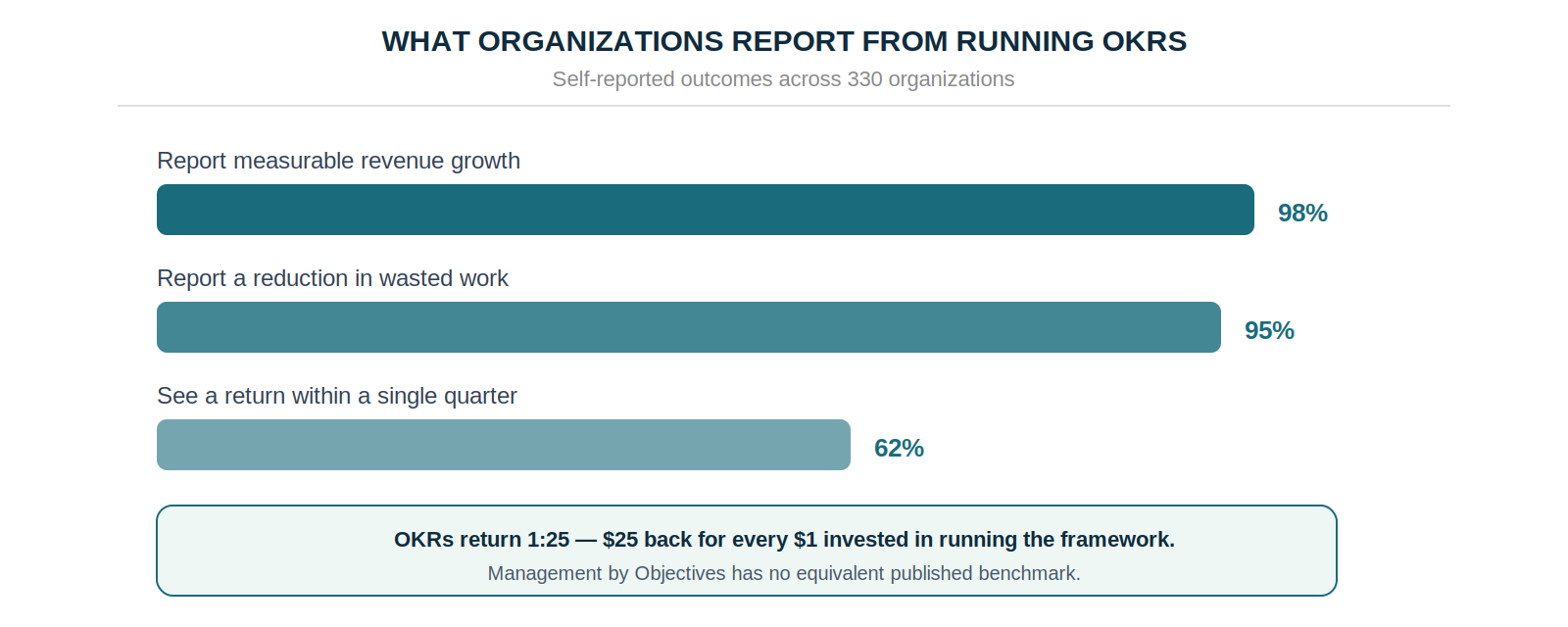
The ROI of OKRs 2026 Benchmark Report, covering 330 organizations, puts the return at 1:25 — $25 back for every $1 spent running the framework. 98% report measurable revenue growth, 95% report a reduction in wasted or misaligned work, and 62% see a return inside a single quarter.
No equivalent published benchmark exists for Management by Objectives, and that absence is structural rather than accidental. An annual cycle wired to compensation makes the framework's contribution nearly impossible to isolate — by the time you measure, a year of everything else has happened too.
What the OKR data does show is that the behaviours generating the return are precisely the ones MBO discourages: weekly check-ins worth 43% more completed goals, ambition that survives contact with the compensation review, and goals visible to the whole organization rather than to one manager.
Should You Use MBO or OKRs?
The answer depends on how your company actually operates, not on which framework sounds more current.
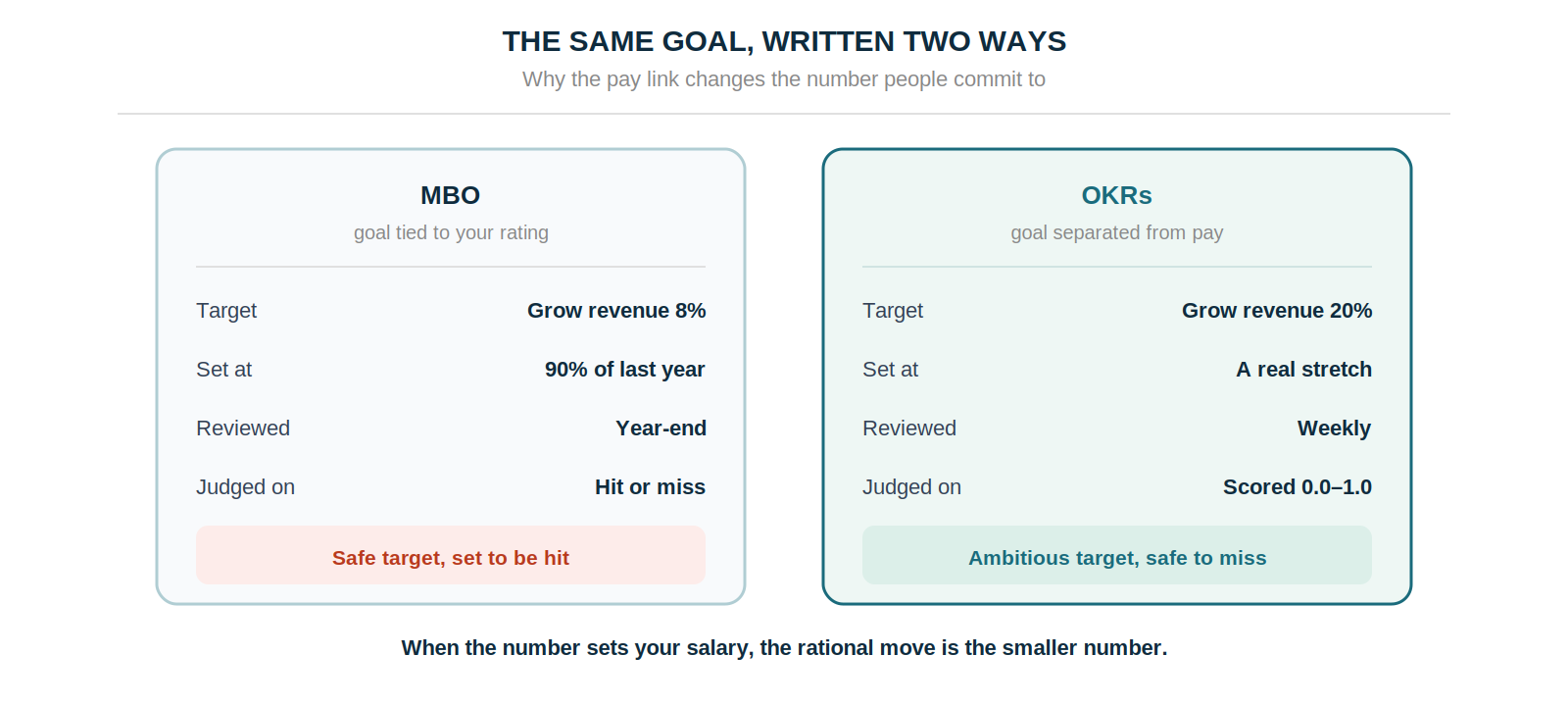
Management by Objectives fits when your business runs on annual rhythms that genuinely hold for twelve months, when goal-setting and performance management are intentionally the same exercise, and when the objectives you set in January are still the right ones in September.
OKRs fit when priorities shift faster than an annual cycle can absorb, when you want goals visible across teams rather than inside manager-employee pairs, when you want performance reviews separated from goal-setting, and when you need feedback loops that catch misalignment before it compounds.
For most technology and growth-stage companies, the quarterly cadence, organization-wide visibility, and compensation separation are the reason the framework works at all — not optional refinements. If you're moving, the fastest route is a single first cycle with one company objective and two or three key results. Teams that launch inside a week see up to 50% higher completion than teams that spend weeks planning the launch.
What to Take From MBO, and What to Leave
Drucker's insight holds: organizations perform better when objectives are explicit, measurable, and connected to the work. Seventy years of evidence hasn't dented it, and every framework that followed — OKRs included — is built on it.
What's changed is everything around the insight. Annual cycles and manager-owned visibility made sense when strategy moved slowly and information travelled between teams over weeks. In a company where a priority can go stale in six weeks, an annual review functions as a delay with a meeting attached. The 89% who sandbag aren't failing the framework either; they're reading the incentive correctly.
Keep the principle. Replace the machinery around it, and the thing Drucker was actually after — people who know what they're aiming at and can see whether they're hitting it — becomes achievable in a way the annual review never allowed.
Data: The ROI of OKRs 2026 Benchmark Report (330 organizations), Strategy Execution Benchmark 2026 (180 strategy and operations leaders), The State of Goal Management (210 employees), OKR Intelligence Report 2026 (222 organizations), The 2026 OKR Benchmark Report (200 organizations).