
Across 210 full-time employees at growing companies, 89% admit to sandbagging — setting a goal they had already mostly achieved. The rate climbs to 96% when goals directly affect performance ratings and falls to 81% when goals are kept separate. Sandbagging is not a discipline problem or an integrity problem. It is a rational response to a rating link, and it happens twelve weeks before anyone scores anything.
Most discussion of sandbagging treats it as something visible at cycle end — a suspiciously perfect score, a team hitting 1.0 every quarter. By then it's long over. The sandbag was placed during the planning session, when the target was chosen, and the person who chose it already knew where they'd land.
The State of Goal Management asked 210 employees what they actually do to their goals when nobody is grading the answer. 92% admit to at least one form of goal-gaming. Only 8% have done none of it. And the strongest predictor of who games isn't seniority, function, or company size. It's how tightly the goal is bound to the performance review.
What Sandbagging Actually Is
Sandbagging is setting a target you have already substantially achieved, or one you know with near-certainty you will achieve, so that the goal is guaranteed to be met. It is not the same as a conservative estimate made in good faith, and it is not the same as watermelon reporting — showing a goal as healthier than you know it to be.
The distinction matters because the two happen at opposite ends of the OKR cycle. Watermelon reporting is a tracking-phase behaviour: the target was honest, the progress isn't. Sandbagging is a planning-phase behaviour: the progress is honest, the target was never real. A team can sandbag perfectly and never once misreport a number.
89% of employees admit to the first. 70% admit to the second. 50% admit to writing a goal mainly to impress leadership rather than to change anything. And 43% admit to all three at once. These are not three populations. They are largely the same people, responding to the same incentive — the defining pattern in goal management today.
The Incentive Gradient
The pattern in the data is a gradient, not a switch. As goals move from being kept separate from ratings to directly determining them, every gaming behaviour rises in lockstep.
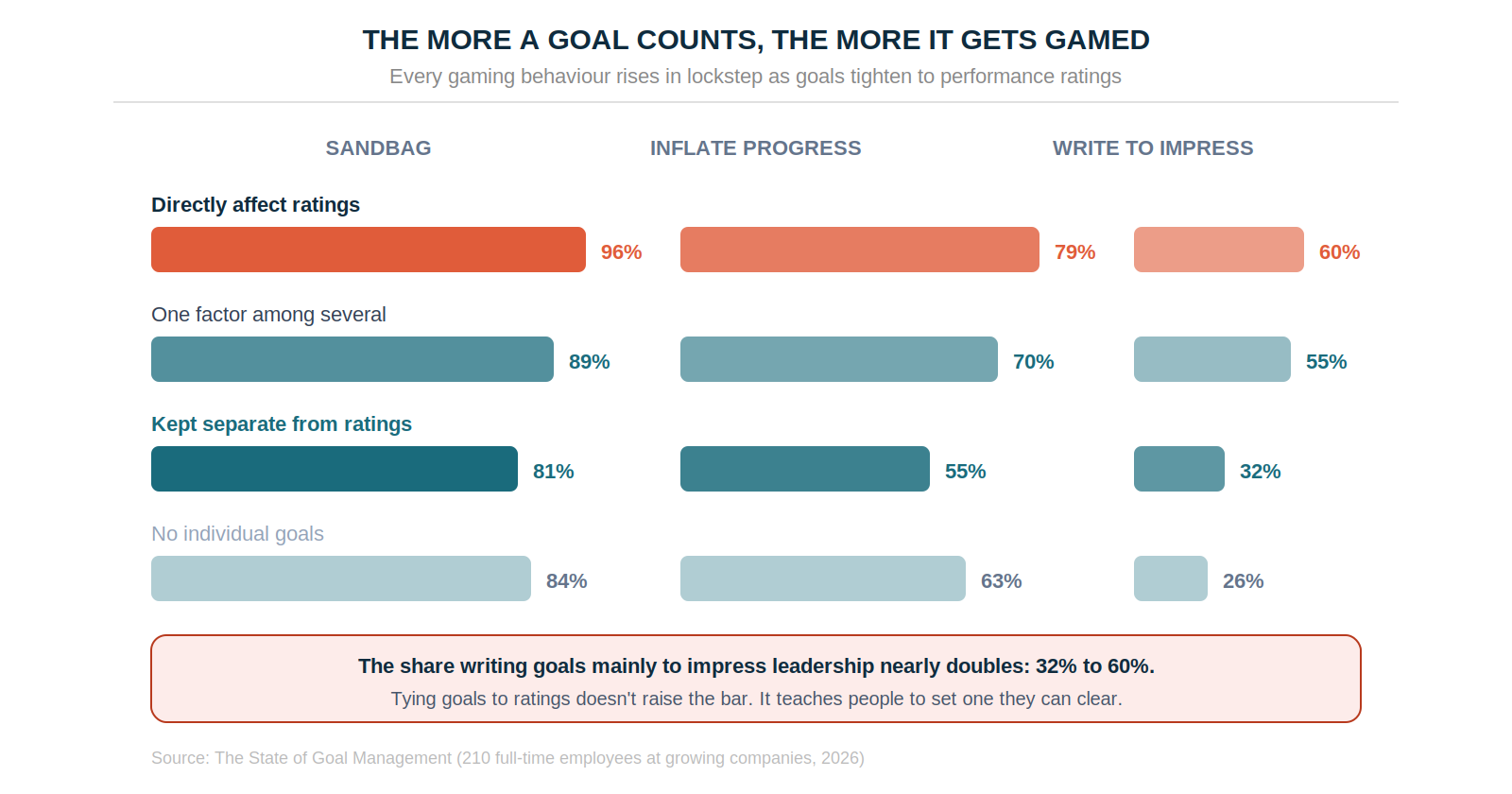
When goals directly affect ratings, 96% sandbag, 79% inflate progress, and 60% write goals mainly to impress. When goals are one factor among several, those figures fall to 89%, 70%, and 55%. When goals are kept separate from ratings entirely, they drop to 81%, 55%, and 32%.
The clearest signal is the look-good goal. The share writing objectives primarily to impress leadership nearly doubles — from 32% to 60% — as goals move from kept-separate to rating-determining. Tying OKRs to ratings doesn't raise the bar. It teaches people to set a bar they can clear.
This is the paradox at the centre of the research. The mechanism organizations reach for to make goals matter — accountability through performance reviews — is the same mechanism that corrupts them. When a missed goal becomes a mark against you, the rational move is to set a goal you've already hit.
Grove Solved This in 1974
Andy Grove built OKRs at Intel with an explicit prohibition: OKR scores were not to be used in performance reviews. This was not a cultural preference. It was a structural correction for a failure mode he had observed firsthand in Peter Drucker's Management by Objectives, where compensation was tied to MBO scores and managers systematically set conservative targets they could reliably achieve.
Grove's insight was that ambition and evaluation cannot occupy the same instrument. A goal that determines your rating is a commitment you must meet. A goal that informs a conversation is a bet you can afford to lose. Only the second kind produces the stretch that makes the framework worth running.
The history of OKRs is, in part, a history of that decision being quietly undone. Organizations adopt the framework, then bind it to the review cycle because that is how performance management works — and recreate exactly the failure mode Grove designed the system to prevent. The gap the data now measures — 96% sandbagging when goals determine ratings versus 81% when they don't — is the same gap Grove designed around before the framework had a name.
Owners Game Most
The intuition that ownership drives honesty does not survive contact with the data. Goal owners write look-good goals at 63%. People who merely track goals do so at 45%. Observers, at 32%.

Ownership doesn't reduce gaming. It concentrates it, because authorship is what gives someone the means to manage appearances in the first place. The person who writes the target chooses where it sits.
This is not an argument against named ownership. Required single ownership drives 26% higher completion, and a Key Result owned by nobody is a goal nobody pursues. The argument is that ownership must sit inside a system that surfaces real progress — so that owners are rewarded for truth rather than polish.
What Sandbagged Goals Cost
A sandbagged OKR produces a 1.0 score and no information. The 2026 OKR Benchmark Report identifies 70–80% completion as the sweet spot for genuinely ambitious goals: far enough beyond current capability to require real change, close enough to realistic that the team commits. A team hitting 100% every quarter is not outperforming. It is setting targets it already knew how to reach.
The compounding cost is worse than the single cycle. The maturity curve — 51% completion in cycles one and two rising to 79% by cycle five — depends on each retrospective extracting real learning from an honest score. A 1.0 teaches nothing. A 0.65 tells a team exactly which Key Result stalled, who owned it, and what to change. Sandbagging doesn't just waste a quarter. It removes the learning loop that makes the next quarter better.
And it corrodes the system itself. 34% of employees say nothing about how they work would change if their goal tracker were deleted tomorrow. That is what a board of pre-achieved goals produces — a dashboard everyone updates and nobody believes.
Making Honesty the Rational Choice
Sandbagging is rational behaviour inside a system that punishes the miss. Changing the behaviour requires changing what is rational, and the research points to three structural moves rather than a cultural appeal.
Decouple goals from the verdict. Keep OKR delivery as informed context in a performance conversation, not as the determining score. The aim is to make ambition safe to admit — so people set goals they might miss instead of ones they've already hit. This is the single highest-leverage change available, and it is the one Grove made in 1974.
Make the real state always visible. A goal can only be quietly inflated when its true health is assembled at review time. Continuous visibility through a weekly check-in removes the space in which a target can drift from reality unobserved. Teams that check in weekly complete 43% more OKRs than those reviewing monthly or ad hoc.
Give every goal a real ending. 35% of employees had goals last cycle that simply stopped being mentioned. Among those who say nothing would change if their tracker vanished, that figure rises to 49%. A goal that can quietly disappear was never holding anything up — and people learn quickly which goals those are.
The Number Was Never the Point
A sandbagged goal is a goal that was never a goal. It is a prediction dressed as a target, written by someone who already knew the answer and had good reason not to say so.
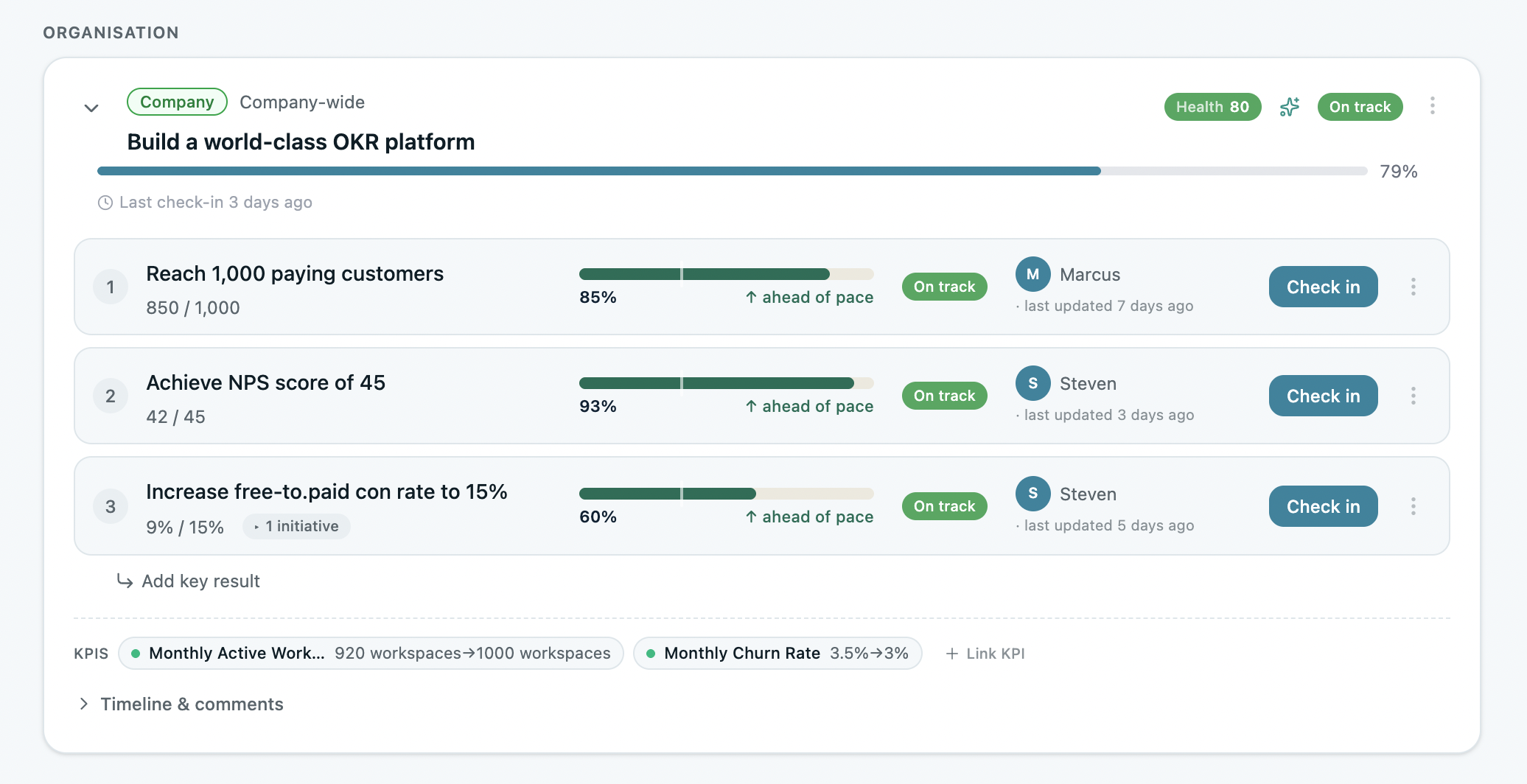
The organizations whose goals actually work don't have stricter scoring or better templates. They have systems where the truthful state of a goal is always visible, ambition is safe to admit, and no goal quietly disappears. That is an operating discipline, not a feature. See how OKRs Tool separates honest scoring from performance evaluation — free for up to 5 users.
Data: The State of Goal Management (210 full-time employees at growing companies, 2026), The 2026 OKR Benchmark Report (330 organizations).