
OKR calibration is the end-of-cycle process that aligns scoring standards across teams before scores feed into performance conversations. Without it, a team that scores honestly gets penalised against a team that sandbagged — and the data leadership relies on to make decisions becomes noise.
OKR scoring works on a 0.0–1.0 scale with 0.7 as the target. The logic is clear in theory: 0.7 reflects genuine ambition with strong execution, 1.0 consistently means targets were too easy, and anything below 0.5 signals a structural problem. In practice, what 0.7 means varies significantly by team, manager, and quarter — unless there's a structured process to align those standards before the scores are used.
That process is the calibration sync. It's a structured session, typically 60–90 minutes in the final week of the cycle, where people managers share their teams' proposed scores, surface outliers, and align on a consistent interpretation before the cycle formally closes. The OKR Intelligence Report 2026 found 75% of organisations have formally linked OKR outcomes to performance decisions. That means in three out of four organisations, a miscalibrated score doesn't just affect a Key Result — it affects a performance rating, a development conversation, or a compensation decision.
The State of Goal Management found 96% of employees sandbag when goals directly affect performance ratings — versus 81% when goals are kept separate. Calibration is the structural mechanism that makes sandbagging visible: when all managers share scores before the cycle closes, consistently inflated 1.0s and suspiciously low targets become apparent to the group, not just to the individual manager who set them.
Why OKR Calibration Matters
Without calibration, OKR scores are subjective data. A manager who scores conservatively — honest 0.7s where the work was genuinely strong — produces a team record that looks worse than a manager who scores generously against sandbagged targets. If those scores then feed into performance reviews, compensation, or promotion decisions, the conservative manager is inadvertently penalising their team for honest reporting.
This is the mechanism behind the 96% sandbagging figure. When the consequence of an honest score is a worse-looking track record than a team that set easier targets, the rational response is to set easier targets. Calibration removes that incentive by making the scoring patterns visible across the whole group — so a team with consistently 1.0 scores becomes a data point to interrogate rather than a benchmark to envy.
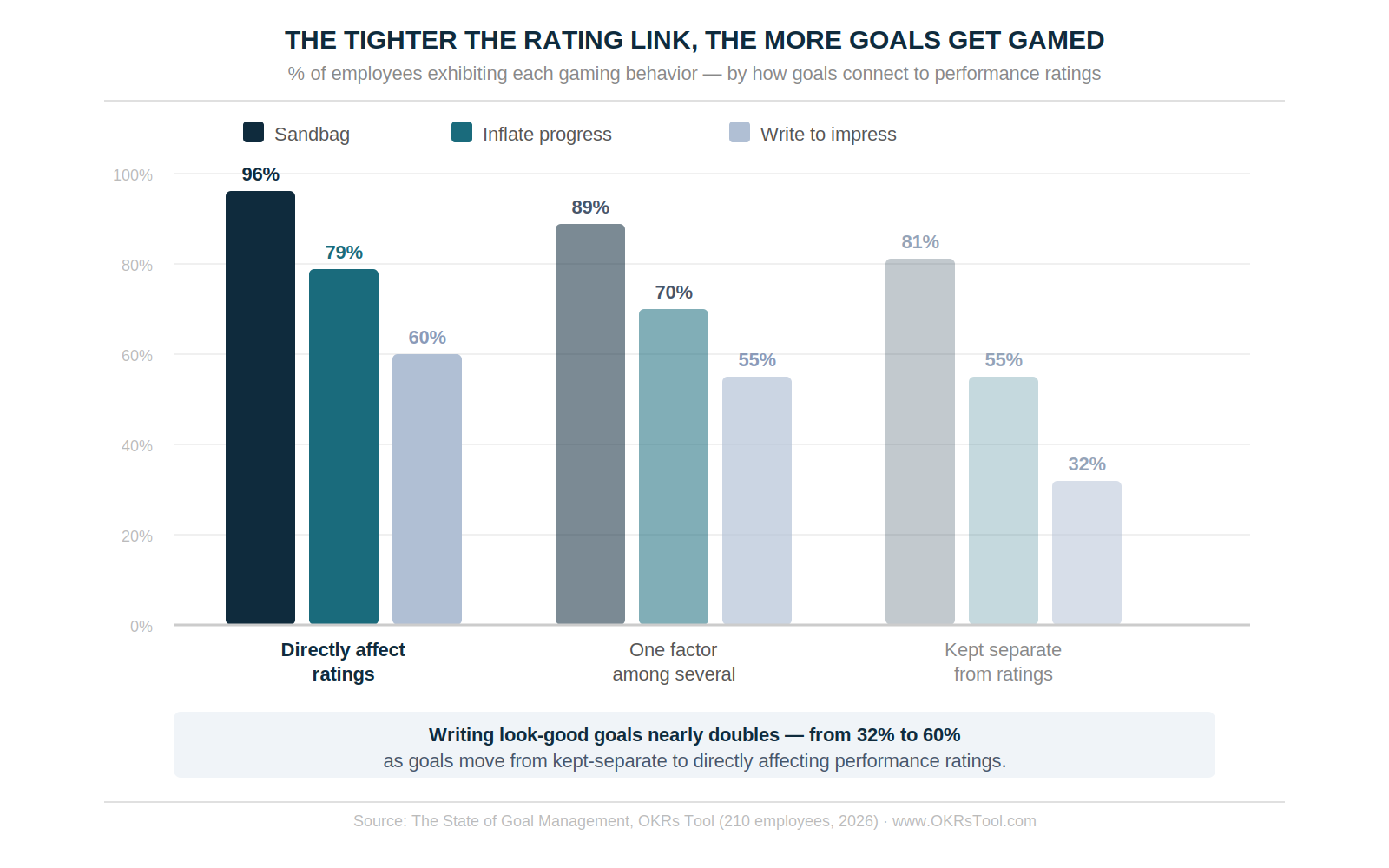
The second reason calibration matters: it makes the data usable for leadership. When OKR dashboards aggregate scores across teams, leadership needs to be able to trust that a 0.65 in one function means roughly the same thing as a 0.65 in another. Without calibration, the aggregate is meaningless — it reflects scoring culture as much as execution quality.
What OKR Calibration Is Not
Calibration is not a process for inflating scores to protect teams from uncomfortable feedback. The goal is consistency, not generosity. A team that genuinely underperformed this cycle should score below 0.5. The calibration session should confirm that score, not revise it upward to protect the manager's relationship with their team.
It's also not a replacement for honest retrospectives. Calibration aligns scoring standards. The retrospective diagnoses what drove or blocked the result. Both are required at cycle end — calibration to produce comparable scores, and the retrospective to produce the learning that makes the next cycle better. Teams that run consistent end-of-cycle retrospectives complete 30–45% more goals the following quarter.
How to Run an OKR Calibration Sync
The calibration sync runs in the final week of the OKR cycle, before scores are finalised and before the cycle's results feed into any performance conversation.
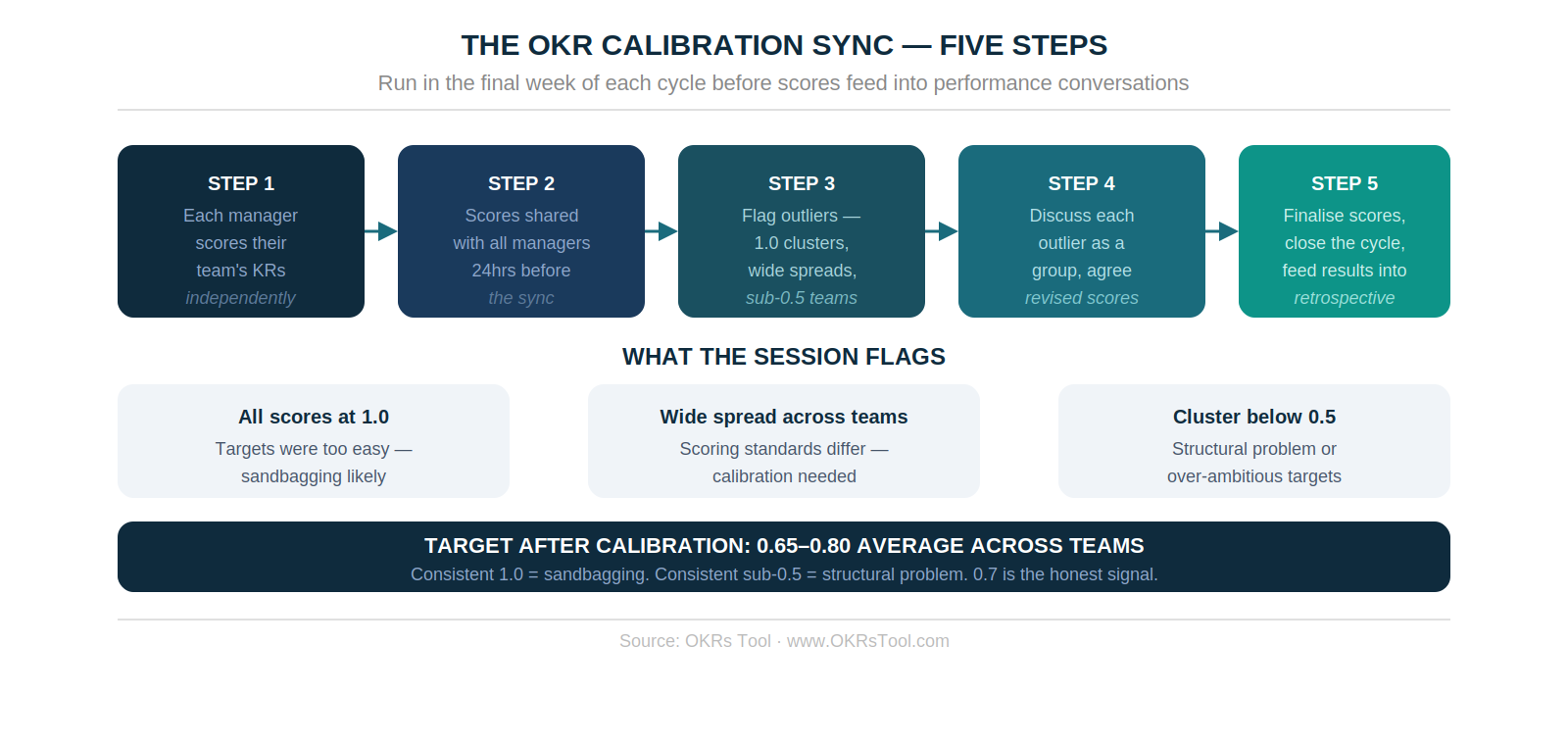
Step 1: Each manager scores their team's Key Results independently. Before the sync, every manager proposes a 0.0–1.0 score for each of their team's Key Results with a one-line rationale. The scoring should happen without reference to what other teams are scoring — the independence is what makes the calibration useful.
Step 2: Scores are shared before the meeting starts. A shared document or OKR dashboard view showing all proposed scores across teams goes out 24 hours before the sync. This lets participants review the data before the discussion, which makes the session more efficient and surfaces obvious outliers before anyone has to raise them in the room.
Step 3: Flag the outliers. The facilitator — typically a Chief of Staff, People Ops lead, or senior operator — identifies three patterns that warrant discussion. Consistently 1.0 scores across a team's Key Results suggest targets may have been set too conservatively. A wide spread between teams on similar work suggests scoring standards differ. Scores clustered below 0.5 across a whole function suggest either targets were genuinely over-ambitious or there was a structural resourcing problem that wasn't flagged mid-cycle.
Step 4: Discuss and align. For each flagged outlier, the manager explains the rationale. The group asks whether the score reflects the genuine difficulty of the target or the scoring standard applied to it. Revised scores are agreed before the session ends — not assigned by the facilitator, but reached through the discussion.
Step 5: Finalise and close. Final scores are recorded in the OKR system and the cycle formally closes. The target range after calibration: a 0.65–0.80 average across teams. Consistent averages at 1.0 indicate sandbagging. Consistent averages below 0.5 indicate a structural problem that needs diagnosis, not calibration.
What to Do When Scores and Ratings Are Connected
When OKR scores feed into performance reviews, calibration becomes even more important — and the risk of sandbagging becomes even higher. The OKR framework deliberately recommends separating goals from compensation precisely because the link corrupts the goal-setting behaviour. When that separation isn't possible, calibration is the compensating mechanism.
In organisations where OKR delivery is one input among several in a performance review, the calibration sync should include both the OKR scores and the performance evidence alongside them — so the group can assess whether a 0.7 in one team reflects the same level of effort and difficulty as a 0.7 in another before either feeds into a rating conversation.
The State of Goal Management found that even among employees who admit all three forms of goal-gaming — sandbagging, watermelon reporting, and writing goals to impress — 43% do so in the same cycle. Calibration makes that pattern visible at the cycle level rather than invisible until the next planning session.
OKR Calibration at Scale
For organisations running OKRs across multiple functions simultaneously, the calibration sync structure scales with a few adjustments. Function-level calibrations run first — within Engineering, within Sales, within Marketing — and a cross-functional calibration follows with one representative from each function. This prevents the cross-functional session from becoming too large to be useful while still ensuring that scoring standards are consistent across the whole organisation.
OKR software that surfaces proposed scores in a shared dashboard before the sync significantly reduces the facilitation overhead — managers can flag concerns before the session rather than discovering outliers in the room. See how OKRs Tool runs the full end-of-cycle sequence — honest scoring, retrospective, and the cascade visibility that makes cross-team calibration possible without a separate spreadsheet.
Calibration Is What Makes Scoring Honest
The 2026 OKR Benchmark Report found teams in their first OKR cycle average 51% completion, rising to 79% by cycle five. That improvement comes from accumulated learning — but learning only accumulates when the scores that close each cycle are honest enough to be diagnostic. A cycle that closes with inflated scores produces a retrospective that diagnoses the wrong problem. Calibration is what keeps the scores honest enough to be useful.
Data: The OKR Intelligence Report 2026 (222 organizations), The State of Goal Management, OKRs Tool (210 full-time employees at growing companies, 2026), The 2026 OKR Benchmark Report (330 organizations).