The performance management process runs in four stages — plan, monitor, review, reward — but nearly every organization skips the second, and skipping it is why the rating at the end can't be proven. When 35% of managers have to reconstruct a person's goals at review time, the process didn't fail at the review; it failed months earlier, when no one kept the record.
Nearly every description of the performance management process makes it sound like it works: set goals, track them, review them, reward them, repeat. On paper the four stages are sound. In practice, one of them almost always gets skipped — and it happens to be the one that holds the other three together.
The stage that breaks is the same one in almost every organization, and the Performance Rating Benchmark Report — an independent survey of 230 People and HR leaders — puts numbers on the damage: goals reconstructed from memory, ratings no one can defend, strong work forgotten by December.
What follows names the stage, shows what its absence costs, and lays out the fix, as one piece of the broader performance management discipline.
The Four Stages of the Performance Management Process
The performance management process is the repeating cycle an organization runs to set expectations, track delivery, evaluate results, and act on them. It has four stages, and they're meant to run as a continuous cycle rather than a once-a-year sequence.
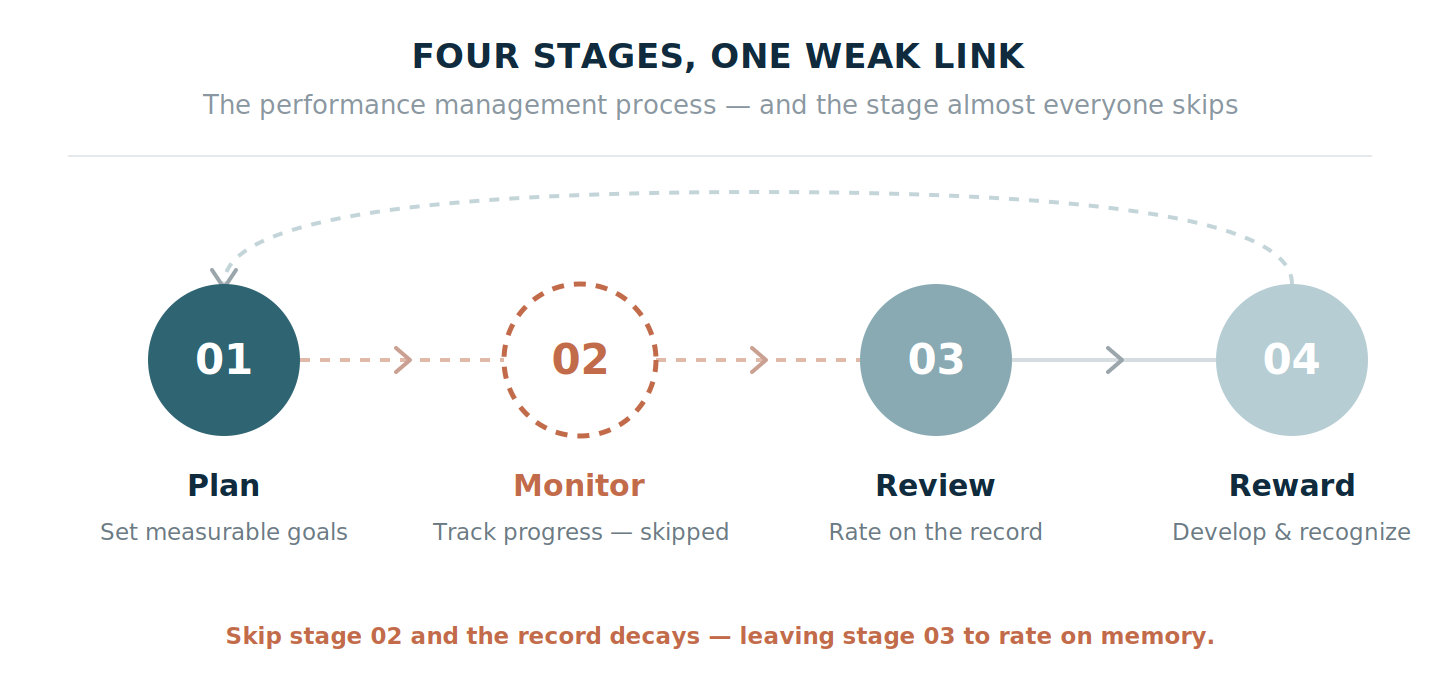
Stage 1 — Plan. Set goals and expectations for the period, ideally as measurable outcomes rather than vague responsibilities. A goal written as "improve retention" gives the later stages nothing to measure; "cut monthly churn from 4% to 2.5%" gives every stage after it something concrete to read. This planning discipline is the heart of older frameworks like management by objectives and modern goal management alike.
Stage 2 — Monitor. Track progress against those goals continuously, through regular check-ins and progress tracking across the period. This is the stage that keeps the record current — and the stage almost everyone skips.
Stage 3 — Review. Evaluate delivery at the end of the period and produce a rating, ideally by scoring against the goals set in Stage 1. When Stage 2 was done well, this stage reads a record. When it wasn't, this stage rebuilds one from memory. Structured performance reviews work best as a summary of that record rather than a search for it.
Stage 4 — Reward. Connect the outcome to development, recognition, or compensation — often through regular 1:1s — then carry the lessons into the next planning round through a retrospective. This closes the loop and turns four stages into a cycle.
Laid out like this, the process looks self-correcting. The problem is that one stage does most of the work of holding it together, and it's the one that gets dropped first.
Where the Process Breaks: Stage 2
The performance management process breaks at monitoring, and the break stays hidden, because a skipped Stage 2 doesn't announce itself until the review.
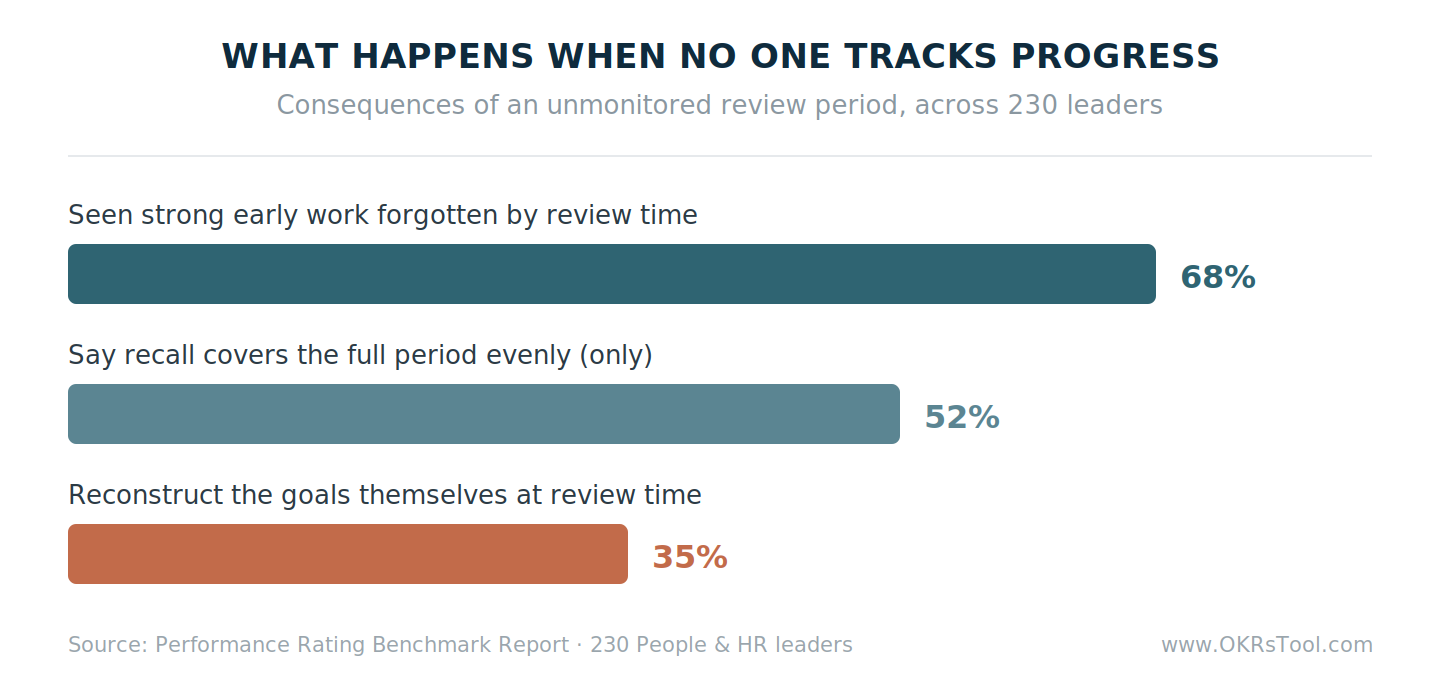
When no one tracks progress through the period, the record of what happened decays in real time. By review, the damage is visible in the data: 68% of leaders have watched a strong performer rated lower because their best work happened early and faded from memory, and only 52% say a manager's recall covers the full review period evenly. For the other half, the rating reflects the last month or two, not the year.
The clearest evidence of the broken stage is what managers do at review time. 35% reconstruct a person's goals at review — rebuilding the goals themselves, not just the progress against them. The plan from Stage 1 was set, then lost, because nothing in Stage 2 kept it alive. A process where a third of managers rebuild the goals from memory before they can even rate against them is a process running on three stages, not four.
This is why the review stage gets blamed for problems it didn't create. The bias, the recency effect, the score that doesn't match the work — these are read as review-stage failures and addressed with better rating forms and evaluation templates. They start upstream, in the stage where the record was supposed to be kept and wasn't.
Why the Rating Can't Be Proven Without Stage 2
The consequence of a skipped monitoring stage shows up as a specific, measurable gap: managers rate on goals they can't access.
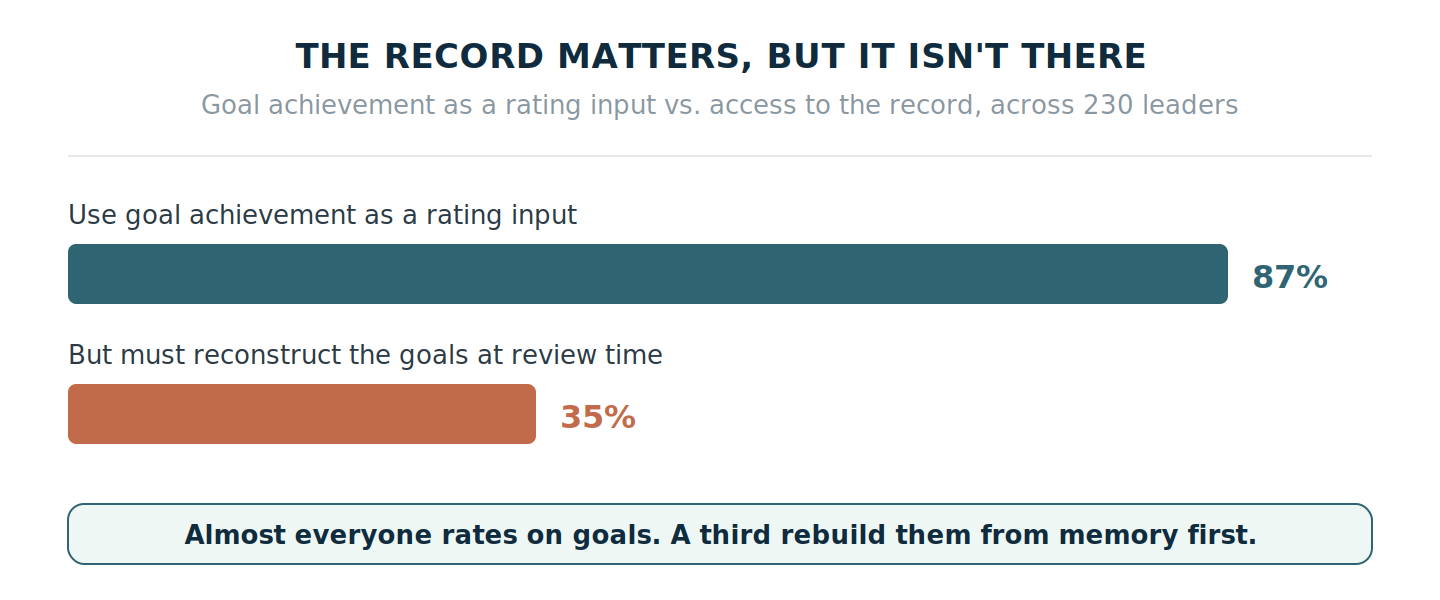
87% of leaders use goal achievement as an input to the rating. That near-universal number is the whole case for monitoring: performance is judged on goals, so the goal record is the most important artifact the process produces. Yet 35% have to rebuild that record at review time, because Stage 2 never captured it. The process asks almost everyone to rate on evidence, then leaves a third of them without it.
A rating built on a reconstructed record can be asserted but not proven. The manager remembers the person did well, assigns a score that feels right, and has nothing to point to when it's questioned. This is the confidence gap the benchmark documents across the whole discipline — 66% of leaders trust their ratings, but only 27% could defend one with goal evidence. The missing evidence is exactly what Stage 2 was supposed to collect.
How to Fix the Process
Fixing the performance management process means fixing Stage 2 specifically — not adding stages, not redesigning the review, but keeping the record current between planning and evaluation. Four moves do it, and each one closes a specific way the monitoring stage falls apart.
1. Set goals that can be tracked.
Monitoring has nothing to monitor if Stage 1 produced soft goals. "Be a strong contributor" or "own onboarding" can't be checked at week four — there's no number that moves, so there's nothing to update, and the stage collapses into a monthly "going okay?" that captures nothing. The fix is to write every goal so that a specific value changes over the period, with a named owner accountable for it.
This is where OKRs earn their place in the process: a key result carries a number by definition — "move activation from 38% to 55%," "close 12 enterprise deals" — so every check-in has a concrete question to answer. A goal you can't measure at an interval is a goal you can't monitor, which means it's a goal you'll be reconstructing at review.
2. Run monitoring on a fixed cadence.
The monitoring stage dies from ambition, not neglect. Teams design an elaborate monthly review with prep docs and slides, run it twice, and abandon it the first time a launch week hits — and once it lapses, the record goes dark for the rest of the cycle. A light rhythm that holds beats a heavy one that breaks: a two-minute check-in where each owner posts a number and a one-line status, every week, keeps the record continuous with almost no overhead.
What the cadence looks like matters far less than whether it's still running in week ten, so design it for the worst week of the quarter, not the calmest. The goal is a record that never has a gap longer than a week, because a gap is exactly where memory takes over from evidence.
3. Make the review read the record, not rebuild it.
When monitoring has run all period, the review stops being an act of recall and becomes an act of reading. The manager opens a goal that has forty weekly data points behind it, sees exactly how the period went, and writes a rating that points to specific moments rather than a general impression.
This is what makes a rating defensible: when someone questions the score, the answer is a record, not "that's how I remember it." The discipline is to resist re-litigating the period in the review meeting itself — if the number is in dispute at review time, that's a signal the monitoring stage wasn't trusted during the period, and the fix is upstream, not in the room.
4. Run the whole process where the goals live.
The deepest reason Stage 2 gets skipped is friction, and friction is structural. When goals sit in one tool and reviews happen in another, keeping the record current means a human remembering to copy progress from one system to the other, every week, for twelve weeks — and that discipline is the first thing to go when the quarter gets busy.
Collapse the two systems into one and the friction disappears: run the process on a single platform where the check-in and the review read from the same live record, and monitoring stops being an extra task someone has to remember. It becomes the ambient state of the system, because the record updates in the same place the work is already tracked.
That single architectural decision — which performance management software exists to make for you — is what separates a process that naturally holds all four stages from one that loses the second the moment attention drifts.
None of the four require more effort at review time. They front-load the work into small, cheap increments across the period, so the expensive, error-prone act of reconstruction at the end simply never has to happen. A process fixed this way costs no more than a broken one; it's the same work, moved earlier, where it's still accurate.
The Process Is Only as Good as Its Weakest Stage
The four stages of the performance management process aren't equally fragile. Planning gets attention because it's the fun part, and reviewing gets attention because it's the high-stakes part. Monitoring gets skipped because it's the invisible part — the work that happens out of sight between the two events everyone remembers.
That invisibility is exactly why it fails, and why fixing it changes everything downstream. A process that monitors produces a review that reads a record; a process that doesn't produces a review that guesses at one. Whether a rating can be defended or only asserted gets decided months before the review makes it visible — in whether anyone kept the record between planning and judgment.
Organizations that treat monitoring as the load-bearing stage, rather than the skippable one, are the ones whose ratings hold up. The plan and the review get all the ceremony, but the record kept in between is what makes the whole process worth running.
Data: The Performance Rating Benchmark Report, an independent survey of 230 People and HR leaders at technology companies of 50–200 employees. No OKRs Tool customers were included.