
The State of Goal Management found 92% of employees admit to at least one form of goal-gaming — sandbagging targets, reporting a goal as healthier than it is, or writing goals to look good rather than to change anything. 43% do all three in the same cycle. That is not a fringe integrity problem. It is the default behaviour of people working inside systems that make gaming the rational choice.
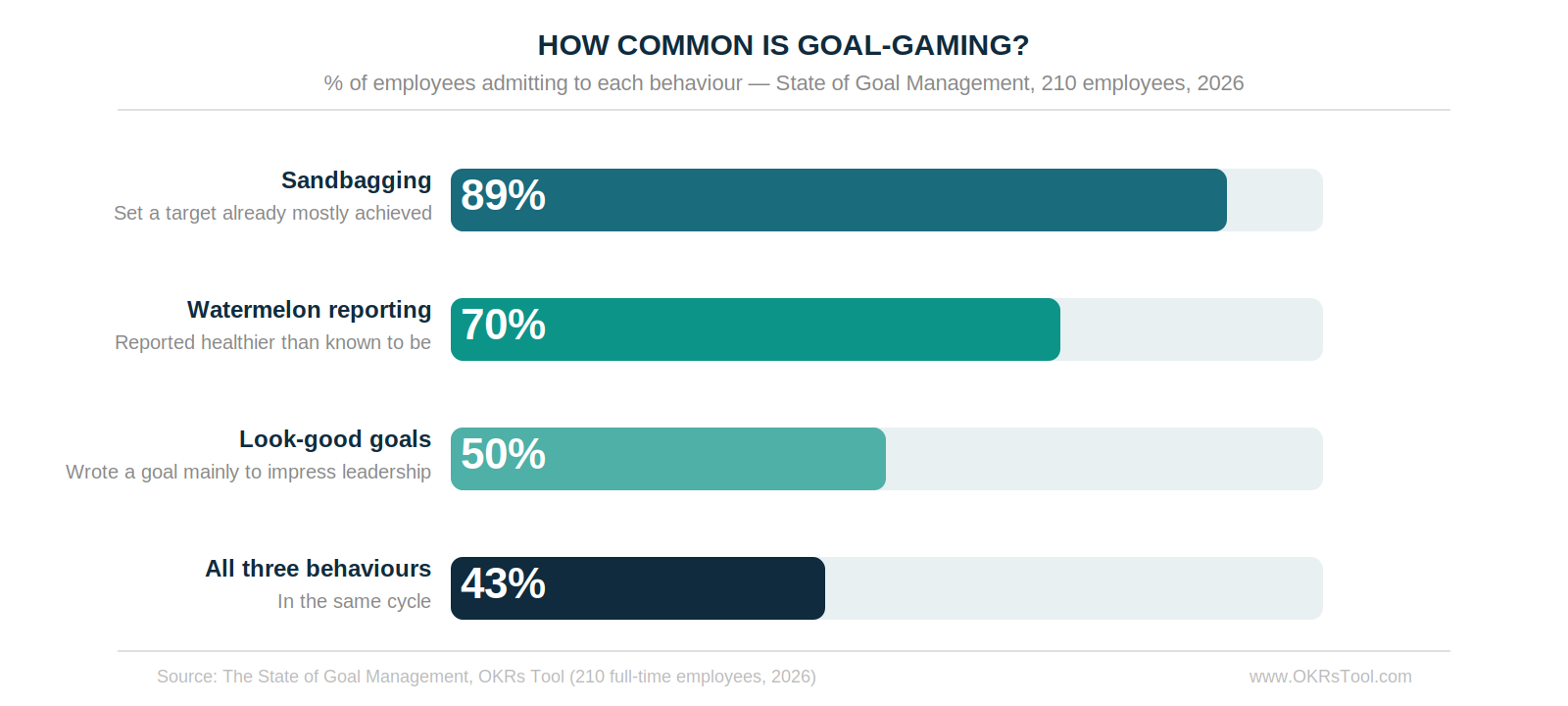
The State of Goal Management asked 210 full-time employees whether they had ever engaged in three specific goal behaviours. 89% had sandbagged — set a target they had already mostly achieved. 70% had reported a goal as healthier than they knew it to be. 50% had written a goal mainly to impress leadership rather than to change anything meaningful. Only 8% said they had never done any of it.
These aren't people with integrity problems. They're people making rational calculations inside systems that punish honesty and reward managed appearances. When setting an ambitious target risks a miss that damages a performance rating, the rational move is to set a target that's already half-achieved. When reporting a struggling goal risks a difficult conversation with leadership, the rational move is to report it as amber rather than red. When goal-setting is observed by the people who write your review, the rational move is to write goals they'll find impressive rather than goals that will genuinely be hard to hit.
Fix the incentive structure and the behaviour changes. The State of Goal Management provides the clearest evidence of this: 96% of employees sandbag when goals directly affect performance ratings — versus 81% when goals are kept separate from ratings. The same people, the same goals, the same organisation — a 15-point difference in gaming behaviour driven entirely by one structural variable.
The Three Gaming Behaviours
Sandbagging: Setting Targets You've Already Mostly Hit
Sandbagging is the practice of setting a Key Result target low enough that hitting it requires minimal effort. The goal looks ambitious at the planning session. By week four it's already at 80%. By cycle end it's at 1.0. Leadership sees a team hitting all its goals. The team has produced a convincing performance of progress without being genuinely stretched.
89% of employees admit to sandbagging. The behaviour is near-universal because the incentive to do it is structural rather than individual. When a 0.7 on an ambitious target and a 1.0 on a sandbagged target produce different performance outcomes, the rational move is to set the sandbagged target. When OKR scores directly affect performance ratings, 96% sandbag — versus 81% when scores are kept separate. The incentive difference of 15 percentage points is the structural variable that produces the behaviour.
The fix: Decouple OKR scoring from performance ratings. Use OKR delivery as context in performance conversations — one input among several — rather than as the determining measure. And run end-of-cycle calibration that makes consistently 1.0 scores visible across teams — so sandbagged targets become apparent to the group rather than invisible to anyone above the team level.
Watermelon Reporting: Green Outside, Red Inside
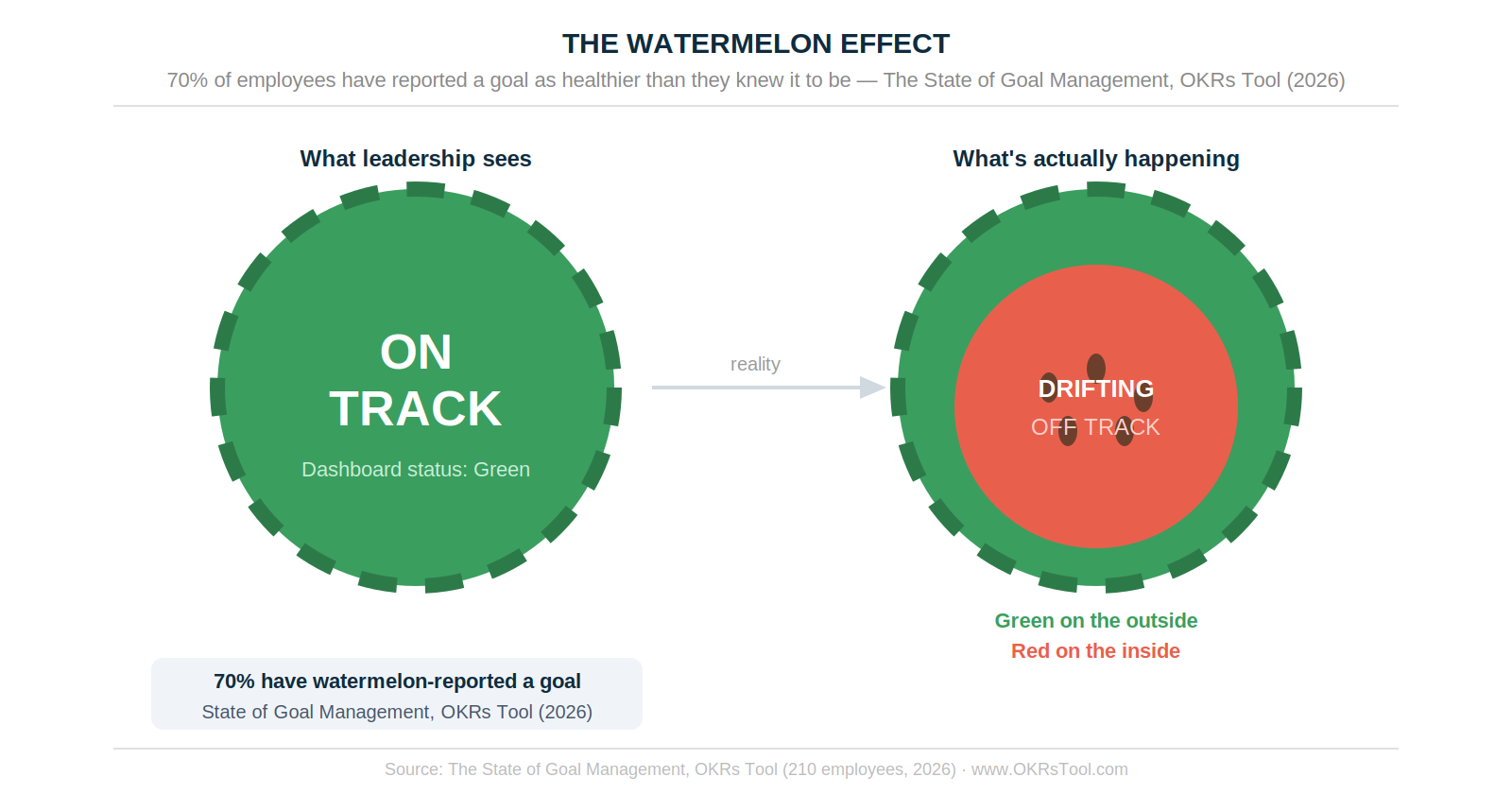
Watermelon reporting is the practice of reporting a goal as healthier than it actually is — green on the outside while the internal reality is red. It's the most visible form of goal-gaming because it operates at the check-in level: the goal looks on track in the dashboard while the person responsible knows it isn't.
70% of employees have reported a goal as healthier than they knew it to be. The mechanism is the same as sandbagging: when honest reporting triggers scrutiny and managed reporting triggers no friction, managed reporting is the rational default. A mid-cycle goal that's struggling requires explanation. The same goal reported as amber requires nothing. The explanation cost — the uncomfortable conversation, the visible miss, the implicit question about competence — produces a consistent incentive to delay honest disclosure until the gap is undeniable.
The fix: Trajectory-based at-risk detection that surfaces drifting goals from check-in data rather than from owner-reported status. The 2026 OKR Benchmark Report found 7% of off-track Key Results are simply abandoned mid-cycle — never flagged, never closed, just silently dropped. Automated detection from progress velocity removes the dependency on the owner choosing to disclose the problem.
Show ImageOKRs Tool automated weekly check-in — progress updated in five minutes, at-risk flagging runs from trajectory data rather than owner-reported status. Watermelon reporting becomes visible before the quarter is lost.
Look-Good Goals: Writing for Approval Rather Than Change
Look-good goals are objectives and Key Results written to impress the people reviewing them rather than to describe genuine business change. They're specific enough to pass the format test, ambitious enough to sound credible, and structured around outcomes leadership has already signalled they value — rather than around the actual work that would move the business.
50% of employees have written a goal mainly to look good. The behaviour is a direct product of goal-setting being observed. When the CEO reviews team OKRs before the cycle starts, the planning session becomes a performance rather than a diagnosis. Teams write toward approval rather than toward honesty about what's actually hard and what's actually achievable this quarter.
Our platform analysis of 7,857 Key Results found 52% were tasks or KPIs in disguise — the output of exactly this dynamic. "Launch new onboarding flow" reads as ambitious in a planning session. It measures nothing. The look-good goal passes review because it sounds like the right kind of work. The honest goal — "increase Day 7 activation from 34% to 52%" — is harder to write, harder to defend if missed, and harder to hit. When the incentive structure rewards the first kind, teams write the first kind.
The fix: Structured Key Result review before the cycle starts — not a leadership approval session, but a peer review against a clear outcome standard. "Can this be tracked every week forever without being complete?" If yes, it's a KPI, not a Key Result. AI-assisted OKR writing that generates outcome-based drafts reduces the blank-page pressure that makes look-good goals the path of least resistance.
The Ratings Trap
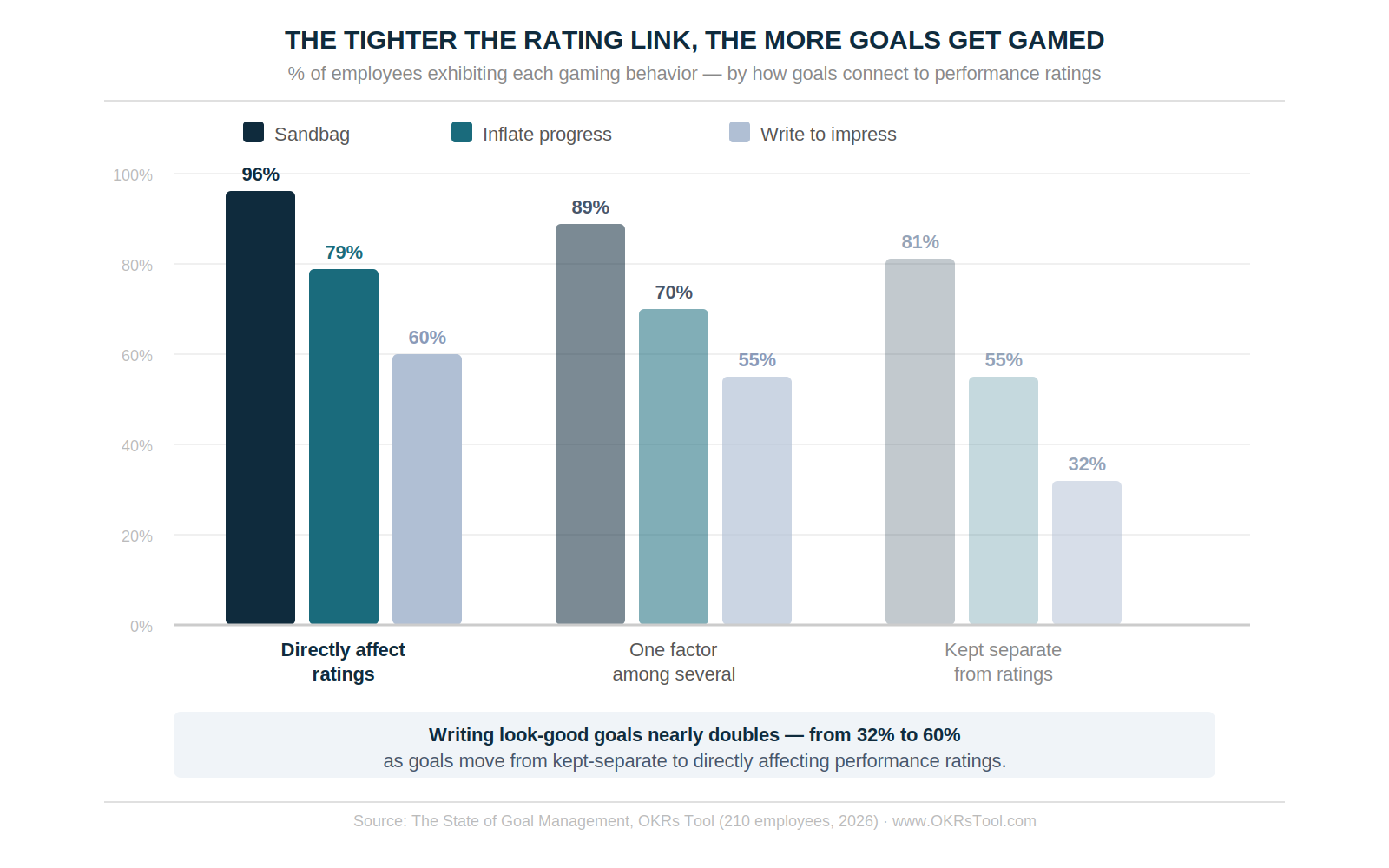
The mechanism most organisations reach for to make goals matter — tying OKR scores to performance ratings — is the same mechanism that quietly makes goals dishonest. When the score on a Key Result directly determines a performance rating, the three gaming behaviours above converge: targets get sandbagged so the score is achievable, progress gets managed so the interim score looks good, and goal-writing shifts toward what the rater will find credible rather than what the team will find difficult.
The State of Goal Management found this isn't a small effect. The 15-point difference in sandbagging rates between goals linked to ratings and goals kept separate represents millions of hours of artificially capped ambition across organisations that have inadvertently taught their teams to optimise for the score rather than the outcome. The irony is that the organisations most focused on making OKRs count — by linking them to compensation and ratings — are also the organisations most actively creating the conditions for gaming.
The structural fix is separating the OKR score from the performance rating while keeping both visible. OKR delivery becomes one input in a performance conversation — alongside 360 feedback, manager assessment, and self-evaluation — rather than the determining measure. This removes the principal incentive to game the score while preserving the accountability that makes OKR cycles meaningful.
The Load-Bearing Test
Goal-gaming, in all three forms, produces the same end state: a goal system that is maintained as a reporting exercise rather than used as a steering mechanism. The State of Goal Management measured this directly: 34% of employees say nothing about how they work would change if their goal tracker were deleted tomorrow. Goals that have been sandbagged, managed, and written to impress are goals that influence nothing — because the work was never connected to them in a meaningful way.
The organisations where goal-gaming is least prevalent share three structural properties: OKR scores are separated from performance ratings, weekly check-ins produce visible trajectory data that makes watermelon reporting immediately apparent, and Key Result quality is reviewed against an outcome standard before the cycle starts. Each property removes the incentive for one of the three gaming behaviours. Together, they make honest progress structurally easier than managed appearances — which is the only durable fix.
See how OKRs Tool implements named ownership, automated weekly check-ins, and trajectory-based at-risk detection — the structural properties that make goal-gaming the irrational choice — free for up to 5 users.
Data: The State of Goal Management, OKRs Tool (210 full-time employees at growing companies, 2026), The 2026 OKR Benchmark Report (200 organizations), OKRs Tool platform data (7,857 Key Results analyzed).