Advice about OKRs is written as if every company runs them the same way. New research says they don't. We compared 200+ startups against 420 companies of 50–200 people — the stage where OKRs stop being a founder's whiteboard habit and become a system more than one person depends on. Nearly everything improves as a company grows; a couple of habits get worse; and one reverses completely. Here are the five findings that matter most.
The headline across both studies is that growing up mostly makes OKRs better — more aligned, better tooled, more trusted. The danger in scaling comes from two habits that slip while everything else improves, plus the one piece of startup advice that stops being true the moment you add teams.
This post pulls out the five findings that change what a scaling ops lead should actually do, drawn from the full Growing Pains of OKRs report. It sits alongside the wider practice of goal management, and the goal setting habits underneath it, read through the lens of what scale changes.
1. Alignment Is the Biggest Change
At startup size, only a third of teams link their OKRs to company goals. By 50–200 people, three-quarters do.
This is the single largest shift in the study, a 41-point jump from 35% to 76%. Scale forces the hierarchy startups are happy to skip, because once work spans many teams, goals that don't connect to the top become visible misalignment fast.
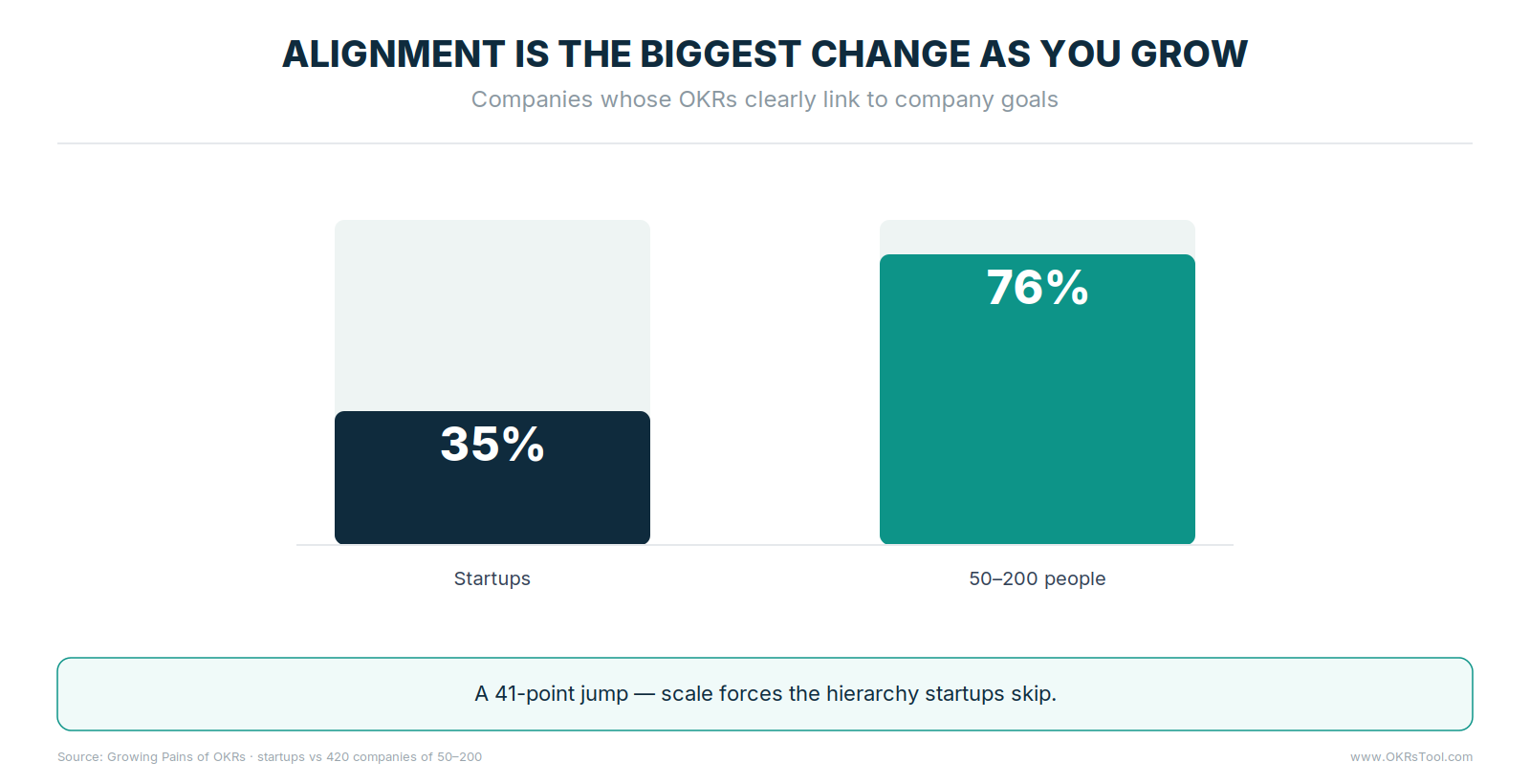
The practical read: laddering goals is the habit startups most regret skipping, and it's far cheaper to build the alignment in while the hierarchy is still trivial than to retrofit it after misalignment has cost a quarter.
2. Ownership Decides — and Matters More at Scale
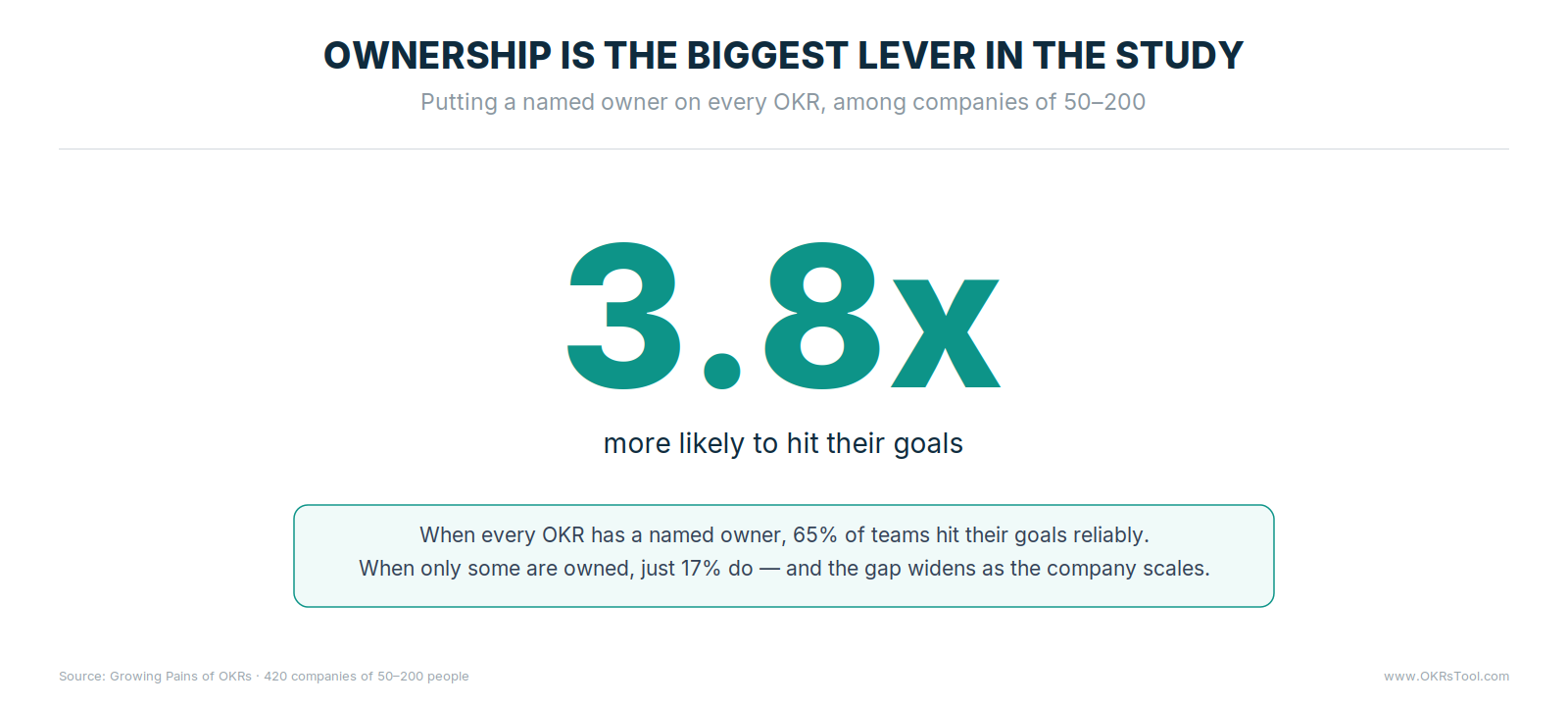
One habit separates the teams that hit goals from the teams that miss, in both studies: a single clear owner on every objective and key result. The gap doesn't shrink as a company grows — it widens.
Among companies of 50–200, teams where every OKR has a named owner hit their goals very consistently 65% of the time, against 17% where only some are owned. That 48-point spread is the widest finding in the whole report. The move is to name one clear owner per OKR from day one, long before scale turns shared accountability into nobody's accountability.
3. The Spreadsheet Era Ends
Startups mostly wing it — docs, sheets, the occasional project tool. By 50–200 people, the majority have moved to purpose-built OKR software: 22% of startups use a dedicated tool, against 59% at scale.
The switch almost always happens reactively. Manual tracking works fine until there are more teams than one person can chase, and then compiling the picture before every leadership meeting becomes someone's second job — the point a spreadsheet breaks.
That's the expensive moment to migrate — mid-quarter, under pressure — which is why moving while the team is still small, when few enough teams make the switch painless, is the cheaper path off the spreadsheet.
4. Two Habits Get Worse — Focus and Abandonment
Nearly everything improves with size, with two exceptions, and both are about losing the plot across more teams.
The share of teams running three or more OKRs per quarter climbs from 35% to 52% as companies grow — more teams, more stakeholders, more "can we just add one more," and focus thins exactly as coordination gets harder.
Setting the right number of OKRs survivable at fifteen people becomes, at a hundred and fifty, how a quarter ends with everything half-done, a classic failure of OKR management that the why OKRs fail patterns name.
The second: teams that have abandoned OKRs somewhere climbs from 28% to 50% — more teams simply mean more places for a goal to slip through unnoticed. The discipline that has to grow fastest as you scale is the discipline of saying no, and a weekly check-in is what surfaces the drift before a goal is abandoned outright.
5. The One That Reverses: Time Flips From Enemy to Ally
Most findings shift with size. One completely flips direction.
In the startup study, spending less time won — under thirty minutes a week beat pouring hours in, because at startup speed the enemy was process for its own sake. At 50–200 people it reverses: the teams spending the most time hit their goals most consistently, with 68% of those investing two or more hours a week landing their goals very reliably.
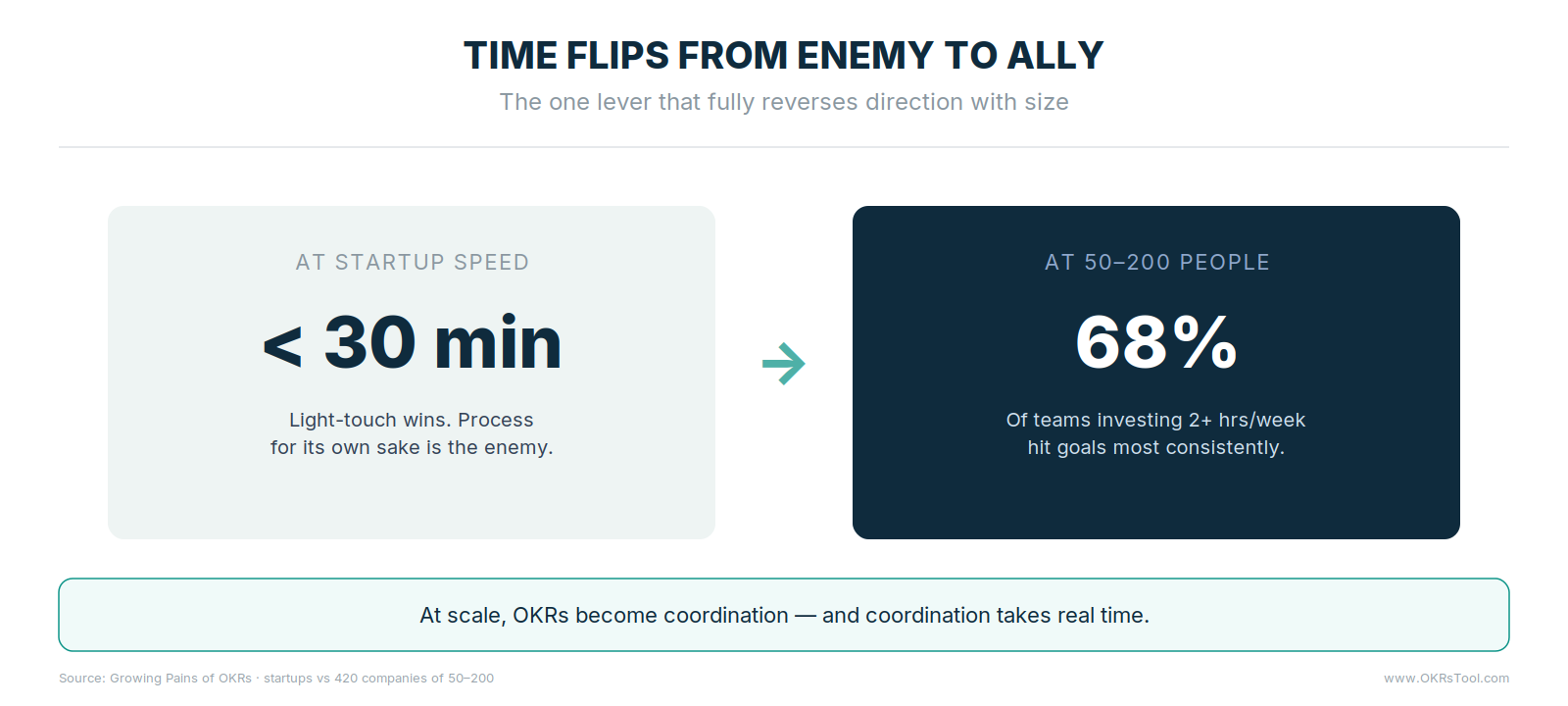
OKRs have become the way to coordinate across many teams, and coordination takes real time. The startup instinct to stay light is exactly the instinct that starts to cost you once the cadence has to hold a whole company together.
What to Do With This, by Size
The same findings read two ways depending which side of the transition you're on. Under 50 people, keep your speed — it's a real advantage — but fix the cheap things early: ladder your goals, name one owner per OKR, and start the retrospective habit while the team is small enough to build it.
At 50–200, invest the time OKRs now demand, move to real tooling before manual chasing becomes a second job, cap the goals per team before focus thins, and plan the founder-to-operator handoff and OKR adoption on purpose rather than discovering it when the founder gets pulled into a raise.
Every item in the "at scale" column is cheaper to do before it's needed than to retrofit once the company has grown into the problem. The full report lays out all ten findings, the read-by-size guide, and a five-step action plan for preparing before you scale.
Data: the Growing Pains of OKRs report — two independent studies, 200+ early-stage startups and 420 companies of 50–200 employees (technology sector). No OKRs Tool customers were included in either sample.