
Most teams treat the OKR cycle as a kickoff and a review with a quiet gap between. The teams that compound from 51% to 79% completion run all 13 weeks as a structured sequence — planning, weekly check-ins, a mid-cycle decision point, and an honest retrospective.
An OKR cycle is the full quarterly loop a team runs to set, track, and close its goals — typically 13 weeks from planning workshop to retrospective. The planning session and the end-of-quarter review are the two moments most teams remember, but the cycle is everything in between, and that's where completion is decided.
The structure matters because the alternative is drift. The 2026 OKR Benchmark Report found that teams compound from 51% completion in their first cycles to 79% by cycle five, and that climb comes entirely from running the cycle as a repeatable rhythm rather than a one-off event. This guide walks through the 13-week sequence week by week — what happens at each stage, who owns it, and the benchmark data behind each step.
What an OKR Cycle Is
An OKR cycle is one complete pass through setting, running, and closing a set of Objectives and Key Results. It has a defined start, a fixed length, and a defined end — which is what separates it from a goal document that gets written once and quietly abandoned.
The quarterly version runs 13 weeks because that length holds a useful balance. Analysis of more than 5,000 cycles found that quarterly cadences average around 46% progress against 37% for monthly and 34% for six-month cycles. A quarter is long enough for outcomes to compound and short enough to surface problems while there's still time to act, which is why the right cycle length is the foundation the rest of the rhythm sits on.
The 13-Week Sequence
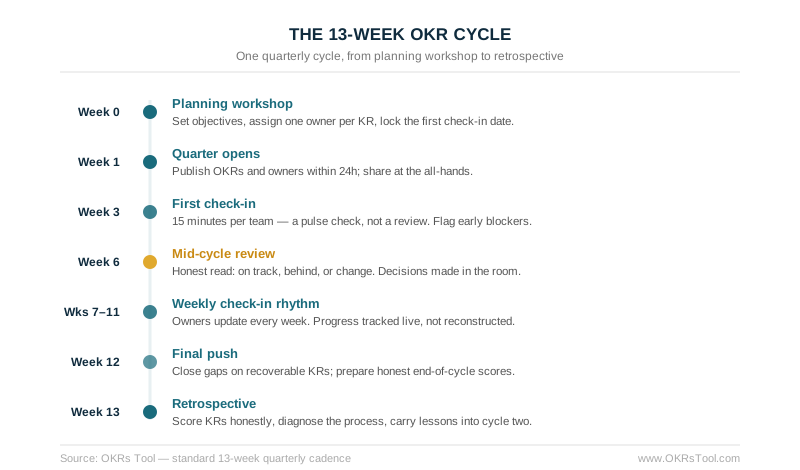
The cycle breaks into four phases — planning, early signal, execution, and close — across thirteen weeks. Each has a distinct job, and skipping any one of them is where most cycles lose their completion rate.
Week 0: The Planning Workshop
The cycle begins before the quarter does. In a single half-day workshop, leadership finalizes company-level Objectives and teams set their own goals against them — every Key Result leaving the room with one named owner and a measurable target.
Speed at this stage predicts the whole cycle. Teams that complete planning and launch within a week see up to 50% higher completion than those taking three to four weeks, because a slow start eats the quarter before the work begins. Getting the OKR planning session right means leaving with outcome-based Key Results, not a list of activities, and with the cascade from company to team already connected.
Week 1: The Quarter Opens
Within 24 hours of the workshop, the OKRs and their owners are published and shared at the all-hands. The point is visibility — every person can see what the quarter is for and where their work connects before any real execution starts.
This is also where the alignment gets pressure-tested. The OKR Intelligence Report 2026 found only 16% of organizations complete the full cascade within the same week, and for the rest the quarter is already running before everyone knows their contribution. Publishing fast closes that gap.
Weeks 3–11: The Execution Rhythm
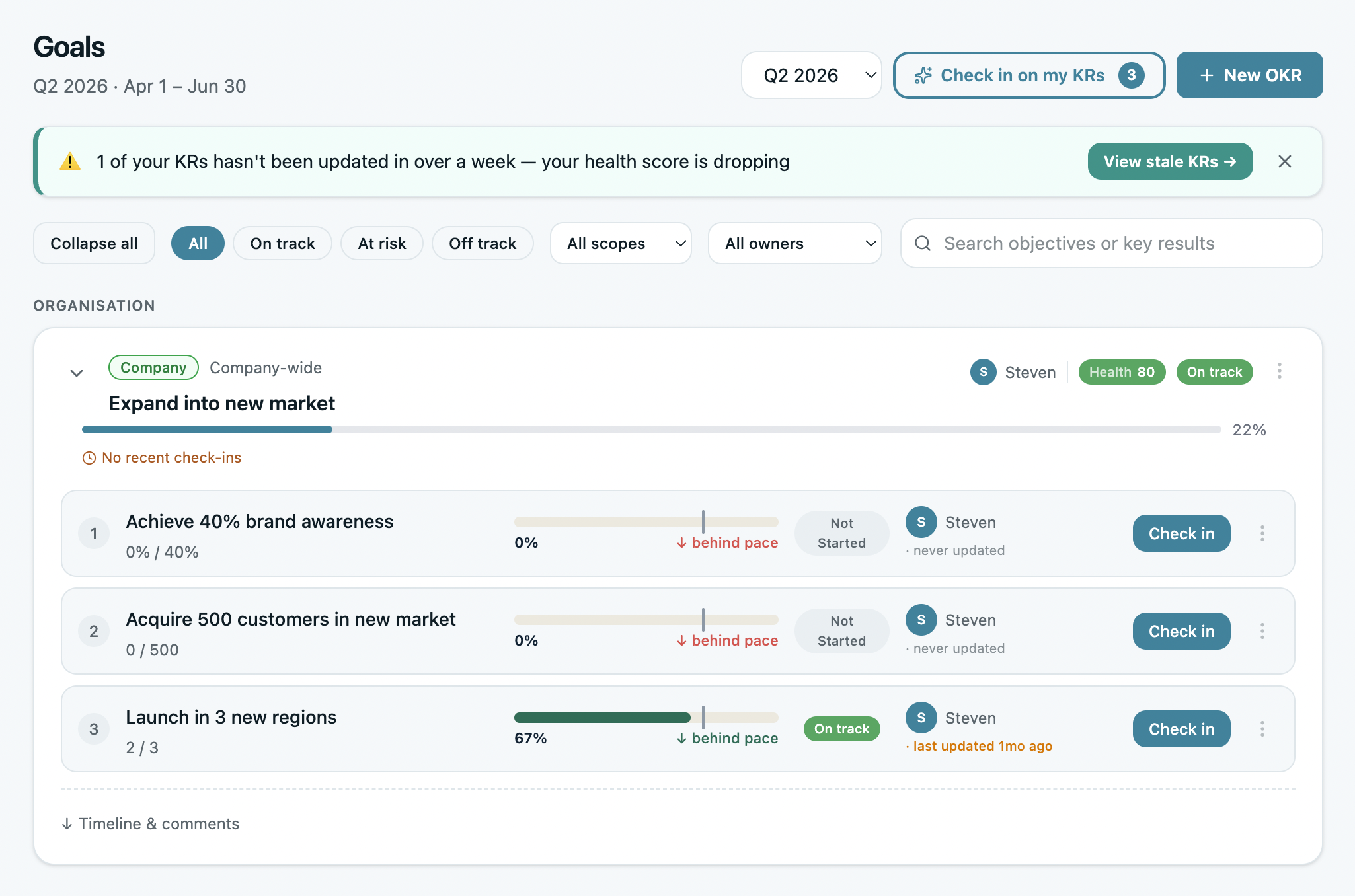
The middle of the cycle is where completion is actually won, and it runs on one habit: the weekly check-in. A first pulse check lands in week three, then the rhythm holds every week — each Key Result owner updating progress, flagging blockers, and keeping the goal present in the work.
The data behind this is the strongest in the benchmark. Teams that check in weekly complete 43% more OKRs than those reviewing monthly or ad hoc, because a Key Result drifting in week four is recoverable while the same drift found in week eleven isn't. A structured weekly check-in turns the cycle into real-time steering, and consistent goal tracking is what keeps a drifting Key Result from quietly becoming an abandoned one.
Week 6: The Mid-Cycle Review
Halfway through the quarter, the cycle needs a real decision point, not just another status update. Every Key Result that's clearly behind should leave the mid-cycle review with one of three outcomes: a revised target, an escalated blocker, or a formal close.
The discipline here is making the call in the room rather than deferring it to the next meeting. Goals that stay at-risk with no explicit decision become the silently abandoned Key Results that drag a cycle's completion down — which is why spotting an off-track OKR at week six, while there's still time to recover it, matters more than any end-of-cycle analysis.
Week 13: The Retrospective
The cycle closes with honest scoring and a structured look back. Each Key Result gets a 0.0–1.0 score reflecting genuine progress, each miss gets a root cause, and the team commits two or three specific changes for the next cycle.
This is the highest-leverage hour in the entire cycle. Teams that run structured end-of-cycle reviews complete 30–45% more OKRs the following quarter, and that compounding is the whole reason completion climbs across cycles.

The most common way this phase fails is compression — the retrospective gets folded into next quarter's planning and becomes a transition rather than a real ending. A standalone retrospective in the final week, before any new planning begins, is what keeps the learning intact.
Why the Cycle Compounds
The cycle isn't valuable as a single 13-week pass — it's valuable because each pass makes the next one better. By the third or fourth cycle, a team has tightened its Key Result quality, built the weekly habit, and learned which targets are genuinely ambitious versus sandbagged.
That accumulation is the maturity curve, and it only accumulates when each cycle has a real ending. A cycle that closes with inflated scores produces a retrospective that diagnoses the wrong problem, so the same goals underperform for a third quarter running. Honest closes are what turn four cycles a year into four compounding improvements.
What OKR Software Should Run
A spreadsheet can hold a quarter's OKRs, but it can't run the cycle — it won't fire the weekly check-in, won't surface a drifting Key Result at week six, and won't assemble the scoring data the retrospective needs. The rhythm ends up depending on someone remembering to chase it, and discipline-dependent rhythms collapse under quarterly pressure.
Purpose-built OKR software runs the cycle as a connected sequence: automated weekly check-ins, at-risk flagging before the mid-cycle review, and scoring data ready when the retrospective starts. See how the OKRs Tool platform runs the full cycle from planning to close, or how it sets up in an afternoon without a consultant.
The Cycle Is the Unit of Improvement
A single OKR cycle delivers a quarter's goals. A sequence of well-run cycles delivers a team that gets measurably better at execution every three months — which is the actual return on running OKRs at all.
Set the cycle up in week zero, hold the weekly rhythm through week eleven, make real decisions at week six, and close honestly at week thirteen. Run that loop four times a year and the compounding does the rest.
Data: The 2026 OKR Benchmark Report (330 organizations), OKR Intelligence Report 2026 (222 organizations), OKRs Tool platform data (5,000+ OKR cycles analyzed).