
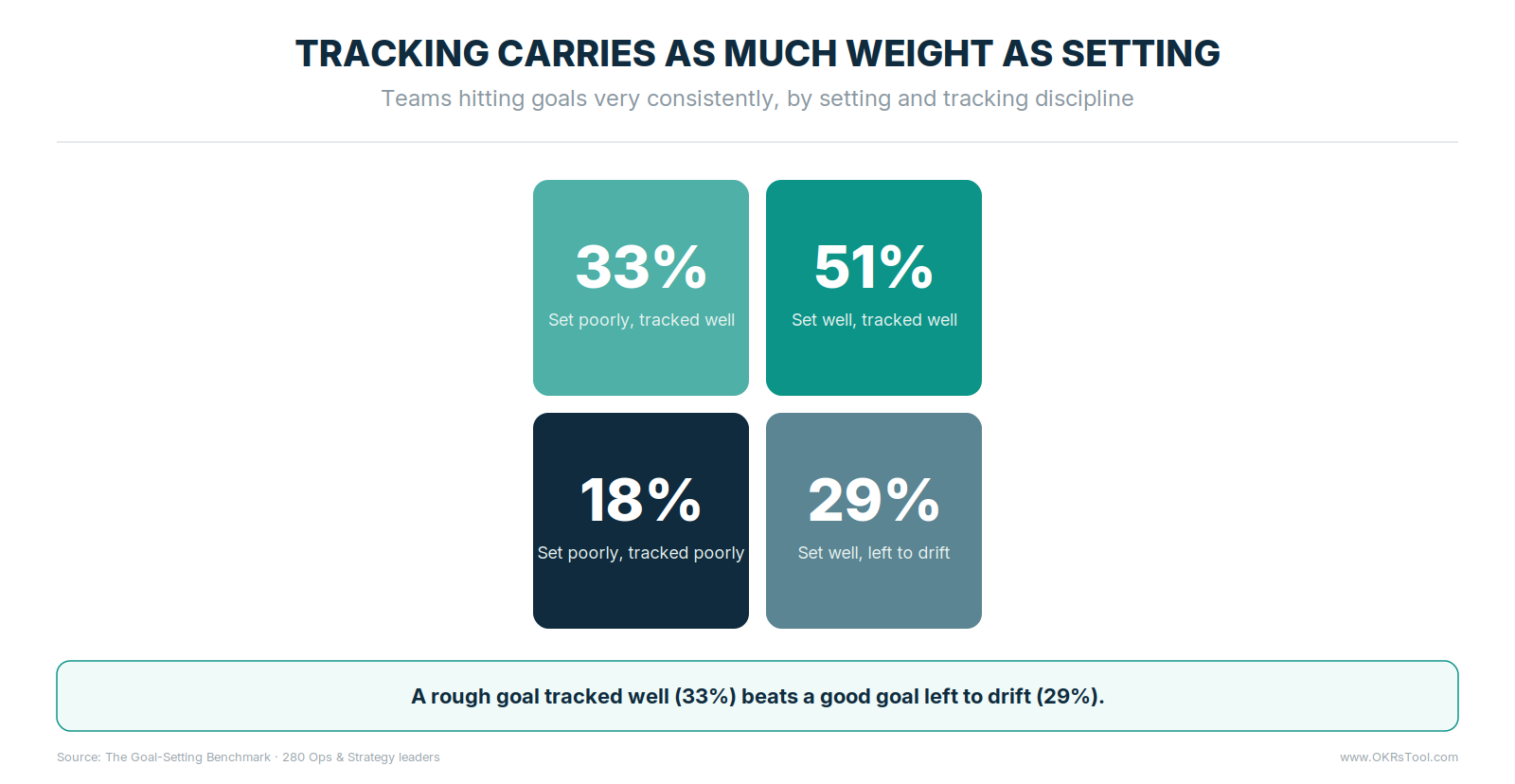
Teams that set goals well and track them well hit their targets 51% of the time. Teams weak at both manage just 18% — new research on 280 leaders. Setting is only one of four components most teams treat as the whole job. Goal management is the full system — setting, alignment, tracking, and closing run as one cycle — and the three components teams skip are the ones that actually move the number.
A goal management system has four components that work together. Setting defines what outcomes matter this quarter. Alignment connects those outcomes from company level to team level so every person's work points at the same priorities. Tracking keeps progress visible between planning sessions. Closing — scoring, retrospective, and explicit commitments for next cycle — is what makes the system compound over time.
Nearly every organization has the first component and skips the others. Goals get set at a planning session and reviewed at a quarterly business review, with nothing structured in between. The 2026 OKR Benchmark Report found 65% of teams admit their goals aren't linked to company strategy. That gap opens when the alignment component of the system is never built, even where the strategy itself is perfectly clear.
And the Goal-Setting Benchmark, an independent survey of 280 operations and strategy leaders, puts the sharpest number on it: the four habits underneath a goal — reviewing weekly, tracking continuously, keeping goals visible, and using real software — predict success far more than which framework a team writes them in. Teams with three or four of those habits hit their goals 2.9x more consistently than teams with zero or one.
Why Most Goal Management Systems Fail
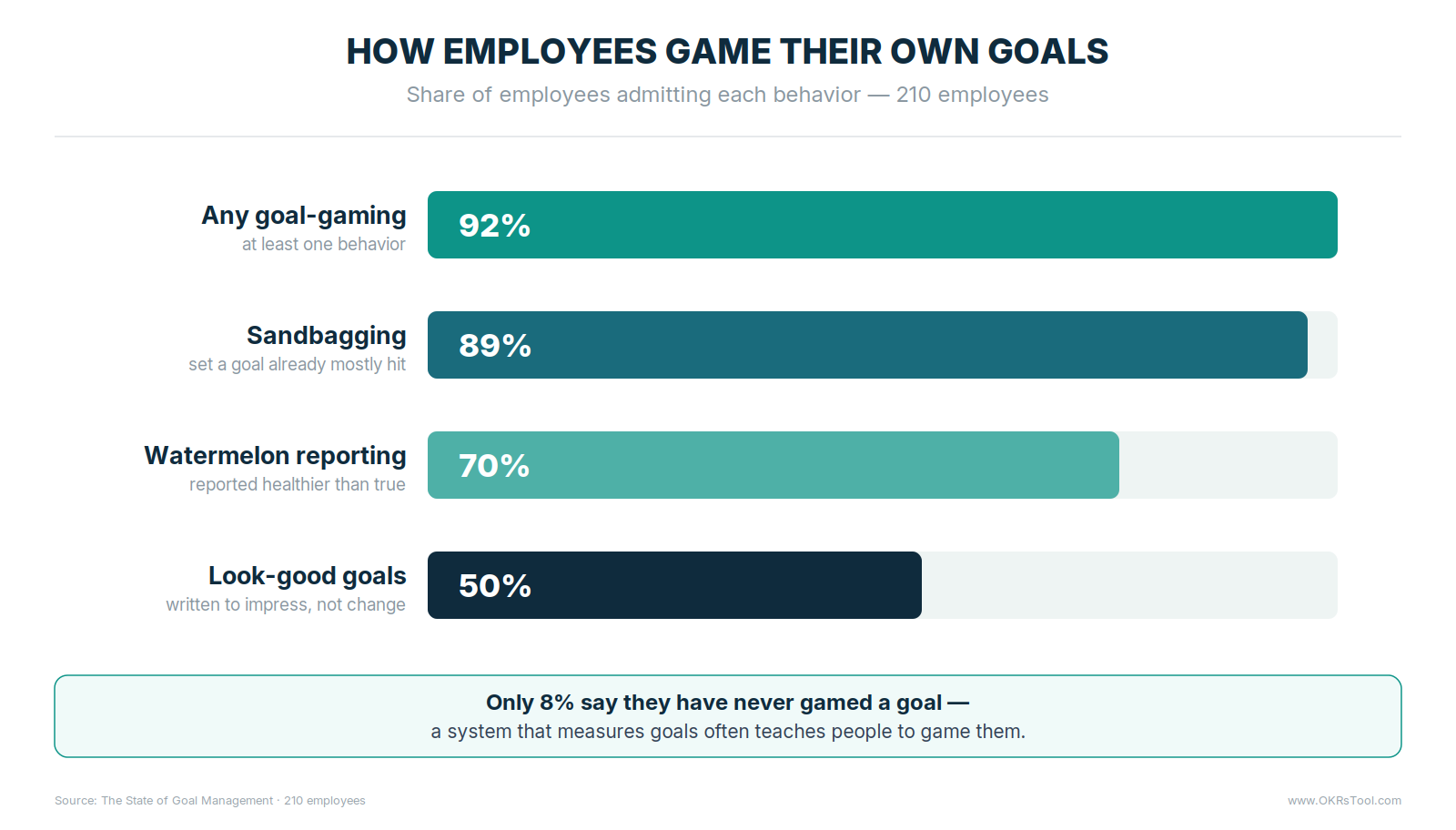
The State of Goal Management asked employees what they actually do with their goals when nobody is grading the answer. The findings describe a system that has lost its load-bearing function.
92% of employees admit to at least one form of goal-gaming — sandbagging targets they've already mostly achieved, reporting a goal as healthier than they know it to be (watermelon reporting), or writing a goal mainly to impress leadership rather than to change anything. Only 8% say they've never done any of it.
34% say nothing about how they work would change if their goal tracker were deleted tomorrow. These goals exist. They get updated. They influence nothing — a non-load-bearing goal system that has all the visible features of goal management without any of the behavioral function.
The pattern gets worse, not better, the more seriously an organization treats its goals. When goals directly affect performance ratings, 96% of employees sandbag, against 81% when goals are kept separate from ratings.
The mechanism most organizations use to make goals count is the same one that teaches people to game them — which is why goal management and performance rating are best handled as connected but distinct systems.
The Four Components
1. Setting
Strong goal management starts with objectives that describe outcomes rather than activities, and Key Results that measure whether those outcomes were achieved. The distinction carries real weight: across 20,952 Key Results from the OKRs Tool platform, 52% were tasks or KPIs in disguise — measuring what was done rather than what changed — with outcome-based verbs in only 34%.
The number of goals matters too. High-performing teams keep to two to four Key Results per Objective and one to two OKRs per quarter. Push past five Key Results and outcomes get worse, because focus dilutes faster than accountability can compensate for.
The newest research sharpens where setting sits in the system. The Goal-Setting Benchmark split teams by how well they set goals and how well they track them: teams strong at both hit their goals very consistently 51% of the time, but a roughly set goal that's tracked closely (33%) still beats a well-set goal left to drift (29%). Setting is necessary and not sufficient — it's the component every team has, and the one that returns the least on its own.
2. Alignment
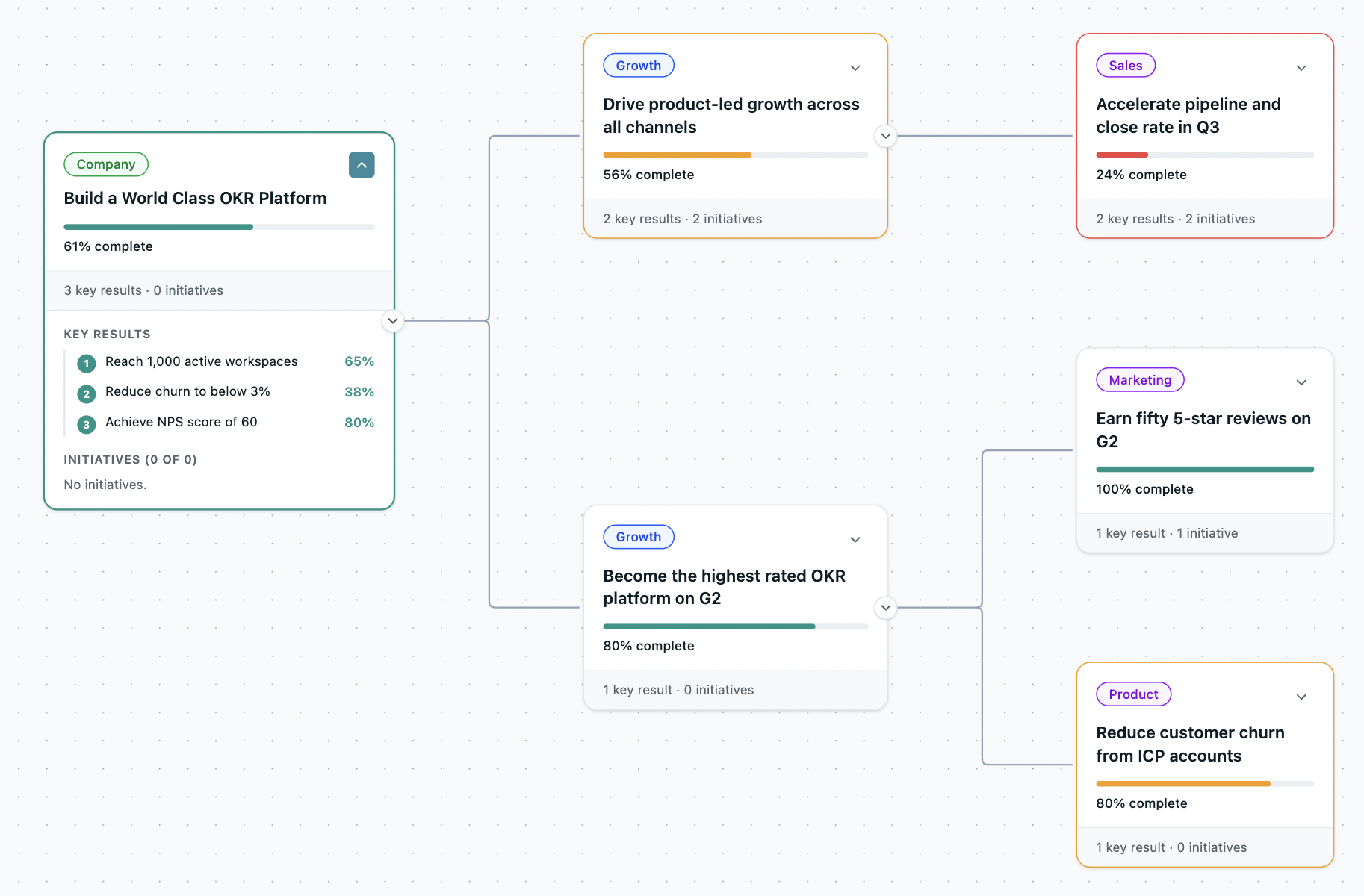
Setting goals achieves little if different teams pursue different priorities with no structural connection between them. Cascade alignment — connecting every team Key Result to a company Objective before the cycle starts — is the mechanism that closes the 65% misalignment gap, and a live cascade is what keeps it closed as the quarter moves.
Only 16% of organizations complete the full cascade from company OKRs to all team Key Results within the same week. A team that takes a month is a third of the way through the quarter before everyone is aligned. Teams that launch in under a week see up to 50% higher completion than those taking two to four weeks.
3. Tracking
Tracking is where most goal management systems collapse. Goals get set at planning sessions and reviewed at quarterly reviews, with nothing structured in between. 50% of all Key Results have no named owner, which means nobody is specifically accountable for moving them between sessions.
Teams with required single ownership see 26% higher completion rates, and teams that hold a weekly check-in rhythm complete 43% more goals than those reviewing monthly. Those are structural gains rather than motivational ones. The weekly check-in doesn't require a meeting; it requires a system that surfaces progress automatically rather than waiting for someone to ask.
This is the habit the Goal-Setting Benchmark found teams most overrate in themselves — among teams that claim to run a framework consistently, only 36% actually review weekly and only 41% run on dedicated software.
4. Closing
Closing is the most skipped component and the most valuable. Teams that run structured end-of-cycle retrospectives complete 30–45% more goals the following quarter — the compounding effect that makes goal management a strategic investment rather than a quarterly chore.
That compounding is measurable across cycles: teams average 51% completion in their first two cycles and 79% by cycle five, as the discipline of closing every cycle honestly carries forward into the next planning session.
Closing requires honest scoring on a 0.0–1.0 scale, not the "we basically got there" rounding that produces a 1.0 on every Key Result and no useful signal. A 0.7 is the target; consistent 1.0s mean the goals weren't ambitious enough, and consistent scores below 0.5 mean something structural needs to change rather than just the goals.
What Effective Goal Management Looks Like
The organizations generating the highest returns share four behaviors that the data consistently separates from those generating nothing: goals set as outcomes rather than activities; a single named owner on each goal before the cycle starts; progress visible continuously, updated every week rather than assembled before reviews; and every cycle ending with an honest score and specific changes committed for the next one.
Organizations using purpose-built goal management software generate a 1:88 return on investment against 1:25 on spreadsheets. That gap has little to do with software cost and everything to do with the tracking and closing infrastructure purpose-built tools enforce structurally, on a single platform where the record stays current by default.
The System Is the Return
Setting goals is the component every team has, and on its own it's the one that returns the least. The return comes from the three components most teams skip: aligning goals to strategy so every team pulls the same direction, tracking them weekly against a named owner so drift surfaces while there's still time to act, and closing each cycle honestly enough to carry what worked into the next. Those three are what separate a goal system that shapes behavior from one 34% of employees wouldn't miss if it vanished.
The gap between the two comes down to system, not effort: the data shows teams strong at both setting and tracking hitting their goals 51% of the time against 18% for teams weak at both, and completion compounding from 51% to 79% as cycles are closed and carried forward. What those teams have is a system where the four components run as one connected cycle rather than four disconnected events scattered across the quarter.
The planning session sets the goals; the alignment map connects them; the weekly check-in keeps them honest; the retrospective feeds the next cycle. None of it depends on anyone remembering to chase a spreadsheet.
That's the shift worth making. Goal management stops being a planning-week ritual that fades by week three and becomes the operating rhythm that turns a strategy on paper into results you can measure at cycle end. Start with the component you're weakest on, run it for one full cycle, and add the next — the staircase is built one habit at a time.
Data: the 2026 OKR Benchmark Report (200 organizations), the Goal-Setting Benchmark (280 operations and strategy leaders), OKRs Tool platform data (876 organizations, 20,952 key results), and the State of Goal Management (210 employees).