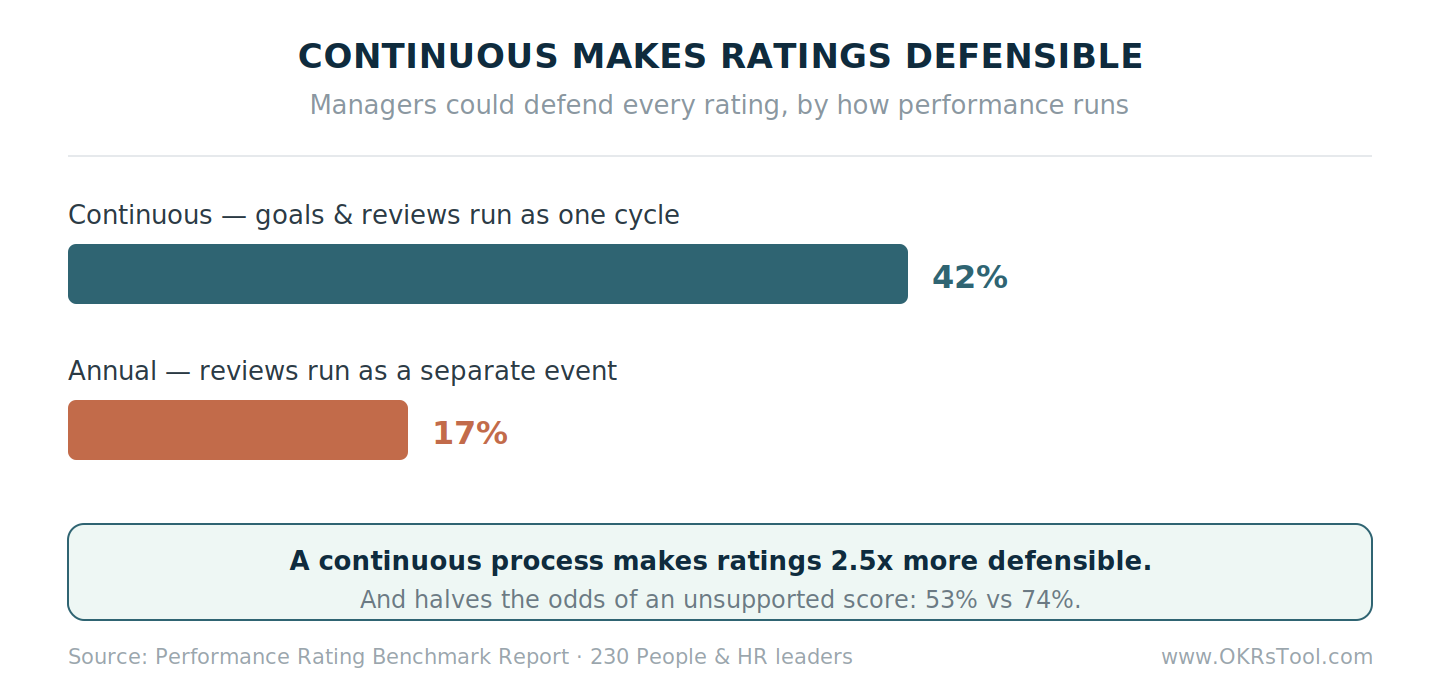
Continuous performance management replaces the single annual review with ongoing goal tracking and regular feedback, so a rating summarizes a running record instead of reconstructing one from memory. In a survey of 230 HR leaders, teams running it were 2.5x more likely to say a manager could defend every rating — 42% versus 17%.
The annual performance review asks a manager to remember twelve months of work in an afternoon. It rarely goes well: by review time, early wins have faded, recent work looms large, and the score gets written from whatever the manager can recall rather than what actually happened. Continuous performance management fixes this at the source — it keeps the record current all year, so the review reads from evidence instead of memory.
This guide covers what continuous performance management is, how it differs from the annual model, why the data favors it so heavily, and how to run it. It draws on the Performance Rating Benchmark Report, an independent survey of 230 People and HR leaders, and sits within the broader performance management discipline.
What Continuous Performance Management Is
Continuous performance management is an always-on approach to setting goals, tracking progress, and giving feedback throughout the period, so that evaluation becomes a summary of an ongoing record rather than a once-a-year reconstruction. Instead of compressing a year of performance into a single review event, it distributes the work across the whole cycle — regular check-ins, in-the-moment feedback, and a goal record that stays current.
The shift is from event to system. In the annual model, performance is something that gets measured once, at the end. In the continuous model, performance is managed as it happens, and the end-of-period rating is the natural output of a record that already exists.
The mechanics are familiar — goals, feedback, reviews — but the timing changes everything: a rating built on a live record can be defended, while one built on recollection can only be asserted.
Three practices make it continuous. Ongoing goal tracking keeps progress visible week to week. Regular feedback — through structured 1:1s and lightweight check-ins — replaces the single annual conversation. And a shared record ties the two together, so when a rating is written, the evidence is already there.
Continuous vs. Annual Performance Management
The two models differ in one structural way: whether the record survives to the moment the rating is written.
The annual model concentrates evaluation into one high-stakes event. A manager sits down once a year, tries to recall twelve months of work, fills in a form, and produces a score. The structural problem is memory: by the time the review happens, the record of what actually occurred has decayed. The continuous model spreads the same evaluation across the period, capturing progress as it happens so the review reads from a record rather than rebuilding one.
The benchmark data shows how much that matters. Teams that run goals and reviews as one continuous, connected cycle are more than twice as likely to say a manager could defend every rating with evidence — 42% versus 17% — and far less likely to have seen an unsupported score, 53% versus 74%. The continuous model doesn't just feel more modern; it produces ratings that hold up when challenged, because the evidence was captured while it was still fresh.
Why the Annual Review Fails
The annual review fails for a reason that has nothing to do with manager effort and everything to do with how memory works over twelve months.
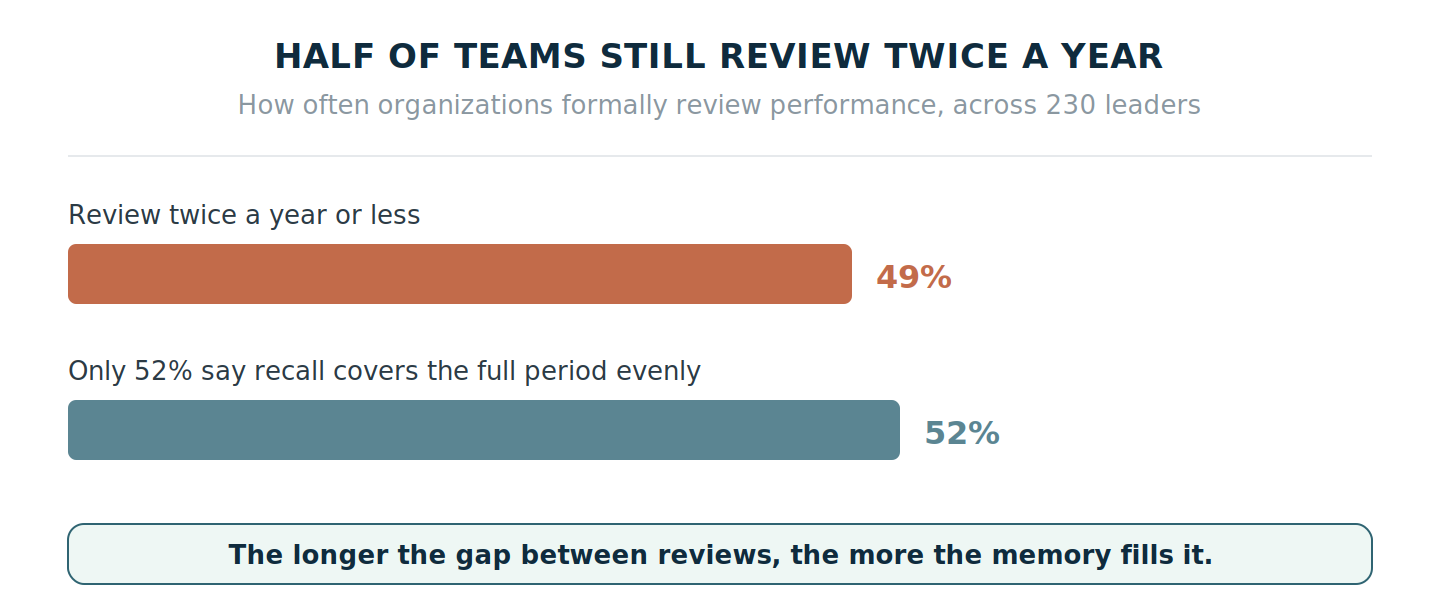
49% of organizations still review performance twice a year or less. Over that interval, memory does what memory does: it compresses. Only 52% of leaders say a manager's recall covers the full review period evenly — for everyone else, the score reflects the last month or two, not the whole year. 68% have watched a strong performer rated lower because their best work happened early and faded by review time. This is the recency effect, and the annual cadence is what creates the runway for it.
Where a complete record is missing, other things fill the gap. 45% of leaders admit something other than goal delivery — recency, visibility, self-advocacy — is what actually moves the number, even though 60% say goal delivery is what should. The annual review leaves the door open for these biases by letting the record decay before the rating is written, and continuous management closes it by keeping the record current, so there's no gap for bias to fill.
The Benefits of Continuous Performance Management
Moving from annual to continuous changes more than the calendar. It changes what the rating rests on, and that has knock-on effects across the whole cycle.
The clearest benefit is defensibility — the 42%-versus-17% gap above. When the record is live, a rating points to evidence, and a challenge resolves by reading the record rather than relitigating memory.
The second is fairness — continuous tracking neutralizes the recency and proximity biases that thrive in the annual gap, which matters most for people whose strong work happened early or who work out of the manager's direct line of sight.
The third is development — feedback that arrives throughout the period can actually change the outcome, where an annual verdict only records it after the fact.
The fourth is engagement — people who see their goals tracked and their progress acknowledged through the period stay more connected to the work than those who hear about it once a year.
None of these require a heavier process. They come from moving the same evaluation earlier and spreading it out, so the record is built while the work is fresh rather than reconstructed after it's cold.
How to Implement Continuous Performance Management
Running performance continuously comes down to four operating disciplines, and each one is a small change from what most teams already do.
Set measurable goals at the start of the period. Continuous tracking only works if there's something concrete to track — a goal written as a measurable outcome rather than a vague responsibility. Frameworks like OKRs fit naturally here because every key result is measurable and owned from the start.
Track progress on a regular cadence. Weekly or biweekly check-ins keep the record current, so nothing has to be reconstructed later. The cadence matters more than the format — a light, consistent rhythm beats an elaborate one that lapses.
Give feedback in the moment, not in an annual batch. Structured 1:1s and in-cycle feedback turn evaluation into a running conversation. This is where development actually happens — course corrections made in month three change the outcome; the same feedback delivered at year-end only explains it.
Run reviews as a summary, not a reconstruction. When the first three disciplines are in place, the formal review becomes largely mechanical — the performance review reads the record rather than rebuilding it. The rating is defensible because the evidence was captured all along.
The one thing that makes all four sustainable is where they run. When goals and reviews live on separate systems, keeping the record current depends on someone remembering to move data between them — which is exactly what breaks down under time pressure, and what the goal record research shows happens most.
When they run on one platform, the record stays live by default, and continuous management becomes the path of least resistance rather than an extra discipline to maintain.
Continuous Performance Management and OKRs
OKRs and continuous performance management fit together naturally, because both are built on the same foundation: a measurable goal record that stays current through the period. An OKR cycle already runs on continuous check-ins and visible progress — extending that record into the performance review is a small step, not a new system.
The connection is also where the caution lives. Tying goal scores too directly to ratings drives gaming — when the number becomes the rating, people sandbag the number. The continuous model handles this well: because the record is rich and ongoing, a rating can draw on the full picture of delivery, effort, and growth rather than collapsing to a single score.
The goal record informs the rating; it doesn't become it. Kept that way, continuous management gives you the accountability of connected goals without the distortion of a hard link.
Making the Shift
Moving from annual to continuous performance management is less a reorganization than a retiming. The pieces stay the same — goals, feedback, reviews — but they get captured while the work is fresh rather than reconstructed after it's cold. Nearly every team already has the raw materials; what they lack is a rhythm that keeps the record current between the setting of a goal and the judging of it.
The change shows up first in the review itself. A manager who has tracked progress all year walks into the conversation with a record, not a blank page, and the rating writes itself from evidence already on the table. The people being rated feel the difference too: a score that points to their actual work lands as fair, where one assembled from a manager's end-of-year memory always carries the suspicion that the wrong things counted. Over a few cycles, that shift in how ratings are made rebuilds the trust that annual reviews wear down.
None of it requires a bigger process or a heavier tool — only the discipline of keeping the record live, and a place for it to live. Teams that get there stop producing ratings they can only assert and start producing ones they can prove, which is what measuring performance was supposed to deliver in the first place.
Data: The Performance Rating Benchmark Report, an independent survey of 230 People and HR leaders at technology companies of 50–200 employees.