Performance ratings are trusted far more than they can be proven. In a survey of 230 People and HR leaders, 66% said their ratings are accurate — but only 27% said a manager could defend one with goal evidence, because for 92% of organizations performance runs on tools with no live connection to the goals. This guide reviews 17 platforms by how well they close that gap, and how carefully.
Performance management fails at the seam between two systems. Goal delivery lives in one tool and performance conversations happen in another, and nobody bridges them consistently — so the manager writes a review from recollection while twelve weeks of Key Result data sits untouched in the OKR tool.
The Performance Rating Benchmark Report put a number on how common that split is: 61% of organizations run goals and reviews on separate calendars, and only 8% run performance where the goals actually live.
The right platform closes that gap structurally — Key Result completion, check-in consistency, and 360 feedback surfacing automatically in review cycles.
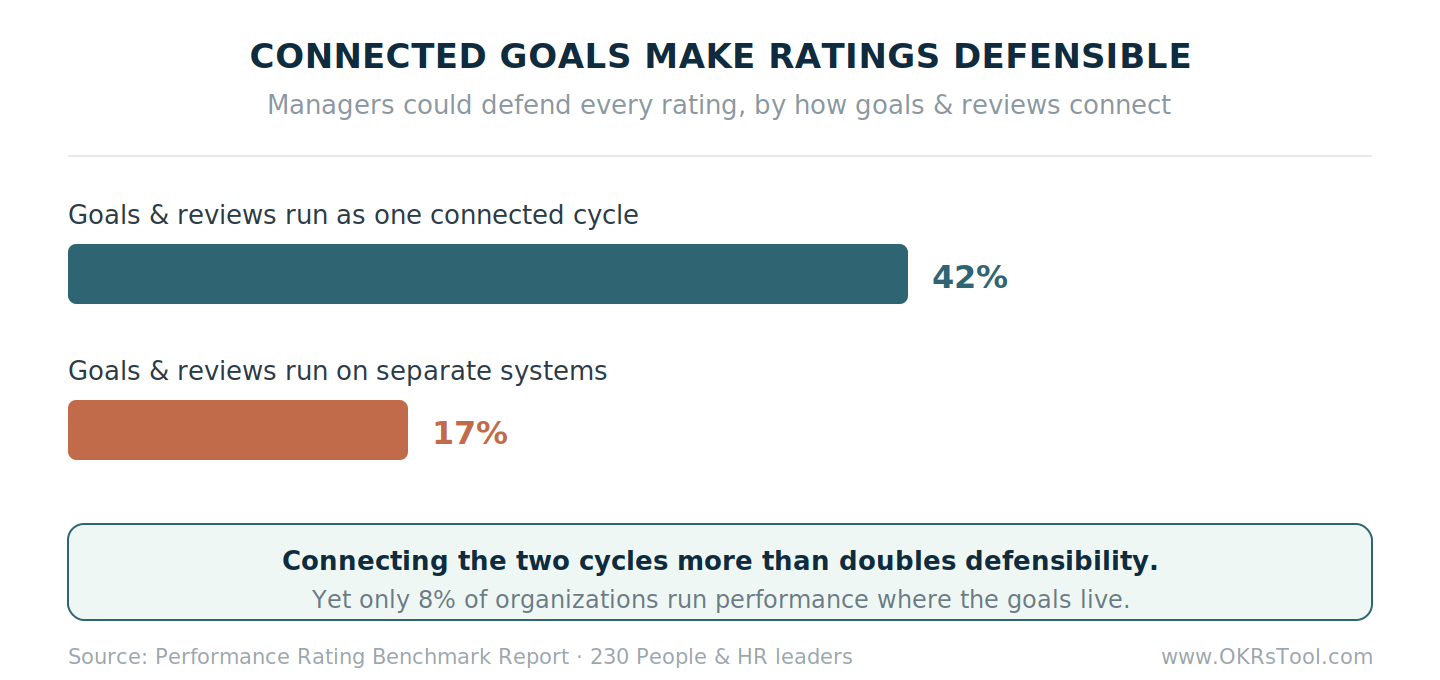
But there's a nuance the category usually gets wrong, and the data proves it: the same report found teams that integrate the two cycles are more than twice as likely to say a rating could be defended, 42% versus 17% — while The State of Goal Management found that the tighter the link between goals and ratings, the more people game their goals. Connection matters; so does keeping it loose enough to stay honest.
This guide reviews seventeen platforms by how well they connect the two, and how carefully.
What a Provable Rating Actually Needs
Three features separate platforms that make a rating defensible from ones that only record it. The benchmark shows why the distinction matters: teams that run goals and reviews as one connected cycle are more than twice as likely to say a manager could defend a rating — 42% versus 17% — yet only 8% actually run performance where the goals live. The gap between those numbers is exactly what these three features close.
The first is goal delivery connected to review cycles — Key Result scores and check-in history surfacing automatically rather than waiting for a manager to export a spreadsheet or reconstruct the period from memory. This is the one that makes a score traceable to evidence instead of recollection. How tightly to wire it is a real choice, and one the next section takes up directly: 47% of organizations treat goal delivery as one factor among several, while only 28% let the score directly drive the rating.
The second is continuous feedback between review cycles, because an annual review built on recollection reproduces the same biases every year — the report found 68% of leaders have watched strong early-cycle work forgotten by review time.
The third is pricing that doesn't compound faster than headcount — per-user fees of $10–15 a month become a serious budget line at 50 people, which is exactly when a growing team can least afford a per-seat growth tax.
The Nuance Most Platforms Miss: Tighter Isn't Better
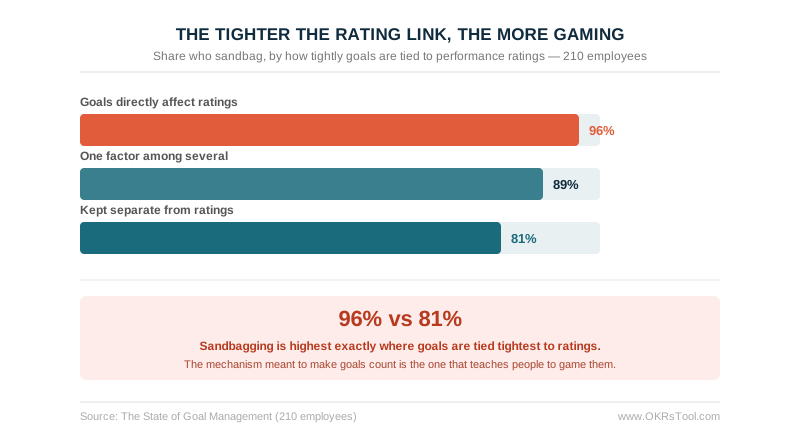
There's a counterintuitive finding that should shape how any of these tools is configured. Connecting OKR scores directly to performance ratings feels like the way to make goals matter — but it's the single strongest driver of goal-gaming in the data.
When goals directly affect ratings, 96% of employees sandbag; when goals are kept separate, that falls to 81%. The mechanism meant to make goals count is the one that teaches people to set targets they've already hit.
The implication for tool selection is direct. A platform that lets OKR delivery inform a performance conversation — alongside 360 feedback, manager assessment, and self-evaluation — preserves the accountability without the gaming. A platform configured so the Key Result score becomes the rating optimizes for watermelon reporting and sandbagged targets.
The 47% one-factor model the benchmark documents works precisely because it keeps goals honest, which is why psychological safety around the score matters as much as the connection itself.
At a Glance: 17 Performance Management Platforms
17 Best Performance Management Software Tools, Reviewed
1. Lattice
Best for: Mid-market organizations that want goals, reviews, and engagement in one platform
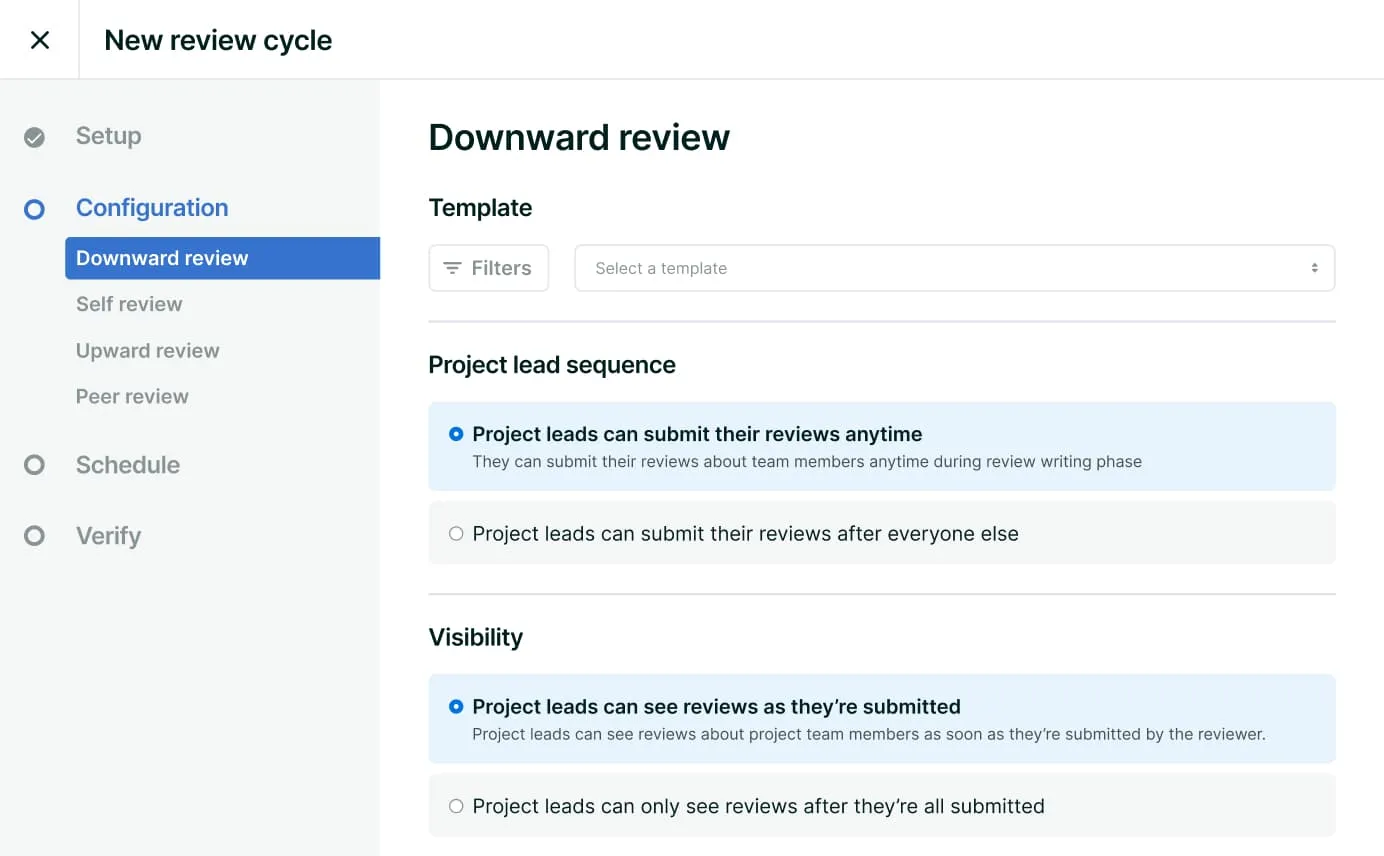
Lattice is the most polished performance management platform in the mid-market. Goals, reviews, 1:1s, engagement surveys, and compensation workflows in one system — and the connection between goal delivery data and performance review scores is more structural than most competitors, with Key Result completion rates surfacing automatically in review cycles rather than requiring manual compilation.
The interface is cleaner than most platforms in this category, and the calibration tools for leadership teams are strong.
The limitation: no self-serve access means a sales conversation before you can evaluate. Per-user pricing at $11/month compounds quickly — a 100-person team is looking at $1,100/month minimum. The OKR layer is solid but not as deep as purpose-built goal platforms.
Pricing: From $11/user/month. No public free tier. Demo required.
2. OKRs Tool
Best for: Growing teams (50–200 people) that need OKRs and performance reviews without enterprise overhead
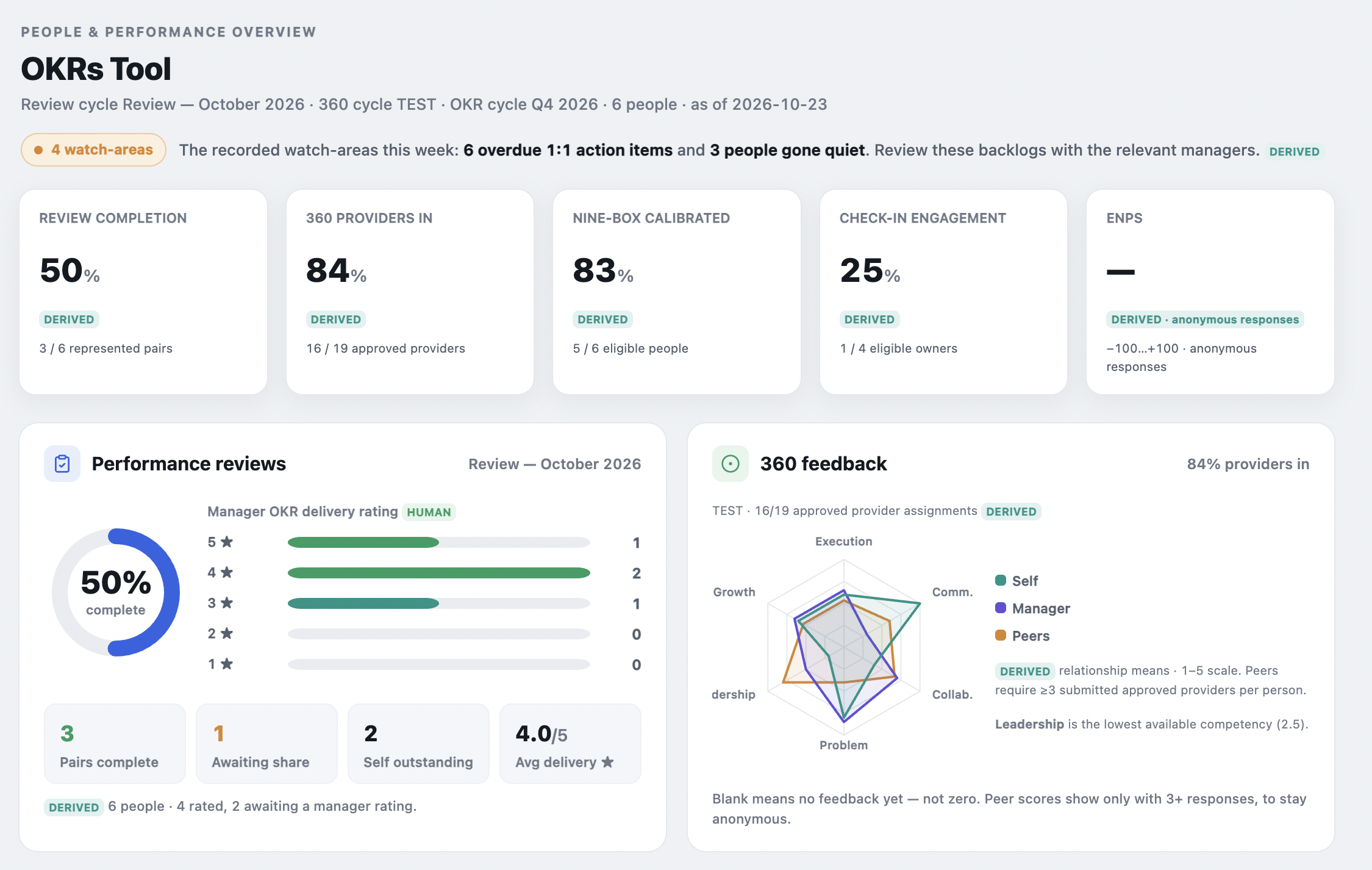
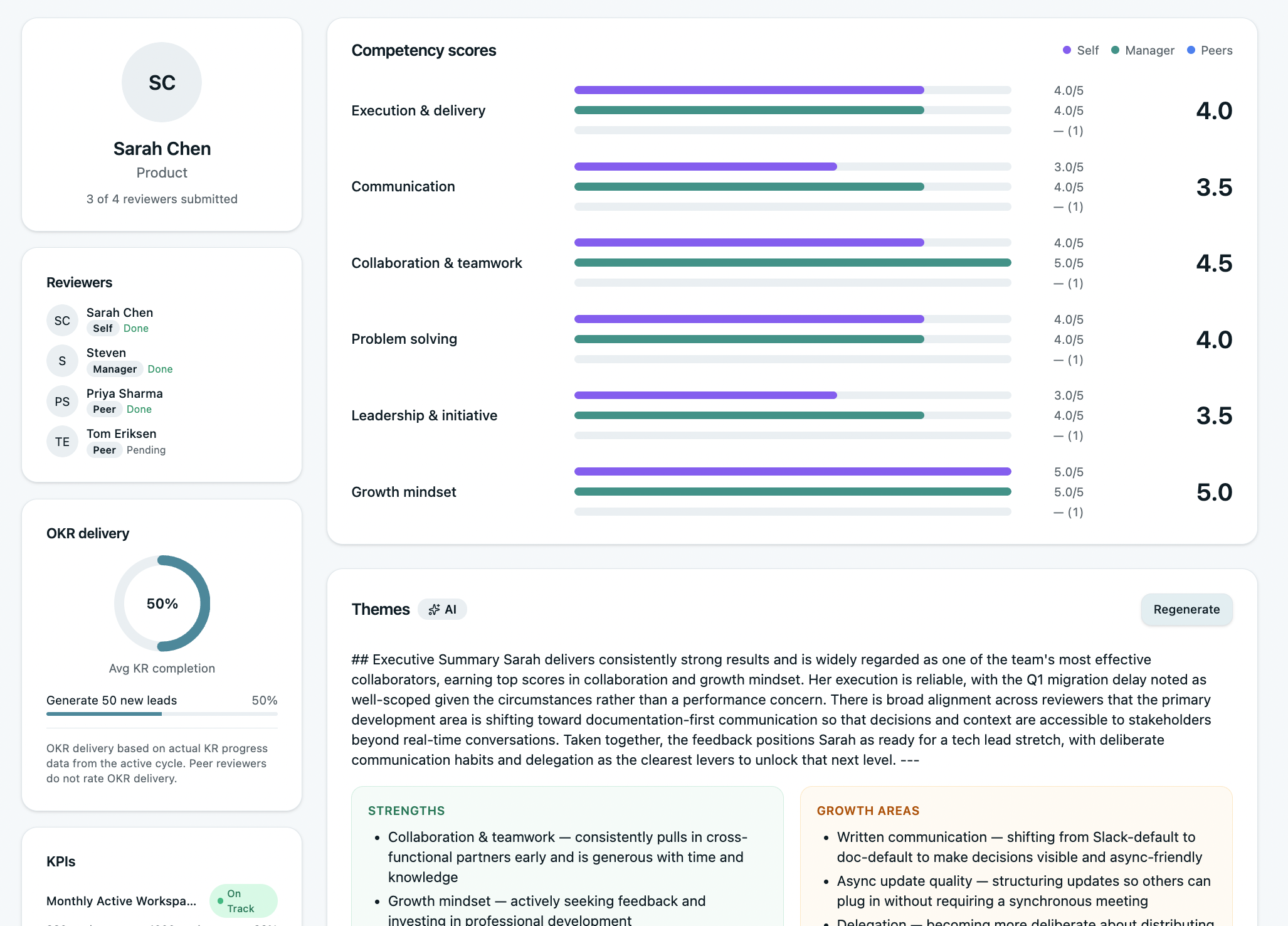
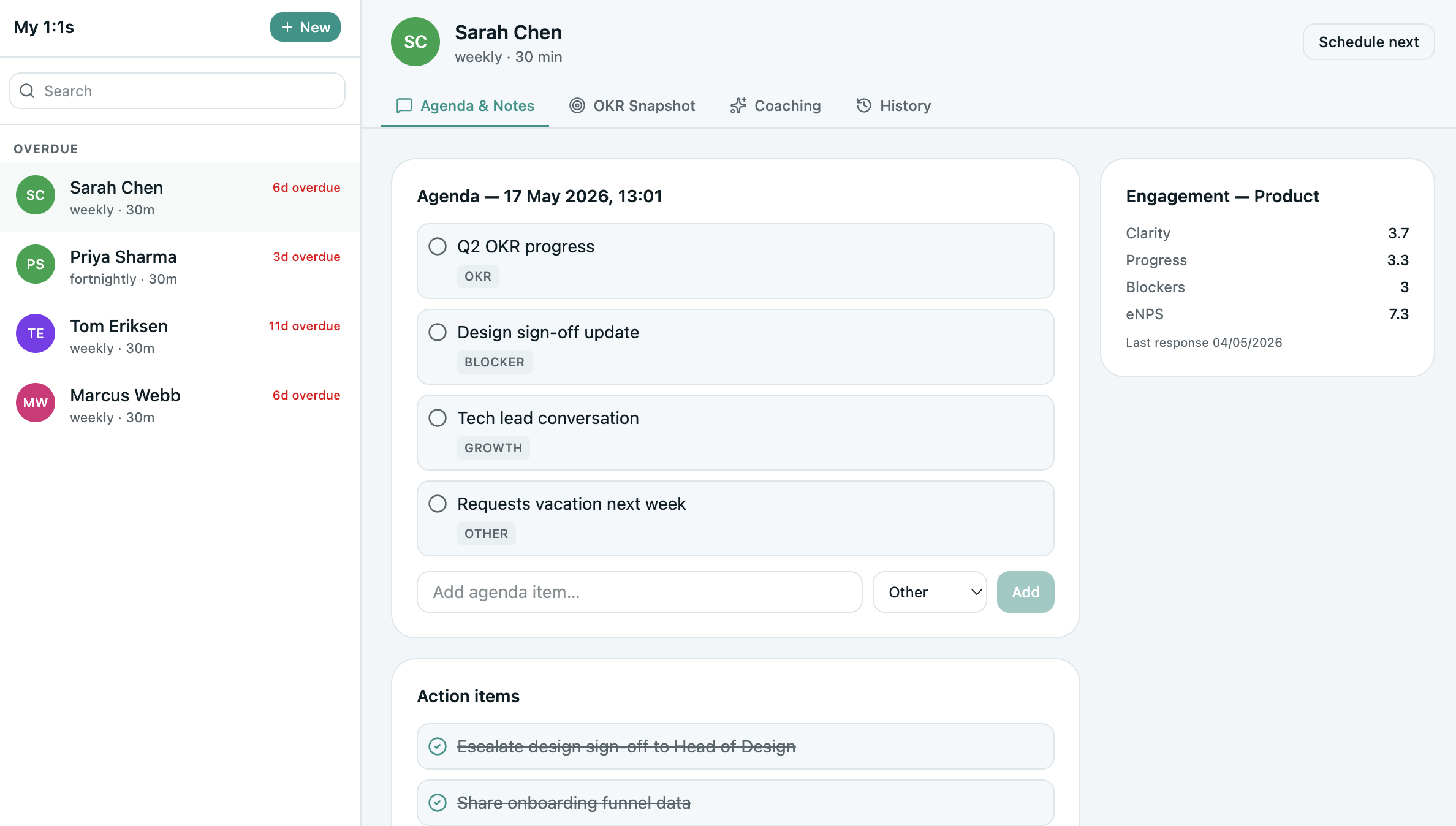
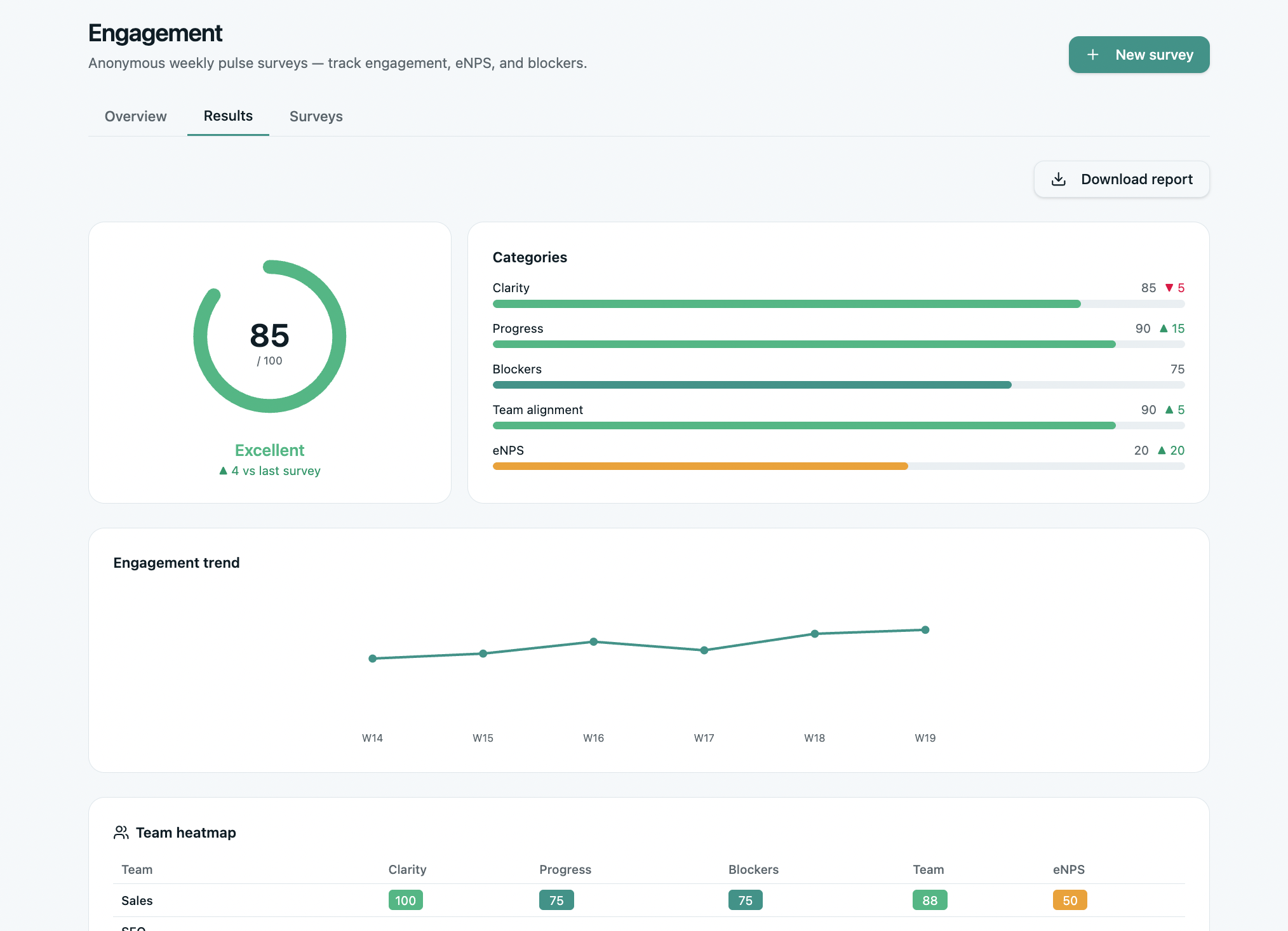
OKRs Tool sits deliberately in the middle of this market — the 50–200 person organization that needs OKR execution and performance review connection without a six-week implementation or an enterprise price tag.
The full feature set is built in and connected: performance reviews with KR delivery scores feeding directly into review cycles, 360 reviews with competency ratings alongside KR completion rates, structured 1:1 management built around OKR progress, employee engagement surveys, a 9 Box Grid and continuous feedback (both currently in beta for select organizations). All in one view, no manual compilation, no second platform required.
The flat pricing model — $129/month — removes the per-user growth tax that makes most platforms expensive exactly when the team is scaling fastest. The ROI data shows organizations using purpose-built software at this stage generate a 1:88 return on investment. Set up in an afternoon. No IT approval, no procurement cycle.
The limitation: integrations are limited to Slack, MS Teams, Jira, and Asana. Not designed for complex enterprise HR workflows or organizations with deep HRIS integration requirements.
Pricing: From $129/month flat.
Free trial: Yes — 14-day full trial.
3. Eletive
Best for: Engagement-led teams that want people analytics and performance in one platform
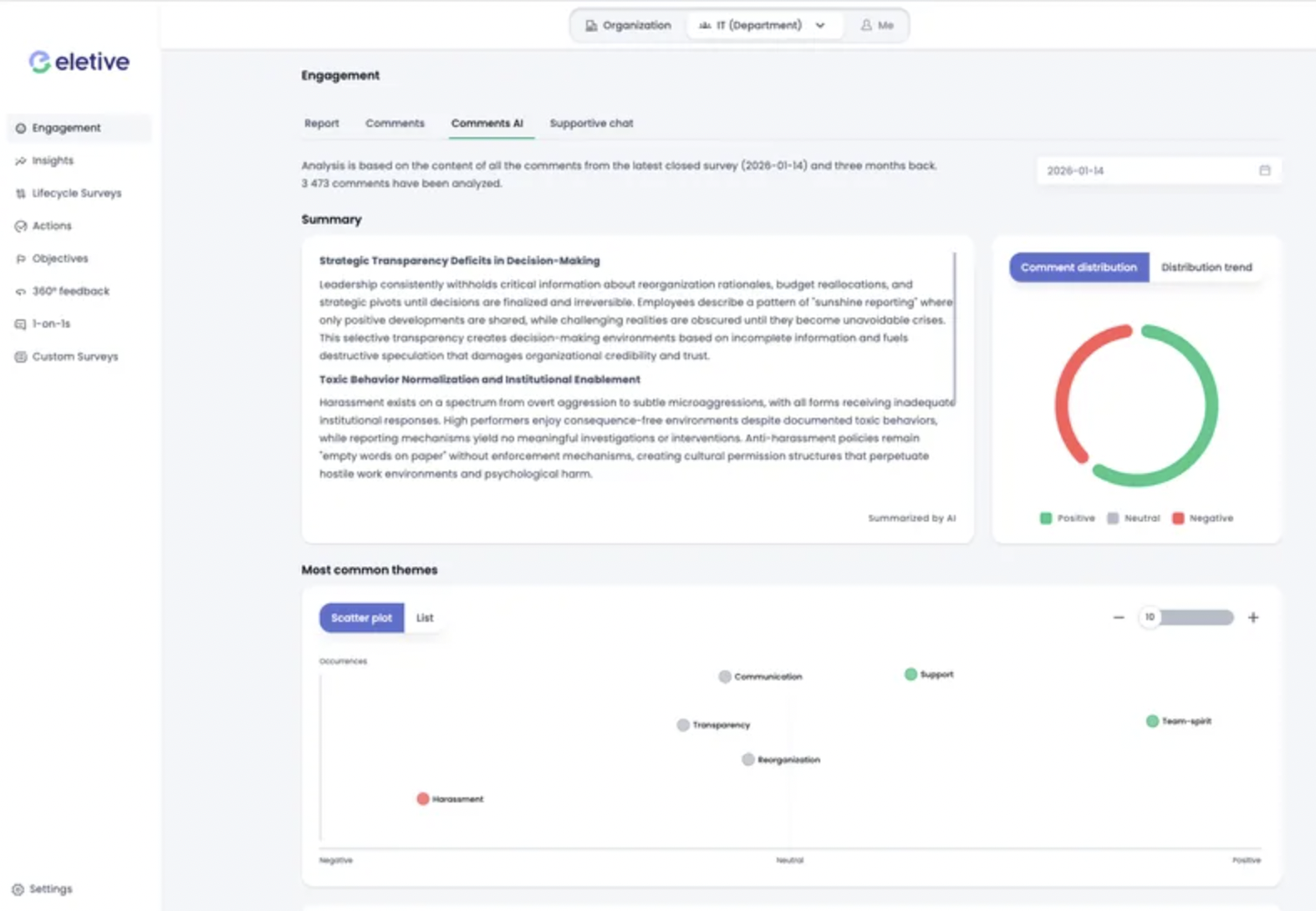
Eletive is an AI-powered people success platform — pulse surveys, engagement analytics, heatmaps, and manager dashboards, with Copilot adding sentiment analysis and attrition-risk signals.
Performance is the secondary layer. Reviews, 1:1s, OKRs, and 360 feedback are add-ons, so the goal layer is light — no Key Result ownership enforcement, no alignment map. For a team whose central need is OKRs, it’s an engagement platform with performance attached.
Pricing: Custom quote. No public per-user pricing. Demo available.
4. Betterworks
Best for: Enterprise organizations running OKR-native performance programs at scale
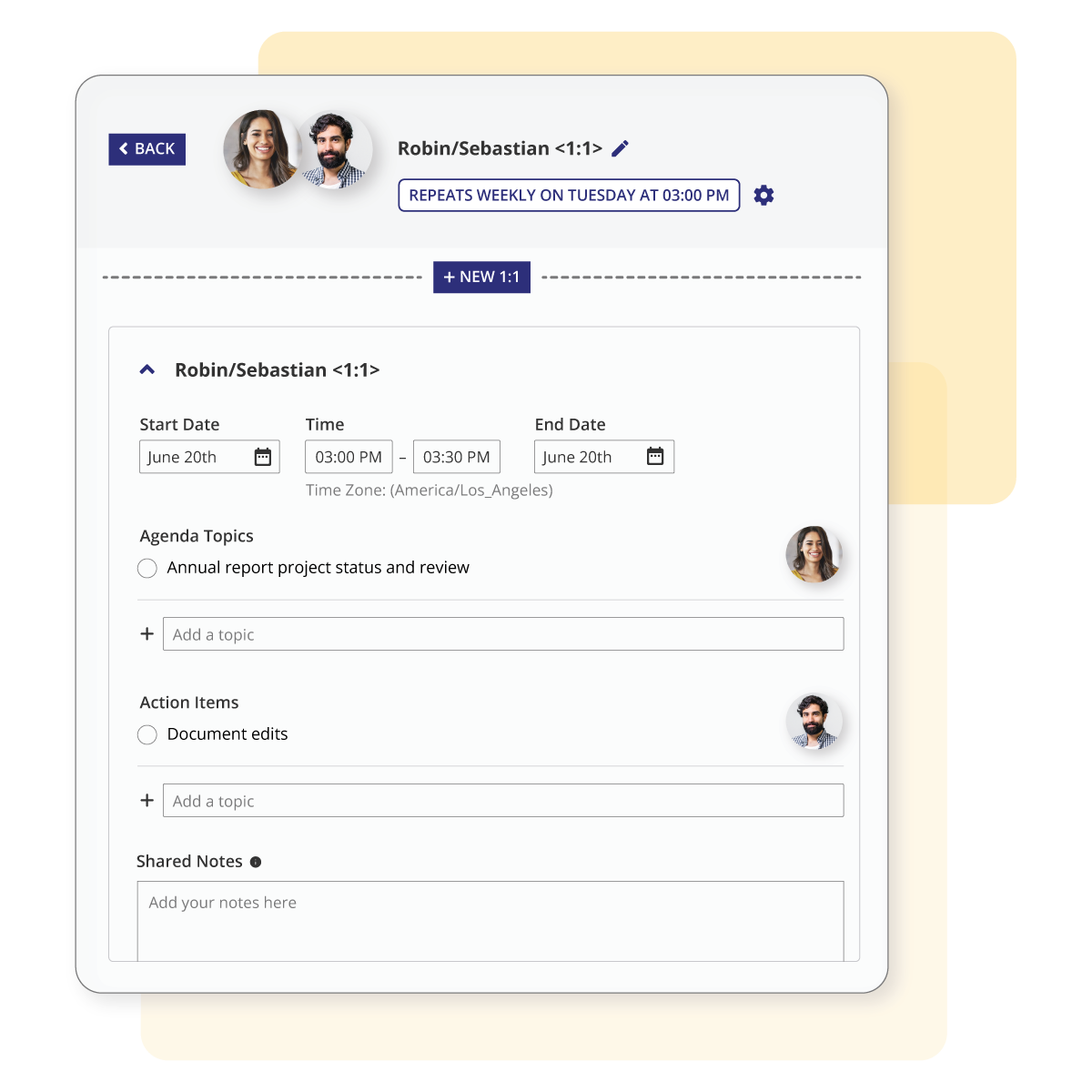
Betterworks is the strongest enterprise option for organizations where OKRs are the primary performance framework — not one feature among many, but the foundation the entire programme is built on.
The platform connects OKRs, continuous feedback, structured check-ins, and performance calibration in one system. The AI-powered execution risk detection flags at-risk goals before the miss happens — the OKR Intelligence Report 2026 found teams using AI for both goal-writing and mid-cycle analysis accept a low score on missed goals only 14% of the time versus 35% for writing-only teams. The Manager Command Centre gives leadership consolidated visibility across all teams without a reporting cycle.
The barrier is high: no self-serve, sales demo required, enterprise pricing only. Not the right tool for any organization under 200 people.
Pricing: Custom quote. Enterprise-focused. Demo required.
5. BambooHR
Best for: HRIS-first teams that want performance reviews attached to their system of record, not a standalone OKR platform
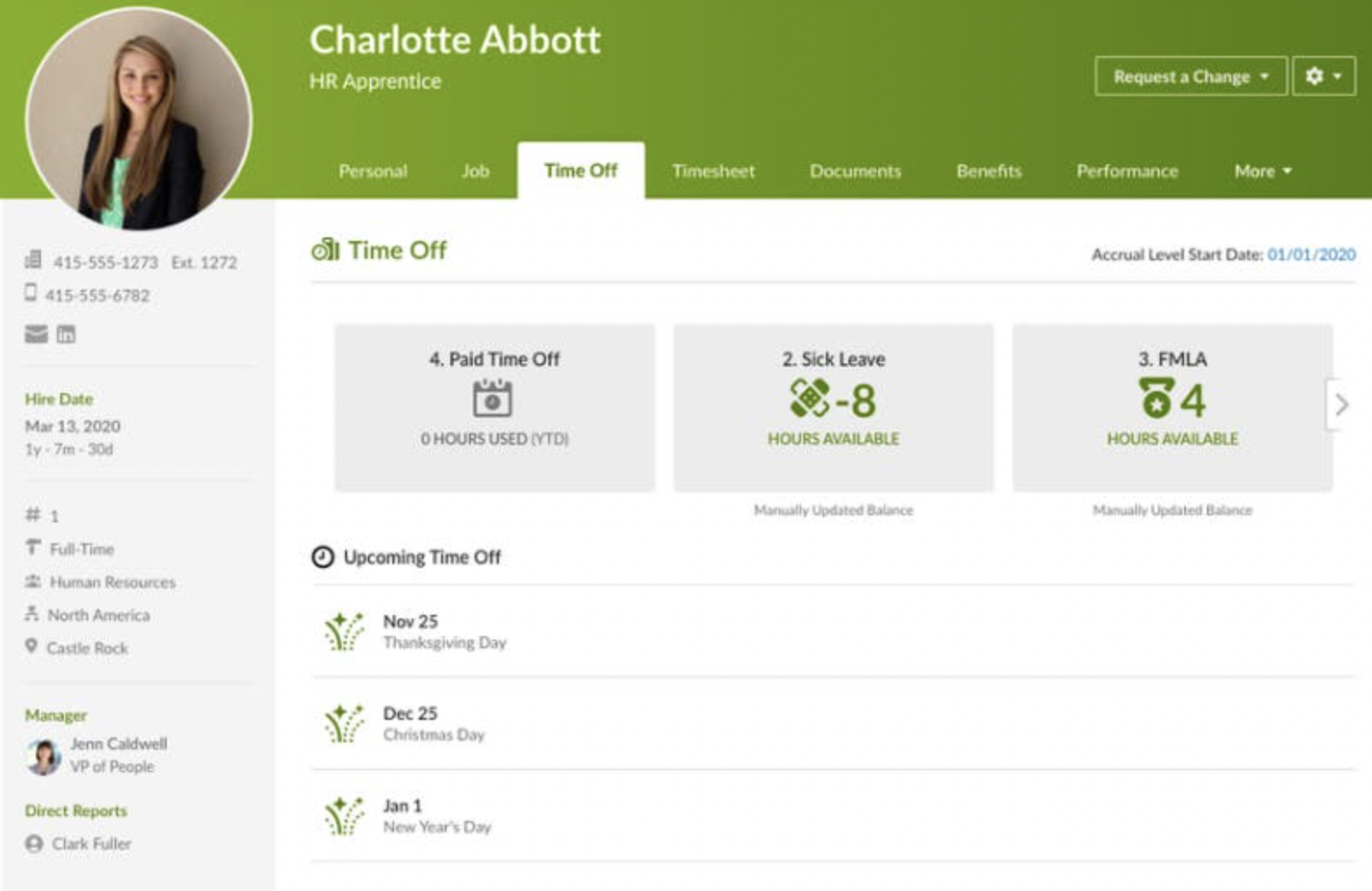
BambooHR is an HRIS first — employee records, time-off, onboarding, and org chart — with performance management layered on top in its Pro tier. For teams that want the review cycle sitting in the same system as payroll and PTO, that consolidation is the whole appeal, and the performance module covers 360 review cycles, 1:1s, and goal tracking cleanly.
The trade-off is depth. Performance is a secondary module, not the core, so the goal layer is light — no Key Result ownership enforcement, no alignment map, no real OKR execution engine.
Pricing is quote-led and headcount-based, with performance bundled into Pro at roughly $17/user/month, so the review capability arrives as part of a broader HR bill rather than a focused spend. For a team whose central need is running OKRs, it's an HR system with reviews attached, not a performance platform.
Pricing: Core from ~$10/user/month; Pro (includes performance) ~$17/user/month.
Quote-led: ~$250/month minimum under 25 employees.
6. 15Five
Best for: Engagement-first organizations that want performance built around a weekly check-in habit
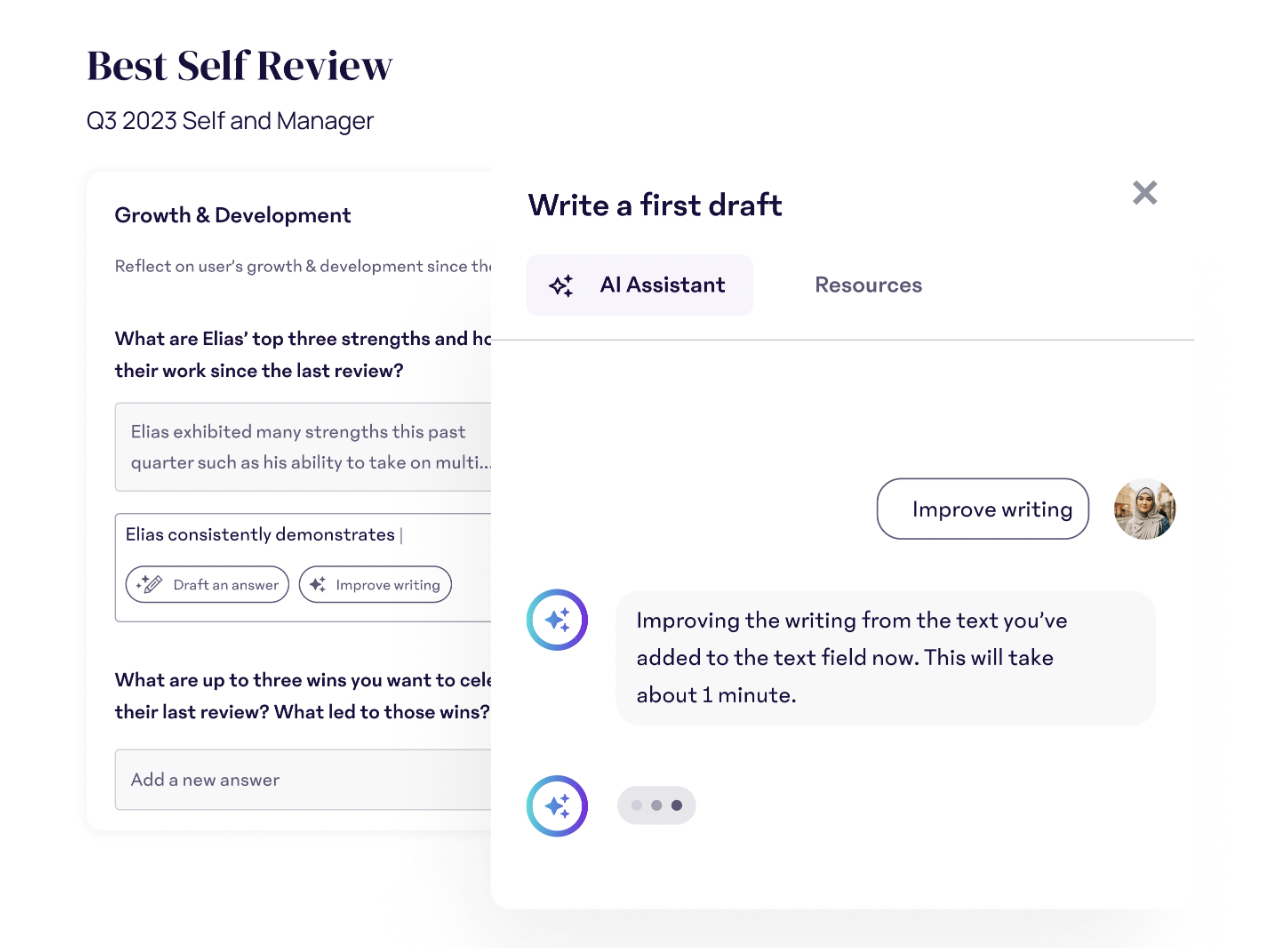
15Five is built around the same insight that drives the highest-return OKR habit: the weekly check-in is where performance is actually managed, not in the annual review.
The platform combines weekly check-ins, goal tracking, 1:1 management, and performance reviews in a single workflow — with the weekly touchpoint as the connective tissue. The result is a performance management system that accumulates real data across the year rather than depending on what managers remember in November.
The OKR layer is lighter than dedicated platforms — no hard ownership enforcement, no automated alignment map. For organizations where the primary challenge is OKR execution depth rather than performance culture, 15Five's goal infrastructure won't solve that on its own.
Pricing: From $4/user/month. Trial available.
7. Leapsome
Best for: European mid-market organizations that want OKRs, reviews, and learning in one platform
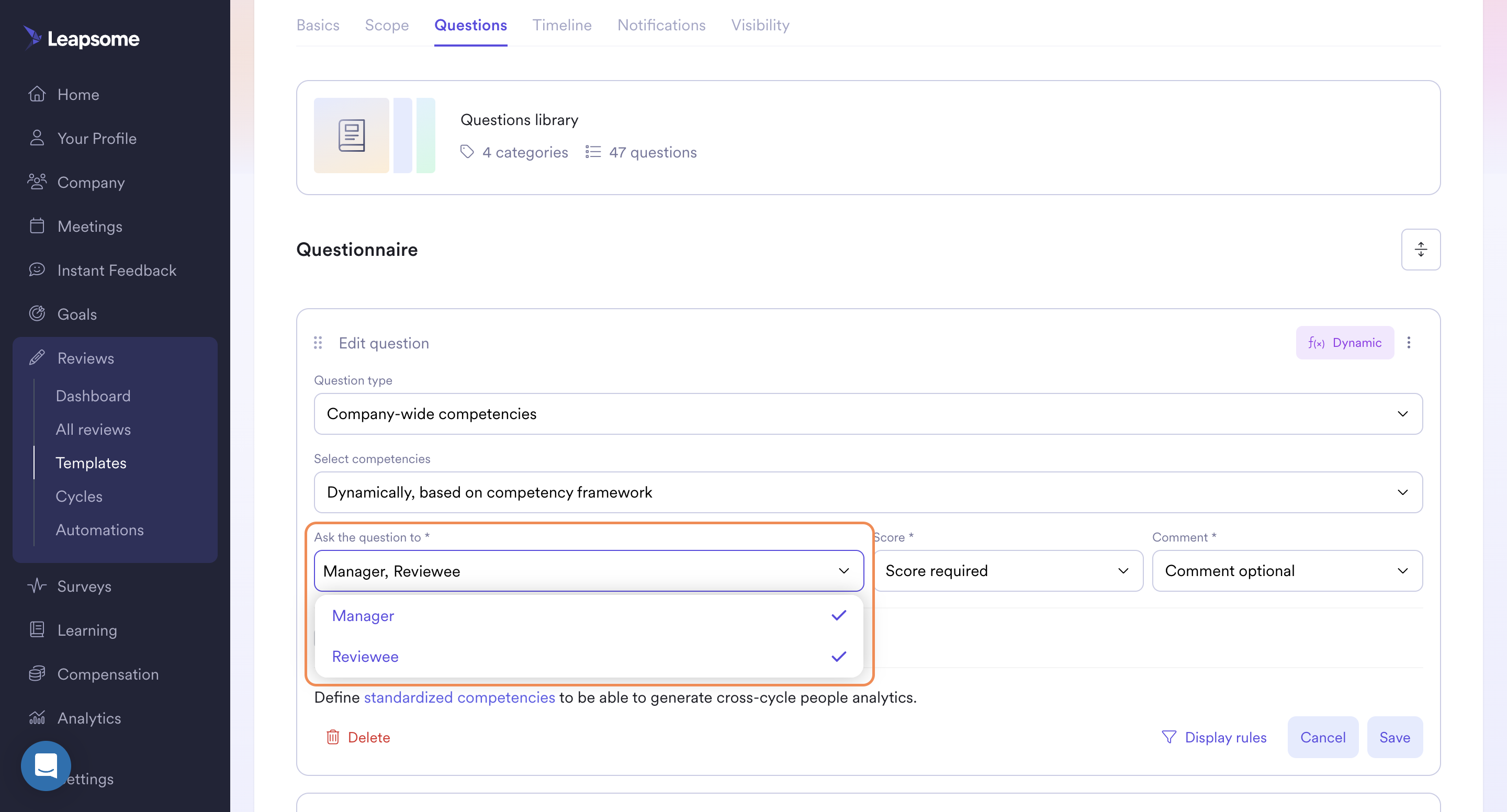
Leapsome is the strongest European-built option on this list — combining OKRs, performance reviews, 360 feedback, engagement surveys, and learning management in one platform.
The OKR integration is genuine — Key Results connect to review cycles and the cascade is visible across the platform. For European organizations where GDPR compliance and data residency create constraints that US-headquartered platforms handle poorly, Leapsome's European infrastructure is a real differentiator. The G2 rating of 4.8/5 is the highest on this list.
The platform can feel overwhelming on first use — the feature breadth creates navigation complexity before the workflow becomes familiar.
Pricing: From $8/user/month. Trial and demo available.
8. Culture Amp
Best for: Engagement-led organizations that want performance connected to employee sentiment
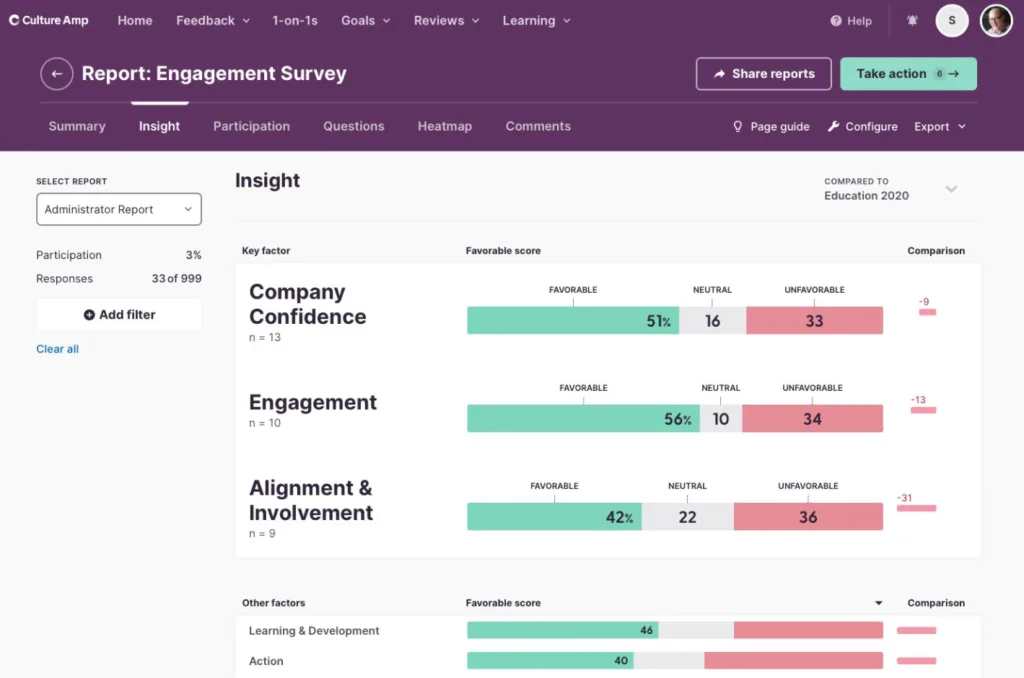
Culture Amp approaches performance management from the engagement direction — the insight being that performance outcomes and engagement levels are more correlated than most platforms acknowledge.
The platform combines engagement surveys, performance reviews, 1:1s, and goal tracking in one system, with analytics that surface the relationship between engagement scores and performance outcomes.
The OKR and goal layer is lighter than dedicated platforms — adequate for tracking but not sufficient as a standalone OKR execution system. Not the right fit for organizations whose primary challenge is OKR adoption rather than engagement measurement. No self-serve access.
Pricing: Custom quote. Demo required.
9. Rippling
Best for: Organizations that want HR, payroll, and performance management in one system
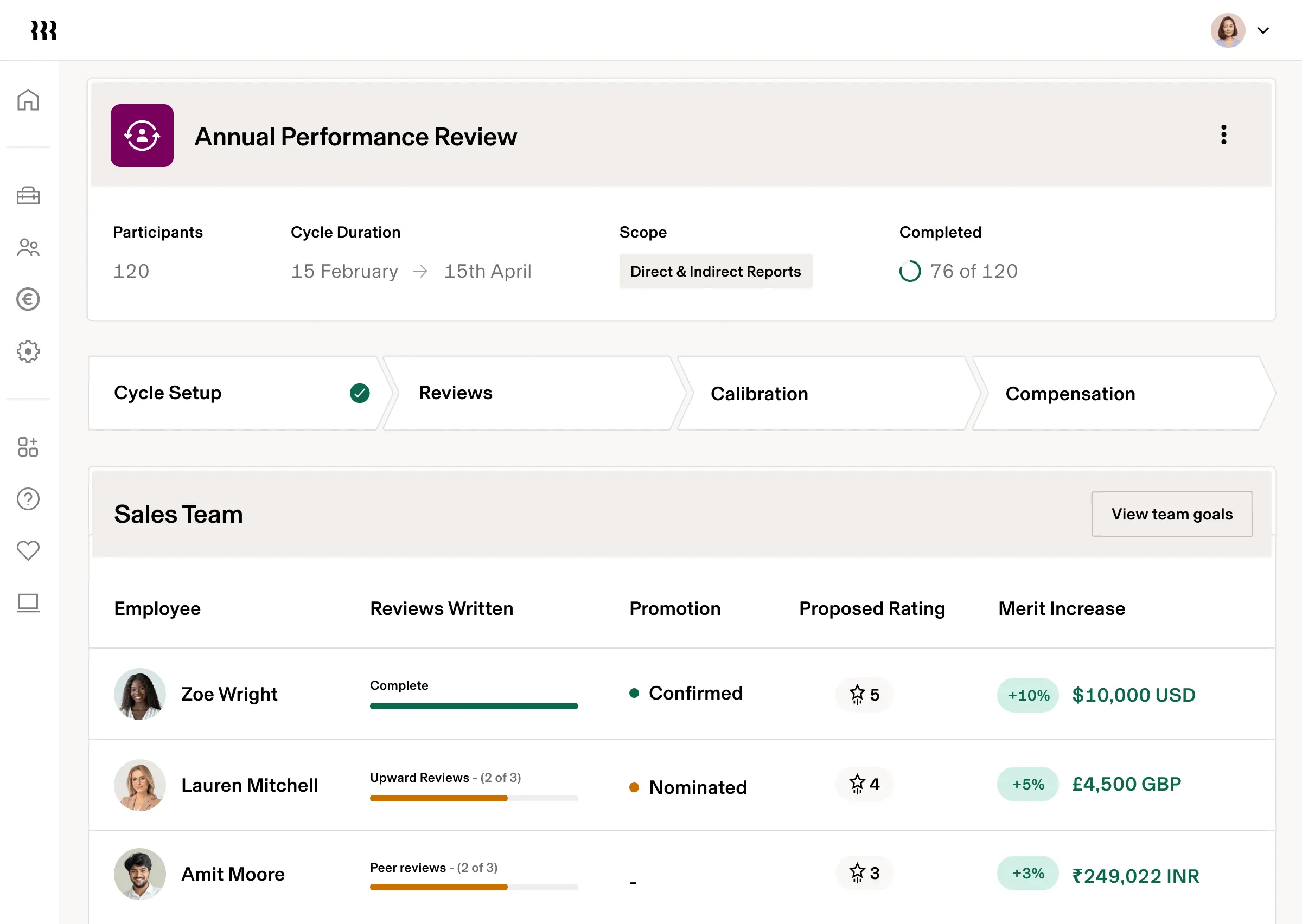
Rippling is an HCM platform — payroll, benefits, device management, and performance management in a single system. For organizations that want to eliminate the data synchronization problem between HR and performance tools, Rippling removes it entirely.
The performance management module includes goal tracking, review cycles, and 360 feedback — not as deep as dedicated platforms, but connected to the broader HR infrastructure in a way that matters for compensation and promotion workflows.
Best for organizations where the HR consolidation argument is the primary driver. Not suitable as a standalone performance management platform where OKR execution depth is the primary need.
Pricing: Custom quote per module. Demo required.
10. Profit.co
Best for: Governance-heavy organizations that need OKRs, KPIs, and weighted performance scoring
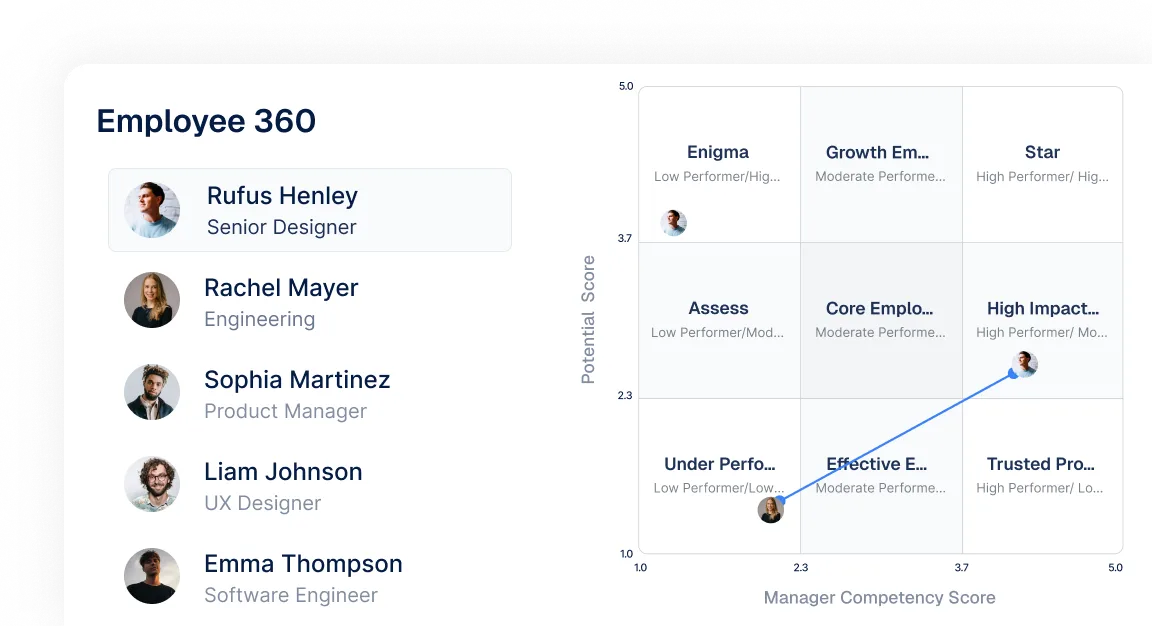
Profit.co is the most feature-complete OKR and performance platform in the mid-market — goals, KPIs, task management, performance reviews, and 1:1s in one system, with weighted OKR scoring that reflects the relative importance of different Key Results in final cycle scores.
For governance-heavy organizations that need comprehensive audit trails and structured review processes, Profit.co provides structural depth that lighter platforms don't offer.
The UI is slow and implementation typically requires 4–6 weeks of configuration. Custom pricing with no public rates adds evaluation friction. The 30-day free trial is a genuine advantage — enough time to evaluate the full platform before committing.
Pricing: Custom quote. 30-day free trial.
11. Peoplebox
Best for: Organizations that run OKRs through a recurring business-review cadence tied to leadership visibility
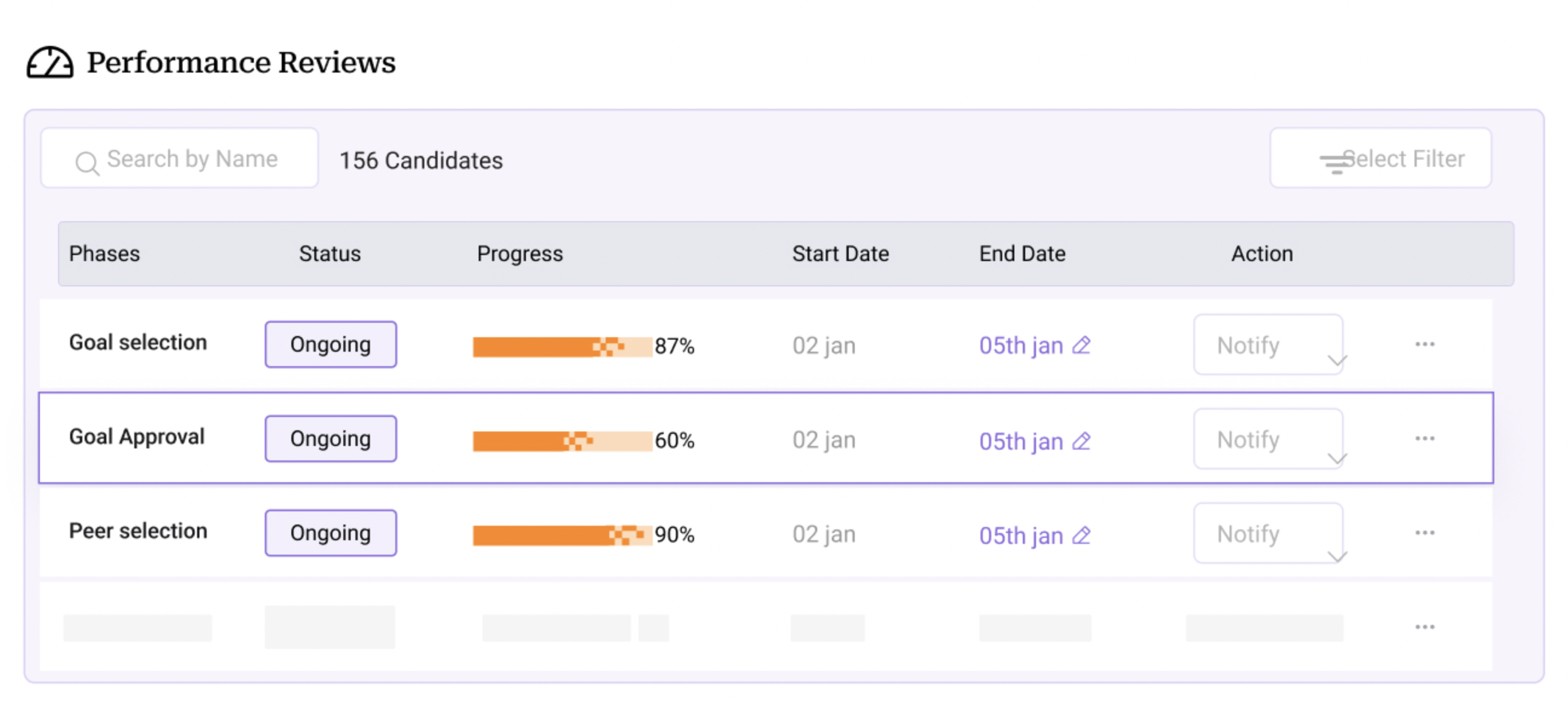
Peoplebox is an OKR-led platform built around the recurring business review — with OKRs, reviews, 1:1s, and KPI tracking all running natively inside Slack and Microsoft Teams, so goal updates happen where the team already works.
Its 50+ native integrations make it a realistic source of truth for teams wanting leadership-ready reporting across functions. The trade-off is weight — extra navigation steps, an OKR hierarchy that buries Key Results in parent goals, and a minimum annual contract (~$4,000) that lifts the real entry cost well above the headline seat rate.
Pricing: OKR platform from $8/user/month; full suite from $12/user/month. Minimum annual contract. Free trial available.
12. PerformYard
Best for: Organizations whose primary need is flexible, well-run performance review cycles rather than OKR execution
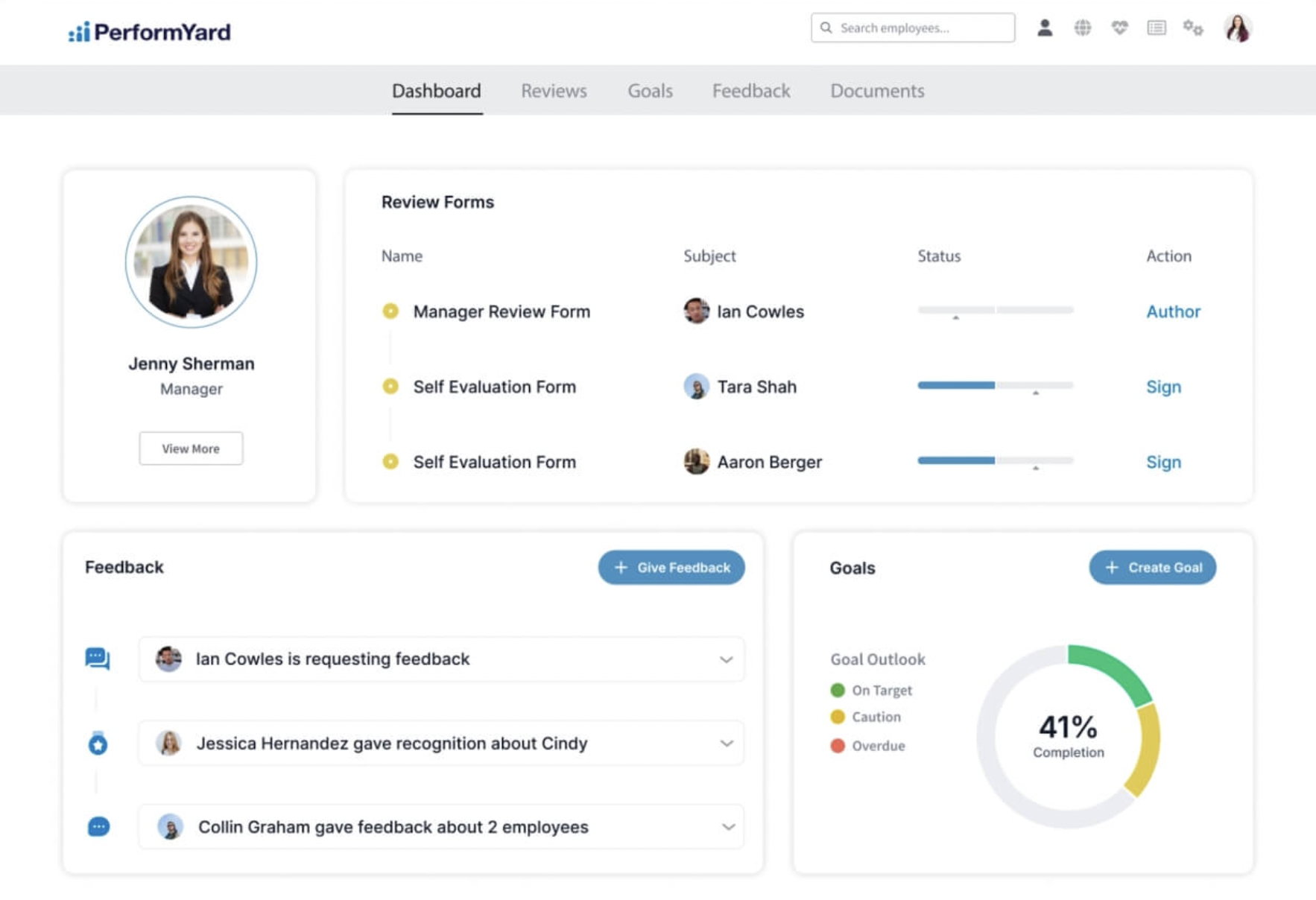
PerformYard does one thing exceptionally well: performance reviews. It concentrates on review-cycle depth — annual, quarterly, monthly, and 360 reviews mixed in one platform — with customisation that rivals tools twice its price and a dedicated success manager on every plan.
For teams whose main gap is a structured, compliance-friendly review process, it's among the best value in the market. The trade-off is the goal layer — OKR tracking is basic, there's no self-serve or free trial, and engagement and AI features are priced as add-ons that grow the headline $5/user rate.
Pricing: Core performance management from $5/user/month (custom quote); modules priced separately. Demo required; no free trial.
13. Teamflect
Best for: Microsoft 365 organizations that want OKRs, reviews, and feedback inside Teams
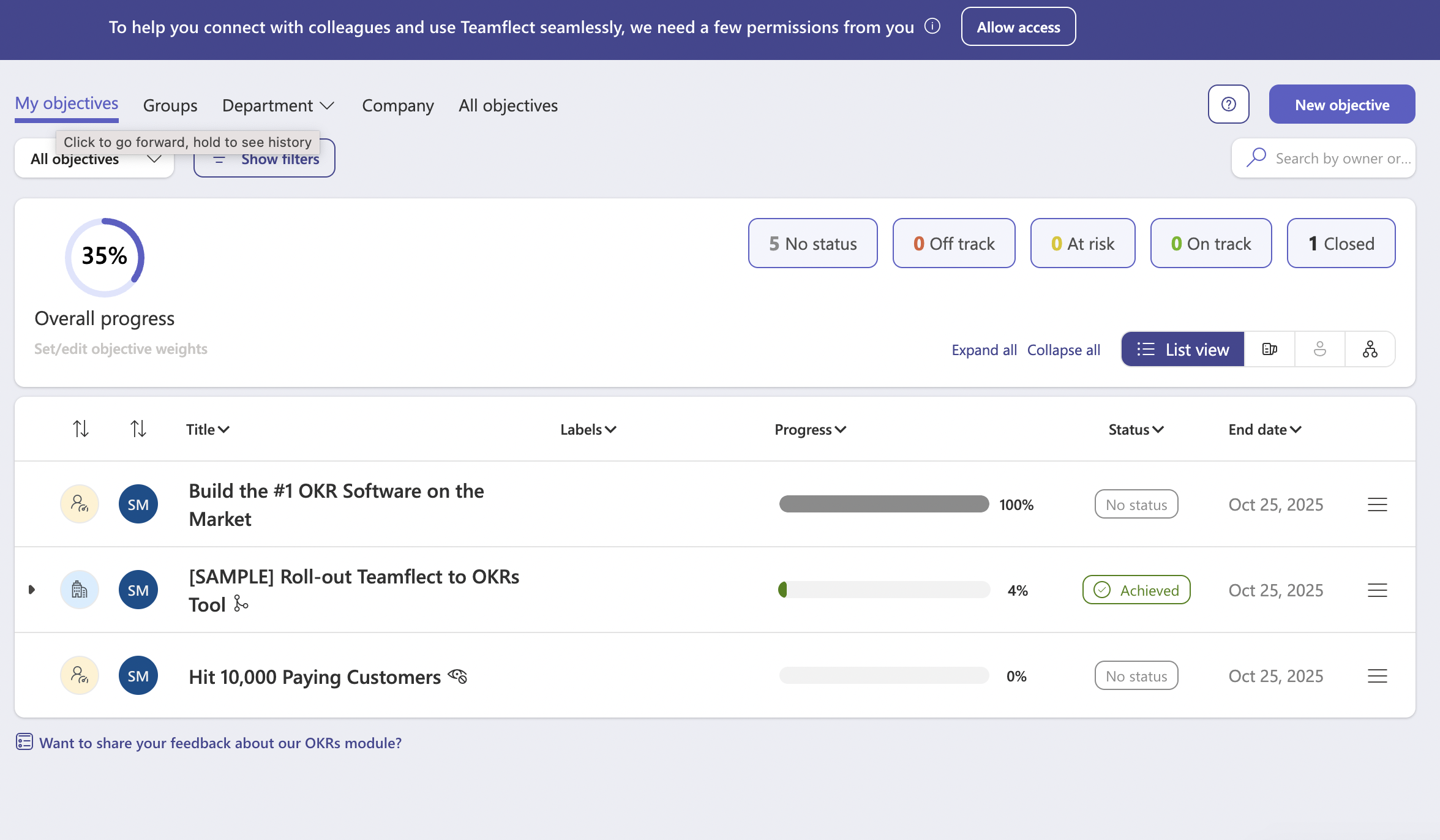
Teamflect is the only platform on this list built inside Microsoft Teams rather than alongside it — OKRs, performance reviews, 1:1s, and feedback all running in the interface your team already has open.
For organizations where the Microsoft 365 stack is non-negotiable and adoption depends on not adding another app, Teamflect removes every friction point. The free tier for up to 10 users is the most generous on this list.
The Microsoft dependency is the limitation — teams not on Microsoft 365 have no reason to consider it.
Pricing: Free for up to 10 users. From $3–7/user/month after that.
14. Primalogik
Best for: HR-led teams that want 360 feedback and engagement surveys alongside performance reviews
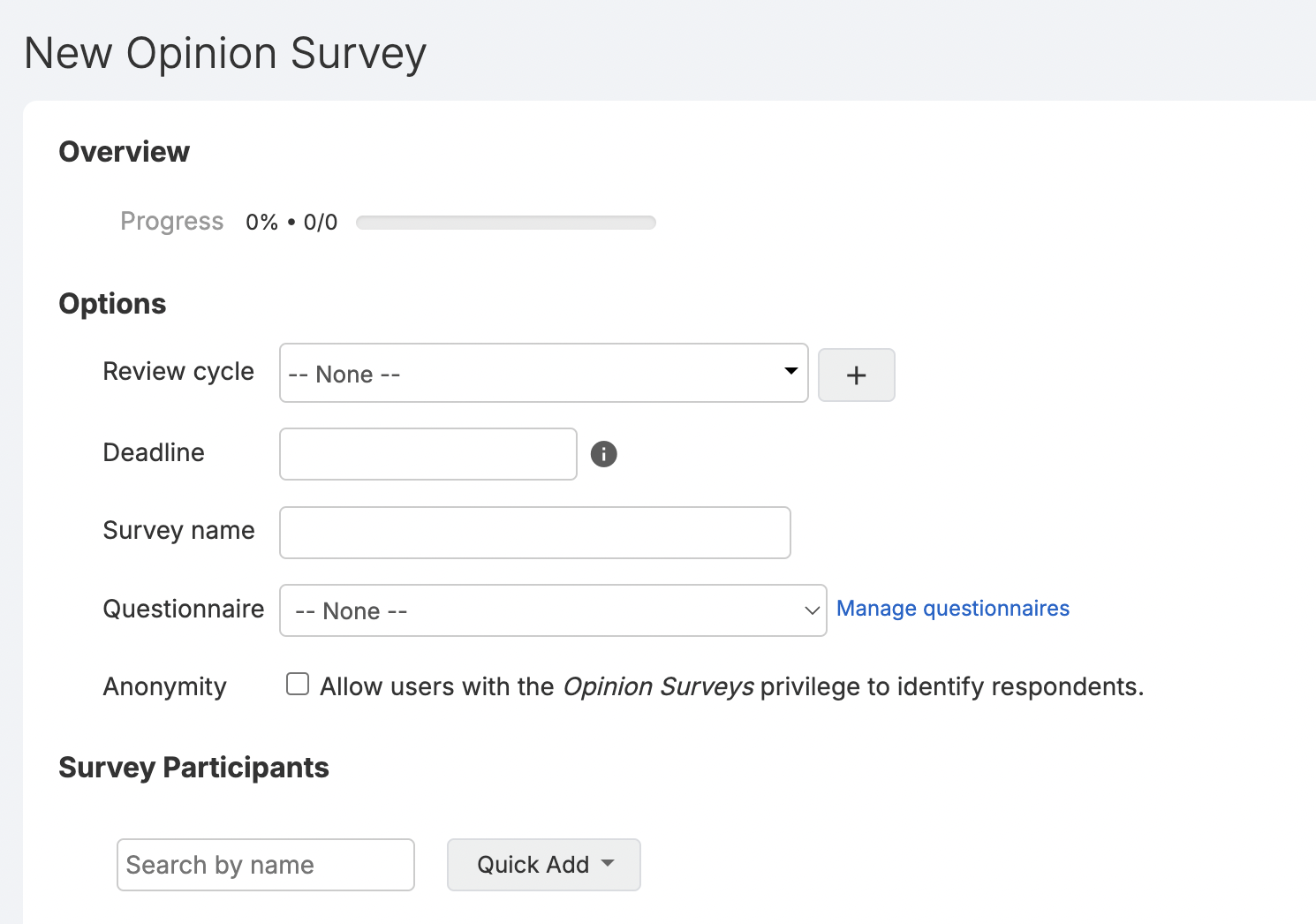
Primalogik combines OKR tracking, 360 feedback, engagement surveys, and performance reviews — with a 30-day free trial that provides full access to every feature.
The survey feature is genuinely differentiated — creating and distributing surveys to targeted groups from within the performance management workflow is something most platforms require a separate tool for.
The feature breadth creates a cluttered experience for teams that primarily need the goal execution layer. For organizations where OKR depth matters, simpler tools will produce better adoption.
Pricing: From $4–8/user/month. 30-day free trial, no credit card required.
15. Workleap
Best for: SMB and mid-market teams that want performance and engagement in one AI-driven platform with predictable, flat pricin
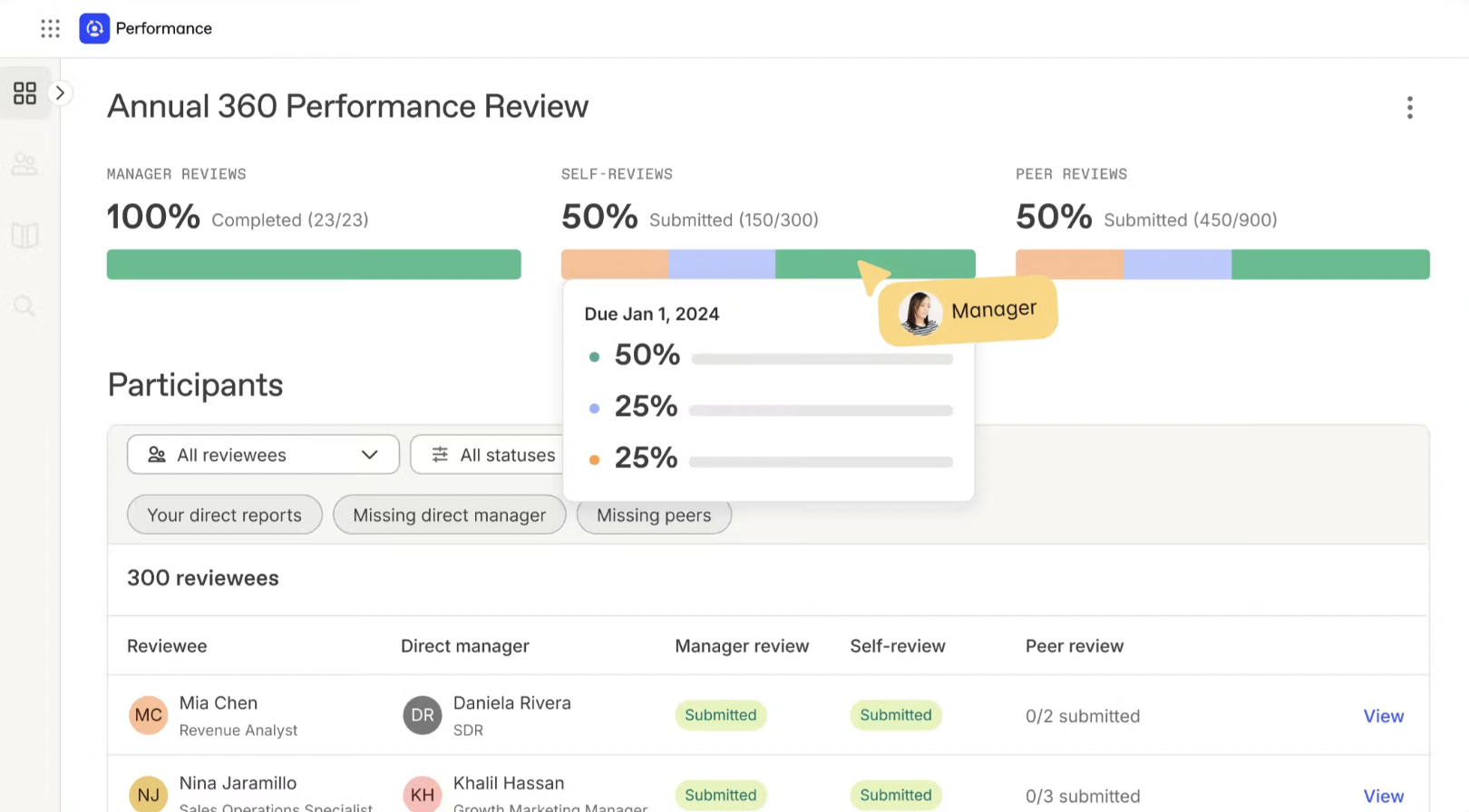
Workleap (behind Officevibe) has consolidated its formerly modular suite into a single AI-centered platform, repositioned around an always-on "Workleap agent" that drafts reviews, preps 1:1s, and surfaces engagement issues.
It covers end-to-end performance management, 360 reviews, team health and engagement reports, and an org chart, with AI summaries and chat throughout. The review-and-engagement combination is the core strength; this is culture-and-feedback software, not a dedicated strategy execution system.
The flat annual platform fee is the differentiator — predictable cost regardless of headcount, rather than per-seat pricing that scales with the org. The trade-off is a high entry point for smaller teams and no self-serve path.
Pricing: From $4,999/year. Billed annually, demo required.
16. HiBob
Best for: Global mid-market companies that want performance reviews connected to their core HR and compensation data
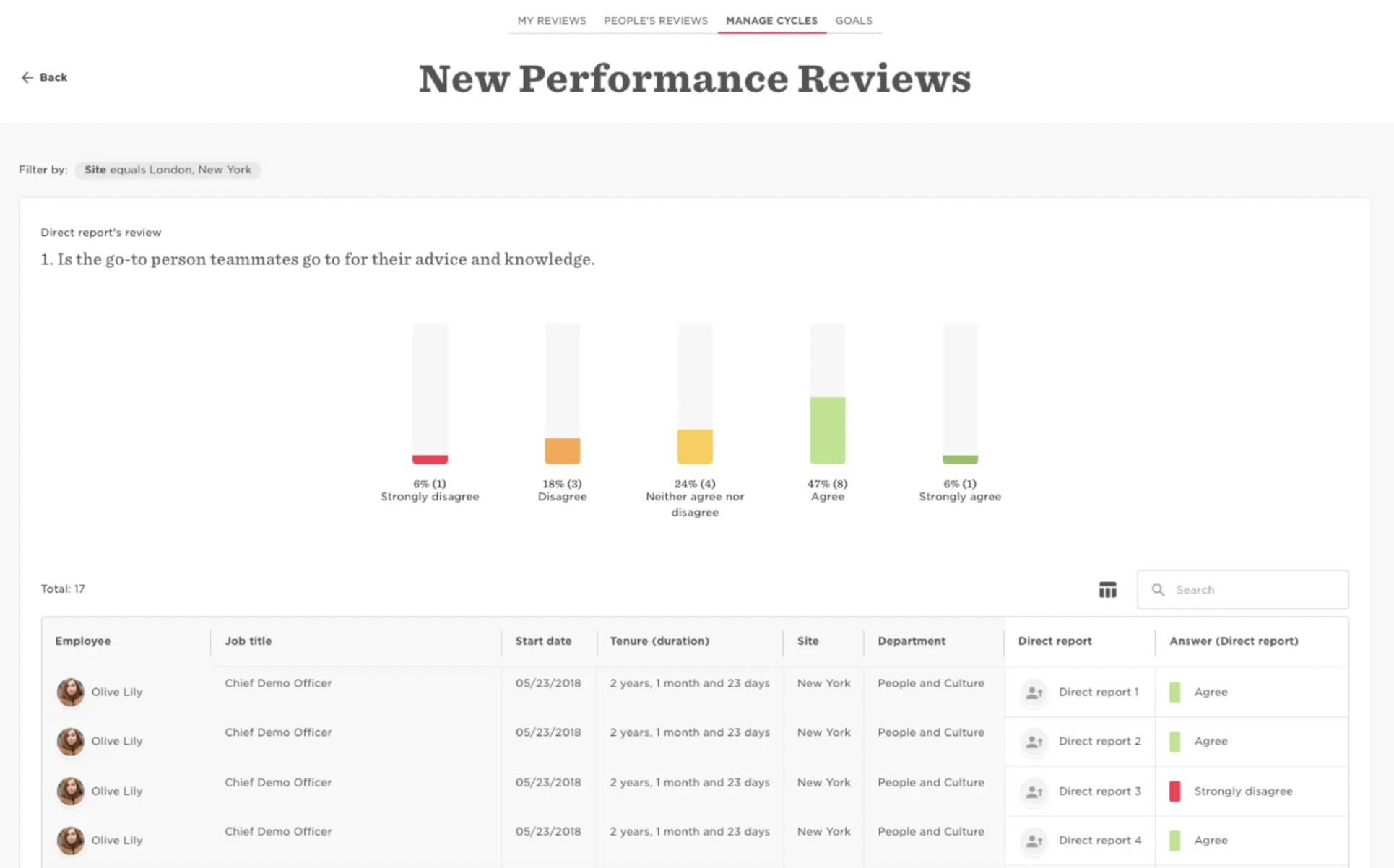
HiBob (known as Bob) approaches performance from the HRIS direction — reviews sit on top of a full HR system of record rather than standing alone. Because they live in the same system as headcount and compensation, review outcomes flow straight into merit planning and salary reviews, eliminating the sync problem between HR and performance tools. Configurable review cycles, 360 feedback, goal tracking, and 1:1 agendas are all there, backed by a strong analytics layer.
The performance layer is solid but built for a culture-first HRIS, not for organizations where deep, structured review cycles are the centerpiece. No public rate card, no free trial, and an implementation fee that rarely surfaces before signing add evaluation friction.
Pricing: Custom quote. Demo required.
17. Factorial
Best for: Growing SMBs that want performance reviews bundled into a broader HR platform
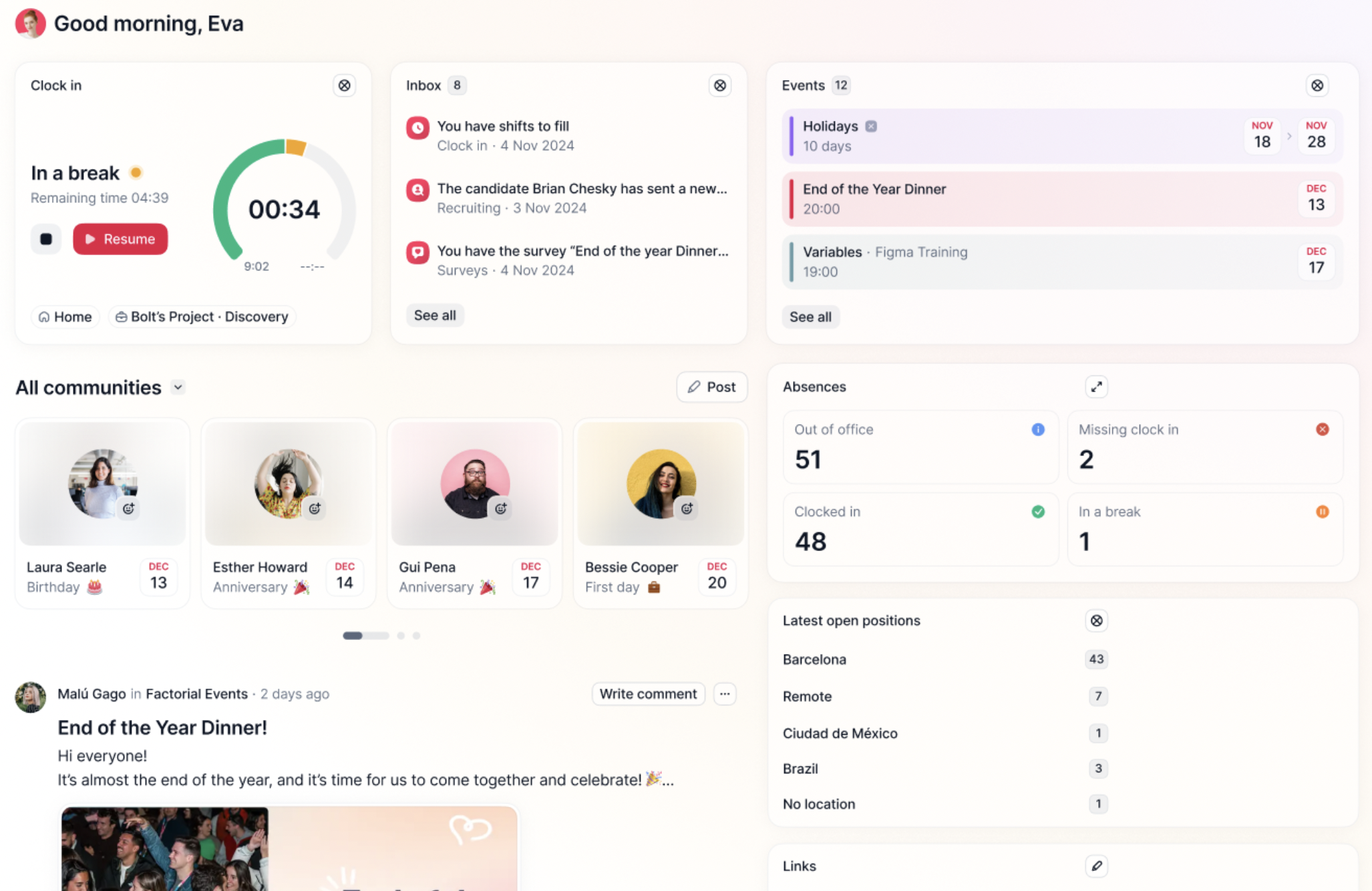
Factorial is an all-in-one HR platform — payroll, time tracking, recruitment, and performance management in one system — built mainly for small and mid-sized companies. Performance sits inside that wider suite, so review data lives next to the HR records that drive compensation and promotion decisions.
The module covers 360° reviews, 1:1s, competency tracking, and analytics, with Factorial AI writing review summaries. Goals and OKR tracking is a separate product, so teams buying for OKR execution assemble two modules rather than one. The goal layer is lighter than dedicated platforms, and there’s no self-serve free trial.
Pricing: Core platform from $8/user/month. Demo required.
Matching the Platform to Your Stage
Under 30 people, no platform is needed — informal conversations and a shared goal tracker cover it until reviews require documentation and consistency. Between 30 and 200, the answer is almost always OKRs Tool, Lattice, or Leapsome, depending on whether flat pricing, interface polish, or European infrastructure matters most.
All three make the goal-to-review connection structural and all three are self-serve. The deciding factor is usually how each handles OKRs in performance reviews — as context or as the rating itself.
Where the primary need is review depth rather than goal execution, PerformYard is the specialist; where OKRs run through a recurring business-review cadence, Peoplebox fits. Past 200 people with an enterprise compliance requirement, Betterworks is the strongest OKR-native option; where HR consolidation is the driver, Rippling. The pricing math is worth doing explicitly, because it's stark.
That's roughly a 5x cost difference for the same stage of organization. The ROI data shows purpose-built software generates a 1:88 return regardless of where on that spectrum you sit — the choice is structural, not cosmetic, and the flat-rate model is what keeps it from becoming a growth penalty.
The Connection Is What You're Buying
A performance rating is only as good as the record behind it, and the benchmark is blunt about how thin that record usually is: 66% of leaders trust their ratings, 27% could defend one, and just 8% run performance where the goals actually live. Every platform here connects goal delivery to reviews on paper — the ones worth choosing surface Key Result delivery, 360 feedback, and check-in history in one place, and configure the goal-to-rating link as informed context rather than a pass/fail verdict.
For a growing team, that combination is what turns a review from a recollection exercise into an evidence-based one, on pricing that doesn't punish headcount. A single platform that holds both the goal record and the review — with OKR-linked performance reviews and honest scoring — is what makes the connection structural rather than manual.
Read the full Performance Rating Benchmark Report for the data on what separates a rating you trust from one you can prove, and how the strongest teams close the gap.
Data: The Performance Rating Benchmark Report (230 People and HR leaders), the OKR Intelligence Report 2026 (222 organizations), and The State of Goal Management (210 employees). Competitor pricing and G2 ratings are subject to change; verify on each vendor's site.