
A performance management strategy is the set of organization-level decisions about how people get evaluated — cadence, visibility, tooling, and what a rating is allowed to rest on. These are leadership choices, not manager habits, and the benchmark data shows one of them decides careers on its own: 62% of leaders say remote and hybrid staff are rated lower on visibility alone.
Performance advice is usually aimed at managers: run better one-on-ones, give clearer feedback, reduce bias. That advice matters, but it operates inside a system leadership designed — and when the system is wrong, no amount of manager skill fixes it. Strategy is the layer above the manager: the decisions that determine whether a fair rating is even possible before any individual review happens.
Five of those decisions show up in the Performance Rating Benchmark Report, an independent survey of 230 People and HR leaders, as the places where organizations either build defensible evaluation or undermine it: how they handle visibility, how often they review, where they keep the record, what a rating is built from, and whether it can be defended afterward. Each is a strategic lever, and each is being pulled the wrong way in most companies.
Strategy One: Rate on Evidence, Not Visibility
The most consequential strategic flaw in modern performance management is that ratings track attention. Managers rate what they see, and in a distributed workplace — the norm for the 50–200-person companies this data covers — what they see is uneven.
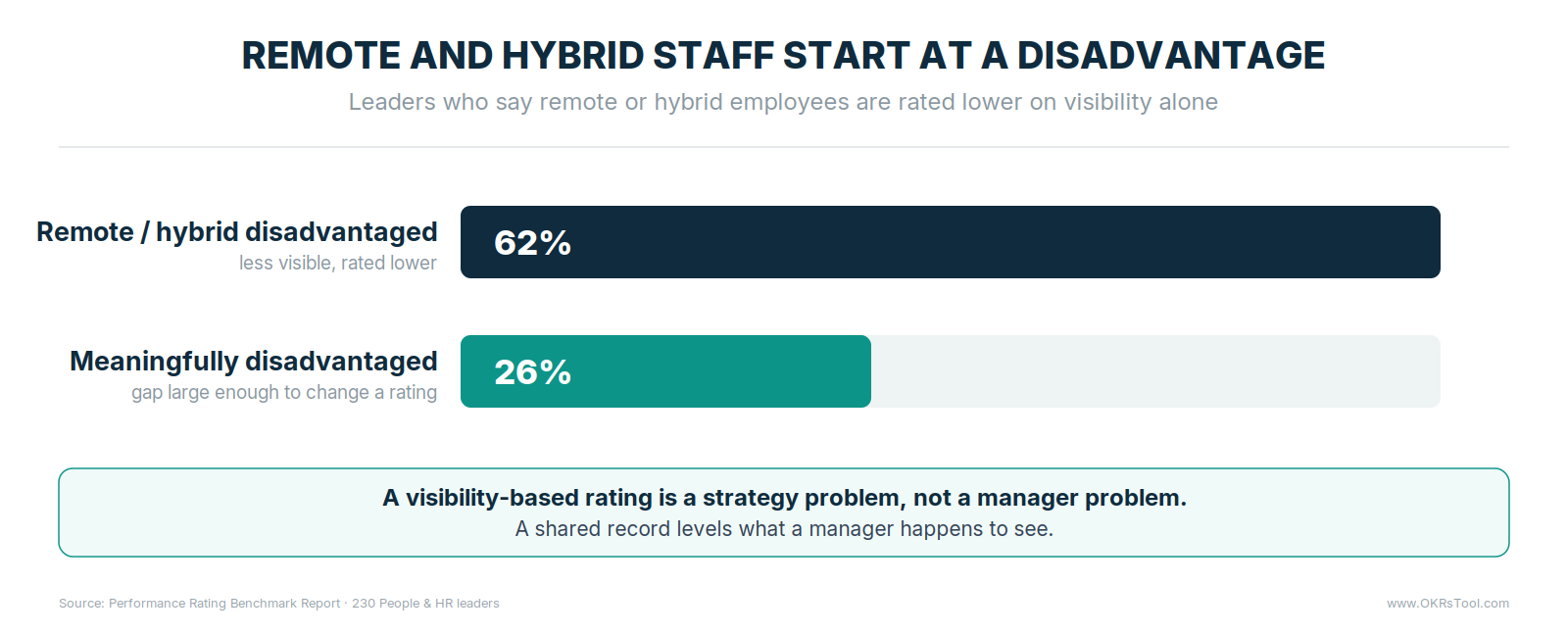
The report puts the effect at 62% — nearly two-thirds of leaders acknowledge that remote and hybrid employees are rated lower purely because they're less visible, with 26% saying the gap is big enough to change a rating outright. This is not a manager-training problem; it's a strategic one. As long as the rating draws on what a manager happened to observe, the employee three time zones away loses to the one who drops by the office, regardless of output.
The strategic fix is to move the basis of the rating from observation to record. When every employee's goals and progress live on a shared system, a manager evaluates delivery that's equally visible for everyone, each goal carrying a key result and an owner — the person in the room and the person on another continent share the same accountability footing, each tied to visible objectives and key results. A strategy built on a visible, shared record of team goals neutralizes proximity bias in a way no amount of manager awareness can.
Strategy Two: Set a Cadence That Keeps the Record Warm
How often an organization reviews performance is treated as an administrative setting. It's actually a strategic decision about how much a rating will depend on memory.
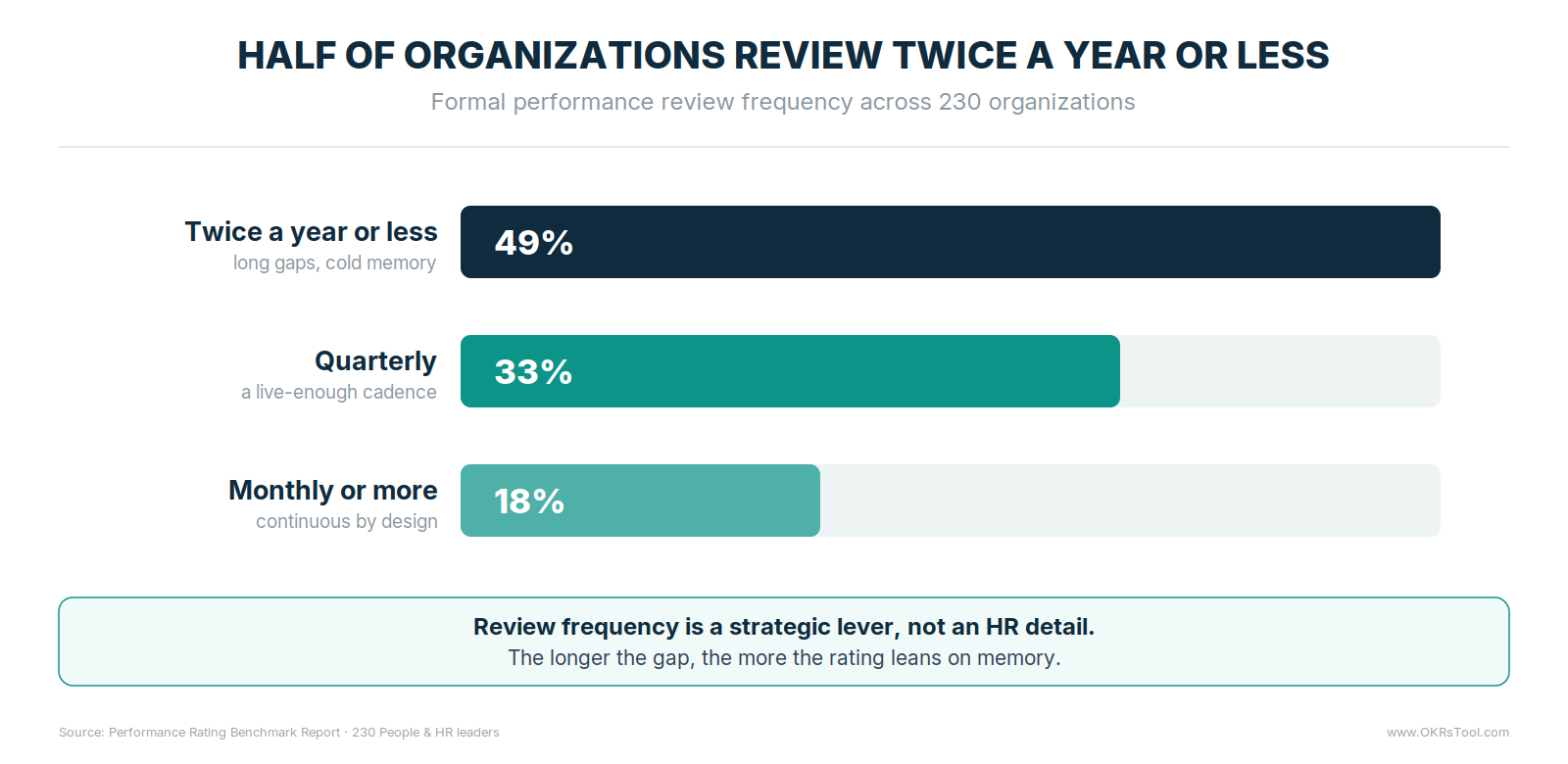
Nearly half of organizations — 49% — run formal reviews twice a year or less. A six-month gap between reviews guarantees that the evaluation leans on whatever the manager can recall, which favors the recent and the memorable over the sustained — the recency problem in its purest form. Quarterly review, run by 33%, tightens that window and matches a natural OKR cycle; the 18% who review monthly or more — closer to a true continuous cadence — make the formal event almost a formality, because the record is already current.
Cadence strategy has little to do with reviewing more for its own sake. The goal is to shorten the distance between when work happens and when it's assessed, so the assessment reflects the work. A frequent, lightweight check-in running on a steady cadence feeds a shared record and does more for rating quality than a heavier annual process, because it keeps evidence fresh. Organizations moving toward continuous performance management are making exactly this bet: many small observations beat one large reconstruction.
Strategy Three: Consolidate Where Performance and Goals Live
The final strategic decision is architectural, and it shapes the other two. Where the goal record and the performance review physically live determines whether a shared-evidence strategy or a warm-cadence strategy is even achievable.
When goals sit in one system and reviews in another, keeping them synchronized is manual work — the kind of overhead that makes OKRs fail — that fails under pressure — so the shared record erodes and the frequent cadence lapses, no matter how well they were designed. Consolidating both onto a single platform, the way the whole process connects, is what makes the first two strategies durable rather than aspirational.
The record stays current because updating it is the same action as doing the work, and every review pulls from the same live source. This is why goal management and evaluation increasingly run on shared infrastructure: split them across tools and both degrade at once.
There's a measurement dimension too. A consolidated system produces the data to check whether the strategy is working — whether remote and in-office ratings have converged, whether reviews actually reference goal data through proper tracking. Strategy without that feedback loop is guesswork; a connected performance review process generates the evidence that the strategy itself is sound.
Strategy Four: Make Goal Achievement the Unit of Evidence
A rating has to be built from something, and the strategic question is what.
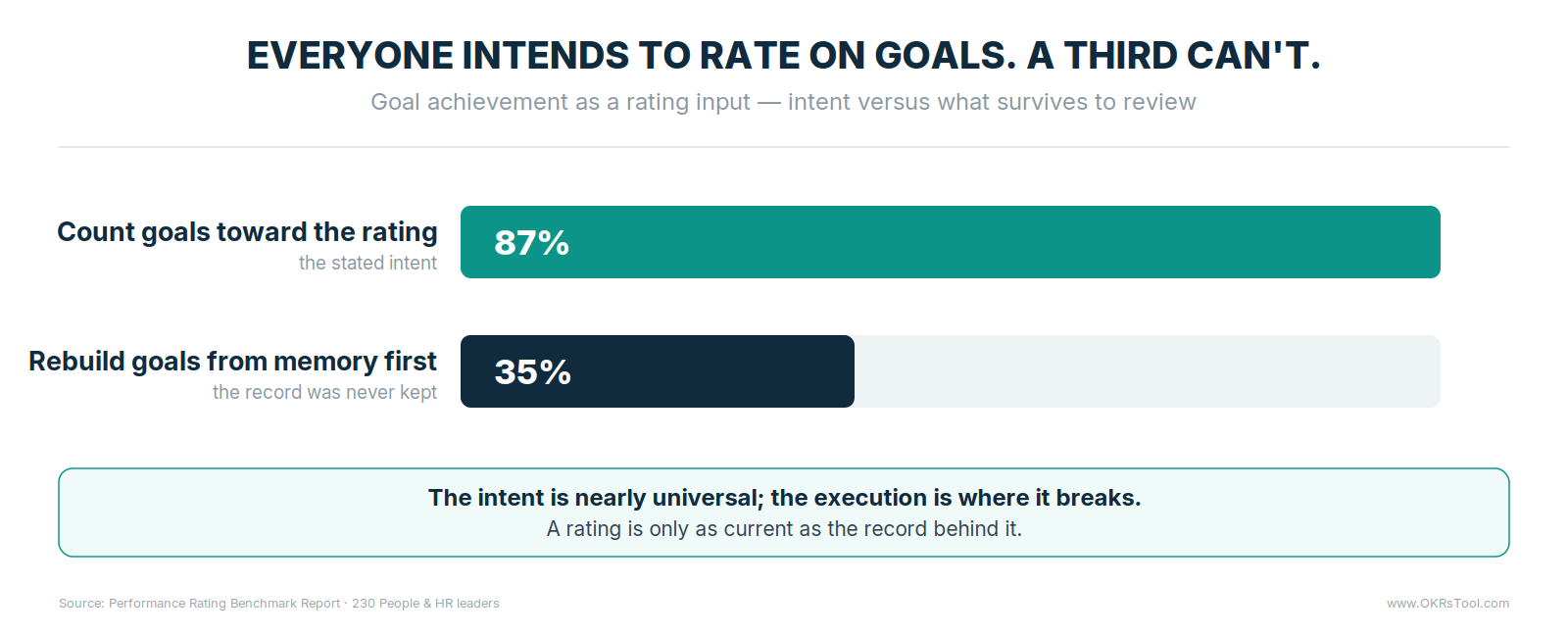
When leadership leaves that unspecified, managers fall back on impression; when it's defined as goal achievement, the rating has a concrete anchor. Nearly every organization intends this — 87% count goal achievement toward the score. Where it breaks is that 35% end up rebuilding those goals from recollection at review time, because nothing kept them current enough to cite directly.
The strategic move is to make the goal record itself the primary evidence, not a supporting document someone rebuilds afterward. That means every objective carries a measurable key result with a named owner, updated as work happens, so that at review time the goal is the evidence rather than a prompt for recollection.
A rating anchored to a live goal record cites what happened and when; one anchored to goals rebuilt from memory is impression relabeled as data. Choosing which of those a review produces is a leadership decision about how goals are managed, made long before the review itself.
Strategy Five: Design for Defensibility From the Start
The last strategic lever is whether a rating can survive being questioned. Few can: only 27% of leaders say a manager in their organization could defend every rating with goal evidence, and 65% have seen a rating no one could back up when it was challenged. A rating that collapses under a single "why?" is a liability the whole system inherits.
Defensibility gets designed into the process upstream rather than bolted on at review time, through calibration that compares managers against a common standard and a clear scoring method and a record complete enough to answer challenges. The strategic test is simple: for any rating the organization produces, could the manager show the evidence behind it, drawn straight from the goal record, without reconstructing anything?
When the answer is yes across the board, the program can withstand scrutiny from employees, from HR, and from a court if it comes to that. When it's no, every rating is a dispute waiting to happen. Building accountability into the rating from the outset is what turns a review from a defensible act into a vulnerable one.
Sequencing the Five
These strategies reinforce each other, but they have an order. Consolidation comes first, because it's the enabler — without a single system, the shared record and the tight cadence can't hold, and neither can the goal-evidence and defensibility strategies that depend on that record existing. Once goals and reviews share a home through a single source of truth, making the record visible to every manager addresses the visibility gap, and setting a real cadence — even a weekly check-in — keeps that record warm. With a current, shared record in place, building ratings from goal achievement and designing for defensibility become natural rather than effortful, because the evidence they require is already there. A leadership team that tries to fix visibility bias while goals and reviews stay in separate tools will watch the fix decay within a cycle.
The common thread is that every strategy moves the rating away from a manager's individual perception and toward a shared, current, factual record. That's the strategic through-line of modern performance management: reduce how much any rating depends on what one person happened to notice, a step toward real performance accountability, and increase how much it rests on what the organization can see together.
Strategy Is Deciding What a Rating Rests On
Every performance management strategy is, at bottom, a decision about the foundation under a rating, and the five levers each shape a different part of that foundation. Visibility sets whether the ground is level or tilted toward whoever the manager sees most, while cadence keeps the evidence current instead of reconstructed.
Architecture holds the record together rather than letting it fracture across disconnected tools, and the way a rating is built and defended is what makes it stand up rather than simply get asserted. A skilled manager works on top of all five, but no amount of individual skill can rescue a rating whose foundation leadership laid down wrong.
Seen that way, the 62% visibility gap and the 49% who review twice a year or less stop looking like failures of managers doing their best with what they can see and remember, and start looking like the predictable output of strategic defaults nobody ever went back to question. When leadership changes those defaults — consolidating goals and reviews onto one shared record, keeping it current, and holding every rating to the same evidentiary bar — the manager's job gets easier and the rating gets fairer in the same move, because both finally draw on the same evidence instead of the same guesswork.
Data: The Performance Rating Benchmark Report, an independent survey of 230 People and HR leaders at technology companies of 50–200 employees.