
A review anchored to Key Result delivery turns a missed goal into next-cycle information. A review that converts the score into the rating turns the same miss into a performance event — and teaches 96% of people to sandbag the next target.
A performance review built on OKRs replaces memory and impression with a shared record of what the team committed to and what actually moved. Most reviews fail quietly — everyone nods, the meeting ends on time, and nothing changes the next quarter — because the review is disconnected from execution. OKRs close that gap by giving both sides the same reference point.
The catch is in how the OKR data is used. Anchoring the conversation to delivery makes it fairer and more specific; wiring the Key Result score straight into the rating makes it dishonest. The State of Goal Management found that 96% of employees sandbag when goals directly affect ratings, against 81% when they're kept separate. This guide covers how to run an OKR-based review — timing, structure, feedback, and close — so it improves execution rather than corrupting it.
Why OKRs Make a Better Anchor Than "Performance"
Traditional reviews open with questions that invite opinion: how did this person perform, are they meeting expectations, what are their strengths and weaknesses. Those questions sound reasonable and produce vague, memory-based answers.
OKRs narrow the conversation to something observable. What outcomes did we commit to, which ones moved, which didn't and why, and what tradeoffs got made under pressure. Anchoring the review to Key Result delivery makes performance concrete rather than abstract — and the shift from effort to outcomes is what makes it fairer, especially on fast-moving teams where effort and impact don't always match.
When to Run the Review
Timing decides whether a review feels useful or performative. The most effective OKR-based reviews happen immediately after the OKR cycle ends, while the context is still fresh and before the next cycle locks in.
The order is what matters. Weekly check-ins handle execution, the end-of-cycle OKR scoring handles outcomes, the performance review handles reflection, and then the next cycle's OKRs handle adjustment. A review sequenced this way shapes what happens next rather than documenting what already happened, which is the difference between a forward-looking conversation and a backward-looking one.
Who Belongs in the Room
The fastest way to weaken an execution-focused review is to involve too many people. At this stage the review aligns one employee and one manager on a shared set of outcomes — clarity beats inclusiveness.
Peer reviews, anonymous feedback, calibration panels, and HR intermediaries each have a place in a mature performance program, but they diffuse ownership in a review meant to align on reality and focus. That said, a tight rating link still benefits from one safeguard: OKR calibration across teams keeps a 0.7 in one team meaning the same as a 0.7 in another, so the delivery data stays comparable before it ever informs a rating.
Structure the Conversation: Self-Reflection First
OKR-based reviews work best with a consistent, predictable structure rather than an improvised one. The employee reflects first, before seeing the manager's perspective, against prompts focused on execution rather than self-judgment — what went well, what didn't go as planned, where they felt blocked, which outcomes best represent the work, and what they'd approach differently.
Self-reflection first surfaces context the manager can't see from a dashboard: the hidden constraints, dependencies, and tradeoffs behind a number. It also lowers defensiveness, because the employee frames the cycle before any evaluation lands.
Then Add the Manager's Perspective
The manager's job in an OKR-based review is to interpret patterns, not to grade. Strong manager feedback identifies where delivery was strong, where execution fell short, which outcomes mattered most, and what should change next cycle — the same lens that makes an outcome-focused 1:1 useful between reviews.
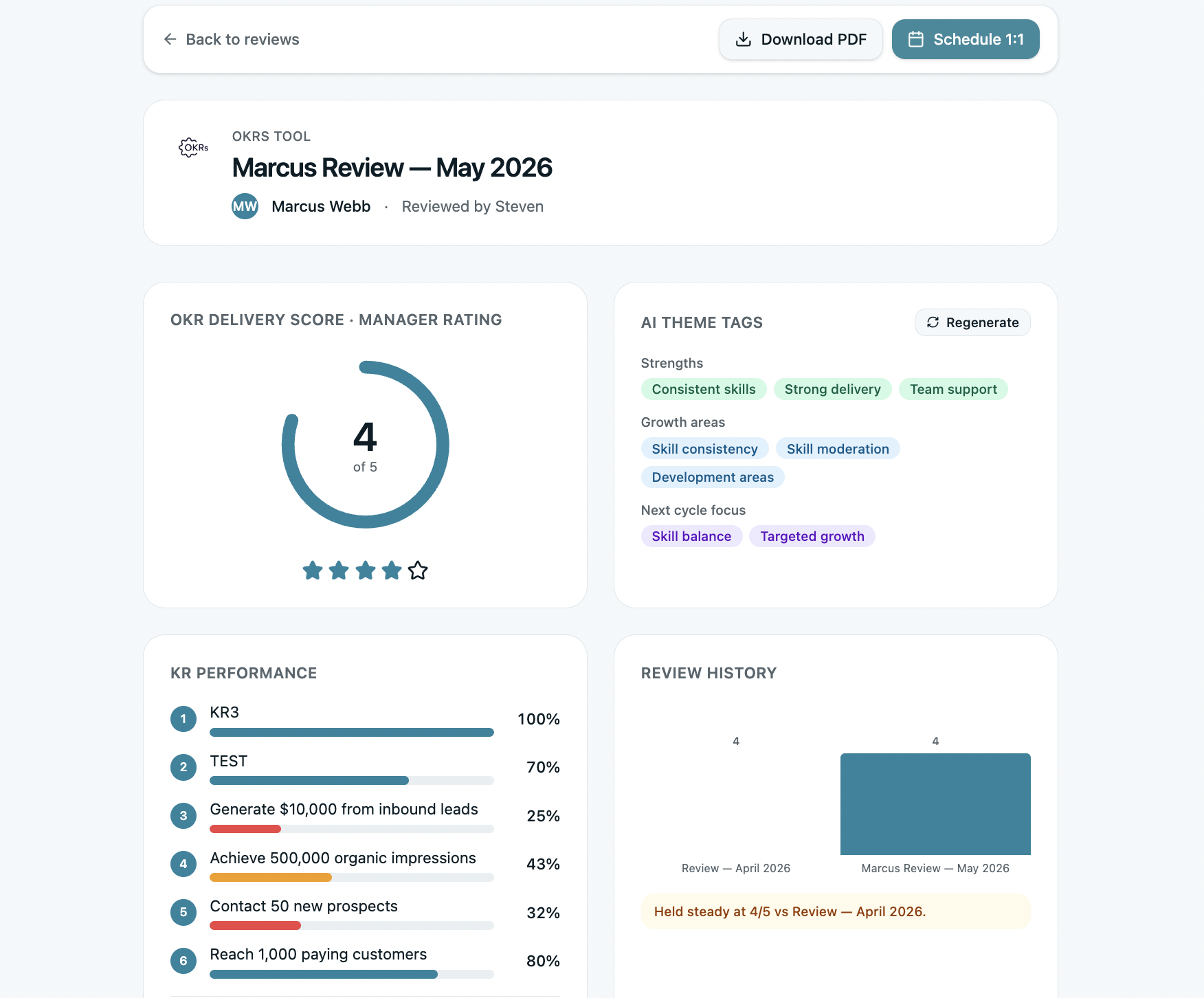
Ratings can exist, but they should never drive the conversation. If the narrative isn't clear without a number, the number won't rescue it — and the data shows why leaning on the number backfires.
Keep the Score Out of the Verdict
The single configuration choice that determines whether an OKR-based review helps or harms is how tightly the Key Result score is bound to the rating. Binding them tightly feels like the way to make goals count, and it's the strongest driver of goal-gaming in the data.
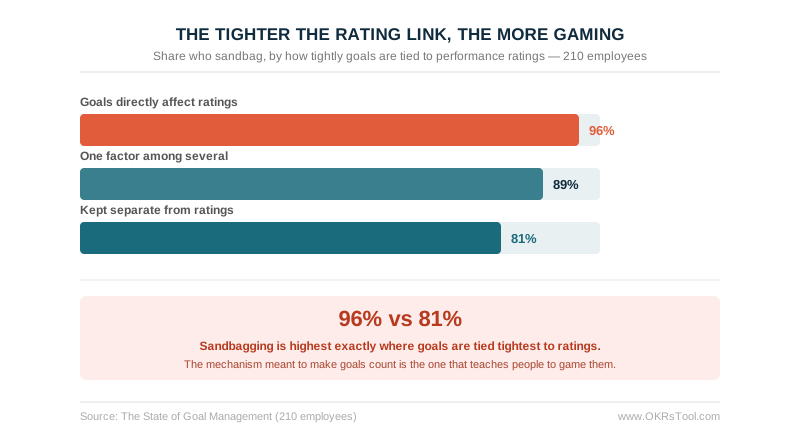
A tight rating link produces sandbagged targets and the watermelon pattern, where a goal reads green while the reality is red. Keeping OKR delivery as one input among several — alongside 360 feedback, manager judgment, and self-assessment — preserves the accountability without the gaming, and an environment with psychological safety to miss an ambitious goal is what makes honest scores possible at all.
What Good OKR-Based Feedback Sounds Like
The sharpest divergence between OKR-based and traditional reviews is in the specificity of the feedback. Vague feedback goes nowhere because it gives the other side nothing to act on.
The difference is specificity, not tone. A shared OKR reference point reduces both defensiveness and ambiguity, because the conversation is about a documented outcome rather than a personal impression.
The Same Miss, Two Different Reviews
How a review handles a missed goal is where its whole character shows. The OKR Intelligence Report 2026 found that the response to a miss splits sharply by how a team sets goals: collaborative teams analyze the miss in a retrospective and feed it into the next cycle, while top-down teams turn it into a formal accountability conversation.
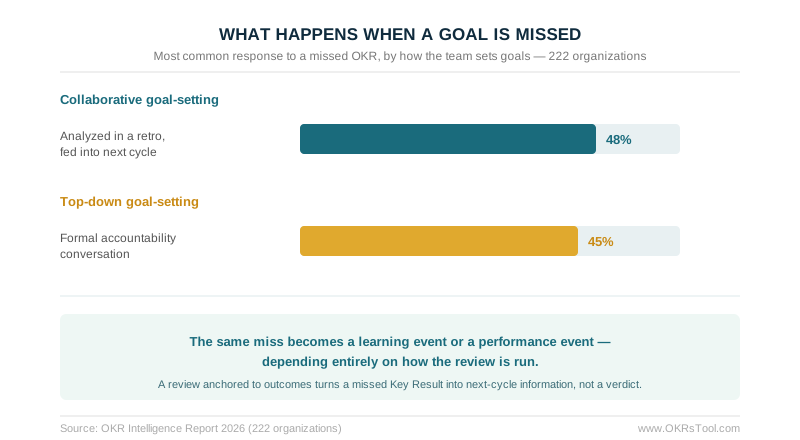
A missed Key Result is information, not an accusation. Treating it as the former turns the review into a retrospective that improves the next cycle; treating it as the latter teaches the team to sandbag so the miss never happens again on paper.
The most common ways managers undermine an OKR-based review all share this root — talking about effort instead of outcomes, avoiding the missed bets, turning execution problems into personality judgments, treating the review as a verdict rather than a course-correction, and ending without changing anything for next cycle.
How to Close So the Review Matters
A review should end with clarity, not consensus. Before the conversation ends, both sides align on the two or three takeaways that matter most, what should change next cycle, and what should stay the same — captured in a short written summary, not a long document.
The real test comes a week later: did the conversation change how the next quarter will run? If the answer is no, the review failed regardless of how positive it felt. A review that reshapes the next cycle's priorities, behaviour, or OKRs has earned its place; one that only documents the last cycle is a continuous record the team already had.
Run Reviews on Delivery, Not Memory
An OKR-based review surfaces tradeoffs, missed bets, and priorities that didn't hold under pressure — which makes it uncomfortable in the productive way. That discomfort is the signal the review is anchored to real execution rather than impression.
Run the review right after the cycle, reflect before grading, keep the conversation on outcomes, and hold the score out of the rating. When a dedicated performance management platform makes sense, the deciding factor is how loosely it holds that rating link.
See how the OKRs Tool platform surfaces Key Result delivery and check-in history in the review itself, on flat pricing built for growing teams — so every review starts from the record instead of from memory.
Data: The State of Goal Management (210 employees), OKR Intelligence Report 2026 (222 organizations), The 2026 OKR Benchmark Report (330 organizations).