Every OKR cycle ends with the same moment: the quarter is either winding down or officially closed, and teams pause long enough to ask a deceptively simple question:
"When should we run our OKR retrospective — before the cycle ends, or after?"
It sounds like a matter of scheduling. It isn't.
The timing of the reflection meaningfully shapes the quality of insights, the honesty of scoring, and the momentum of the next cycle. For growing teams where execution speed matters, this timing choice has an outsized impact on what the team actually learns.
After reviewing thousands of Key Results in our benchmark dataset, one pattern is unmistakable: teams that consistently run well-timed reflections outperform those that treat retrospectives as optional or purely ceremonial. The data is precise — teams who skip retrospectives complete 30–45% fewer OKRs in the following cycle. And by cycle 5+, teams that have maintained a consistent reflection habit complete 20.3% more goals than those still in their first two cycles.
The 1:25 ROI that OKRs generate doesn't come from goal-setting alone. It comes from the learning loop that retrospectives create — the compounding improvement that makes each cycle sharper than the last.
But when that reflection happens — just before or just after the cycle closes — changes what the team learns and how effectively they apply it.
Below is a grounded, opinion-driven comparison of both approaches, including what our data suggests and what actually works inside fast-moving organizations.
Reflecting Just Before the Cycle Ends
This approach is far more powerful than most teams realize.
A "pre-close" reflection happens when there is still a bit of time left in the cycle: usually 3–7 days before the final OKR update. Metrics are still shifting, conversations are still active, and the emotional distance from the work hasn't yet set in.
Why this moment matters
A pre-end reflection captures the quarter while it's still alive. Teams haven't rewritten the narrative of what happened, and there's still an opportunity to adjust course.
Advantages
1. You get more honest learning.
Once a cycle is officially over, people tend to rationalize. Misses start to feel "understandable," initiatives get reframed as "good attempts," and the sharp edges of the truth soften. But just before the cycle closes, the work is still unedited.
2. There's still time to course-correct.
Not all insights need to wait until next quarter. Often, a KR is one initiative away from meaningful progress — but teams only realize this when they're forced to reflect while the window is still open.
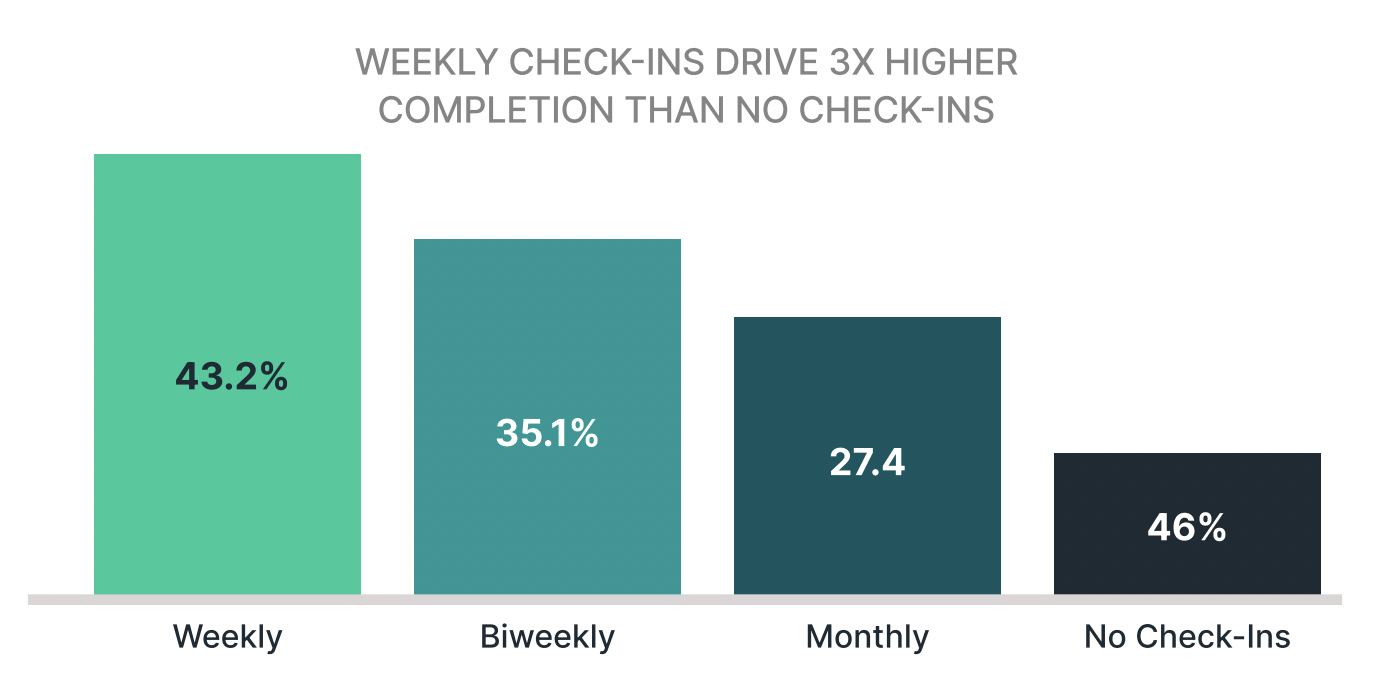
This is particularly valuable because weekly check-ins remain the strongest predictor of OKR success in our research — teams with a weekly habit are 43% more likely to complete their OKRs. Pre-end reflections capture this same spirit: learning while execution is still happening.
3. Psychological safety is higher.
Reflecting before the quarter ends removes the feeling of "grading." Teams are not being evaluated on failure or success — they're examining the system. This almost always creates a more productive, blame-free conversation. The benchmark data confirms this: 72% of high-performing OKR teams operate in environments where missing a goal feels at least somewhat safe. Pre-end reflections structurally support that environment.
Drawbacks
1. The data isn't final.
Some teams prefer to work with completed numbers. If precision matters more than learning, this timing may feel premature.
2. It can unintentionally signal "the cycle is over."
If not framed carefully, a pre-end reflection can make the team mentally close out the quarter earlier than intended.
3. It can collide with planning.
Teams with short turnarounds between cycles may find that reflection and planning start to overlap.
Reflecting Just After the Cycle Ends
This is the more conventional approach: wait until every KR has a final score, every initiative has been updated, and the quarter has a clear ending.
Why this moment matters
A post-cycle review offers clean, stable data. Teams are no longer in execution mode, which makes it easier to zoom out and look for patterns.
Advantages
1. You review the entire story, end to end.
Once everything is finalized, teams can clearly see where performance accelerated, where it stalled, and how their execution rhythm held up.
This reflection moment is far more important than most teams realize — our data shows that teams who skip retrospectives complete 30–45% fewer OKRs in the following cycle. Without this learning loop, mistakes repeat and calibration steadily drifts off course.
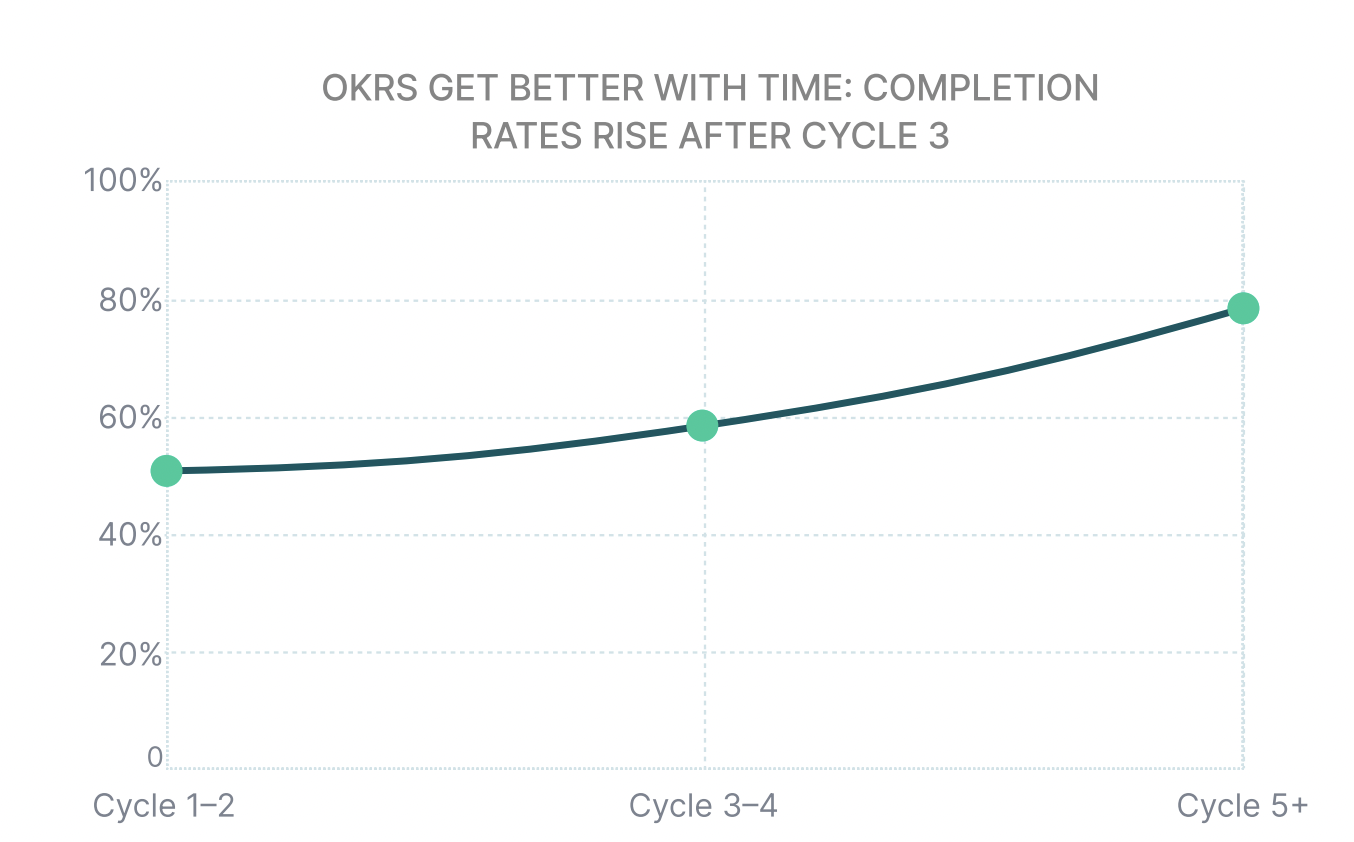
This aligns with the data showing that OKRs become significantly more effective by cycles 4–5, when teams have learned how to interpret patterns rather than individual moments.
2. Ownership is fully visible.
There's no ambiguity about who did what and how consistently. Teams can evaluate quality of planning, quality of execution, and health of habits. A post-cycle retro is powerful for improving structure.
3. It suits mature teams.
For mature teams with strong weekly habits and clean OKR hygiene, a post-cycle reflection is an excellent way to fine-tune long-term strategy.
Drawbacks
1. Narratives get rewritten.
Humans edit their own memories. Once the cycle is over, people unconsciously smooth the rough edges: wins feel bigger, misses feel more justified, and root causes become less clear.
2. You lose the ability to make late improvements.
Many teams don't realize they had the ability to salvage a struggling KR until it's too late.
3. Attention has already shifted.
Once a cycle ends, minds are already on planning and next quarter's priorities. This can make reflection feel rushed or secondary.
So Which Is Better?
For most growing teams — especially those still building OKR muscle — the answer is clear:
Reflect just before the cycle ends.
It produces better learning, stronger accountability, and more corrective action. It also reduces narrative distortion and improves the accuracy of future planning.
As teams mature, however, the value of a post-cycle review increases. Well-established OKR teams benefit from analyzing complete datasets and identifying strategic trends cycle over cycle.
But the smartest teams do something else entirely.
The Best Approach: Use Both — for Different Purposes
A healthy OKR system actually benefits from two reflections:
1. A lightweight pre-end reflectionUsed to identify blockers, catch KR-quality issues, adjust final efforts, and surface honest feedback.
2. A structured post-cycle reflectionUsed to analyze performance patterns, calibrate future goals, refine OKR types (Committed vs. Aspirational vs. Learning), and improve the system itself.
These two moments serve different purposes — one improves execution, the other improves strategy. When teams combine both, they create a continuous improvement loop where OKRs get sharper every quarter.
This compounding effect is exactly what the maturity curve data reflects: the teams generating the highest OKR returns aren't doing anything exotic — they've simply built consistent reflection habits and maintained them across multiple cycles.
A Quick Comparison: Pre-Cycle vs. Post-Cycle Reflection
Before deciding which approach fits your team, it helps to see the strengths and tradeoffs side by side.
Both reflection moments deliver value, but each supports a different part of the OKR system — execution on one side, strategic judgment on the other.
Final Thoughts
The question isn't really when to reflect. It's what kind of learning your team needs most:
- If you want better execution — reflect before the cycle ends.
- If you want better planning — reflect after the cycle ends.
- If you want a better system — intentionally use both moments.
OKRs don't succeed because of ambition — they succeed because teams learn continually, adjust early, and improve their execution rhythm quarter after quarter. The 30–45% completion lift from consistent retrospectives isn't a small gain. It's the difference between an OKR program that compounds and one that stalls.