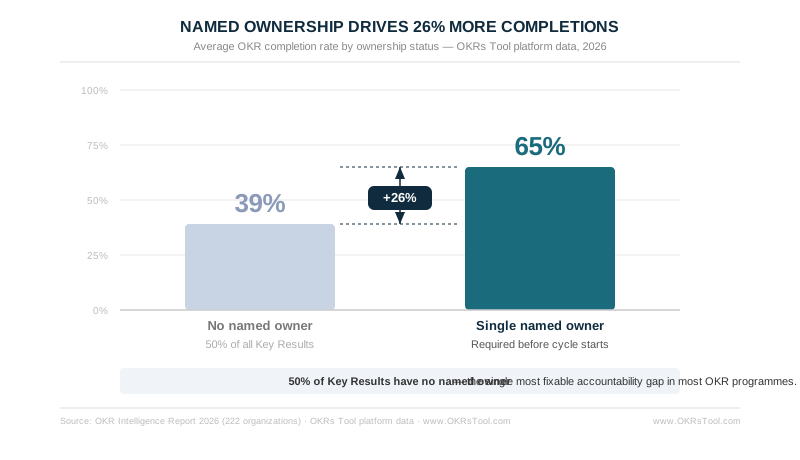
50% of all Key Results across growing organizations have no named owner. 26% higher completion rates come from teams that enforce single ownership. The accountability problem isn't motivational — it's architectural.
Every leadership team believes in accountability. Most don't have a structural mechanism to enforce it.
The gap between intention and infrastructure is where accountability breaks down. A VP says the product launch is her priority. A Head of Sales says pipeline growth is his. But there's no named owner per Key Result, no required update cadence, and no system that makes ownership visible to the rest of the leadership team. Three weeks into the quarter, the goals that were set in the planning session are invisible.
This isn't a leadership quality problem. It's an OKR structure problem. And it's more common than most organizations recognize.
Why Leadership Accountability Breaks Down
The OKR Intelligence Report 2026 found that 50% of all Key Results across growing organizations have no named owner. Not a vague owner — no owner at all. The goal exists in the system with a metric and a target and nobody explicitly accountable for whether it moves.
At the leadership level, this problem is amplified by the nature of senior roles. VPs and department heads own outcomes across teams, functions, and time horizons. Ownership gets diffused — a company Key Result gets attributed to "the leadership team," an initiative gets described as "a cross-functional effort," and accountability dissolves into collective responsibility that belongs to everyone and nobody.
The result is the pattern the benchmark data captures: 7% of off-track Key Results are simply abandoned mid-cycle — informally dropped with no revision, no escalation, and no consequence. At the leadership level, an abandoned Key Result doesn't just miss a metric. It signals to the organization that the goals set in the planning session are aspirational rather than binding.
What Real Leadership Accountability Looks Like
Real accountability has three components — and all three need to be structural, not dependent on culture or goodwill.
Named single ownership per Key Result. Not a team. Not "jointly." One named person who updates the Key Result weekly, escalates when it stalls, and owns the score at cycle end. The 2026 OKR Benchmark Report is precise: teams with required single ownership see 26% higher completion rates than those with shared or implicit accountability. At the leadership level, that means the CFO owns the revenue KR, the CTO owns the engineering velocity KR, and the CMO owns the pipeline KR — each named explicitly before the cycle starts, each visible to the full leadership team.
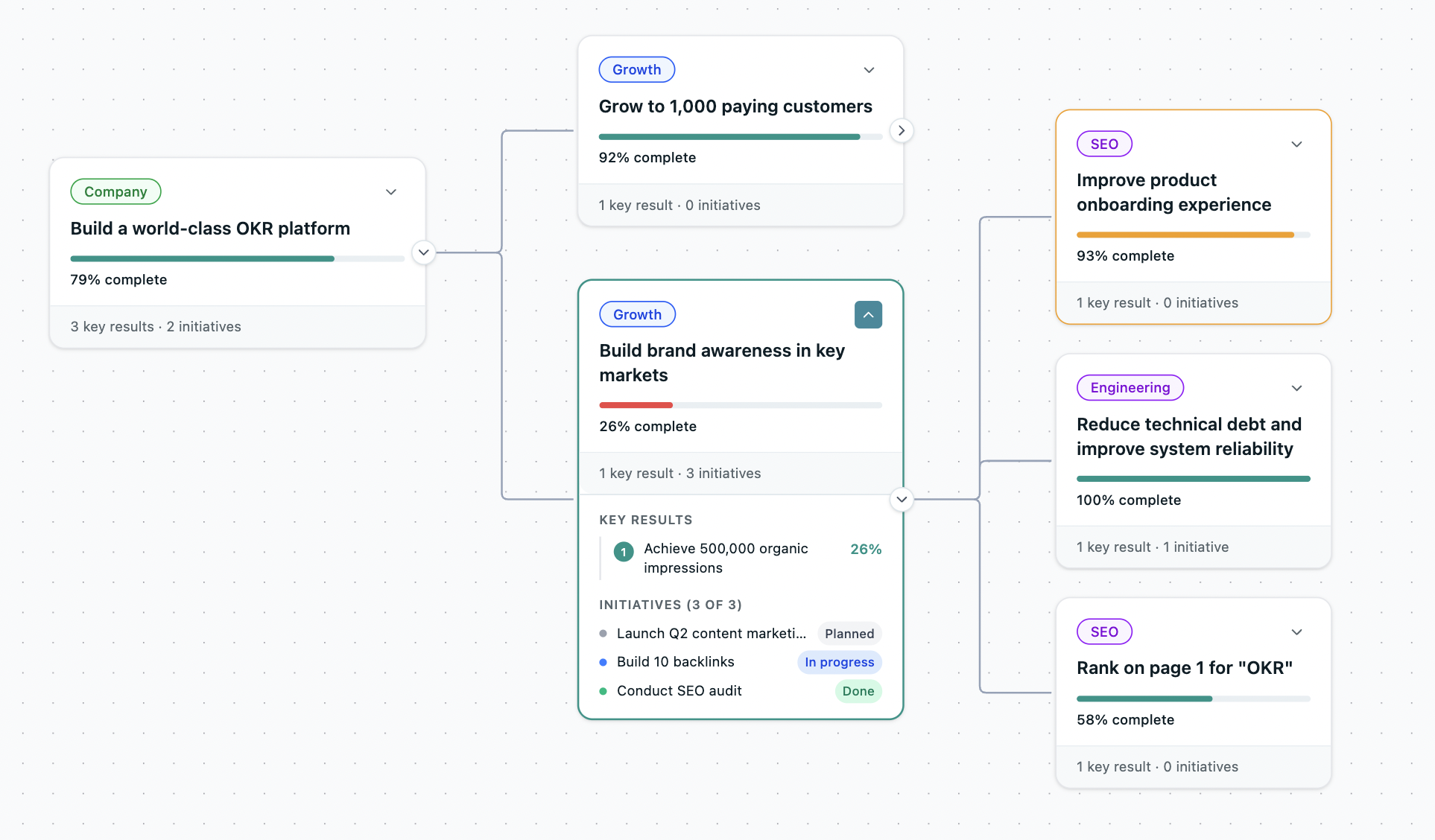
Weekly visibility without a weekly meeting. Accountability requires visibility — but visibility shouldn't require a weekly status call. The alignment map and automated weekly check-in give the CEO and leadership team a live view of which KRs are on track, which are drifting, and which haven't been updated — without anyone having to schedule a reporting cycle. The check-in data is already there. The accountability is visible by default.
Consequences for drift, not just for misses. Most organizations have a mechanism for reviewing results at cycle end. Fewer have a mechanism for catching drift mid-cycle — the point at which an at-risk KR can still be recovered. The mid-cycle review is the structural mechanism for this. The OKR Intelligence Report 2026 found that teams using AI for mid-cycle analysis accept a low score on missed goals only 14% of the time versus 35% for teams without it. The accountability mechanism that matters most isn't the end-of-cycle review — it's the mid-cycle signal that something is drifting before it becomes a miss.
The Accountability Gap at Each Leadership Level
CEO / Executive Team. Company-level OKRs need named executive owners per Key Result. The CEO sets the direction; individual executives own the specific objectives and outcomes. The cascade from company OKRs to department OKRs is the mechanism that makes executive accountability visible to the whole organization — not just to the board.
VP / Department Head. This is the most important accountability layer. VPs sit between company strategy and team execution — their OKRs need to connect upward to company priorities and downward to team Key Results. A VP whose OKRs aren't connected to company priorities in one view is running a silo, not a department. The OKR alignment framework covers how to build that connection structurally.
Team Lead / Manager. At this level, accountability is most visible — team Key Results are the clearest signal of whether work is connected to strategy. The weekly check-in is the primary accountability mechanism: named owners updating progress, blockers surfacing early, and stalled KRs escalated before they become misses. Teams with this habit complete 43% more OKRs than those reviewing monthly.
How OKRs Create Structural Accountability
The reason OKRs are the most effective leadership accountability framework isn't ideological — it's structural. They require four specific things that most goal-setting approaches leave optional.
A named owner per Key Result — not a team, not a function, one person. A baseline and target that make progress objectively measurable rather than subjective. A weekly check-in rhythm that makes ownership visible on a cadence short enough to catch drift. And a scoring system at cycle end that separates honest assessment from performance theatre.
None of these require a culture change. They require a system — and a leadership team willing to hold itself to the same standard it expects from the rest of the organization. The best OKR software guide covers which platforms enforce these standards structurally.
The ROI data across 330 organizations shows what structural accountability produces: organizations using purpose-built OKR software generate a 1:88 return on investment. The mechanism isn't goal-writing quality. It's the weekly visibility, required ownership, and cascade alignment that make accountability structural rather than aspirational.
Common Accountability Failures — and Fixes
Shared ownership. "The leadership team owns this" means nobody owns it. Fix: before any Key Result goes live, name one person. If the right answer genuinely isn't clear, that's a sign the goal needs to be redesigned.
No baseline. A target without a baseline can't be scored honestly. "Increase NPS" isn't accountable — it has no starting point. "Increase NPS from 32 to 55" is. The how to write OKRs guide covers the baseline-to-target format that makes every Key Result scoreable.
Check-ins that depend on scheduling. If the weekly check-in requires someone to schedule a meeting, it will eventually stop being scheduled. The automated nudge — via Slack or MS Teams — removes that dependency entirely. The check-in happens because it's structural, not because someone remembered.
Reviewing scores without understanding causes. A Key Result that scores 0.3 at cycle end is not a performance problem until you know why it scored 0.3. Was the target unrealistic? Was ownership unclear? Did a dependency block progress in week eight? The OKR retrospective is where those causes get documented — and where the structural changes that would have prevented the miss get committed for next cycle.
Accountability Is a System, Not a Standard
Leadership accountability is the difference between an OKR programme that drives results and one that generates documentation. The framework makes accountability structural — but only if the leadership team uses it the way it was designed.
Named ownership, required before cycle start. Weekly visibility, automated and consistent. Mid-cycle escalation, triggered by data not memory. End-of-cycle honesty, scored on outcomes not effort.
That's leadership accountability. It doesn't require a culture change. It requires a system — and the discipline to hold the leadership layer to the same structural standard as every other team in the organization.
Data: OKR Intelligence Report 2026 (222 organizations), The ROI of OKRs: 2026 Benchmark Report (330 respondents), The 2026 OKR Benchmark Report (200+ organizations).