An OKR cadence is the set of review rhythms that carries a goal from the planning session to the result — annual, quarterly, mid-quarter, weekly, and sometimes daily. Get it right and 83% of the drift that normally goes unseen becomes a signal you can act on. Get it wrong and even well-written goals quietly fade, because the interval between reviews is where goals go to die.
Goals drift in the weeks between reviews, where a priority slips off course, nobody notices, and the next check comes too late to act. Teams usually set their OKRs well enough at the planning session; what breaks is the silence afterward. The single variable that governs that silence is your OKR cadence: how often the team actually looks at its goals.
When the Strategy Execution Benchmark 2026 surveyed 180 leaders, 83% said they get no automatic signal when a priority starts drifting — they find out at a scheduled review, if at all. That's a cadence problem, not a goal-quality problem. This guide covers the full OKR cadence: the five review layers, how often each should run, and the data on why the interval you choose matters more than almost anything else in your OKR process.
What Is an OKR Cadence?
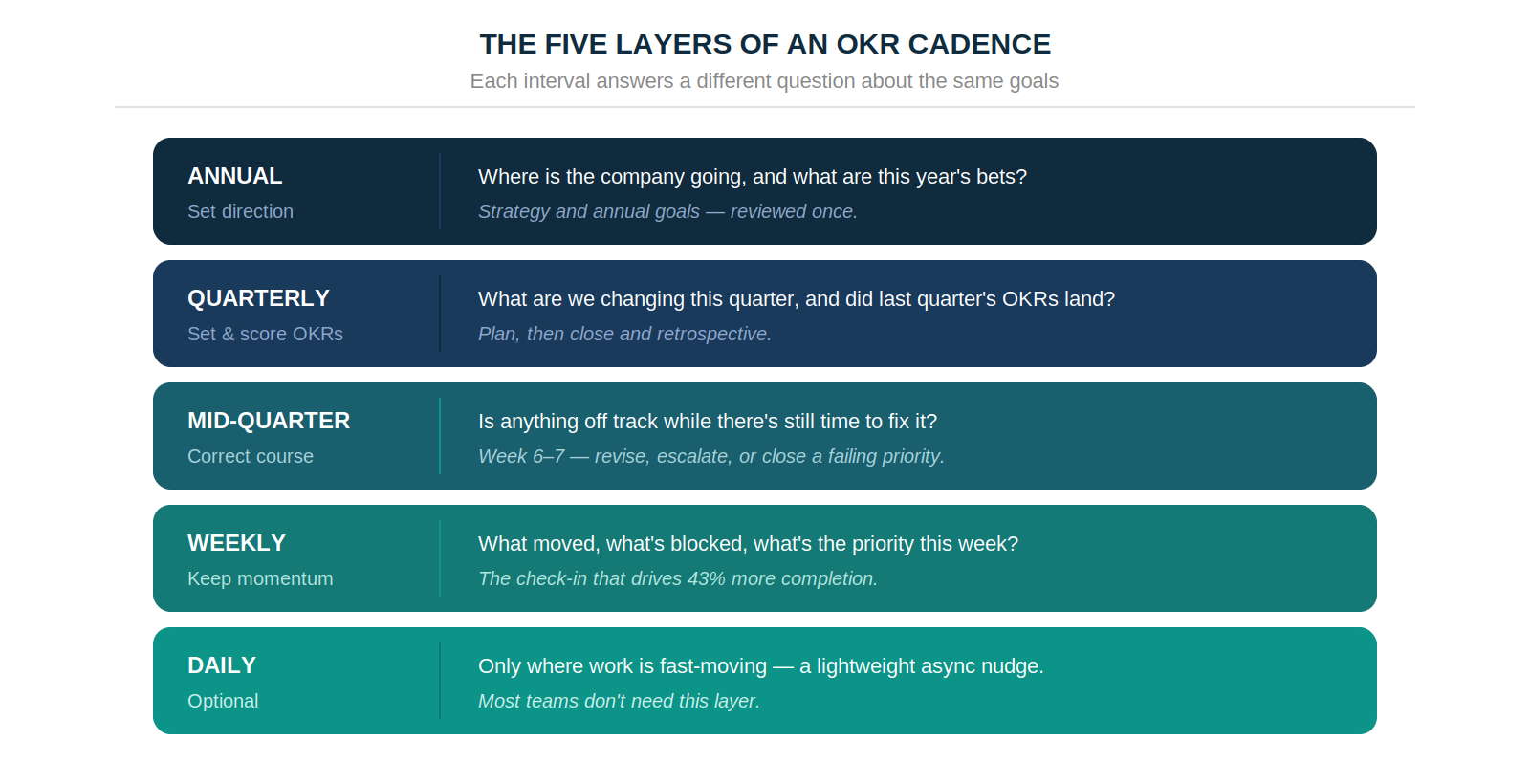
An OKR cadence is the rhythm on which a team sets, reviews, and scores its goals. Rather than a single meeting, it works as a stack of intervals, each answering a different question. The annual layer sets direction. The quarterly layer sets and scores the OKRs themselves. The mid-quarter layer catches drift while there's still time to act. The weekly layer keeps momentum. And a daily layer exists for fast-moving teams that need it, though most don't.
Teams commonly collapse that stack into one interval — usually quarterly — and treat the goal as untouched between planning and the end-of-cycle review. Ninety days of silence is where the drift happens. A working cadence runs several intervals at once, each doing a job the others can't.
The Five Layers of an OKR Cadence
Annual — set direction
The outer layer runs once a year. It's where leadership sets the multi-year direction and the year's strategic goals, and where the annual bets that quarterly OKRs will execute get decided, cascading down through company objectives. This layer moves slowly on purpose — direction shouldn't change every quarter, or it isn't direction.
Quarterly — set and score the OKRs
The quarterly layer is the core of the OKR cadence: it's where OKRs are planned at the start of the cycle and scored at the end. Quarterly cycles are the near-universal default because a quarter is long enough to move a real outcome and short enough to stay honest. The cycle closes with a retrospective that turns what happened into a sharper next quarter — the mechanism that makes each cycle better than the last.
Mid-quarter — correct course
Around week six or seven, a mid-quarter review asks a single question: is anything off track while there's still time to fix it? This is the layer most teams skip, and it's expensive to skip. The benchmark found 60% of failing priorities never get cleanly resolved — they're quietly dropped or limp to the end of the cycle — precisely because no mid-cycle checkpoint forces a decision to revise, escalate, or close.
Weekly — keep momentum
The weekly layer is the highest-frequency review most teams need, and the highest-leverage. It's a short check on what moved, what's blocked, and what the priority is this week. The full mechanics of running one — the four questions, the fifteen-minute format, the async option — are covered in the weekly check-in guide. What matters at the cadence level is simply that it happens every week without exception.
Daily — optional
A daily layer exists, but most teams don't need it. Where work is genuinely fast-moving — an incident response, a launch week, a sales push — a lightweight daily nudge keeps a critical key result visible. Outside those cases, daily reviews add noise without adding signal, and the weekly layer is enough.
Why the Interval Matters More Than the Goal
The reason cadence outranks almost every other OKR decision is that the interval between reviews determines whether a problem is recoverable when you find it.
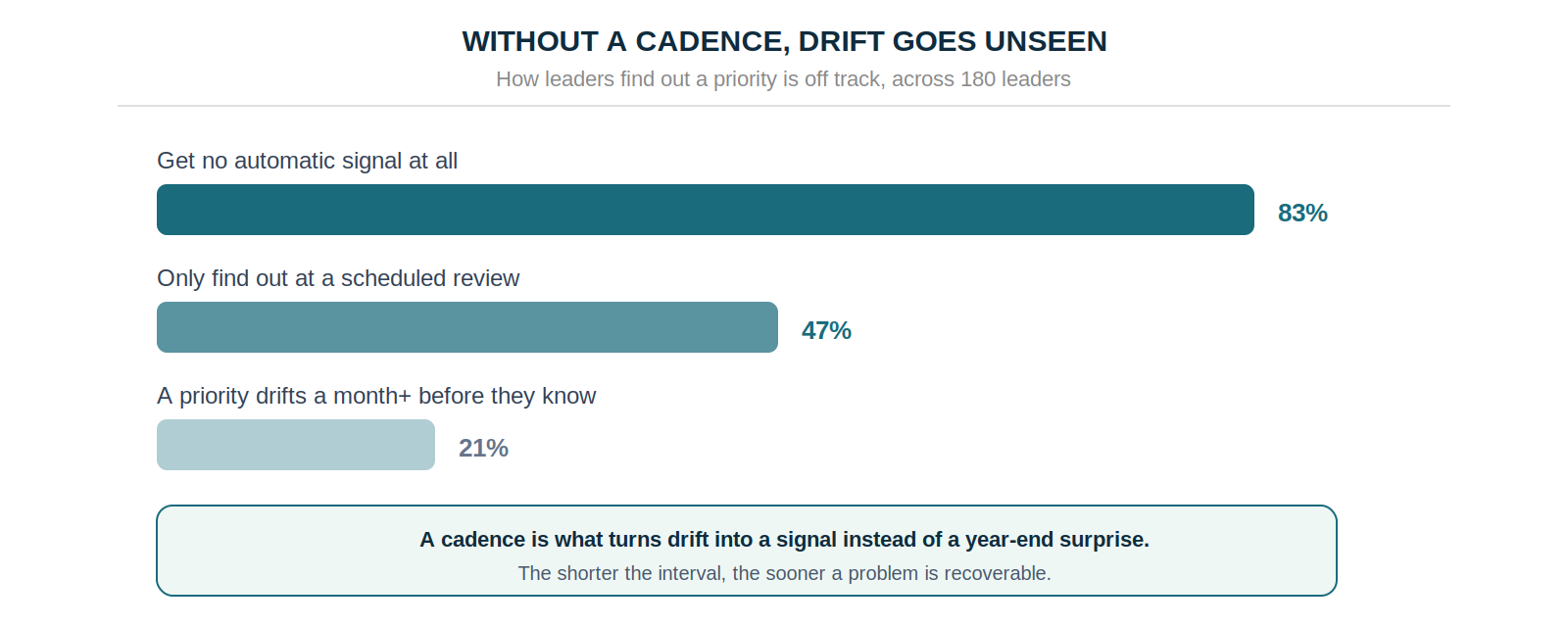
A goal drifting in week four of a quarter is recoverable — you can adjust the approach or escalate the blocker. The same drift discovered in week eleven, at the pre-review scramble, is not. A long interval converts goal management into a series of post-mortems; a short one converts it into steering.
That's why 83% getting no automatic signal is the finding that matters most: without a frequent-enough cadence, the drift is invisible until it's already a miss, and 47% of leaders confirm they only learn at a scheduled review.
It shows up in the completion data too. Teams that review in a weekly check-in complete 43% more of their OKRs than teams reviewing monthly or ad hoc — not because the weekly meeting is better, but because a week is a short enough interval to catch a problem while it's still small.
How a Cadence Compounds Over Time
A cadence isn't just about catching drift this quarter. Kept consistently, it's the single biggest driver of improvement across cycles.
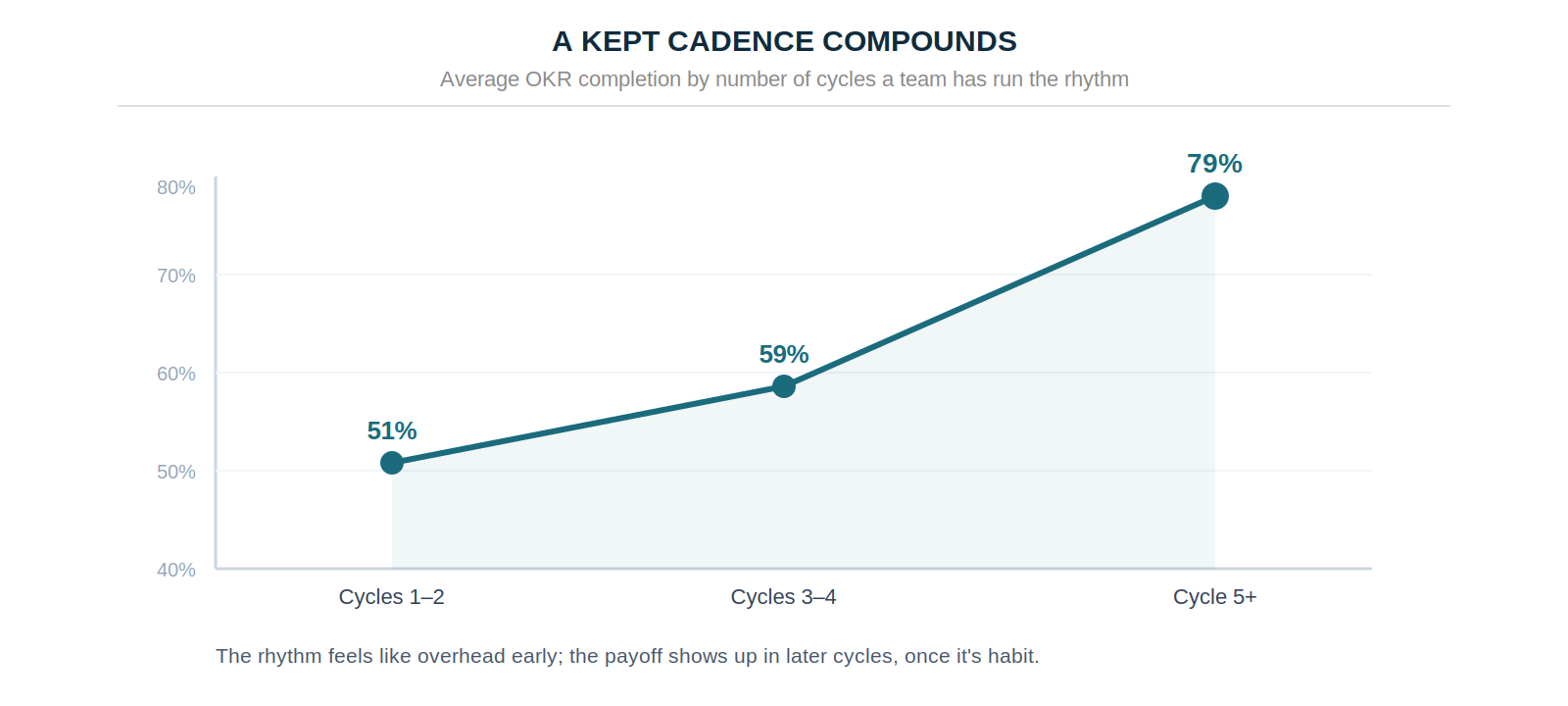
Average completion climbs from 51% in a team's first two cycles to 79% by the fifth. That lift doesn't come from writing better goals each quarter — it comes from the accumulated discipline of the rhythm, and from the retrospective that feeds each cycle's learning into the next.
The catch is that the payoff arrives later than teams expect: the cadence feels like overhead in cycles one and two, which is exactly when many teams abandon it. Sticking with the rhythm through the flat early cycles is the discipline that produces the curve.
There's a failure mode the data names directly. The OKR Intelligence Report 2026 found 7% of off-track key results are simply abandoned mid-cycle — informally dropped with no decision. A cadence with a real mid-quarter checkpoint is what prevents that quiet abandonment: every off-track key result leaves the review revised, escalated, or formally closed, rather than fading.
Setting Your OKR Cadence
For a team between 50 and 200 people running its first cycles, the cadence that works is the standard stack: annual direction, quarterly OKRs, a mid-quarter review, and a weekly check-in — skipping daily unless a specific push demands it. The two layers teams are most tempted to drop, mid-quarter and weekly, are the two that carry the most weight, so protect those first.
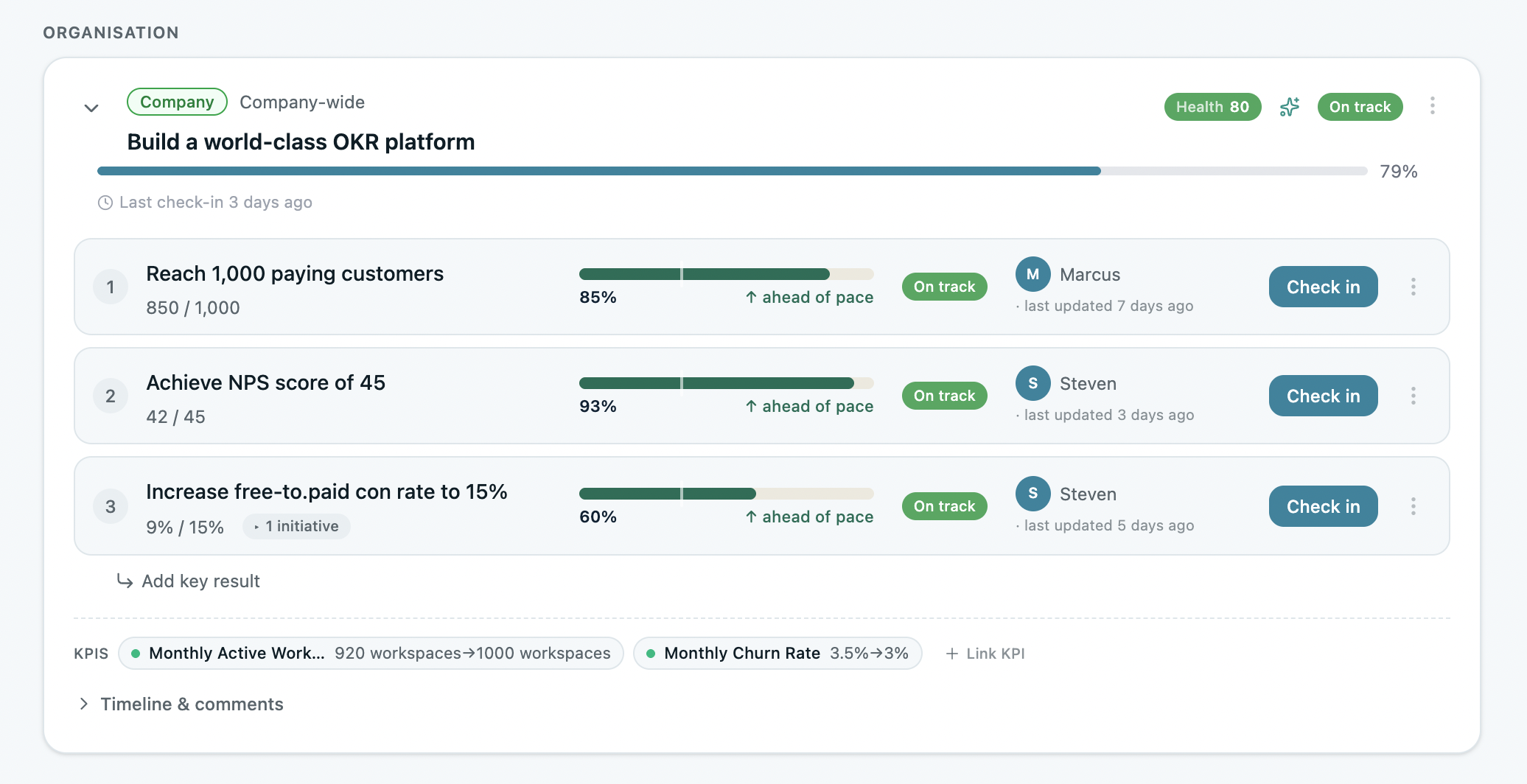
The hard part isn't designing the cadence; it's keeping it when the quarter gets busy. That's where purpose-built OKR software earns its place — an automated weekly nudge and a live view of what's on and off track make the rhythm structural rather than a test of anyone's discipline. A cadence that depends on someone remembering to schedule it is the cadence that lapses first.
The Rhythm Is the Product
An OKR cadence works as the mechanism that makes goals real, not as administrative overhead layered on top of them. The planning session produces a document; the cadence produces results. Annual sets the direction, quarterly sets and scores the OKRs, mid-quarter catches what's drifting, and the weekly check-in keeps it all moving between those larger checkpoints.
The 83% who get no signal when a priority drifts, the 60% who never resolve a failing one, the 7% who quietly abandon a key result mid-cycle — every one of those failures lives in the interval between reviews. Shorten the interval and the failure becomes visible while it's still fixable. That's the whole case for cadence: not more meetings, but the right rhythm, so a goal is never more than a week from the next honest look at it.
Data: Strategy Execution Benchmark 2026 (180 strategy and operations leaders), OKRs Tool platform data (876 organizations, 20,952 key results), The 2026 OKR Benchmark Report (200 organizations), OKR Intelligence Report 2026 (222 organizations).