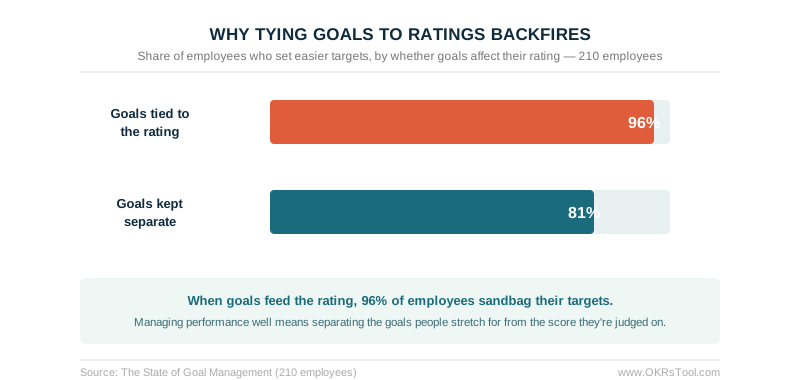
96% of employees set easier targets when their goals feed directly into their performance rating. Managing performance well isn't about better review forms — it's about clear goals, a weekly feedback rhythm, and keeping the goals people stretch for separate from the score they're judged on.
Most performance management runs on a once-a-year ritual: set goals in January, forget them, then reconstruct a rating in December from whatever anyone can remember. It's the process almost every growing company inherits, and it's close to useless — the feedback arrives too late to change anything, and the goals stopped mattering by March.
Managing performance is not an annual event. It's a weekly practice of setting clear expectations, giving feedback while it still matters, and helping people close the gap between where they are and where the work needs them to be. The mechanics that make it work are the same ones behind a good OKR system: specific goals, a short feedback loop, and honest conversations about progress.
This guide covers how to manage employee performance in practice — the habits that work, the data behind them, and the two mistakes that quietly wreck most systems.
What "Managing Performance" Actually Means
Performance management is often confused with performance review — the form, the rating, the once-a-year sit-down. But the review is the smallest and least important part. Managing performance is the ongoing work of making sure people know what's expected, have what they need, and get feedback fast enough to act on it.
Done well, it's mostly invisible. It looks like clear goals set at the start of a quarter, a short weekly conversation about progress, and blockers cleared before they cost a month. The annual review, when it comes, holds no surprises, because everything in it was already discussed in real time — the shift most performance management software is now built around.
Done badly, it's a scramble. Goals are vague or forgotten, feedback is saved up for a formal review, and by the time anyone addresses a problem it's been festering for two quarters. The difference between the two isn't effort or intent — it's cadence.
The Cadence Problem
The single biggest lever in managing performance is how often feedback happens. Annual reviews fail not because managers are bad at them, but because a year is far too long a loop to steer anything.
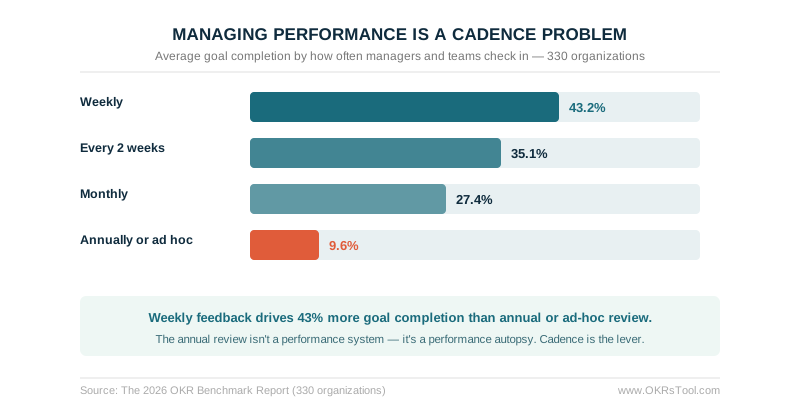
The fix is continuous feedback: short, regular conversations that catch problems while they're still small and reinforce good work while it still feels connected to the effort. This doesn't mean more meetings. It means a standing weekly or biweekly rhythm where progress, blockers, and priorities get five honest minutes — the same check-in habit that drives goal completion.
Step 1: Set Goals People Can Actually Be Managed Against
You can't manage performance against a vague goal. "Improve customer satisfaction" gives a manager nothing to coach toward and an employee nothing to aim at. Managing performance starts with goals specific enough that both people can see, at any moment, whether they're on track.
The fix is to set outcomes with a number and a deadline: "raise CSAT from 72 to 85 by end of quarter," not "improve satisfaction." That's the difference between an objective and a measurable key result, and writing them this way is what turns performance management from a matter of opinion into a matter of evidence. When the goal is measurable, the weekly conversation writes itself: did the number move, and if not, why not?
Keep the list short. A person carrying eight goals is really carrying none, because attention scatters. Two or three clear priorities per person — each with a single owner — is enough to manage well, and more than that guarantees some go unmanaged.
Step 2: Run a Weekly or Biweekly One-on-One
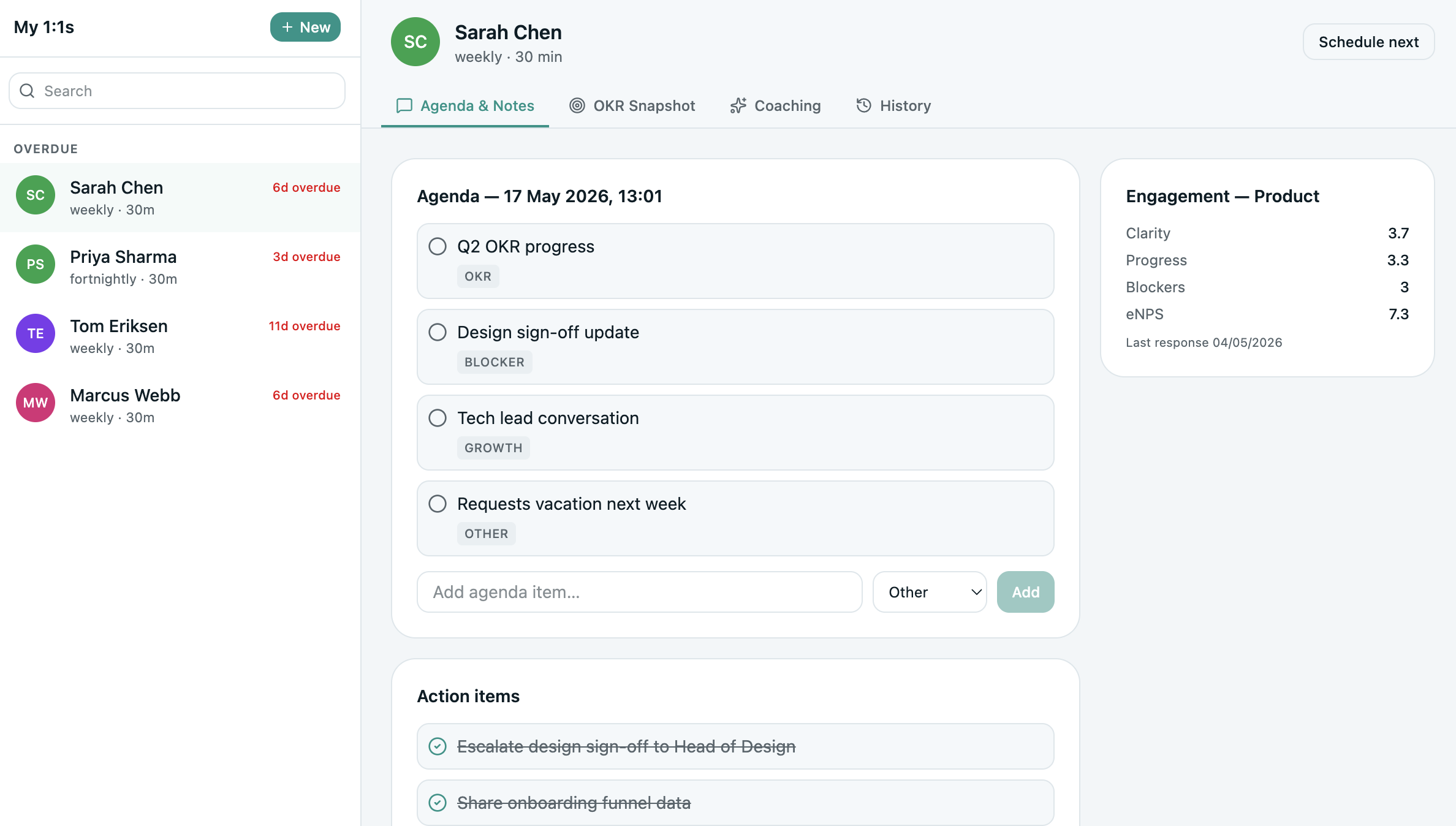
The one-on-one is where performance management actually happens. Not the annual review — the recurring 20-minute conversation where a manager and a report look at progress, surface blockers, and adjust.
A good one-on-one has a simple shape: what moved since last time, what's stuck, and what matters most before the next one. A light 1:1 template keeps it consistent without making it rigid. It's not a status report — the manager can read status in the tool. It's the conversation around the status: what's hard, what's unclear, what the person needs. Done weekly, it means no problem waits more than a few days for attention, and no good work goes a full quarter without being seen — and it feeds richer 360 feedback when a formal review does come.
Step 3: Give Feedback While It Still Matters
Feedback saved for a formal review is feedback wasted. By the time the annual review arrives, the moment to correct a problem passed months ago, and praising work from March in December lands hollow. The value of feedback decays fast — the closer it is to the event, the more it changes behavior.
Managing performance well means giving small, specific feedback continuously: naming what worked right after it worked, and raising a concern the week it appears, not the quarter it compounds. This is uncomfortable at first, which is why most managers batch it into the annual review — but batching is exactly what makes feedback useless. The manager who says the hard thing in week two saves everyone the version that would have been unavoidable by week twenty.
The Two Mistakes That Wreck Performance Management
Two errors quietly break most systems, and both are structural rather than personal — which means both are fixable by changing the setup, not the people.
The first is tying goals directly to ratings and pay. It feels logical: hit your goals, get a good rating. But it manufactures exactly the wrong incentive.
The second is confusing activity with performance. A person can be busy all quarter and move nothing, and a manager watching tasks instead of outcomes will rate them well. Manage against the change the work produces, not the volume of work done — the same outcome-over-output discipline that separates real goals from task lists, and the basis for fair calibration across a team.
How Goals and Performance Fit Together
The cleanest way to manage performance is to run it on the same goals the team already works toward, without letting those goals become the rating. Goals give the weekly conversation its substance; the rating stays a broader judgment the manager makes across the whole picture.
That separation is what lets people be honest. When the OKRs they set are for ambition and learning rather than a direct input to their bonus, they set real targets and report real progress — which is the only condition under which performance management tells you the truth. Keep the goals stretchy and the rating holistic, and the whole system starts working with you instead of against you.
What Good Performance Management Looks Like
Pulled together, managing employee performance well comes down to a short list of habits — none of which is the annual review.
None of these require a new framework or a heavier process. They require a rhythm and the discipline to keep goals honest, supported by simple goal tracking — which is exactly what a lightweight goal system is built for, and what most OKR best practices come back to.
Make the Rhythm Automatic
The hardest part of managing performance well isn't knowing what to do — it's sustaining the cadence when every week is busy. The weekly one-on-one gets skipped, the feedback gets saved up, and the system drifts back to the annual scramble it was meant to replace.
That's the gap a tool closes. The OKRs Tool platform keeps each person's goals visible, runs the weekly check-in on an automated cadence, and gives managers a live view of progress before every one-on-one — so the rhythm holds without anyone policing it. It's free for up to five users, which is enough to run performance management on clear goals instead of a once-a-year form.
Data: The 2026 OKR Benchmark Report (330 organizations) and The State of Goal Management (210 full-time employees).