
Teams that set their goals well and track them well hit their targets 51% of the time. Teams weak at both manage just 18%. What separates them comes down to four ordinary habits, run week after week, and those habits matter more than the framework or the motivation behind the goals. This guide covers what goal setting is, why most of it fails, and the four habits that move the number, drawn from an independent survey of 280 operations and strategy leaders.
Goal setting is the practice of deciding what outcomes matter over a set period and defining how you'll know they were reached. Done well, it points a team's daily work at the priorities that matter through clear team OKRs and makes progress visible enough to correct through honest scoring. Done the way most teams do it — a burst of activity at a planning offsite, then silence until the quarter closes, is one of the most common reasons goals fail — it produces a list of intentions nobody revisits and no one would miss if it vanished.
The gap between those two outcomes has been measured. The Goal-Setting Benchmark surveyed 280 leaders at technology companies of 50–200 employees about how they set goals, how consistently they hit them, and what happens in the weeks between reviews. The finding that runs through everything below: the framework a team picks barely predicts success, and a stack of four habits predicts almost all of it.
The Framework You Pick Barely Moves the Number
Walk into most planning sessions and the first argument is about method: SMART goals, OKRs, KPIs, a homegrown scorecard. The benchmark measured how the market actually splits, and how much the choice mattered. SMART leads at 39%, KPIs sit at 16%, and every structured method combined — OKRs, MBO, and V2MOM — accounts for just 13%.
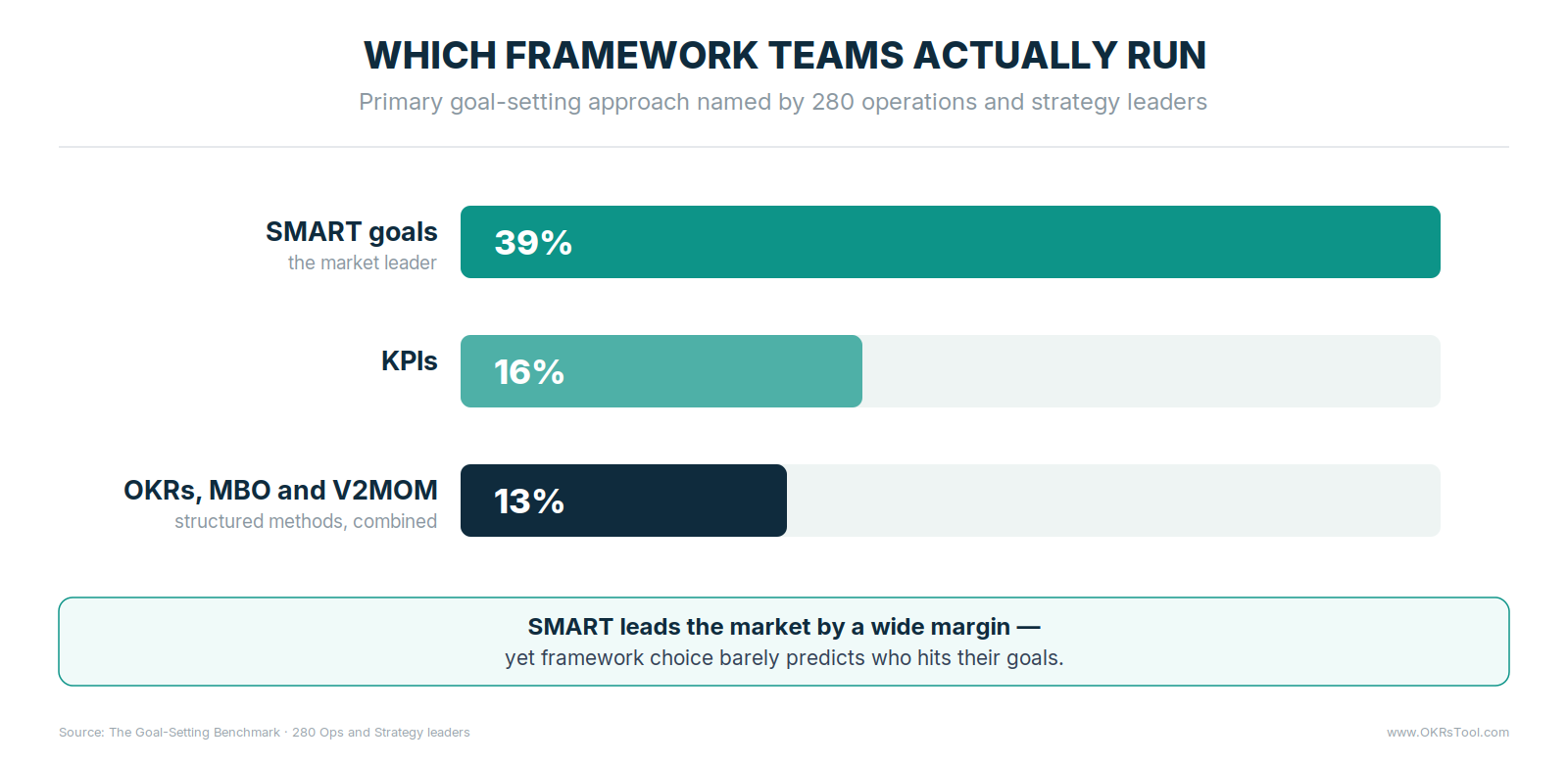
Applying a framework consistently does help — 43% of teams that do hit their goals very consistently, against 23% of teams that apply one loosely. But that gap is about consistency, which is a property of how a team works, not the label on its method.
Two teams can both run SMART goals and land in completely different places depending on what they do after the goals are written. So the useful question isn't which framework to adopt. It's what the teams that hit their goals do that the teams that miss don't.
The Four Habits That Separate Hitters From Missers
Four habits show up again and again on the winning side, and they hold whichever framework sits on top of them, or none at all: reviewing goals every week, tracking progress continuously, keeping goals visible to the team, and running the whole thing on dedicated goal management software rather than a spreadsheet — the shift many teams make once tracking OKRs in a sheet stops keeping up. Each one, on its own, roughly doubles a team's chance of hitting its goals very consistently. Stacked, they compound.
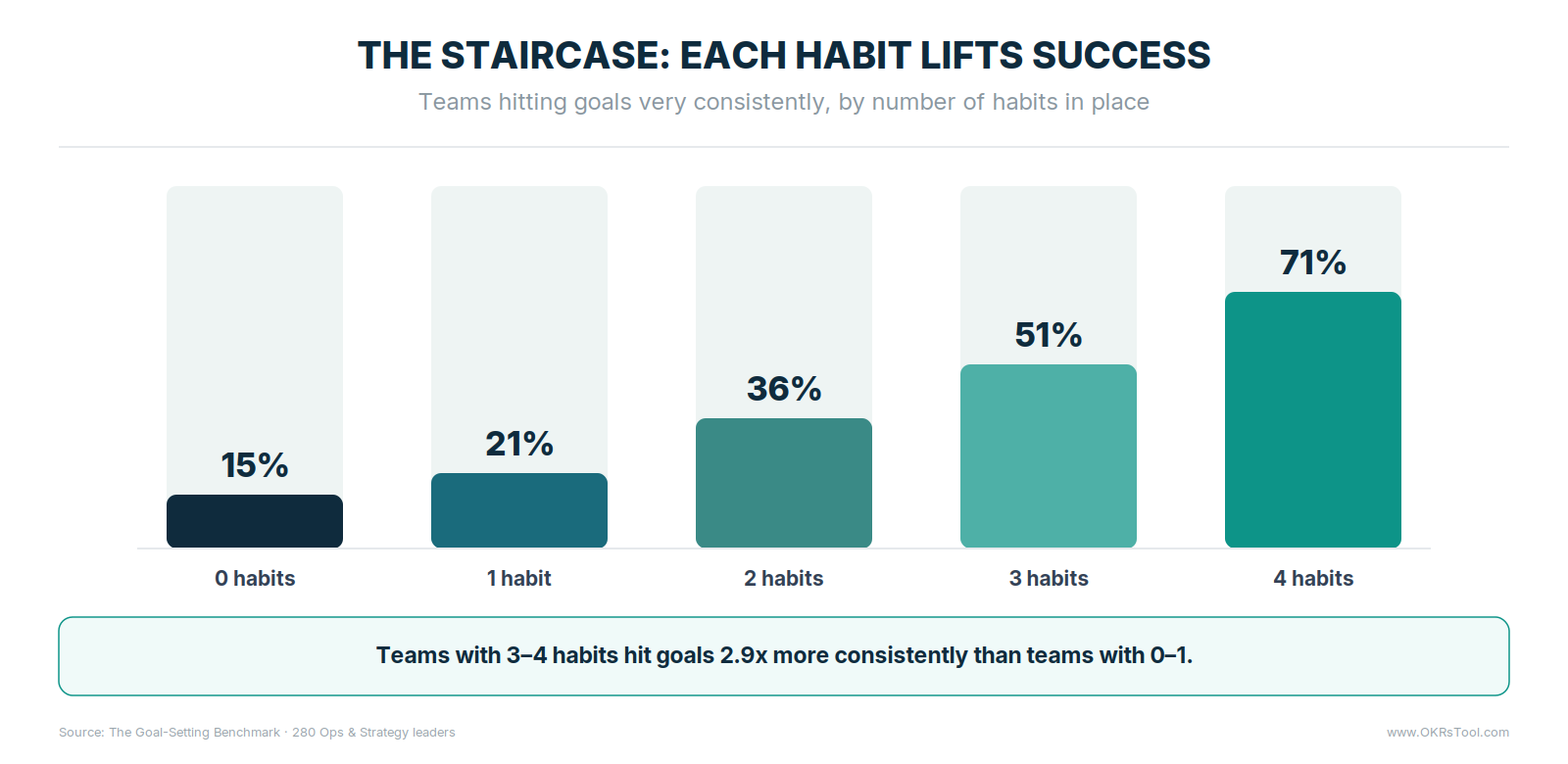
Score every team from zero to four on the habits and plot how consistently each group hits its goals, and the result is a staircase: 15% at zero habits, then 21%, 36%, 51%, and 71% at all four. The climb is close to linear, with no plateau until the top. Teams with three or four habits hit their goals 2.9x more consistently than teams with zero or one.
A team on KPIs running all four out-performs a team on the most fashionable framework running none, whatever the OKR examples on its planning slide. The rest of this guide takes the four habits one at a time.
Habit One: Review Goals Every Week
The single strongest predictor of completion is a standing weekly check-in. Teams that review their goals weekly complete 43% more of them than teams reviewing monthly or ad hoc. Teams that skip check-ins entirely are three times more likely to abandon their goals before the cycle ends, one of the clearest OKR mistakes in the data.
The habit is cheaper than it sounds. Teams spending 45 minutes or more a week on goals actually perform worse than those under 30 minutes — the point is a short, consistent rhythm focused on blockers, decisions, and next steps, not a long status meeting.
A check-in cadence of 15 to 20 minutes is the sweet spot, close to the maturity curve high performers settle into. What matters is that the review happens on a schedule rather than only when a quarterly deadline forces it.
Habit Two: Track Progress Continuously
The market spends most of its energy on setting better goals — cleaner wording, sharper targets. The benchmark says tracking carries at least as much weight, and it's the half teams skip. Split teams four ways on whether they set goals well and whether they track them well, and the winning quadrant is the one where both work together.
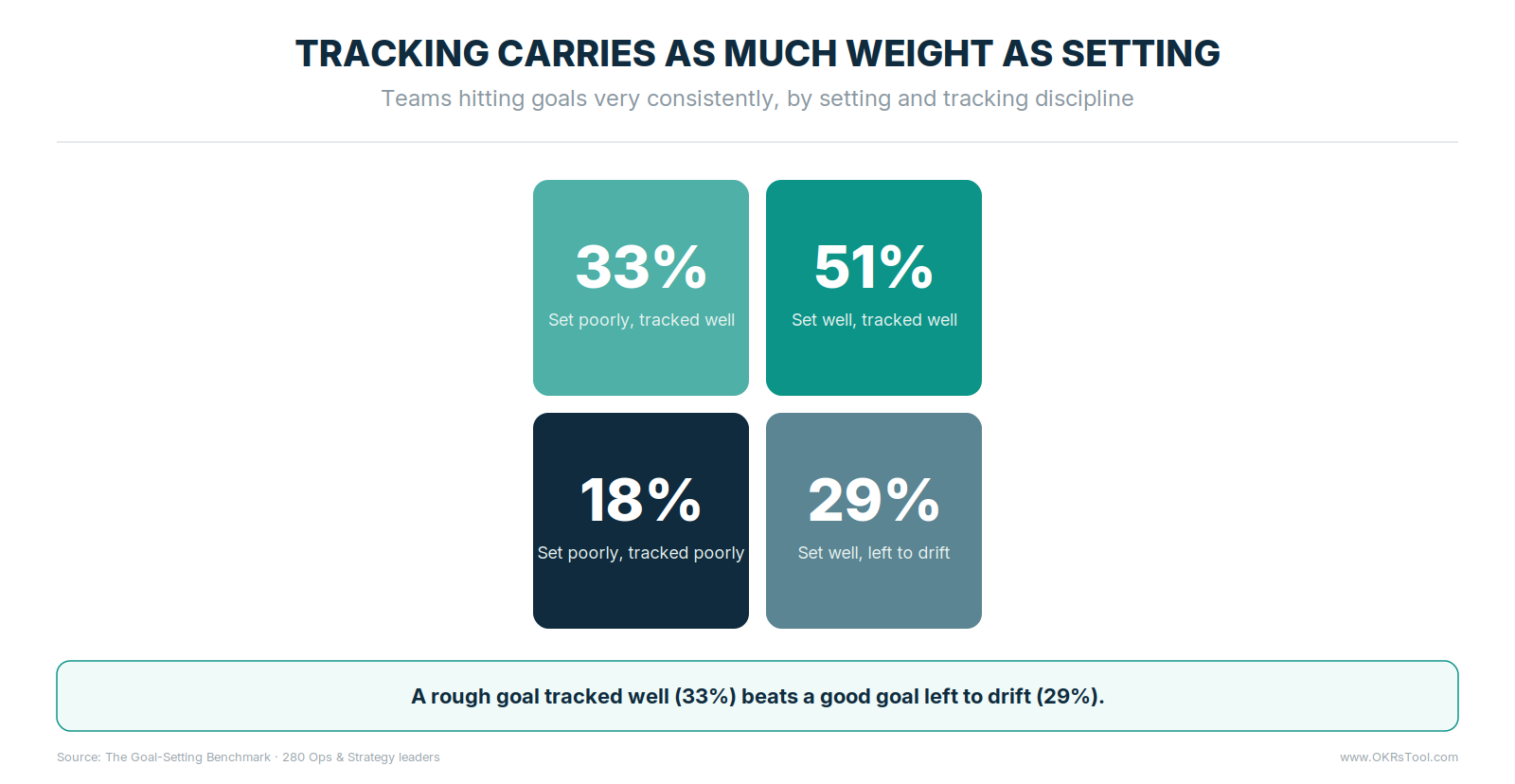
A carefully set goal that no one tracks lands at 29% — barely above the 18% floor where neither discipline exists. A roughly set goal that's tracked closely does better, at 33%. The sloppy goal that gets watched beats the beautiful goal that gets ignored. "Continuous" is the operative word: continuous progress that updates as work happens, not a status reconstructed from memory the night before a review.
That reconstruction is where the cost shows up — 59% of teams lose an hour or more every month just piecing together where their goals stand.
Habit Three: Keep Goals Visible
A goal nobody can see is a goal nobody acts on. When goals live in a slide deck seen once a quarter or a spreadsheet buried in someone's drive, the daily work drifts away from them without anyone deciding it should, the pattern behind most OKR failures. Keeping goals visible — in one shared place, current by default — is the habit that does the least on its own but makes the other three pay off.
The cost of skipping it is concrete: 66% of teams see work done twice because goals aren't visible in one place, and only 30% of employees can name all their company's current top goals without looking them up, a goal-gaming warning sign.
Visibility is also what closes the alignment gap — 65% of teams admit their goals aren't clearly linked to company strategy, a gap that only closes when the links are visible and maintained rather than drawn once and forgotten. A live cascade from company objectives down to team key results is what keeps every team pointed the same direction.
Habit Four: Run It on Real Software
Habits raise the floor; the tool raises the ceiling. Among teams that already review weekly and track continuously — the ones doing the genuinely hard part — the tool still decides how high they go.
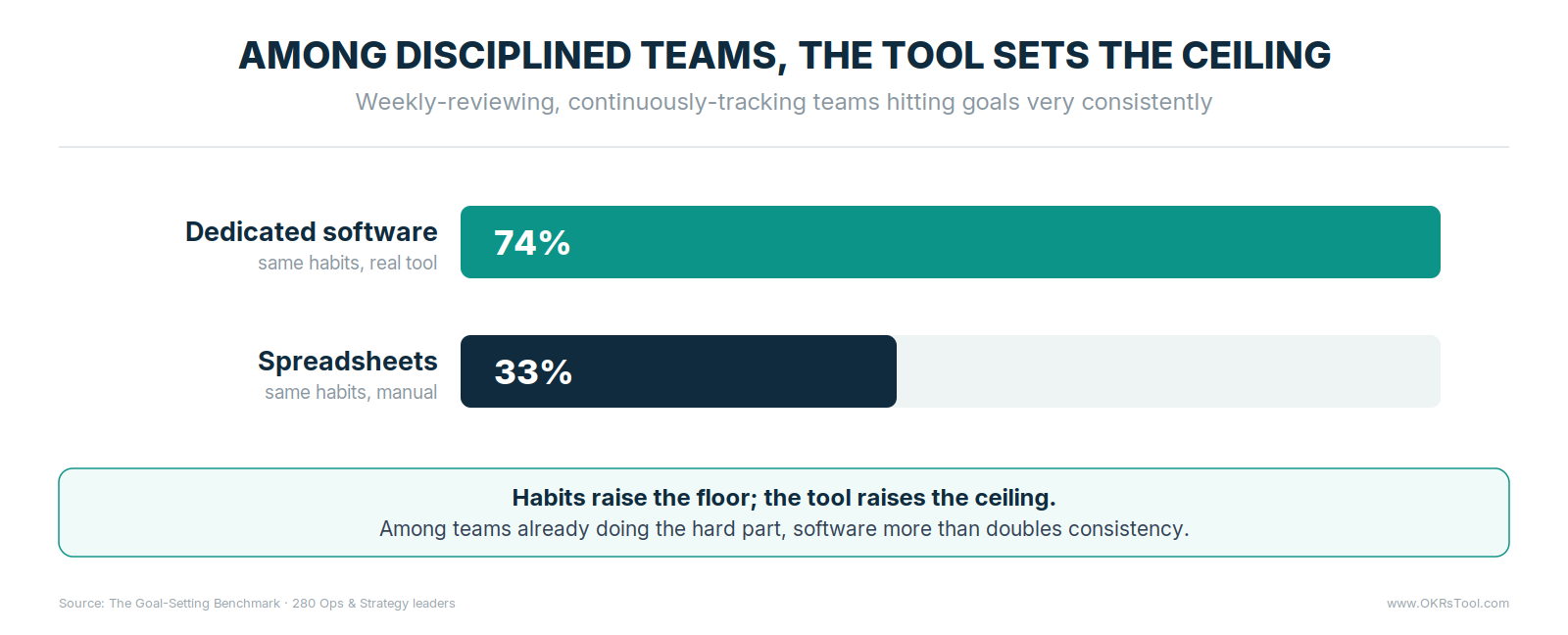
Among those disciplined teams, 74% on dedicated software hit their goals very consistently, against 33% on spreadsheets — the tool more than doubles the result. The order matters: software without the habits changes nothing, which is why moving off the spreadsheet is the last move, not the first.
A spreadsheet can hold goals, but it can't surface a drifting priority, prompt a check-in, or keep the record current on its own. Purpose-built OKR software enforces the habits structurally instead of leaving them to willpower — how it works in practice is one connected cycle rather than four disconnected tools.
How the Four Habits Compare
Each habit earns its place on a different measure. Read together, they describe what a team that hits its goals actually does week to week.
What About the Goal Itself?
None of this replaces writing a good goal — it decides whether a good goal survives the quarter. A goal worth tracking names an outcome rather than an activity, carries a baseline and a target so you can tell at a glance whether it moved, and has a single named owner before the cycle starts.
Across 20,952 real key results in the platform data, 52% were tasks or KPIs in disguise — measuring what was done rather than what changed. Teams that connect goals to outcomes rather than outputs are 30% more likely to hit them.
The SMART criteria are a useful filter for writing each goal — specific, measurable, achievable, relevant, time-bound — and the OKR structure is a useful shape for connecting a team goal to a company objective. Pick whichever fits how your team works; the framework is the easy half. The four habits are what make the goal you wrote actually land.
Start With the Habit You're Weakest On
Setting goals is the part every team already does, and on its own it returns the least. The return comes from the three habits most teams skip — reviewing weekly, tracking continuously, and keeping goals visible — plus the tool that lifts a disciplined team's ceiling toward higher OKR completion.
You don't need all four at once. Put every goal in one visible place first, because it's the cheapest to adopt and kills the most duplicated work. Add a weekly rhythm. Move tracking from before-the-review to continuous. Then move off the spreadsheet once the habits hold.
Built as one connected cycle, goal setting stops being a planning-week ritual that fades by week three and becomes the operating rhythm that turns a strategy on paper into results you can measure at each OKR cycle end. The teams at the top of the staircase, running mature OKR check-in rhythms, aren't more disciplined by nature. They run four ordinary habits — the core of OKR best practices — in order, and let them compound.
Data: the Goal-Setting Benchmark (280 operations and strategy leaders) and OKRs Tool platform data (876 organizations, 20,952 key results).