
Teams that consistently score 1.0 aren't winning — they're sandbagging. The benchmark sweet spot is 70–80%, and scoring honestly against it is the feedback loop that makes every cycle sharper than the last.
OKR scoring turns end-of-cycle progress into a number rather than a narrative. It evaluates how much of each Key Result a team actually achieved, on a 0.0–1.0 scale, so the result is comparable across teams and across cycles. Most of the value isn't the number itself — it's the honest reckoning the number forces.
Done wrong, scoring destroys the signal that makes OKRs worth running. Score too generously and every cycle reads 1.0 with no useful information; score too harshly and the team loses confidence in goals it was right to set. The 2026 OKR Benchmark Report found that teams running consistent end-of-cycle reviews complete 30–45% more OKRs the following quarter, and scoring is where that review begins. This guide covers the scale, the target range, the step-by-step method, and the mistakes that quietly drain the signal.
What OKR Scoring Measures
Scoring evaluates how far a team got toward each Key Result target by cycle end, expressed as a decimal between 0.0 and 1.0. A 0.0 means no progress against the target; a 1.0 means the target was fully hit. The number sits beneath the Objective and rolls up from its Key Results.
The standard scale comes from Google's original practice, where 0.7 — not 1.0 — is the intended target. The logic is that a genuinely ambitious goal should leave a gap at cycle end, and a team clearing every goal completely was almost certainly aiming too low. The 0.0–1.0 scoring scale is one of four common methods, and which one a team picks shapes the culture that forms around missed goals.
Why 70–80% Is the Target, Not 100%
The most common scoring mistake is treating 1.0 as the goal and quietly scaling back ambition to reach it. The benchmark data is clear that the healthy completion range is 70–80% — a target a team reached most of the way toward through real effort, not one it coasted to.
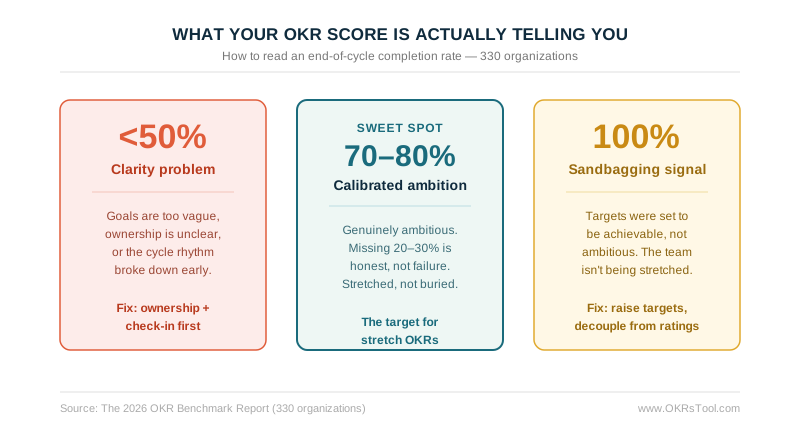
A score in the 70–80% band means the objective was genuinely ambitious, the team executed well, and the remaining gap is information for the next cycle. A team stuck below 50% typically has a clarity problem or no clear owner, while a team consistently hitting 100% is setting goals it already knows it can reach. The pattern behind that 100% is sandbagging — and it climbs sharply when scores feed performance ratings, which is why honest scoring depends on psychological safety around the miss.
A 0.65 in an early cycle is exactly where a team should be. The maturity curve shows why: teams average 51% completion in their first cycles and reach 79% by cycle five, and that compounding comes from what the retrospective extracts from each honest score.
How to Score OKRs, Step by Step
Score each Key Result independently, then derive the Objective score from the result. Scoring the Objective directly hides which specific Key Result drove or dragged the outcome.
For each Key Result, the math is the same: actual progress divided by the planned movement from baseline to target. A Key Result moving from a 34% baseline toward a 52% target that lands at 44% scored 10 points of an intended 18 — a 0.56. The baseline-to-target format is what makes this calculable; a Key Result with no baseline can't be scored honestly at all.
Binary Key Results — the thing shipped or it didn't — score 0.0 or 1.0, or proportionally if partly done. If most of a team's Key Results are binary, that's a signal in itself: binary goals usually describe tasks rather than outcomes, and the output-versus-outcome trap is exactly what the retrospective should catch and rewrite. Average the Key Result scores for the Objective score, weighting the more strategically important Key Results if needed, and document the weighting so it stays consistent across cycles.
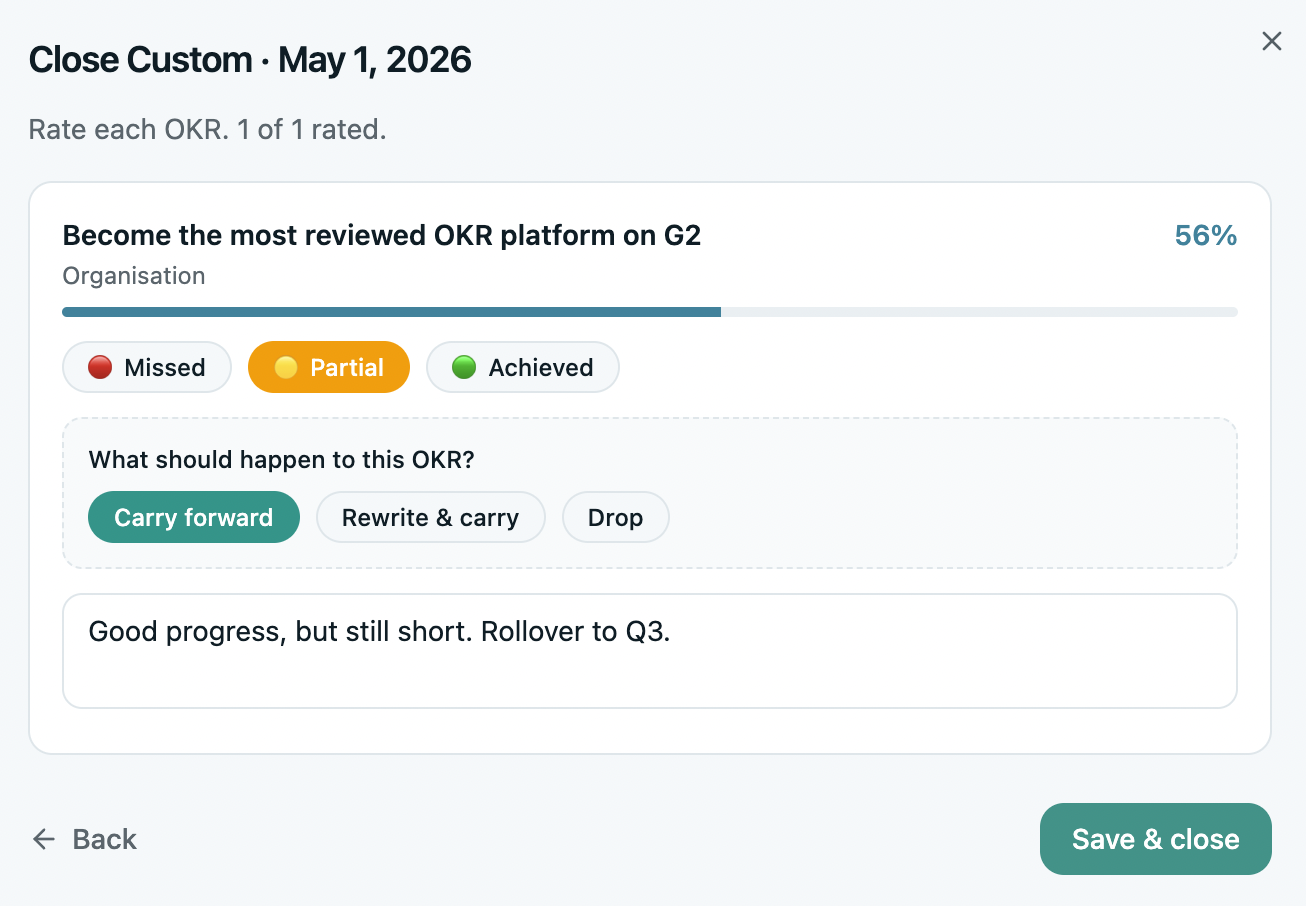
The number is only half the work. For each Key Result, write one sentence — what the score was, why, and what the team would do differently — because the score is the data and the sentence is the insight that feeds the next planning session.
Worked Examples Across Three Teams
The same method produces a clear pattern read at the Objective level. A sales team that generates pipeline volume but misses on win rate and cycle speed scores around 0.68 with a legible story: quantity strong, quality and velocity need work.
The product score of 0.61 is the most useful of the three. It says the team executed but the user behaviour didn't move, which points the next cycle's Key Results at a different lever rather than at trying harder on the same one.
The Scoring Method Predicts the Culture
The OKR Intelligence Report 2026 — 222 organizations — is the first study to map how growing organizations actually score. Percentage completion is the dominant method at 55%, followed by the Google-style 0.0–1.0 scale at 16%, qualitative review at 13%, and no formal scoring at 3%.
The method an organization chooses predicts what happens when a goal is missed. Teams using traffic-light status are the most likely to turn a miss into a learning event in a retrospective, at 57%. Teams using percentage completion are the most likely to trigger a formal accountability conversation, at 40%. Teams with no scoring have no consistent consequence 43% of the time — the clearest failure cluster in the data, most likely to abandon off-track Key Results entirely.
The practical implication is that the method matters less than having one and applying it consistently. A traffic-light team builds a learning culture; a 0.0–1.0 team builds a precision culture; a team with no scoring builds no goal culture at all. What separates the three is whether the score reliably triggers a consistent end-of-cycle review every time.
Score Quarterly, Track Weekly
The end-of-cycle score should never be a surprise, because the team has been tracking progress every week. If the score shocks anyone, the weekly check-in habit isn't working — scoring is the confirmation of a number the team already knew, not a reconstruction from memory.
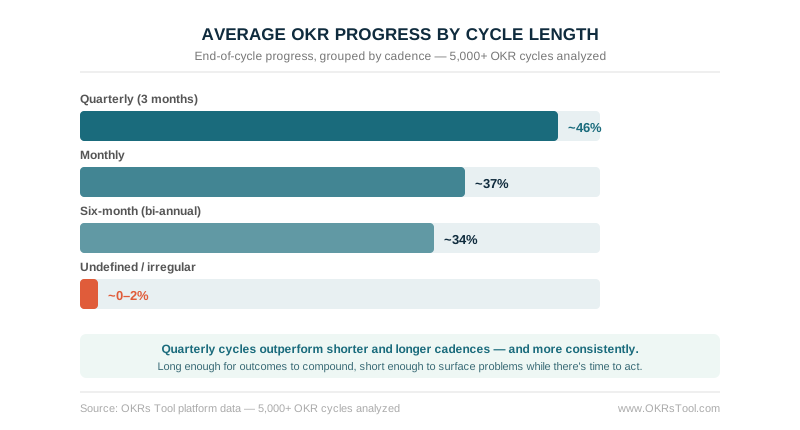
Cadence also determines whether a score is worth anything. Analysis of more than 5,000 OKR cycles found that quarterly cycles average ~46% progress against ~37% for monthly and ~34% for six-month cycles, with undefined cadences near zero. A quarter is long enough for outcomes to compound and short enough to surface problems while there's still time to act — which is also what makes its end-of-cycle score diagnostic rather than arbitrary.
Common Scoring Mistakes
Four patterns drain the signal out of an otherwise honest scoring process. Scoring too late, so the number is assembled from memory rather than confirmed from tracked progress. Inflating a 0.4 to a 0.7 to avoid a difficult conversation, which trades the entire point of scoring for short-term comfort. Scoring the effort instead of the outcome, when the metric simply didn't move regardless of how hard the team worked. And never exceeding 0.7, which signals targets that are structurally too aggressive or an execution problem that scoring alone won't fix.
Each of these is a failure of honesty, not arithmetic, and each removes a piece of the feedback the next cycle depends on. The score that gets inflated this quarter produces a retrospective that diagnoses the wrong problem next quarter. Honest scoring is also what makes real leadership accountability possible, since the named owner of each Key Result owns its score.
What Scoring Software Should Remove
A spreadsheet stores a 0.4 as easily as an inflated 0.7, and it has no record of what drove the result, when a blocker appeared, or which initiative moved the metric — all of which has faded from memory by the time the cycle closes. Manual scoring becomes a reconstruction exercise, and reconstruction is where inflation creeps in.
Purpose-built software removes the reconstruction. Automated weekly check-ins keep the progress data current, at-risk Key Results surface before cycle end, and the scoring data is already assembled when the retrospective starts. See how the OKRs Tool platform tracks progress weekly and turns it into an honest score automatically, or compare scoring against a spreadsheet workflow directly.
Scoring Is a Learning System, Not a Report Card
The teams generating the highest returns from OKRs aren't better at hitting targets — they're better at using scoring honestly, as the feedback mechanism that improves the next cycle's goals, Key Results, and ownership. A 0.7 they earned tells them more than a 1.0 they manufactured.
Score every Key Result against its baseline, write one sentence of insight per score, and take the retrospective seriously. The compounding that turns a 51% first cycle into a 79% fifth one begins with a score honest enough to learn from.
Data: The 2026 OKR Benchmark Report (330 organizations), OKR Intelligence Report 2026 (222 organizations), OKRs Tool platform data (5,000+ OKR cycles analyzed).