
A weekly check-in is a short, recurring update on each Key Result — progress, confidence, and blockers — that takes under five minutes per owner to complete. The habit behind it is the single highest-leverage move in OKRs: teams that keep their Key Results moving hit their goals at 68%, versus 35% for teams that let them go quiet.
The template is the easy part, and it's where most guides stop. The harder, more valuable part is running the check-in so it survives past week five and actually surfaces problems while there's time to fix them. A weak check-in does nothing for OKR completion no matter how good its questions are — whether it balloons to 45 minutes or collapses into a box nobody fills in.
This piece gives you the copy-paste template, a 20-minute agenda, and the operating rules for running it — the cadence that works, who owns the update, whether to run it async or live, and the four habits that kill check-ins. It's the practical companion to the behavioral case for weekly check-ins, which lays out the full data behind why the habit matters this much.
The Weekly Check-In Template
Each Key Result owner fills this in once a week, before any meeting. It's five fields, and a complete answer takes about five minutes.
The restraint is deliberate. Five fields an owner can answer from memory keep the check-in to five minutes, and five minutes is what makes it sustainable for twelve straight weeks. A template demanding a paragraph per Key Result gets filled in for two weeks and abandoned by week four. If you'd rather generate a tailored set from your own goals, the free check-in question generator builds one in a few seconds.
The two fields that carry the most signal are status and change-since-last-week. A status tracked week over week turns a vague sense of "how's it going" into a trend line — a goal sliding from Green to Yellow to Red tells you something the raw percentage hasn't caught up to yet. And "no movement" two weeks running is the earliest honest warning a goal is stalling, and the cue to update the goal or its plan before it goes cold.
The 20-Minute Agenda
The check-in template feeds a meeting, and the meeting has one job: turn those updates into decisions, fast. The counterintuitive finding in the data is that longer meetings produce worse outcomes — completion peaks when check-ins run 15 to 20 minutes, and teams spending 45 minutes or more perform worse than teams keeping it short. Past a point, the meeting stops producing decisions and starts producing status theater.
The agenda that produces the lift is four questions, in order, inside 20 minutes for a team of six to eight:
Run async by default: each owner fills in the template on their own time, so the live meeting skips the status readout entirely and jumps to the exceptions — the Reds, the standing blockers, the requests for help. A meeting that stays a status readout wastes the room; one that opens on the flagged items uses it.
How to Run It: Cadence, Owner, Format
Three decisions determine whether the habit holds past the first month.
Cadence: weekly, on a fixed day. Weekly is the sweet spot — frequent enough that a stall surfaces within days, and spaced enough that there's real movement to report. A twelve-week cycle checked weekly gives eleven chances to catch a drifting goal; reviewed monthly, you get three. Getting the review cadence right is half the battle: hold a fixed day, because a check-in that floats to "whenever we get to it" becomes the pre-review scramble that barely helps whether it covers one person's goals or a whole team's OKRs.
Owner: the person accountable for the Key Result. The update has to come from whoever owns the Key Result, not a manager relaying it — they're the one who knows what actually moved and what's blocking it. This matters more than it sounds: half of all Key Results have no single named owner, and unowned goals go quiet first, because nobody's week is incomplete until the number is updated.
Single, clear accountability is what gives the check-in something real to surface, and teams with one clear owner per Key Result complete 26% more than teams with shared or vague ownership.
Format: async first, meeting for exceptions. Covered in the agenda above — the principle is that collecting updates and discussing them are two different activities, and only the second needs a room. Keeping the async updates and the live progress tracking in one platform, rather than a shared doc that goes stale, is what makes the exceptions easy to spot before the meeting starts.
The first check-in matters out of proportion to its place in the cycle, because the earliest update already predicts where a goal lands.
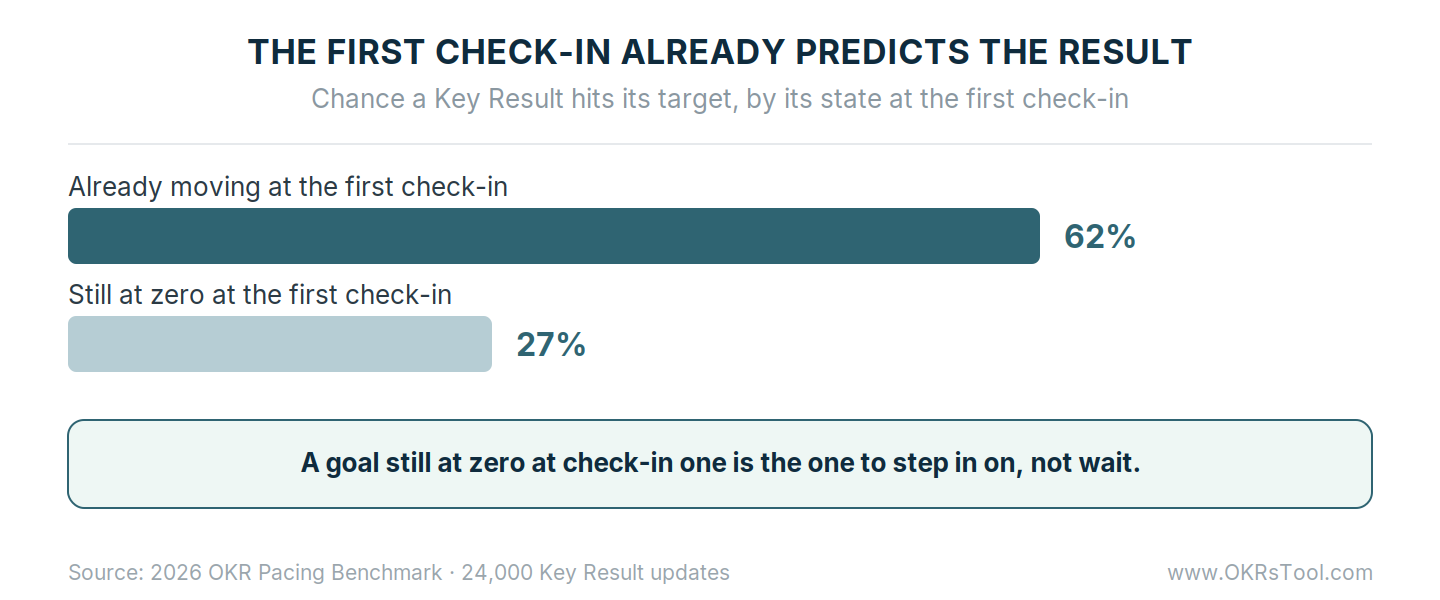
A Key Result already moving at its first check-in hits its target 62% of the time; one still at zero hits just 27%. A flat zero at the opening check-in reads as the earliest reliable warning a goal needs help, not a slow start to wait out — and the "change since last week" field exists to surface exactly that.
The Four Habits That Kill Check-Ins
Failed check-ins usually die from one of four avoidable patterns. Each maps to a specific finding.
Letting goals go quiet. The fastest way for a goal to die is silence. A Key Result updated once across the cycle hits its target 48% of the time; one updated nine or more times hits 72%. The climb is steady, and it's the whole return on the habit — a goal touched once a quarter isn't being managed, it's being remembered. Frequency of contact is the strongest lever on OKR completion there is.
Running long. Completion peaks at 15 to 20 minutes and drops past 45. A long check-in feels thorough and performs worse, because time gets spent narrating status instead of deciding what to do about it.
Accepting a Green with no number. The watermelon effect — green on the surface, red underneath — is the most common way a review misleads. Seventy percent of employees admit to reporting a goal as healthier than they knew it to be. The fix is mechanical: ask "what moved, and by how much?" and a goal with no real progress has no answer.
Leaving Key Results unowned. A goal owned by everyone is owned by no one. Unowned Key Results are the ones that go dark first, and they're invisible in a check-in until someone asks who's moving them.
Make the Honest Report the Win
The template and agenda only work if people tell the truth in the room, and the data on that is sobering: 92% of employees admit to at least one form of goal-gaming, from sandbagging targets to inflating status. That's the rational response to a culture that rewards a clean dashboard and punishes an honest Red.
The watermelon reporting it produces — green on top, red underneath — is exactly what a real status question is built to break. The teams that beat it make surfacing a problem the win — an off-track goal raised in week four is a gift, the same goal hidden until week eleven is a crisis. When early honesty is normal, the reasons goals fail stop compounding in the dark.
That's the real function of the weekly check-in, underneath the template and the agenda. It's the cheapest early-warning system a team has — one short meeting a week that keeps every number in view while there's still time to act, catching drift weeks before a mid-quarter review would.
Run it consistently and the end-of-cycle score stops being a surprise, because the team watched it move the whole way — and the habit compounds across cycles, which is the behavior behind the finding that weekly teams complete 43% more of their goals than monthly ones. Take the template, protect the rhythm harder than the wording, and read every check-in for the two things that predict a miss: a flat zero, and a status heading the wrong direction.
Data: OKRs Tool platform data (876 organizations, 20,952 Key Results), The 2026 OKR Pacing Benchmark (24,000 Key Result updates), and The State of Goal Management (210 employees).