
Strategic plans set by one leader alone ended with 74% of companies stopping OKRs on at least one team, against 40% where strategy was built collaboratively. Whether a plan lasts depends on who writes it, how it turns into quarterly goals with owners, and how often leaders reopen it once the year is under way, which are the steps a planning offsite tends to leave for later.
A strategic plan usually takes shape over two days in a hotel meeting room, gets signed off by the board in December and is presented to the company in January. By spring it can be hard to find. In the Strategy Execution Benchmark, 86% of strategy and operations leaders said their workforce can't name the company's top priorities, and 21% said a priority can run off track for more than a month before leadership finds out.
Strategic planning chooses a handful of priorities for the next one to three years and turns them into work that teams can measure. The choosing gets the attention, and the OKR Benchmark Report, our survey of 420 companies running OKRs, points to what comes after it: only 9% of companies run all five of the habits that keep goals owned, current and linked to company priorities, while teams running four or five of them hit their goals very consistently 82% of the time.
Strategic Planning and Strategic Management
The two terms often get used interchangeably, though they describe different jobs with different owners. Strategic planning has a deadline and produces a written plan, usually once a year. Strategic management is the cycle around that plan, covering how it gets carried out, measured and corrected through the year.
The strategic management process is usually taught in five stages: goal setting, analysis, strategy formulation, implementation, and evaluation and control. Planning covers the first three, and the last two decide whether the plan delivers anything.
Seven Steps in the Strategic Planning Process
The first five steps run once a year, while the last two repeat every quarter until the next plan is written. A company of 50 to 200 people can usually complete the first five within a month or two, with a leadership offsite in the middle.
1. Assess Where the Company Stands
Start with evidence from the year that's ending: revenue and margin by segment, customer retention, win and loss reasons from sales, and how last year's goals finished. OKR completion data is the input that gets skipped most often, and it's the most reliable record of how much the company can deliver in a year.
Frameworks help organize the outside picture. SWOT sets strengths and weaknesses against opportunities and threats, PESTEL scans political, economic, social, technological, environmental and legal forces, and Porter's Five Forces sizes the competitive pressure in an industry. Each one answers a different question, so choosing the strategic planning framework that fits the decision in front of the leadership team saves a day of analysis that nobody uses.
2. Set the Direction
Direction covers three to five years and states where the company will compete and how it intends to win there. A mission statement says why the company exists, a vision describes what it should look like at the end of the period, and companies that want a single long-range target add a BHAG for ten years or more.
Direction is also where the hard choices get made: which customer segments to serve, which products to grow and which to stop funding. A plan that names what the company will stop doing gives every team a reason to turn down work that falls outside it. Salesforce's V2MOM puts vision, values, methods, obstacles and measures on one page, which suits companies that want direction and priorities in a single document.
3. Build the Plan With the Teams Who Run It
Who writes the plan predicts how long it lasts. In The Death of OKRs, drawn from the same survey of 420 companies, the share still running OKRs on every team changed sharply with who set the strategy.
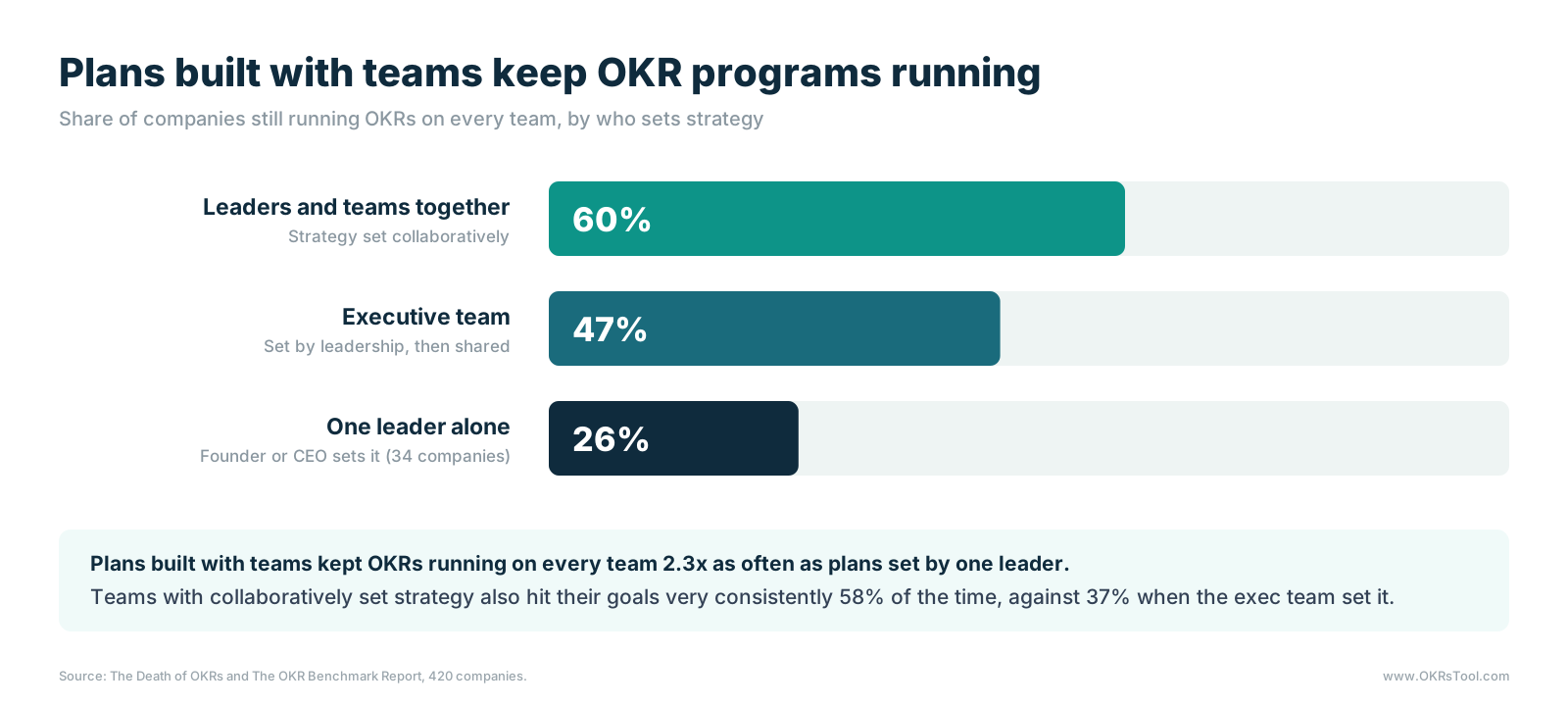
Where leaders and teams set strategy together, 60% of companies still ran OKRs on every team, against 47% where the executive team set it and 26% where one leader set it alone, a small group of 34 companies. Goal results follow the same order, with teams whose strategy was set collaboratively hitting their goals very consistently 58% of the time, against 37% where the exec team set it.
Collaborative planning keeps the final decisions with leadership. Leaders set the direction and draft the priorities, then department heads test them against what their teams can deliver and propose the goals underneath. That mix of top-down and bottom-up input gives each team a hand in the numbers it will be measured against.
4. Narrow the Plan to Three to Five Priorities
A priority list longer than five stops working as a filter, because every project can find a priority to sit under. In the Strategy Execution Benchmark, only 7% of leaders said most of the company's work clearly ladders up to strategy, and a short list makes that link far easier to see and to check.
Each priority needs a name a team lead can repeat, a measure that shows whether it's working and one executive accountable for it. Strategic pillars can group related priorities under a few themes when the plan is large, and each pillar still needs its own measure.
A useful test for every item on the list is to ask what the company would stop doing if it were removed, since a priority that changes nothing about this year's work belongs in the backlog, and ruthless prioritization keeps applying that test after the offsite.
5. Turn Each Priority Into Quarterly Goals With Owners
An annual priority is too broad to manage week to week, so each one becomes a company objective with key results for the quarter, and teams write their own OKRs underneath. A quarterly planning process that starts from the company objectives keeps every team goal tied to a priority from the first day of the quarter.
Two decisions at this step carry some of the widest gaps in the benchmark. Teams that give every OKR one named owner hit their goals very consistently 65% of the time, against 17% where only some are owned. Teams that link almost all their goals to company goals hit them 68% of the time, against 19% where only some link up, and an alignment map shows at a glance any team goal with no company objective above it.
6. Put the Reviews on the Calendar
A plan gets reviewed as often as the calendar says it will. Teams holding a weekly check-in hit their goals very consistently 60% of the time, against 30% with monthly check-ins, and leadership teams that review OKRs every week post 65%, against 33% for those that review quarterly.
Only 26% of companies run that weekly leadership review. It takes about ten minutes when owners update their scores beforehand and the meeting covers only what's at risk, which is the format behind leadership visibility without status meetings. At the end of each quarter, a quarterly business review checks the priorities against results and sets the next quarter's objectives.
7. Close Each Cycle With a Retro That Feeds the Next Plan
Teams that run a retrospective at the end of every cycle hit their goals very consistently 61% of the time, against 25% for teams that hold one occasionally. Each retro should end with a decision on every OKR, whether to carry it forward, change it or close it.
Those decisions, collected over four quarters, become the first input to next year's assessment in step one. A company that keeps them has a written record of what its plan delivered, which makes the next offsite shorter and its targets more realistic.
A Strategic Plan Outline
The written plan should fit on a few pages, because a document nobody rereads can't guide a decision in May. The outline below covers what a plan for a company of 50 to 200 people needs, section by section, with a guide to the length of each.
Sections five and eight keep the plan honest once the year starts, since one records what the company has given up and the other sets when the plan will be checked. Companies that want measures across finance, customers, internal processes and learning can use a balanced scorecard for section four.
Four Planning Horizons on One Calendar
A strategic plan works on four time horizons at once, from multi-year direction down to the week. Each horizon has its own owners and its own review, and the diagram shows how they connect.
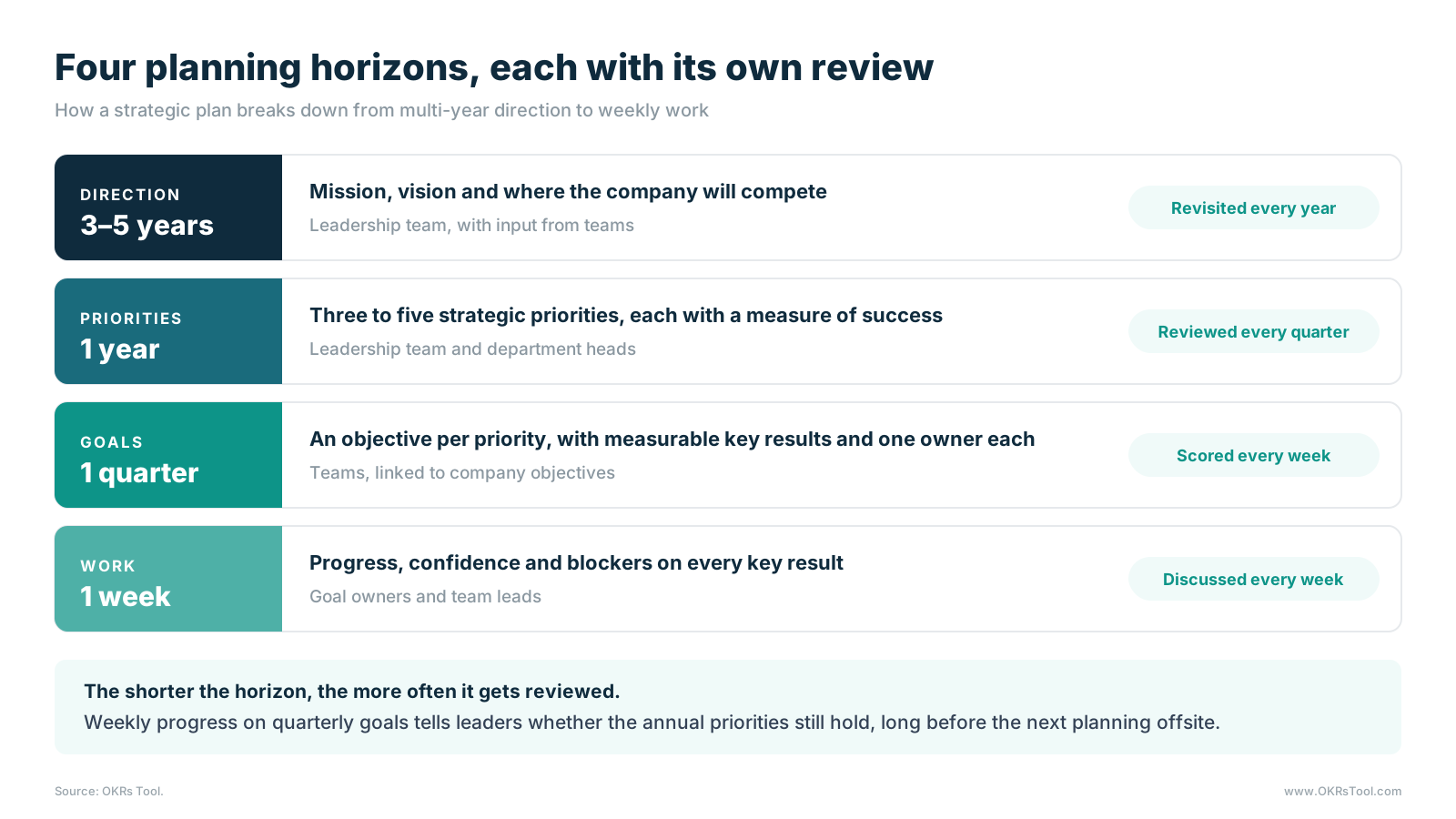
The quarter is where the plan becomes concrete, and quarterly OKRs remain the practical default. Teams on monthly cycles hit their goals very consistently 63% of the time, against 38% for quarterly cycles, though monthly teams also run stronger habits overall, so the shorter cycle likely accounts for only part of that gap.
Business KPIs such as revenue, churn and uptime run alongside all four horizons. A priority's OKRs should move the KPIs that the plan cares about most, which gives leadership one view of whether the strategy is changing the numbers it was written to change.
Reopen the Plan When the Facts Change
Annual plans meet reality within weeks, whether that's a competitor's launch, a large customer leaving or a key hire falling through. In the Strategy Execution Benchmark, 47% of leaders said they first learn a priority is off track at a scheduled review, so the plan only adapts as quickly as the reviews come around.
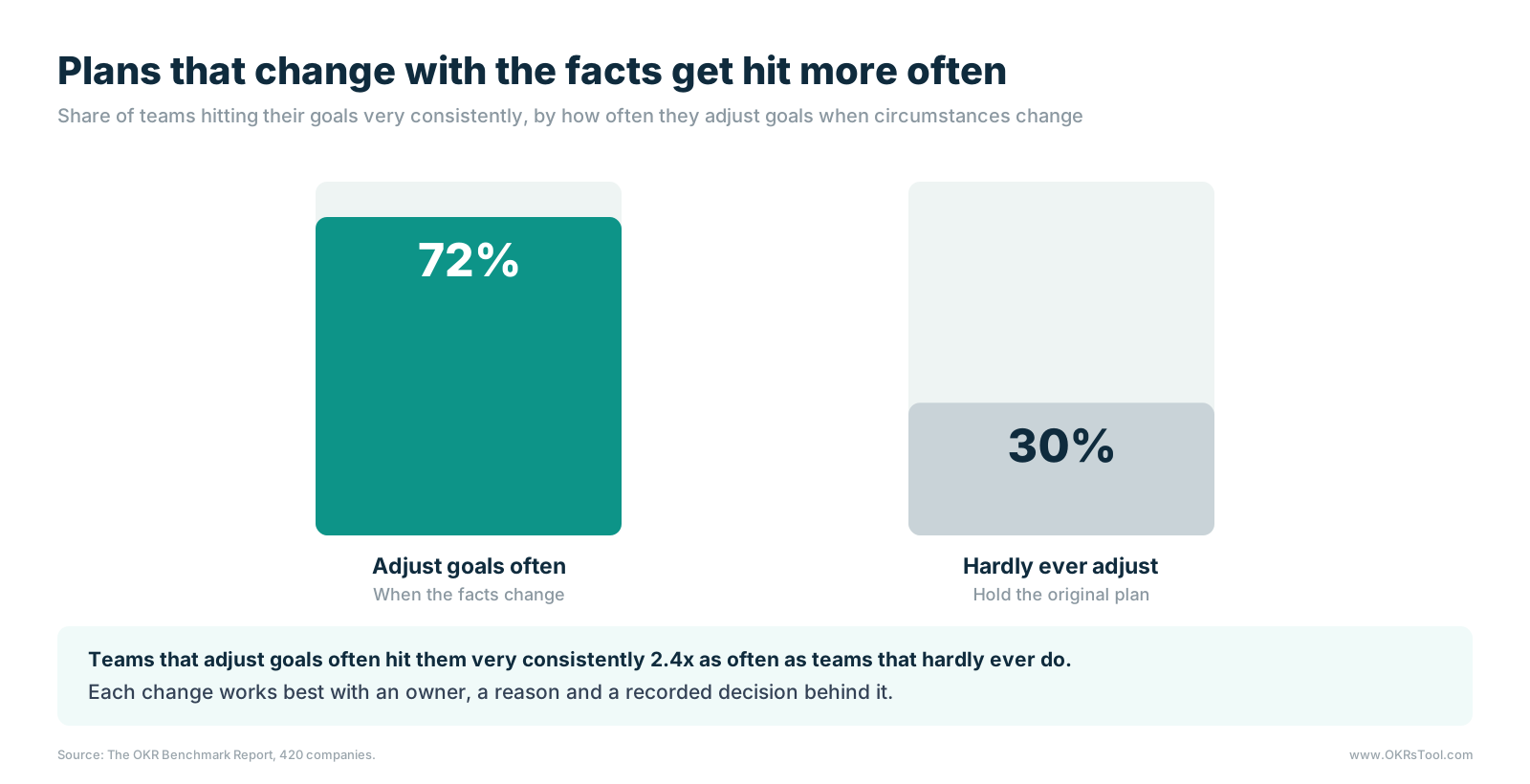
Teams that adjust goals often hit them very consistently 72% of the time, against 30% for teams that hardly ever do. Each change works when it has an owner, a reason and a record, which is what a clear process for adjusting OKRs when priorities change provides, and the mid-quarter review is the natural point to make those calls.
Whole priorities need the same treatment. When one stops making sense, leadership should end it on the record, move its people and budget to the remaining priorities and update the written plan, because a priority that fades without a decision keeps its claim on the team's time.
Strategic Planning Software
In the Strategy Execution Benchmark, 61% of companies run strategy on spreadsheets, documents or nothing at all. A plan kept in a slide deck has no owners attached, no progress against it and no signal when a priority slips, so every review starts with someone rebuilding the numbers.
Dedicated strategic planning tools change that. Companies using OKR software hit their goals very consistently 55% of the time, against 32% without it, and the Goal-Setting Benchmark found the gap widest among teams already reviewing weekly and tracking continuously, where software users reached 74% against 33% for teams tracking in sheets. Teams that keep spreadsheets for modelling and analysis next to their software post 62%, the best result of any setup in the OKR Benchmark Report.
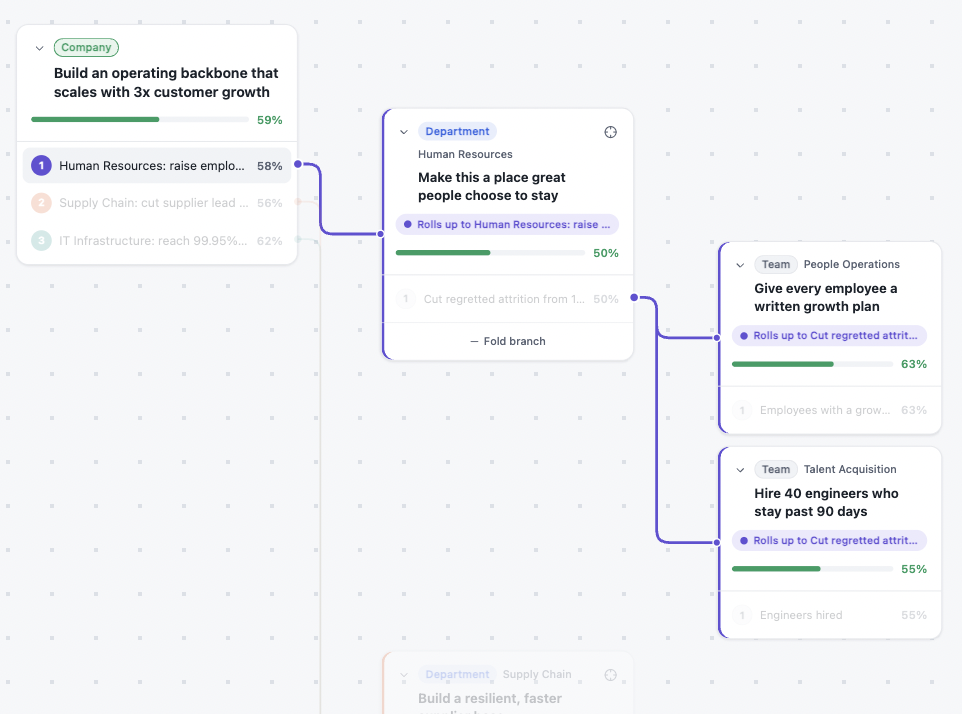
The features that matter for strategic planning follow the steps above. Every team goal should link visibly to a company priority, every key result should have one owner, check-ins should collect progress and a confidence score each week, and leadership should see the whole plan on one OKR dashboard without asking for a report. OKRs Tool's strategy execution features are built around that sequence, from company priorities to weekly check-ins.
The Plan Lives in the Weekly Review
A strategic plan earns its value in the weeks after the offsite. The assessment, the direction and the short list of priorities set the course, and the steps that follow decide whether anyone is still steering by it in the autumn: goals with one owner each, links from every team goal to a company priority, and reviews that happen on schedule.
Companies that build the plan with their teams and reopen it when the facts change give it the best chance of lasting the year. A platform that holds the priorities, the goals beneath them and the weekly progress in one place keeps the plan current without a quarterly rebuild.
Data: The Strategy Execution Benchmark, The OKR Benchmark Report, The Death of OKRs (and How to Revive Them) and The Goal-Setting Benchmark.