Across 330 organizations, 93% modified at least one OKR mid-cycle. Adjusting goals partway through a quarter isn't a sign of a broken process — it's what almost every organization does. The risk isn't the adjustment itself. It's that changing a target because the strategy shifted and changing a target because it's going to be missed look identical inside the tool.
Priorities move. A competitor ships something unexpected, a customer segment behaves differently than modeled, a dependency slips, or leadership reprioritizes. When that happens, OKRs written eight weeks ago can stop describing what the team should actually be working on.
The instinct to leave them untouched until the cycle closes is understandable but wrong. A Key Result nobody is pursuing is worse than no Key Result at all — it occupies attention in every check-in and produces a dishonest score at cycle end. The discipline is knowing which adjustments are legitimate and which are quiet capitulation.
Mid-Cycle Adjustment Is the Norm
The 2026 OKR Benchmark Report found that 93% of organizations modified at least one OKR before the quarter ended. Adjusting goals mid-cycle is not an edge case, and treating it as a failure of planning discipline creates a worse problem: teams leave dead Key Results on the board rather than admit the target no longer makes sense.

The honest framing is that a quarterly OKR is a bet made with the information available at the start of the quarter. When the information changes materially, the bet should change. What matters is that the change is deliberate, visible, and made for a reason the team can articulate.
The Distinction That Matters: Calibration vs Capitulation
Two adjustments can look identical in a dashboard and mean opposite things. Changing a Key Result because leadership shifted the strategic priority is calibration — the goal no longer serves the objective it was written for. Changing a Key Result because it's tracking behind and the team would rather not miss it is capitulation.
The second is a form of sandbagging, and it's more common than most teams admit. The State of Goal Management found 89% of employees admit to sandbagging goals, and 35% report having had goals quietly disappear. A mid-cycle "adjustment" that lowers a target the team is behind on, with no external change to justify it, is that disappearance in slow motion.
The test is a single question: what changed outside the team that makes this target wrong? If the answer is a strategy shift, a market change, a lost dependency, or new information that invalidates the original assumption — adjust. If the answer is "we're behind," the target isn't wrong. The execution is, and lowering the number hides the signal that would tell you why.
Refine, Pause, or Remove
Not every out-of-date OKR needs the same treatment. When priorities shift, each affected Objective and its Key Results falls into one of three categories, and choosing the wrong one is where cycles get muddy.
Refine when the direction still holds but the measure or target no longer reflects reality. The Objective survives. A Key Result's baseline or target changes because the underlying assumption was wrong — the starting number was measured incorrectly, or a dependency shifted the ceiling. The scope of what the team is trying to achieve is unchanged.
Pause when the Objective is still strategically valid but resources have moved elsewhere for a defined period. The goal isn't wrong; it's deprioritized. Pausing is honest in a way that quietly ignoring is not — it leaves a visible record that the team stopped, why, and when it might resume.
Remove when the Objective no longer serves the company strategy. This is the cleanest adjustment and the one teams avoid most, because deleting a goal feels like admitting failure. It isn't. Carrying a dead Objective through to cycle close so it can be scored at 0.1 wastes the retrospective and teaches the team that goals are decorative.
Make the Change Visible
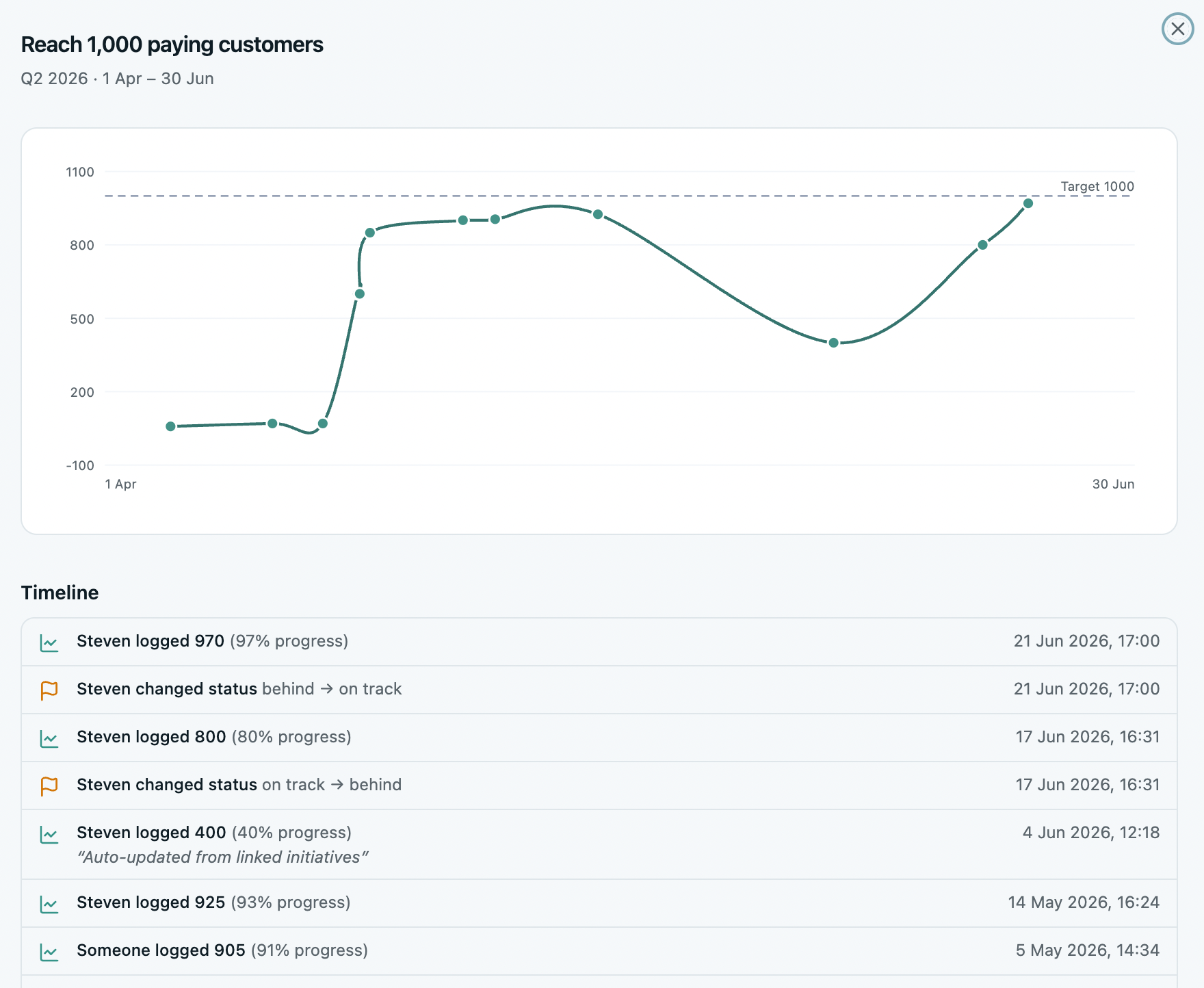
An adjustment that happens quietly is functionally the same as a goal that vanished. The State of Goal Management data on goals that disappear when nobody is watching describes exactly this pattern — and the teams where it happens most are the ones with the least visibility into who changed what and why.
Every mid-cycle change should carry three things: what changed, what external event triggered it, and who made the call. That record is what separates a defensible calibration from an unaccountable edit six weeks later when nobody remembers the reasoning. It also gives the end-of-cycle review something to learn from — a team that adjusted three Key Results for three different reasons has three data points about how its planning assumptions failed.
Adjust Less Often Than You Think
The 93% figure describes how often organizations change something, not how often they should. Frequent adjustment carries a real cost: a team that renegotiates its targets every few weeks never learns whether its original assumptions were calibrated, because it never lets one run to conclusion.
A consistent weekly habit is the mechanism that keeps adjustment rare. Teams that check in weekly complete 43% more OKRs than those reviewing monthly or ad hoc — largely because drift surfaces in week three, when a course correction is still possible, rather than in week eleven when the only remaining option is to change the target. Most adjustments that feel necessary in week nine would have been unnecessary if the Key Result had a named owner watching it in week two.
A useful discipline: hold a single formal review at the midpoint of the OKR cycle, around week six, where every OKR gets an explicit refine, pause, remove, or continue decision. That concentrates adjustment into one deliberate moment rather than a slow leak of quiet edits across the quarter.
Changing the Goal Is Not the Same as Changing the Standard
When priorities shift, the OKRs should shift with them — and doing so is what the overwhelming majority of organizations already do. The failure mode isn't the adjustment. It's the adjustment that never gets explained, the target that quietly drops when a team falls behind, and the goal that disappears without a trace between the planning session and the review.
Adjusting an OKR because the world changed is discipline. Adjusting it because the number is uncomfortable is the beginning of a system nobody believes in. See how OKRs Tool handles mid-cycle changes with a visible record of what moved and why — free for up to 5 users.
Data: The 2026 OKR Benchmark Report (330 organizations), The State of Goal Management (210 full-time employees at growing companies, 2026).