
Rollouts led by the CEO hit their goals very consistently 58% of the time, against 37% when HR or People Ops leads, and teams with one owner on every goal hit 65% against 17%. The first number measures leadership and the second measures management, and in a company of 50 to 200 people the same person is usually responsible for both.
A head of sales at a company of 120 people spends Monday morning explaining to her team why the company is moving upmarket this year, and Monday afternoon chasing three reps whose pipeline numbers haven't been updated since Thursday. The first conversation is leadership and the second is management, and in a company that size there's nobody else to hand either one to.
The two are easiest to tell apart by what each one does to a team's goals. In the OKR Benchmark Report, our survey of 420 companies running OKRs, leadership habits such as who sets strategy and how often leaders look at progress, and management habits such as who owns each goal and how often teams check in, each went with gaps of 20 points or more in how consistently teams hit their goals.
Where the Two Jobs Split
Leaders and managers work on the same goals from different ends. Leadership decides where the team is going and why the effort is worth it, while management decides how the work gets organized, tracked and corrected along the way. The table sets the two side by side across six areas.
Each column depends on the other. Direction without a weekly system tends to fade by the second quarter, and a weekly system without direction produces well-tracked work on the wrong priorities.
The Distinction Has Been Argued Since 1977
Abraham Zaleznik opened the debate in Harvard Business Review in 1977 with "Managers and Leaders: Are They Different?", arguing that managers value order and process while leaders are drawn to change and new ideas. John Kotter's 1990 article "What Leaders Really Do" gave the version still taught in business schools: management copes with complexity through planning, budgeting, organizing and controlling, and leadership copes with change by setting direction, aligning people and motivating them.
Warren Bennis and Burt Nanus put it into one line in their 1985 book Leaders, writing that managers do things right and leaders do the right thing. Kotter added the point that matters most for a company of 150 people, which is that organizations need both and the strongest people can do both. Peter Drucker's management by objectives, first set out in 1954, sits firmly on the management side and is the ancestor of the goal systems teams use today.
One Person, Two Jobs
Large companies can split the roles across levels, with executives setting direction and layers of managers running the system underneath. A company of 50 to 200 people has few of those layers, so the department head who writes the priorities on Monday is the same person checking on Friday whether the team updated its numbers.
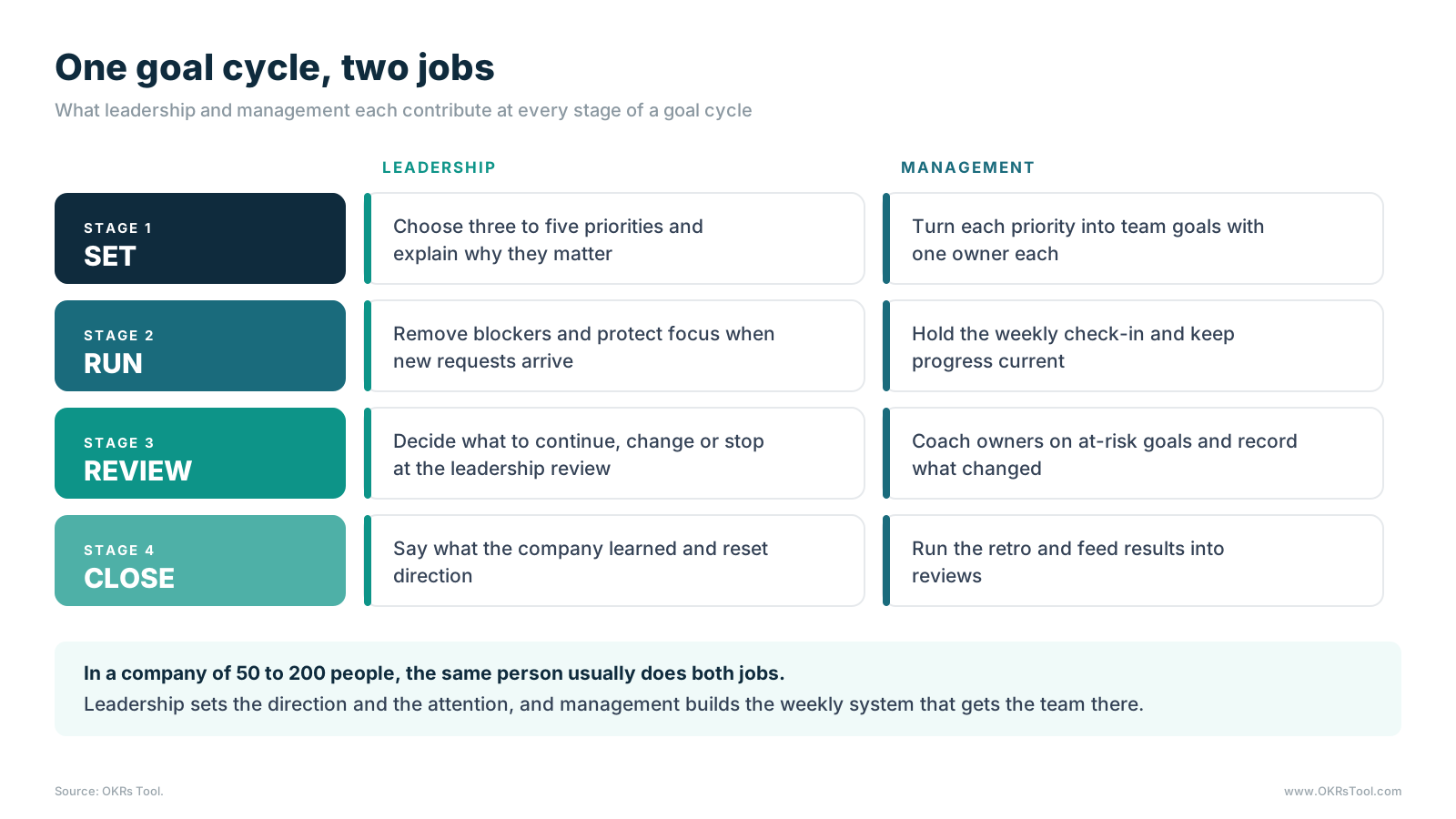
Each stage of a goal cycle needs one leadership decision and one management routine. A department head who handles only the left column gives a clear direction that nobody turns into weekly work, and one who handles only the right column runs a tidy process toward team goals that nobody chose with care. The weekly OKR meeting is where both columns meet, because the same half hour covers progress on the numbers and the reasons behind them.
Leadership Shows Up in Direction and Attention
Leadership can be measured by what a team can repeat back. In the Strategy Execution Benchmark, 86% of strategy and operations leaders said their workforce can't name the company's top priorities, so the direction lives mostly on a slide. Where strategy is set collaboratively, with teams testing the priorities before they're final, teams hit their goals very consistently 58% of the time, against 37% where the exec team sets it alone.
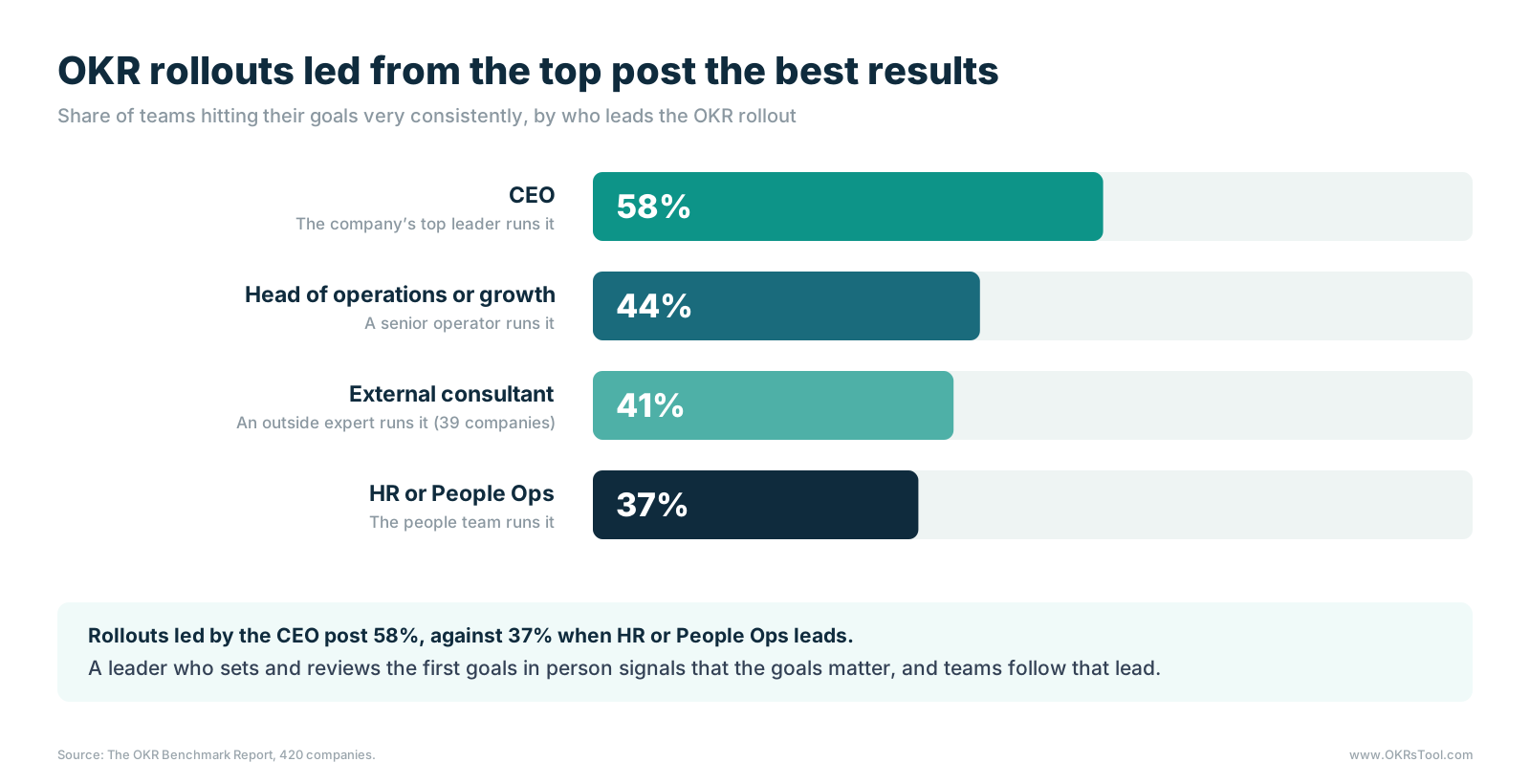
Who leads the OKR adoption shows the same pattern. The benchmark compared rollouts by the person in charge of them.
Rollouts led by the CEO reach 58%, against 44% for a head of operations or growth, 41% for an external consultant and 37% for HR or People Ops. When the top leader sets the first goals and reviews them in person, the goals carry the weight of the company's direction, and teams treat them that way.
The same holds after launch: leadership teams that review OKRs every week see their teams hit goals very consistently 65% of the time, against 33% for quarterly review, yet only 26% of companies hold that weekly review.
That review takes about ten minutes when owners update their scores beforehand, and it's how leadership accountability becomes visible to everyone below. The OKR culture a company ends up with follows what its leaders look at each week, and a leadership team that reviews progress through visibility without status meetings sends the message without adding a meeting.
Management Shows Up in the Weekly System
Management is the set of routines that keeps a goal moving between the moments leaders look at it. Three of them carry the largest gaps in the benchmark. Teams that give every OKR one named owner hit their goals very consistently 65% of the time, against 17% where only some goals are owned, and teams holding a weekly check-in post 60%, against 30% for monthly ones.
Scoring every key result for confidence goes with 66%, against 22% when only some are scored, because a confidence score gives the manager a reason to talk about a goal before its numbers turn red. A manager running these three routines can answer, on any day of the quarter, which goals are at risk and who is working on them.
Screenshot suggestion: the OKRs Tool weekly check-in screen for one team, showing each key result with its owner, current progress and confidence score. Alt text: Weekly OKR check-in showing each key result with one owner, live progress and a confidence score.
The same routines decide whether a manager can defend a performance rating. In the Performance Rating Benchmark Report, only 27% of HR leaders said nearly all managers could back every rating with goal evidence, and 68% had seen strong early work forgotten by review time. A manager who keeps the goal record current all year walks into OKR-based performance reviews with the evidence already written, and a regular 1:1 meeting adds the context behind each number.
Why Teams Need Both
Teams feel the absence of either job quickly. In The State of Goal Management, our survey of 210 employees, only 30% could name all of their company's top goals, which is a leadership gap, and 34% said nothing about their work would change if the goal tracker were deleted, which is a management gap.
The way goals connect to pay shows the two jobs pulling on each other. When goals affect performance ratings, 96% of employees admit to sandbagging, setting targets they know they can beat, against 81% when goals and ratings are kept separate. Leadership sets the expectation that ambitious goals are welcome, and management decides how a missed stretch goal shows up in a review, and teams take more risk when both jobs send the same signal, which is the basis of psychological safety in OKRs.
New managers tend to arrive strong in neither job, because they're usually promoted for their own output. Building the management routines first, with goals, owners and a weekly check-in, gives them a structure to lead from and a clear way to manage employee performance. Regular 360 feedback then shows them whether their team hears the direction as clearly as they think they're giving it.
The Strongest Managers Lead Every Week
Leadership and management describe two jobs that a department head in a growing company does in the same week, often on the same day. Leadership chooses the direction, explains it and reviews progress against it, and management turns it into owned goals, weekly check-ins and a record that holds up at review time.
The data favors people who do both in small, regular amounts: a priority explained clearly, a goal with one owner, a ten-minute review every week. A platform that keeps goals, owners and progress in one place and gives leaders a live OKR dashboard handles the routine part of management, which leaves more of the week for leading. For managers who also run reviews, OKRs Tool's performance features connect that goal record to each rating.
Data: The OKR Benchmark Report, The Strategy Execution Benchmark, The Performance Rating Benchmark Report and The State of Goal Management.