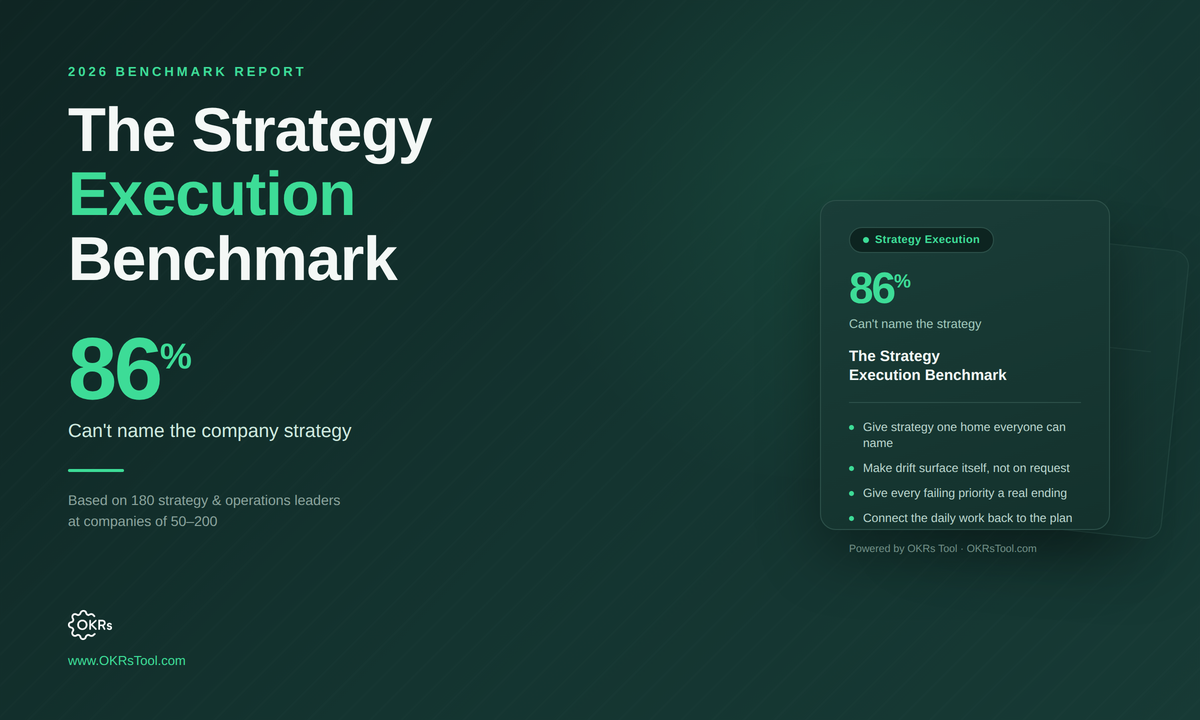
Across 180 strategy and operations leaders at companies of 50–200 people, strategy doesn't fail at the whiteboard — it decays in four measurable ways after the offsite. 86% say most of their people can't name the top priorities. Only 7% say most daily work connects to strategy. 83% get no automatic signal when something drifts. And 60% never cleanly resolve a priority that's clearly failing.
Ask a leadership team whether their strategy is working and you'll hear "on track." Ask the person actually responsible for executing it — the VP of operations, the head of strategy — what happens between the planning offsite and the quarterly review, and the picture changes.
The Strategy Execution Benchmark 2026 surveyed 180 strategy and operations leaders at companies of 50–200 employees, all confirmed accountable for how strategy gets executed, with no OKRs Tool customers in the sample. The finding points to the same conclusion four different ways: strategy that gets set well still decays, and it doesn't decay because people abandon the plan. These leaders review execution weekly or monthly and feel confident in their view. The failure isn't effort. It's that nothing in the operating system around the strategy keeps it alive.
The Four-Part Decay
Strategy has to stay named, connected, visible, and decided to survive contact with the quarter. The benchmark measures where each of those breaks — and the gaps are wide.
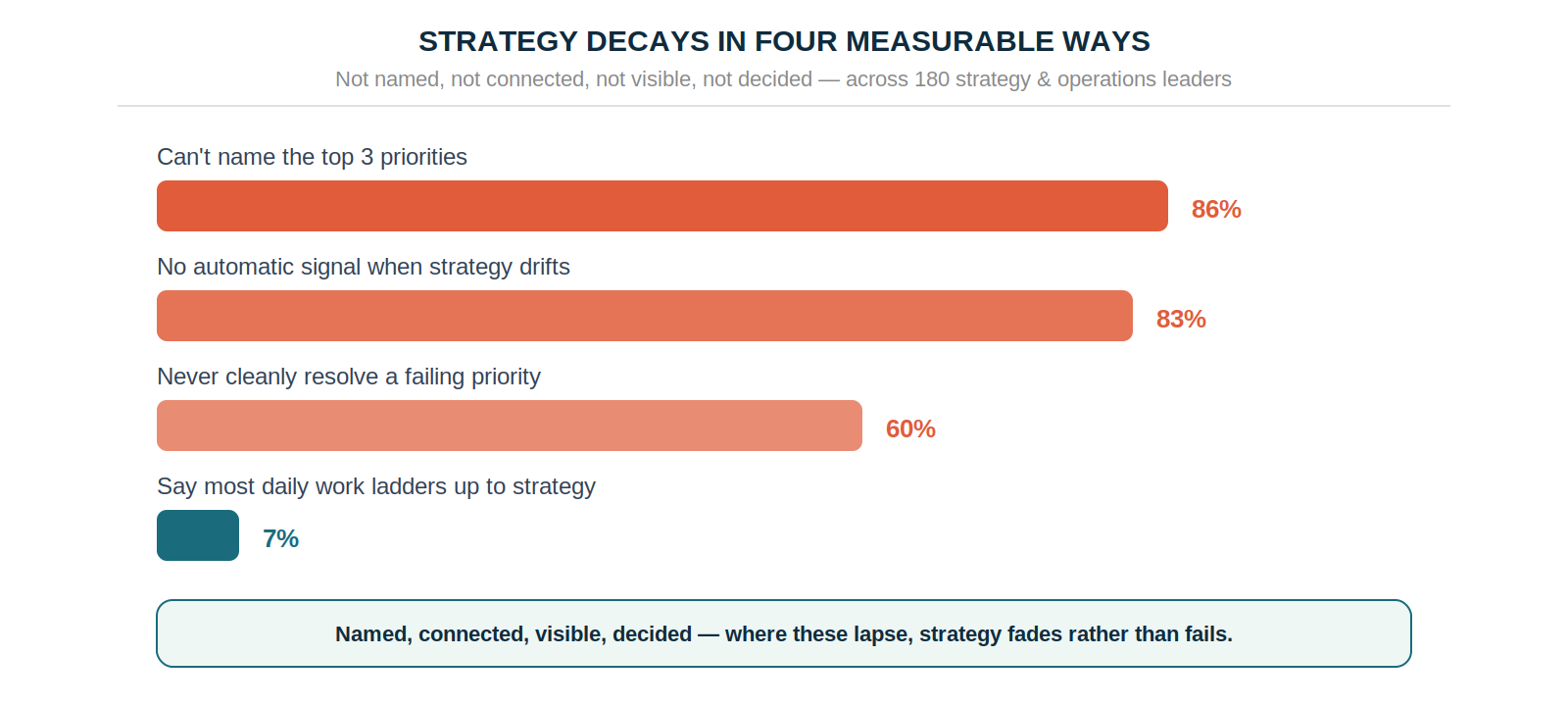
None of the four is an effort problem. The leaders in this study care and show up. Where the four lapse, strategy doesn't fail loudly — it fades between the plan and the day-to-day, and by quarter-end the outcome feels inevitable even though no one decided it.
Finding 1: 86% Can't Name the Strategy
The first thing that has to survive the trip from planning to execution is the strategy itself, as something people can hold in their heads. It mostly doesn't. Asked what share of their employees could state the company's top three priorities right now, unprompted, only 14% of leaders said more than three-quarters could.
Nearly two-thirds — 64% — say half or fewer of their people can name the strategy. A goal that can't be recalled can't be pursued deliberately; it can only be performed at review time.
Part of why recall is low is that the strategy has no durable home. 41% store it in a goals or OKR document, but 26% rely on a slide deck as the primary artifact and 13% have no central written strategy at all. A strategy that exists mainly as a deck seen once a quarter is structurally hard to remember — and impossible to keep in front of people between reviews.
Finding 2: Only 7% Say Most Work Ladders Up to Strategy
Even where strategy is named, the second break happens fast: the daily work doesn't connect to it. Asked what share of their teams' day-to-day work actually ladders up to company strategy, only 7% of leaders said 76–100%. Nearly two-thirds put it at half or less.
This is the gap between what a company decided to do and what its people are actually spending their hours on — the space where OKRs are meant to operate. 93% of leaders say a meaningful share of daily work does not fully ladder up to strategy.
The translation lag is real but it isn't the core problem. 78% of leaders say getting strategy from "decided" to "reflected in every team's work" takes two weeks to a full quarter. That handoff is a one-time cost. The laddering gap is the ongoing one — work that started aligned drifts out of alignment as priorities shift and nobody re-connects them.
Finding 3: 83% Get No Automatic Signal When Strategy Drifts
This is the sharpest finding in the study, and the one no comparable benchmark has named. These leaders aren't blind — 88% say they're at least somewhat confident in their view of execution. The problem is subtler: nothing surfaces a problem to them. They have to go and find it.
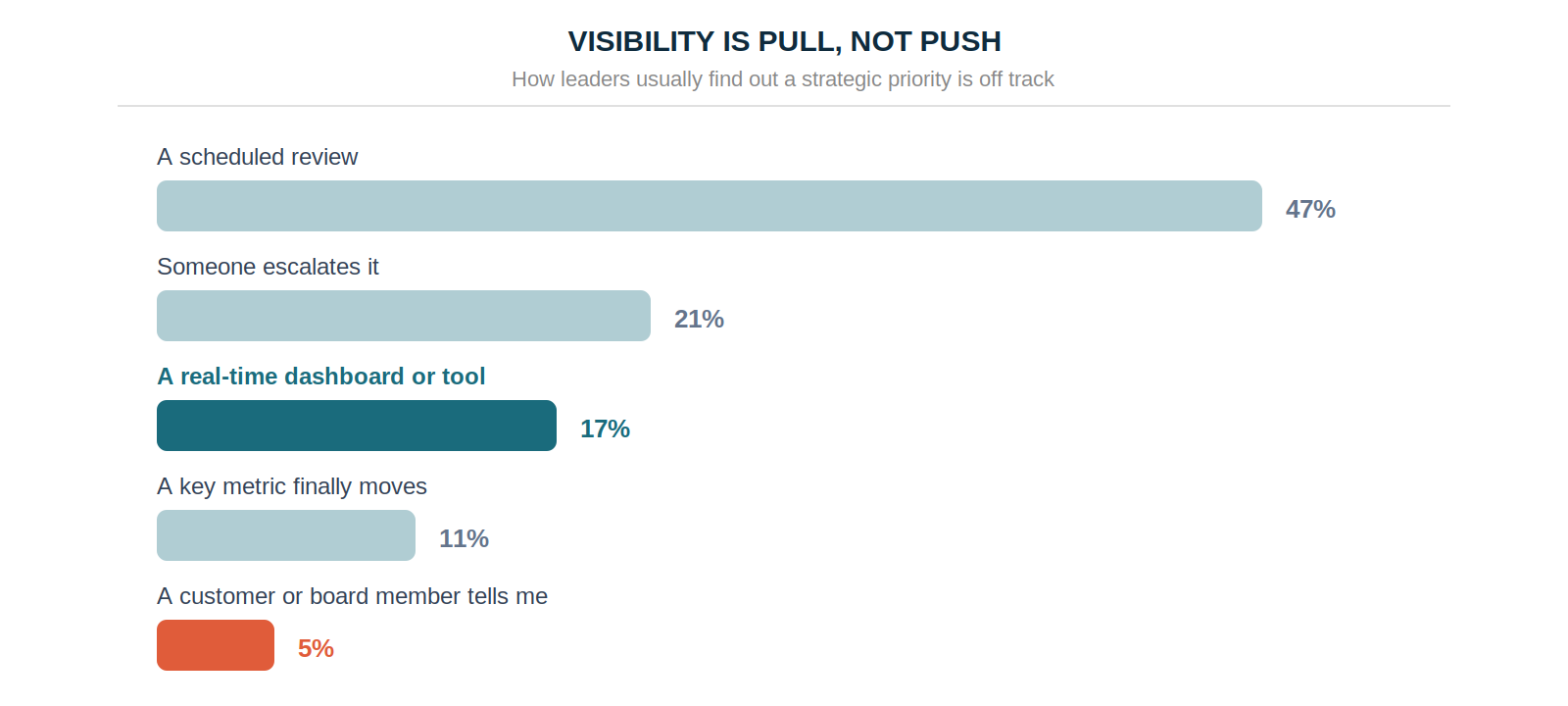
Only 17% of leaders learn about drift from a tool that surfaces it automatically. The other 83% find out by attending a review, being escalated to, watching a metric finally move, or — for 1 in 20 — hearing it from a customer or the board. By then the drift has already happened.
The default state is dark. Between planning cycles, 62% of leaders say execution progress reaches them only when they ask or when a scheduled review comes around. Just 35% can see it live, any time. Asked what they'd most want to see that they currently can't, one operations leader answered simply: "To have an alert to let me know."
Finding 4: 60% Never Cleanly Resolve a Failing Priority
The final break is the quietest. When a strategic priority is clearly failing mid-cycle, only 40% of leaders say it gets formally revised or killed. The other 60% describe some version of nothing happening: the priority is quietly dropped, it limps to the end of the cycle, or nobody clearly decides either way.
A failing priority is now almost exactly as likely to vanish silently (39%) as to get a real decision (40%). The absence of a decision is itself a decision — just an unaccountable one. It's how a strategic bet dies without a retrospective, and without anyone learning from it.
The lag compounds the silence. Because visibility is pull rather than push, problems also arrive late — 21% of leaders say a priority is typically off track for a month or more before they personally know. Late detection plus no forced decision is the mechanism behind the resolution gap.
Where It Breaks, and What It Runs On
Two findings tie the decay together. The first: leaders are clear that strategy doesn't break at the launch. Asked where it most often breaks down, only 23% pointed to the initial translation into team work. 68% pointed downstream — to sustaining attention over time, and to measuring whether it's actually progressing. The hard part isn't the kickoff. It's everything after.
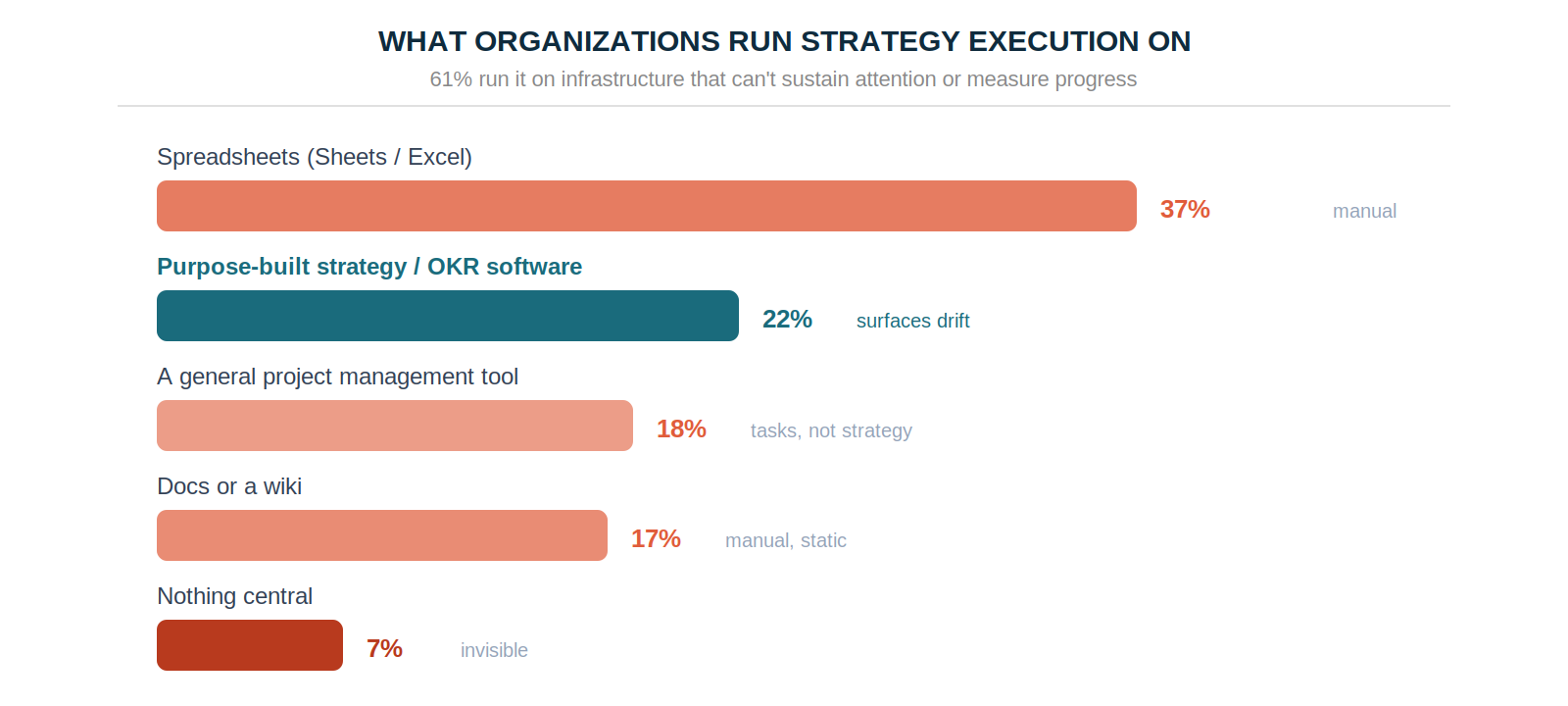
The second: the infrastructure most of this runs on can't do the sustaining or the measuring. 61% of leaders manage strategy execution on spreadsheets, docs and wikis, a general project tool, or nothing central at all. A spreadsheet doesn't send a reminder, surface a drifting priority, or force a continue-revise-kill decision.
It creates the appearance of management while leaving every gap in this report wide open. The breakdown points leaders name — sustaining attention and measuring progress — are exactly the two things a static spreadsheet cannot do.
What Best Looks Like
The organizations where strategy stays load-bearing aren't running better strategy. They're running better systems around it — mapped to the four gaps this report measures.
The distance between this profile and where most organizations sit isn't a capability gap. It's a systems gap — and systems can be fixed.
Four Moves, In Order of Impact
The report's action plan is ordered by leverage. First, make drift surface itself — turning visibility from pull to push is the single highest-leverage change, because it shrinks the detection lag that lets strategy die quietly. Second, give strategy one durable home everyone can name, since a recallable strategy is the precondition for everything else.
Third, give every failing priority a real ending — a logged continue, revise, or kill, applied every time, so the decision is visible rather than avoided. Fourth, move off the spreadsheet: purpose-built software makes the naming, connecting, surfacing, and deciding structural instead of dependent on someone remembering to update a file.
None of the fixes are exotic. Name it once, connect the work to it, make drift surface itself, and give every miss a real decision. These are operating disciplines, not features — and the organizations that run them don't have better strategy, they have strategy that's still alive at quarter-end.
Get the Full Data
The complete Strategy Execution Benchmark 2026 includes all the findings across the four gaps, the six-dimension "What Best Looks Like" profile, a self-assessment scorecard, and the full action plan. It's an independent survey — no OKRs Tool customers were included, because an honest number is more valuable than an impressive one.
See how OKRs Tool closes the four gaps this report measures — keeping strategy named, connected, visible, and decided through the quarter. Free for up to 5 users.
Data: Strategy Execution Benchmark 2026 — 180 strategy and operations leaders at companies of 50–200 employees, all confirmed accountable for strategy execution. Independent research — no OKRs Tool customers included.