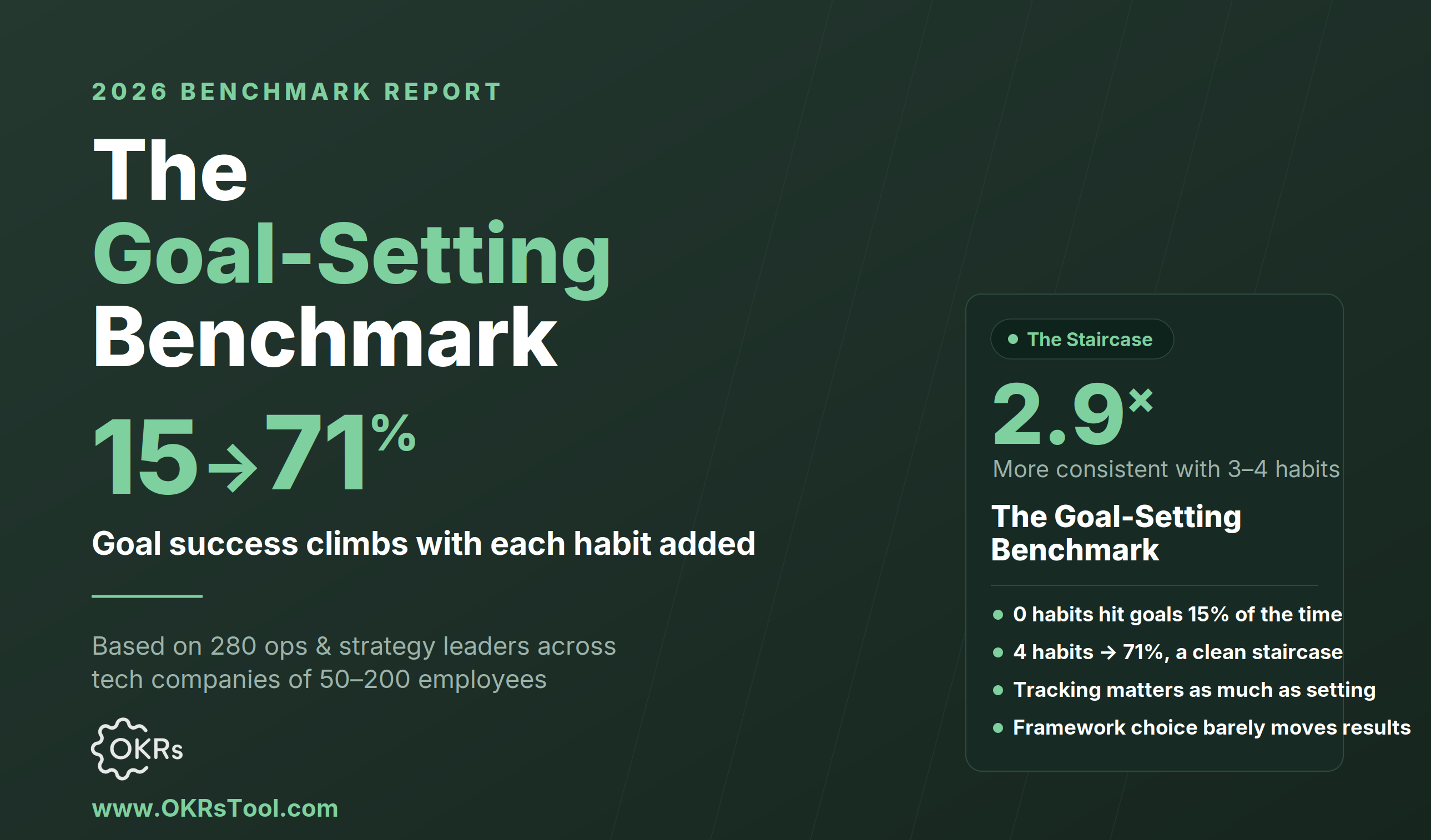
A team running KPIs, if it reviews weekly, tracks continuously, keeps goals visible, and uses real software, hits its goals more consistently than a team on a fashionable framework doing none of that. Across 280 leaders, the framework a team picked barely predicted success. Four ordinary habits predicted almost all of it — and stacked, they lifted goal success 2.9x.
Every planning offsite opens with the same argument: which goal-setting framework should we run — SMART, OKRs, MBO, some homegrown scorecard?
The Goal-Setting Benchmark surveyed 280 operations and strategy leaders at growing tech companies and found that argument is mostly a waste of the afternoon. The label on the framework was one of the weakest things in the whole dataset for predicting whether a team actually hit its goals.
What did predict it was the unglamorous work that happens in the weeks between reviews — whether goals got looked at every week, whether progress stayed current, whether anyone could see the goals at all, and whether the team ran on real software or a spreadsheet no one opened.
Those four habits did nearly all the work, and they compounded so cleanly that the framework question stops looking like the important one. This is the argument the report makes, finding by finding, and what to do about it in order.
The Framework You Pick Barely Moves the Needle
The market is fragmented and light. SMART goals lead at 39%, another 32% run something basic or no named framework at all, and KPIs-only take 16%. The structured methods everyone argues about — MBO, OKRs, V2MOM — each come in at 5% or below. No framework holds the market, and switching from one to another moves almost nothing.
Applying a framework consistently does help — 43% of teams that do hit their goals very consistently, against 23% of teams that apply one loosely. That gap is real, and worth noticing: consistency matters. But consistency is a property of how a team works, not of which framework it named. So if the label isn't what separates the teams that hit from the teams that miss, the honest next question is what does.
Four Habits Do Almost All the Work
The answer the data keeps returning to is a set of four habits, and they hold whichever framework sits on top of them, or none:
Each one, on its own, roughly doubles a team's chance of hitting goals very consistently. Weekly review and dedicated software pull hardest; visibility does the least alone but earns its keep once the other three are in place.
Every one of these is simple, and none of them relies on a particular framework. So the real question is what happens when a team does all four at once.
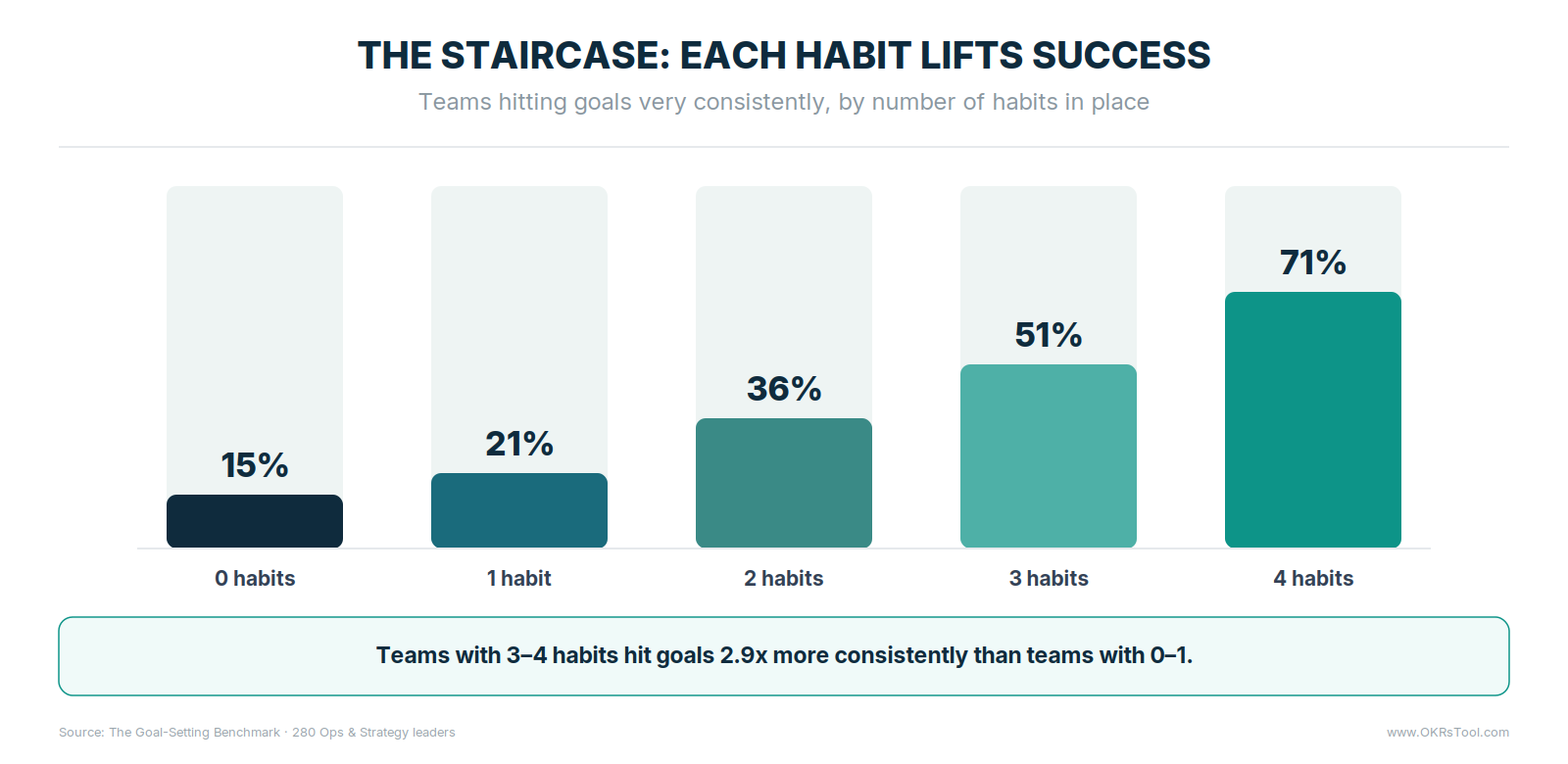
They compound into a staircase. Score every team from zero to four on the habits, plot how consistently each group hits its goals, and success climbs at every step with no plateau until the top: 15%, 21%, 36%, 51%, 71%.
Teams with three or four habits hit their goals 2.9x more consistently than teams with zero or one. This is the whole case in one image — a team on KPIs running all four habits clears a team on the trendiest framework running none, and it isn't close.
Most Teams Only Claim the Discipline
If the staircase is this clean and the habits are this well-known, everyone should be climbing it. Yet most teams aren't climbing it, and the reason is the gap between saying "we're disciplined" and doing the week-to-week work that discipline actually means. Just under half of teams say they apply their framework consistently.
Ask those same teams what they do between reviews and the mechanics mostly aren't there: only 36% review their goals weekly, only 41% run on dedicated software, and 35% only touch their goals when a review is coming up.
That's the catch that explains why the staircase and reality look so different. Every team in the sample could recite the four habits, so the shortfall is a practice gap rather than a knowledge one — and no new framework closes a practice gap. Only the habits, run for real, do.
Tracking Wins Goals, and It's the Half Teams Skip
The market spends its energy on setting better goals — cleaner wording, sharper targets, the perfect key result. The data says that's half the job, and not the harder half. Split teams four ways on whether they set goals well and whether they track them well, and the picture is stark.
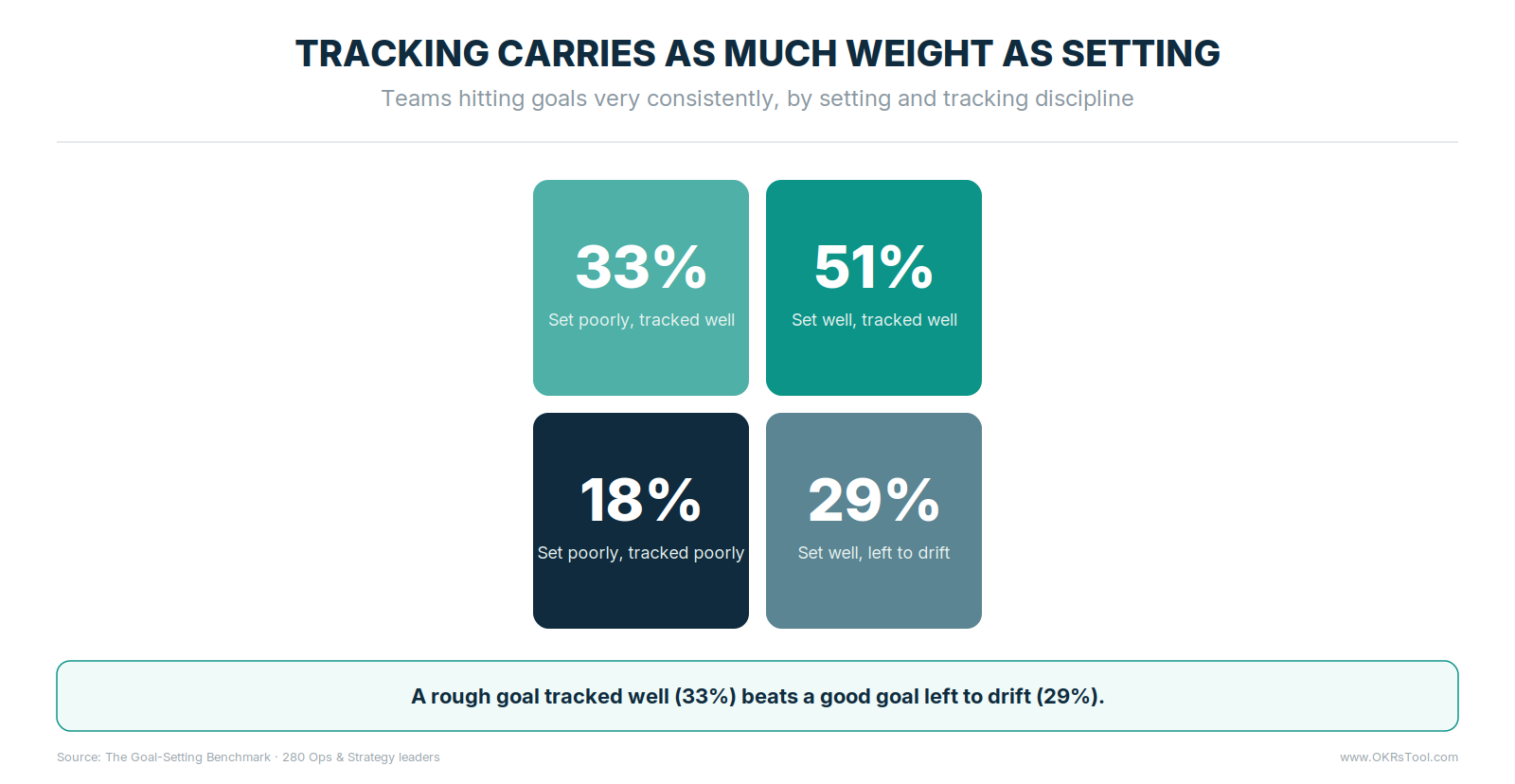
A carefully set goal that no one tracks lands at 29% — barely above the 18% floor where neither discipline exists. A roughly set goal that's tracked closely does better, at 33%. Read those two numbers together: the sloppy goal that gets watched beats the beautiful goal that gets ignored. Setting well and tracking badly throws most of the value away, and tracking is exactly the habit teams are most likely to drop.
Skipping the Habits Costs a Working Week a Year
The habits cost attention and nothing else. Skipping them costs real hours, and then results. 59% of teams lose an hour or more every month just reconstructing where their goals stand — call it a full working week over a year, spent re-answering a question a live system would answer for free. Another 66% see work done twice because goals aren't visible in one place.
And the time drain tracks with the outcome: the heaviest status-chasers run a 16-point lower on-track rate than the lightest. The hours you spend hunting for the number are hours you're not spending moving it.
Do the Habits First. Then the Tool Sets the Ceiling.
The tool matters — but it matters last, and only once the habits are real. Among teams that already review weekly and track continuously, the ones doing the genuinely hard part, the tool still decides how high they go.
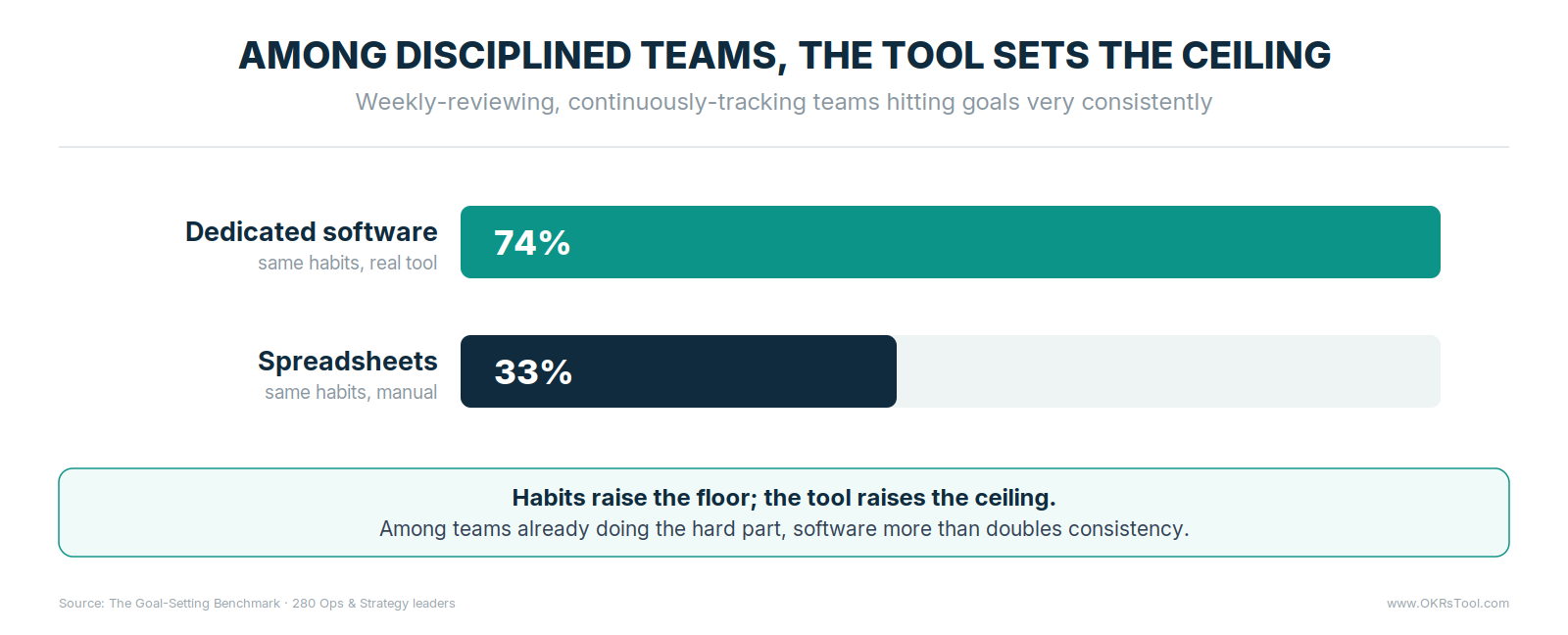
Among those disciplined teams, 74% on dedicated software hit their goals very consistently, against 33% on spreadsheets — the tool more than doubles the result. But the order is everything: software without the habits changes nothing, which is why moving off the spreadsheet is the last move, not the first.
And one honest limit, because the data shows it: no cadence fixes shifting priorities. "Priorities shifted" is the number-one reason goals get missed at 46%, and it stays number one whether a team reviews weekly (47%) or quarterly (51%). A weekly rhythm keeps a goal honest; it can't decide whether the goal still deserves to exist. That's a leadership call no tracking habit will make for you.
Where This Leaves You
The teams pulling ahead aren't the ones with the best-named framework. They put every goal in one visible place through a clear cascade, review it weekly, keep the numbers current, and run it on a real tool — in that order, because each move makes the next one pay.
Start with visibility (the cheapest habit, and the one that kills duplicated work), add the weekly rhythm, track continuously instead of only before reviews, and move off the spreadsheet once the habits hold. The practice is the hard part, and the good news buried in the data is that practice can be built one habit at a time — starting this cycle.
Data: The Goal-Setting Benchmark, an independent survey of 280 operations and strategy leaders at technology companies of 50–200 employees.