
Strategic planning frameworks are structured methods for analyzing a company's position and choosing where to compete. Each answers a different question — external forces, industry structure, internal strengths — and picking the wrong one wastes an offsite. But no framework executes itself: across 180 companies, 93% of daily work never connects to the strategy these frameworks produce.
There are dozens of strategic planning frameworks, and most guides list all of them with equal weight, which is the least useful thing a guide can do. The frameworks are not interchangeable. SWOT and PESTEL scan the environment; Porter's Five Forces dissects an industry; Playing to Win and the Ansoff Matrix force a choice about where to grow; VRIO tests whether an advantage will last. Reaching for the wrong one produces a tidy analysis that answers a question you weren't asking.
This guide covers the frameworks that earn their place, grouped by the job they do: understand the landscape, understand the industry, and choose a direction. For each, the honest version of what it's good at and where it falls short. And because analysis is only half of strategy, the guide closes on the part every framework leaves out — turning the plan into work that actually happens.
The Frameworks at a Glance
Before the detail, here's the whole set in one view — what each framework analyzes, and the question it exists to answer.
Frameworks for Scanning the Landscape
These are the widest-angle tools — used early, to understand the environment before making any choice.
SWOT: The One Everyone Starts With
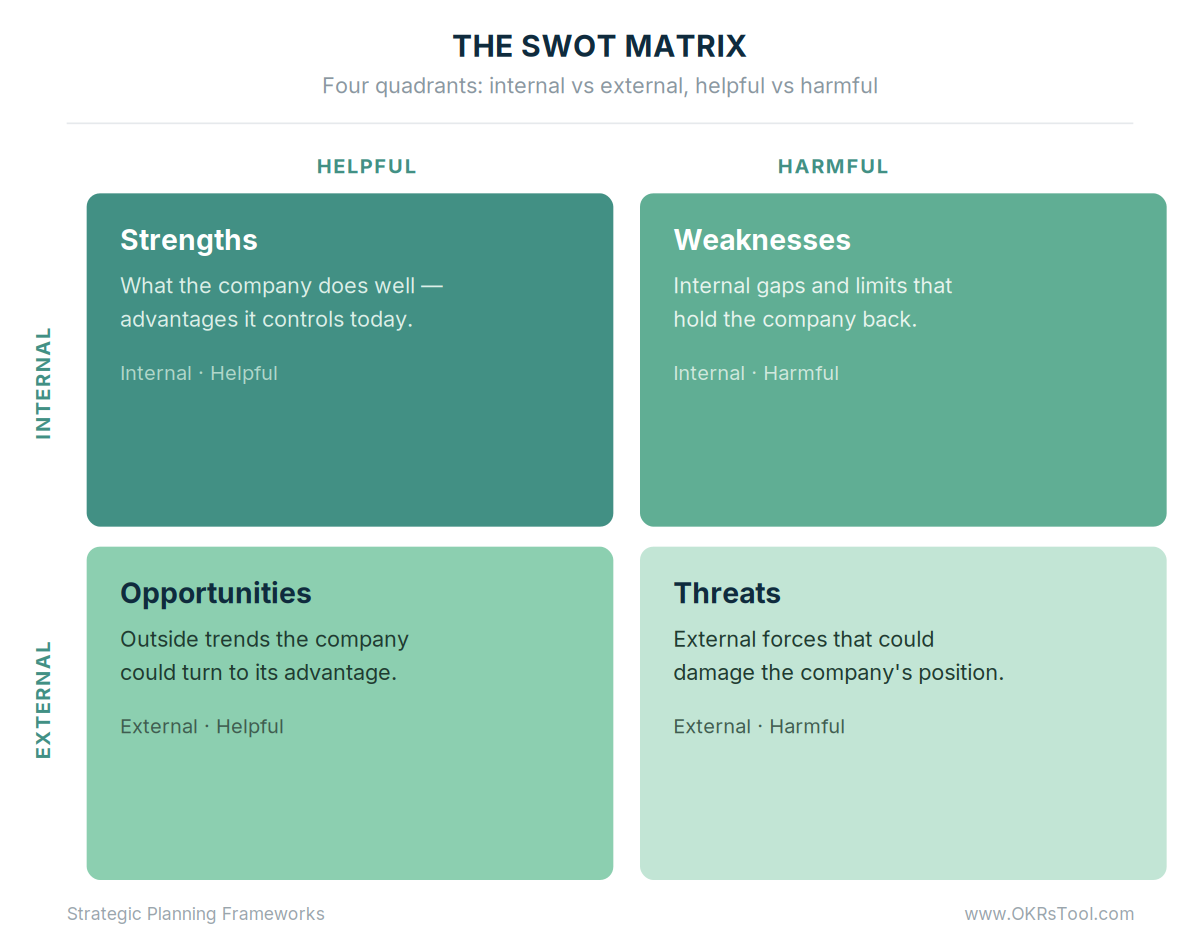
SWOT maps strengths, weaknesses, opportunities, and threats into four quadrants. Its virtue is speed: a team can fill one in during a single session and leave with a shared picture of where the company stands. Its weakness is that it stops at the picture.
A SWOT lists factors without weighing them, so it's easy to walk out with fifteen items and no idea which three matter. Use it as a warm-up that feeds a sharper framework, not as the strategy itself. The moment a SWOT quadrant fills up, the real work is deciding which entries are worth acting on.
PESTEL: Scanning the Forces You Don't Control
PESTEL widens the lens to the macro-environment: political, economic, social, technological, environmental, and legal forces. Where SWOT looks at the company, PESTEL looks at the world the company operates in — the forces no single business controls but every business is shaped by.
It's strongest for entering a new market or stress-testing a long-range plan against shifts a team might otherwise miss. Its limit is that it identifies forces without telling you what to do about them; PESTEL is an input to strategy, not a strategy. Pair it with a framework that forces a decision, or the scan becomes a report nobody acts on.
Frameworks for Reading the Industry
Scanning the environment tells you what's out there. The next question is whether the industry itself is worth competing in.
Porter's Five Forces: How Hard Will This Be to Win
Porter's Five Forces analyzes the structural forces that set an industry's profitability: rivalry among competitors, the threat of new entrants, the threat of substitutes, and the bargaining power of buyers and suppliers.
It answers a question the scanning frameworks can't — not "what's happening" but "how attractive is this game to play." A market can be growing fast and still be brutal to compete in if buyers hold all the power and entrants pour in.
Five Forces is at its best before entering a market or committing to a major bet. Its weakness is that it's a snapshot of a structure that's always moving, so a Five Forces done once and filed is worth little; the value is in redoing it when the industry shifts.
Frameworks for Choosing a Direction
Analysis has to end in a choice. These frameworks exist to force one.
Playing to Win: Strategy as a Cascade of Choices
Playing to Win, from Roger Martin and A.G. Lafley, frames strategy as five linked choices: a winning aspiration, where to play, how to win, the capabilities required, and the management systems to support them. Its power is that it refuses to let strategy stay abstract — each choice constrains the next, so "where to play" without a matching "how to win" is visibly incomplete.
It's the strongest of these frameworks at producing an actual strategy rather than an analysis, which is why it belongs at the deciding end of the process. The catch is that the fifth choice — management systems — is where most teams stop paying attention, and it's the one that determines whether the strategy survives contact with the quarter. Those management systems are exactly what a check-in cadence provides.
The Ansoff Matrix: Four Ways to Grow
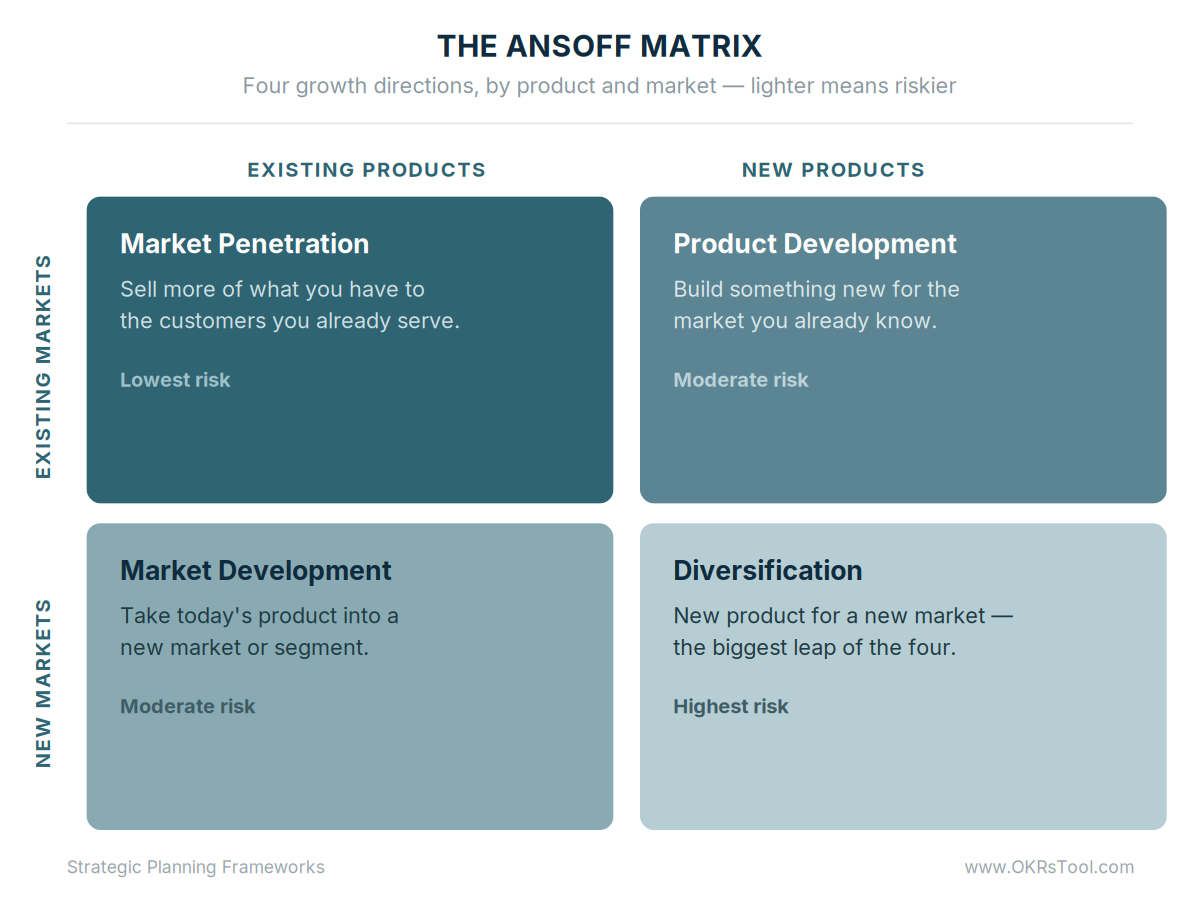
The Ansoff Matrix sorts growth options into four boxes by pairing existing or new products with existing or new markets: market penetration, market development, product development, and diversification.
Its value is clarity about risk — selling more of what you have to who you already serve is far safer than building something new for someone you don't know, and the matrix makes that gradient obvious. Use it when the question is specifically "which direction do we grow?"
Its limit is narrowness: it's a growth-direction tool, not a whole-strategy framework, and treating it as more than that leaves large parts of the strategy unaddressed.
The BCG Matrix: Where to Put the Money
The BCG Matrix plots a company's products or business units on market share against market growth, sorting them into stars, cash cows, question marks, and dogs. It's a portfolio tool — most useful for a multi-product company deciding where to invest, hold, or divest. Its strength is forcing an honest look at which parts of the business fund the others.
Its weaknesses are well-documented: market share and growth are only two dimensions of many, and the labels can become self-fulfilling if a "dog" is starved of investment before it's had a chance. Use it to structure a portfolio conversation, not to end one.
VRIO: Does the Advantage Actually Last
VRIO tests a single resource or capability against four questions: is it Valuable, Rare, hard to Imitate, and is the company Organized to exploit it? A resource that passes all four is a source of durable advantage; one that fails any is not.
VRIO is the sharpest of these frameworks for a specific job — pressure-testing whether an advantage you think you have will survive competition. Its limit is scope: it evaluates resources one at a time and says nothing about the market or the customer, so it's a component of strategy analysis rather than the whole of it.
Why the Framework Matters Less Than What Comes After
These frameworks share a blind spot almost no framework guide mentions. Every tool above helps a company decide what its strategy is. None of them touch whether that strategy actually happens. And the evidence says that second half is where strategy overwhelmingly fails.
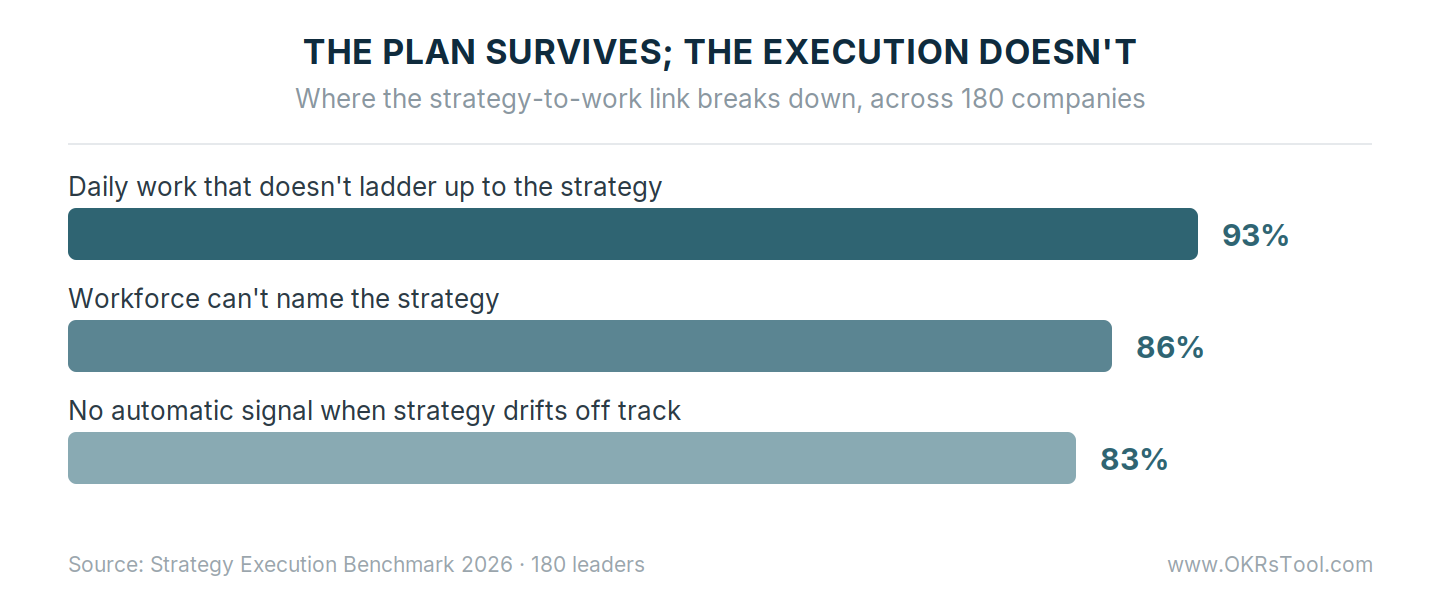
The 2026 Strategy Execution Benchmark surveyed 180 strategy and operations leaders and found that in only 7% of companies does most daily work clearly ladder up to strategy. A company can run a flawless Playing to Win cascade, validate its advantage with VRIO, and still watch 93% of the actual work drift disconnected from any of it — because the framework produced a plan, and a plan is not execution.
The best-analyzed strategy in the world dies in the gap between the offsite and the calendar, which is the same reason so many plans stall in the strategy visibility gap no matter how sound the analysis.
This is why the framework you choose matters less than what you build underneath it. A SWOT wired into weekly work will out-deliver a brilliant Five Forces analysis that lives in a slide deck, because the SWOT is connected to something that happens and the Five Forces is not. The connective layer is unglamorous — clear ownership and live progress tracking — but it's what turns any framework's output into results.
From Framework to Execution
The bridge from any of these frameworks to execution is a goal system. A strategic planning framework produces a set of choices; an OKR turns each choice into measurable outcomes a team works toward this quarter.
Playing to Win's "how to win" becomes a set of key results; the growth direction chosen in an Ansoff Matrix becomes the objective a team owns. Writing those goals well is its own discipline — the same one covered in how to write OKRs — but the principle is simple: the framework decides the destination, and the OKR cycle is how the company actually travels toward it.
That handoff is where most strategy leaks away. The choices made at the offsite need to become team-level goals, each with a named owner, tracked in a weekly check-in so a drifting priority surfaces in week three rather than at the quarter-end review.
An alignment map makes the connection between each choice and the goals beneath it visible, and holding all of it in one platform is what keeps the plan and the work from describing two different companies. Without that connective layer, the output of even the best framework is a document.
Pick the Framework, Then Build the Bridge
Strategic planning frameworks are worth knowing well, and the right one genuinely sharpens a decision — SWOT to survey, PESTEL to scan, Five Forces to weigh an industry, Playing to Win to force the choices, Ansoff and BCG to direct growth and investment, VRIO to test whether the advantage lasts. Matching the framework to the question is a real skill, and picking the wrong one wastes the analysis.
But the framework is the easy half of strategy, and it's the half most companies over-invest in. The hard half is the connection between the plan and the work, which no analysis framework provides and which decides whether any of the analysis mattered.
A plan with no goals beneath it is one of the clearest reasons strategies die. Choose the framework that fits your question, run it well — and then spend at least as much energy wiring its output into the goals your teams actually work on, because that bridge, not the framework, is where the strategy is won or lost.
Data: The 2026 Strategy Execution Benchmark, an independent survey of 180 strategy and operations leaders at 50–200 person companies.