A mid-quarter OKR review exists to do one thing a weekly check-in can't: force a decision on every goal that's drifting, while there's still runway to change the outcome. Skip it and the odds are steep — 60% of failing priorities never get cleanly resolved. They're quietly dropped or left to limp to the end of the cycle.
A quarter usually comes apart somewhere around week seven, not at the planning session — a priority quietly slips off track, everyone half-knows it, and nobody has the mandate to act until the end-of-cycle review, by which point the quarter is already lost. The mid-quarter OKR review is the checkpoint built to prevent exactly that.
It sits at the halfway mark of the cycle and asks a single blunt question of every objective: is this on track, and if not, what are we going to do about it today? That question matters more than it sounds, because the alternative to asking it is well documented.
The Strategy Execution Benchmark 2026, surveying 180 leaders, found 60% of clearly failing priorities never get cleanly resolved — they're dropped without a decision or left to drift to the deadline. This guide covers what a mid-quarter OKR review is for, when to run it within the OKR cycle, the agenda that makes it work, and the three decisions it exists to force.
What a Mid-Quarter OKR Review Is For
A weekly check-in keeps goals visible and surfaces blockers. It's not built to make big calls — it's too frequent and too tactical for a team to keep re-deciding whether a whole objective should continue. The mid-quarter OKR review is the opposite: infrequent by design, and built specifically to make the decisions a weekly rhythm keeps deferring.
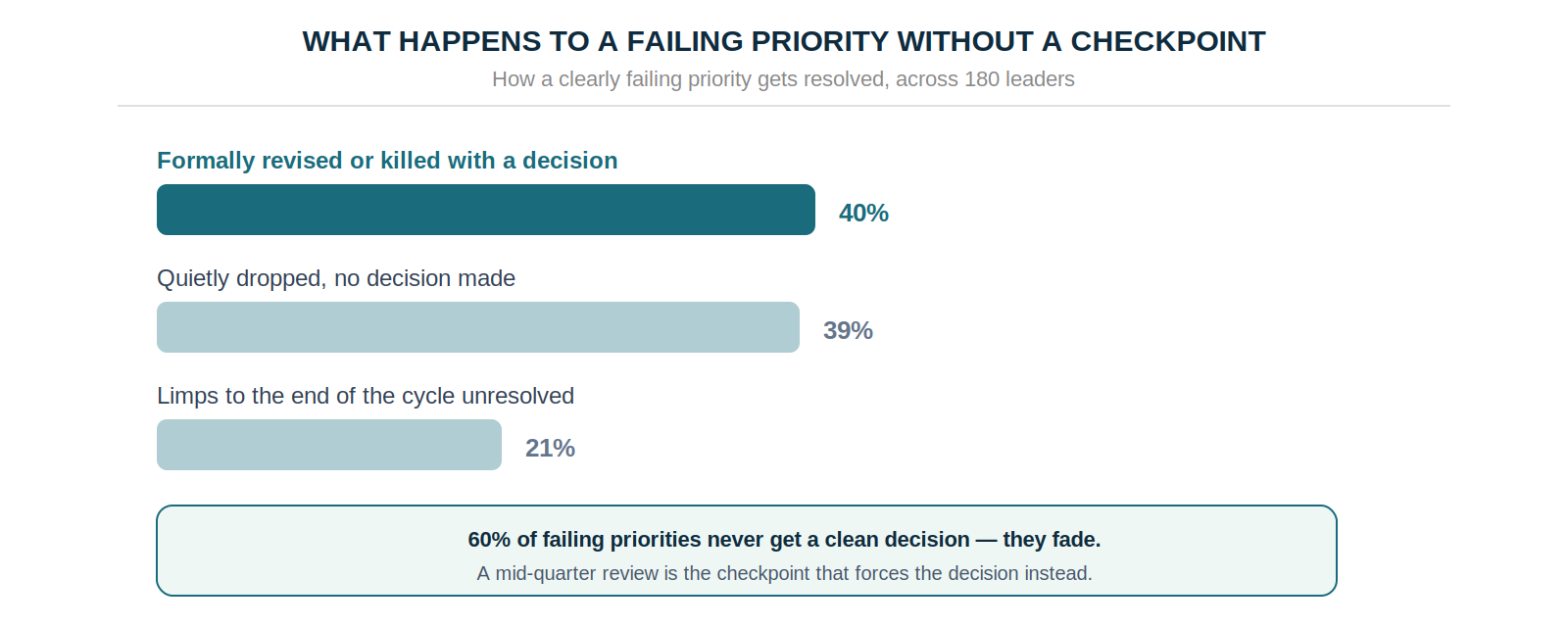
The resolution data is the whole argument for holding one. When a priority is clearly failing, only 40% of the time does it get formally revised or killed with an actual decision. The other 60% splits between quietly dropped, with no decision made, and left to limp to the deadline unresolved.
That 60% is what a mid-quarter review is designed to convert into a decision — because a failing goal that nobody formally addresses doesn't fix itself; it just consumes the quarter's effort while producing nothing.
When to Run the Mid-Quarter OKR Review
Timing is the feature. Run it too early and there isn't enough signal to know what's really drifting; run it too late and there's no runway left to act on what you find.
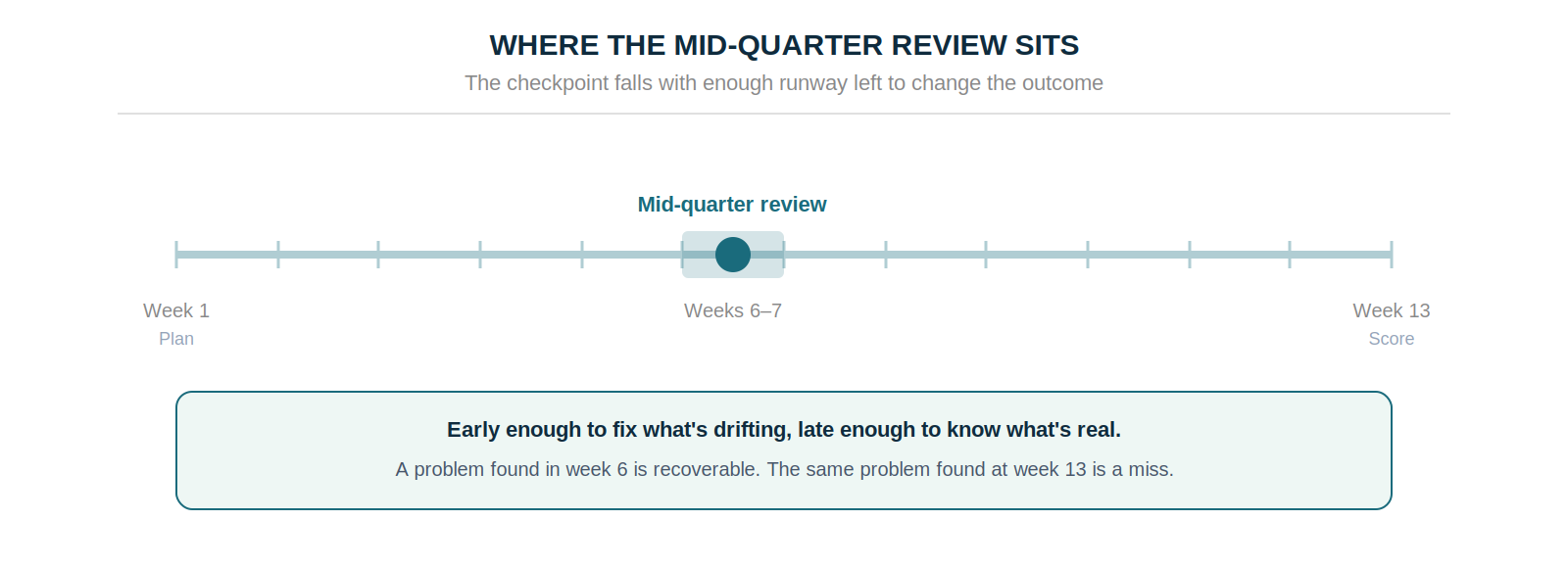
For a standard quarterly cycle, weeks six and seven are the sweet spot. By then each key result has enough history to show a real trajectory rather than start-of-cycle noise, and there are still six or seven weeks left — enough runway to change an approach, clear a blocker, or reallocate effort and actually see it land before scoring. A problem caught in week six is recoverable. The same problem surfaced at the week-thirteen review is simply a miss with an explanation attached.
The Mid-Quarter OKR Review Agenda
A good review is fast and decision-dense. It is not a status meeting — status is what the weekly check-in already covered — so the agenda skips anything green and spends its time only where a decision is needed.
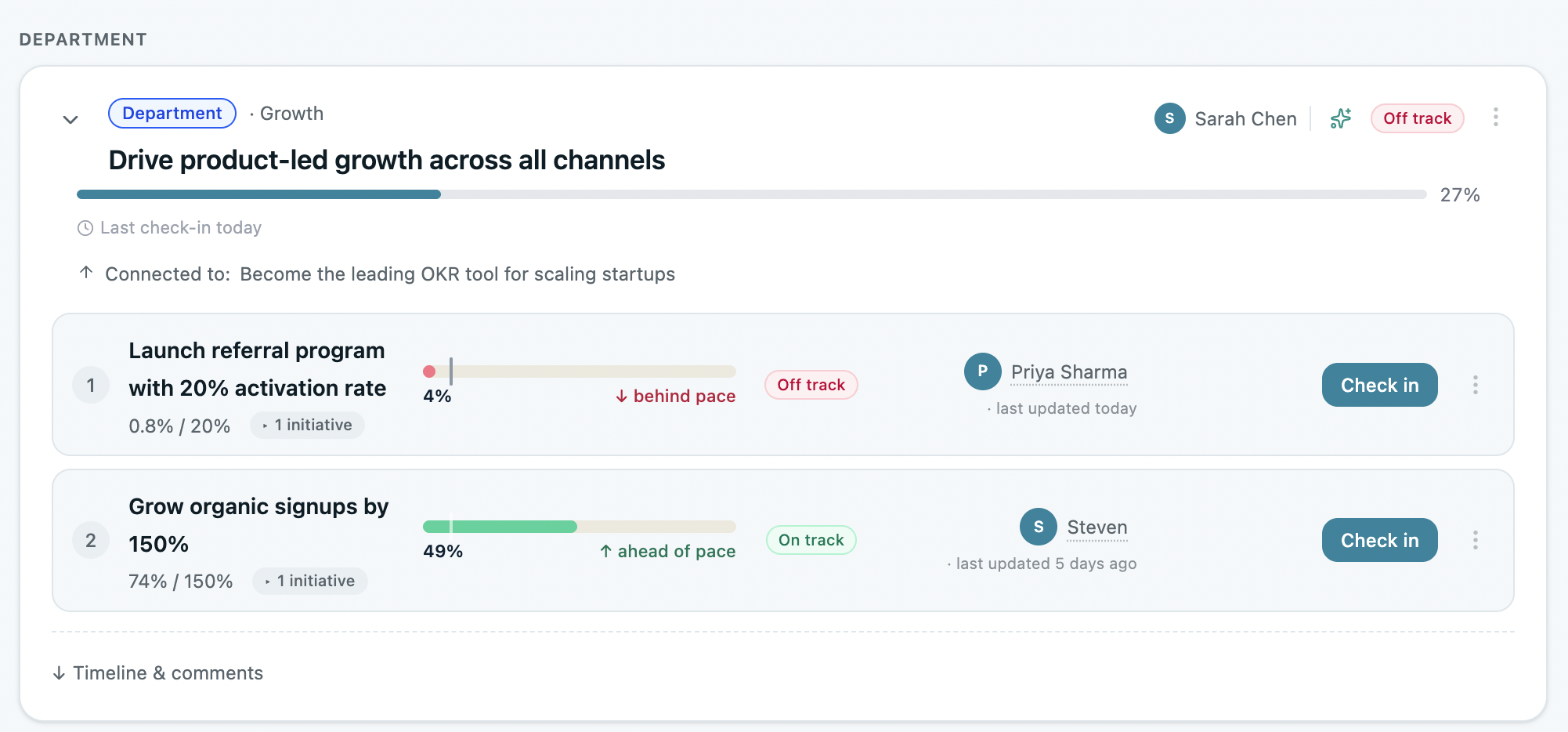
Pre-work (owners, before the meeting). Every key result owner updates their progress and flags their own status honestly: on track, at risk, or off track. Walking in cold and reconstructing status live is what turns a 30-minute review into a two-hour one.
Green gets noted, not discussed. Anything on track is acknowledged in one line and skipped. Spending review time on what's working is the most common way these meetings bloat and lose their edge.
At-risk gets a question. For each at-risk key result: what changed, what's the plan, and what does the owner need. The goal is a concrete next step, not reassurance.
Off-track gets a decision. This is the core of the meeting. Every off-track key result leaves the room revised, escalated, or closed — never with a vague "let's keep an eye on it," which is how the 60% resolution gap forms in the first place.
Confirm and close. Each decision gets an owner and a date. The output of the review is a short list of decisions made, not a set of notes about how things are going.
The Three Decisions It Exists to Force
Every off-track key result has exactly three honest exits from a mid-quarter OKR review. The skill is matching the exit to the reason it's off track.
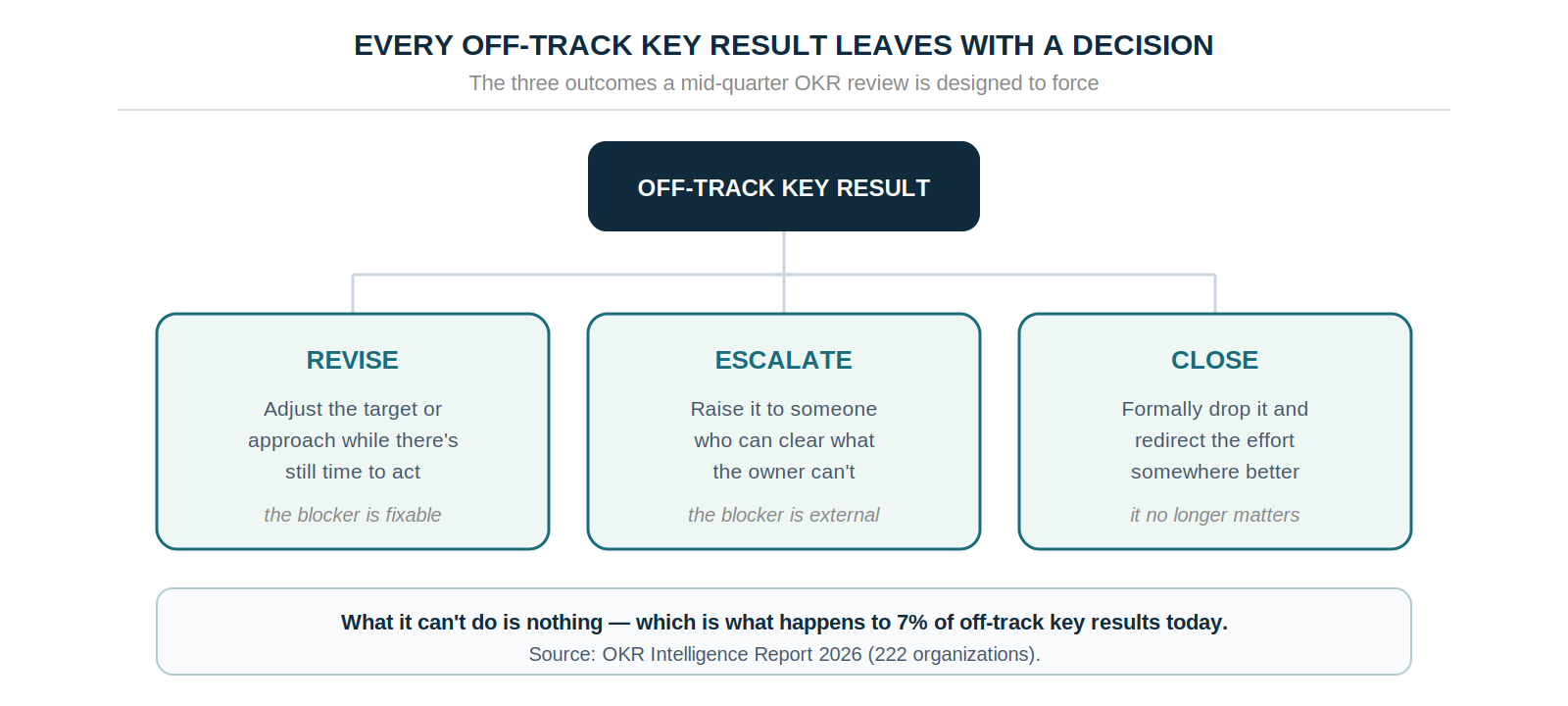
Revise when the blocker is something the team can fix — adjust the target, change the approach, or rescope the work while there's still time for the change to matter.
Escalate when the blocker is genuinely outside the owner's control and needs someone with more authority to clear it; escalation isn't failure, it's the system working. C
lose when the goal no longer deserves the effort — priorities shifted, the bet didn't pay off, or something more important emerged mid-cycle. Formally closing a goal and redirecting the effort is a legitimate, often underused decision.
What none of the three is: silence. The OKR Intelligence Report 2026, covering 222 organizations, found 7% of off-track key results are simply abandoned mid-cycle with no revision or escalation at all — the exact outcome a mid-quarter review is built to eliminate. Every off-track goal leaves with a named decision, or the review didn't do its job.
Making the Review Stick
The mid-quarter OKR review only works if the data feeding it is trustworthy and the decisions it produces actually get tracked. Both depend on the surrounding habits.
The review is only as good as the check-in cadence underneath it — teams with a consistent weekly rhythm complete 43% more of their goals, and they also walk into the mid-quarter review with real data rather than a scramble of last-minute updates.
Ownership matters just as much: every key result needs a single named owner who can speak to its status and carry its decision, because a goal owned by a whole team is a goal nobody can make a call on. And the decisions themselves need to be recorded where the next review can see them, so revise-escalate-close becomes a tracked commitment rather than a good intention that evaporates by week nine.
Purpose-built OKR software makes all three structural rather than dependent on discipline — surfacing at-risk key results automatically, enforcing ownership before a goal goes live, and keeping every mid-cycle decision attached to the goal it changed.
Half the Quarter Is Still in Front of You
The mid-quarter OKR review earns its place by treating week seven as a decision point rather than a status update. Teams usually sense which goals are drifting by the halfway mark; what they lack is the forcing function that turns that sense into a revise, an escalate, or a close while it still changes the outcome.
That's the whole value. Not more meetings, but one well-placed one — early enough to act, structured enough to decide, and honest enough to close what isn't working. Run it at week six or seven, spend the time only on what's at risk or off track, and make sure every failing goal leaves with a decision. Do that, and the 60% resolution gap becomes someone else's problem, not yours.
Data: Strategy Execution Benchmark 2026 (180 strategy and operations leaders), OKR Intelligence Report 2026 (222 organizations), The 2026 OKR Benchmark Report (200 organizations).