
Strategic pillars are the three to five themes a company organizes everything else around — the durable priorities that outlast any single quarter. But a pillar only matters if work ladders up to it, and across 180 companies, 93% of daily work doesn't connect to any strategic priority at all. A pillar with no goals beneath it is a heading, not a strategy.
Every company that runs an annual planning offsite comes out with a handful of strategic pillars: "Win the mid-market," "Become the platform of record," "Operational excellence." They go on the leadership deck, get announced at the all-hands, and then — in most companies — stop mattering by week 4 of the quarter, because nothing connects the pillar on the slide to the work in the calendar.
This isn't a writing problem. Companies are good at naming pillars. The failure is downstream: the pillars never translate into the OKRs teams actually work on, so there's no way to tell which pillar a given team is advancing, or which pillar has no one working on it at all. The 2026 Strategy Execution Benchmark found that in only 7% of companies do leaders say most daily work clearly ladders up to strategy.
This piece defines strategic pillars in plain terms, shows how to write ones sturdy enough to organize a company around, and then spends most of its length on the part that decides whether they matter: connecting each pillar to the work beneath it, and seeing — before the quarter starts — which pillars have no coverage.
What Strategic Pillars Actually Are
A strategic pillar is a durable theme that a company uses to organize its priorities — broader than a goal, longer-lived than a quarter, and fewer in number than either. Where an OKR expires at the end of a cycle, a pillar persists across many cycles, giving a through-line that individual goals ladder up to. Companies tend to land on three to five; more than that and they stop being priorities, because a company with ten pillars has effectively chosen none.
Pillars answer a different question than goals do. A goal asks "what are we changing this quarter?" A pillar asks "what are we organized around, cycle after cycle?" "Win the mid-market" is a pillar; "raise mid-market win rate from 22% to 30% by Q3" is one of the key results that advances it. The pillar sets the direction that makes the goal worth setting, and the clearest company-level objectives are the ones that trace straight back to a pillar.
The test of a real pillar is whether it changes what a team decides to work on. If a pillar could be deleted from the strategy deck and no team would do anything differently, it was only ever a slogan.
A pillar earns its place by ruling things out: choosing to organize around "operational excellence" this year means choosing not to organize around aggressive new-market expansion, and that tradeoff is why naming pillars matters at all.
How to Write Pillars That Hold
The most common failure is writing pillars so broad they can't guide a decision. "Growth," "innovation," and "customer focus" are not pillars — no team can look at "innovation" and know whether this week's work advances it or not. A pillar has to be specific enough that a team lead can hold their planned work against it and judge fit, the same clarity discipline that separates a sharp written OKR from a vague one.
The second failure is writing too many. Beyond five, pillars stop doing the one job they exist for: forcing a choice about where the company's attention goes. When everything is a strategic pillar, teams default to whatever was already on their list and backfill the pillar it "supports," which is exactly backwards. Fewer pillars, each ruling something out, beats a comprehensive list nobody uses to decide.
The third failure is the one the data exposes most sharply: writing pillars nobody can remember. A pillar the workforce can't recall can't guide a single decision, and recall is rarer than most leaders assume.
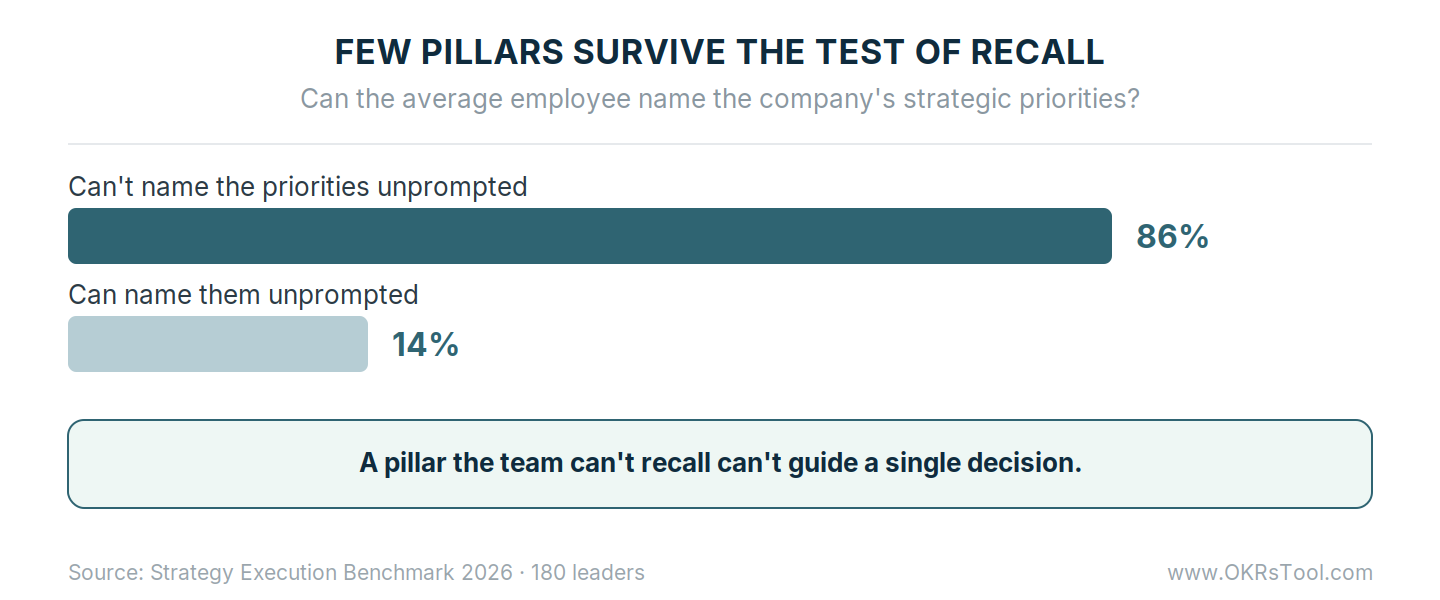
Across the benchmark, 86% of workforces couldn't name their company's top priorities without prompting. A pillar that lives only in a slide deck reopened once a quarter isn't organizing anything the other twelve weeks. Sturdy pillars are few, specific, and repeated often enough that a team can state them from memory — because a pillar only shapes decisions the team can recall it making.
Why Pillars Don't Reach the Work
Here is where strategy actually breaks. A company can name good pillars, write them specifically, and still watch them fail to touch a single team's week — because naming a pillar and connecting it to work are two entirely separate acts, and most companies do only the first.
In only 7% of companies does most daily work clearly connect to a strategic priority — meaning in 93%, a meaningful share of what people do all day isn't tied to any pillar the leadership named. The pillars exist. The work exists. The link between them was never built, so the strategy deck and the team trackers describe two different companies. This is the strategy-to-execution gap that an alignment map is meant to close.
The failure compounds because it's invisible. When 83% of teams get no automatic signal that a priority is drifting, a pillar can go an entire quarter with no one working on it and nobody notices until the cycle-end review.
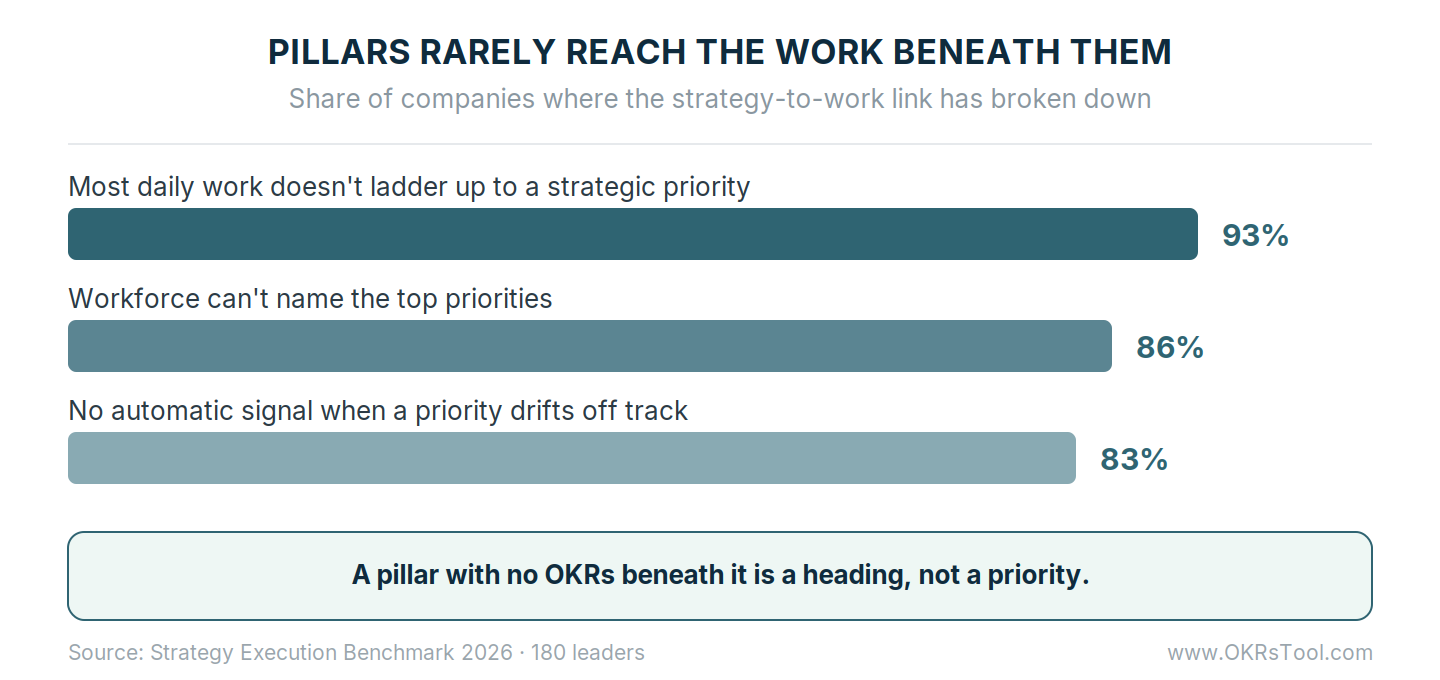
Without live progress tracking rolling up to each pillar, that silence is where a strategy comes apart. The reverse happens too: three teams pour effort into the same pillar while another sits uncovered, and without a view that maps pillars against the goals beneath them, the duplication and the gap are both silent until it's too late to fix either.
Connect Each Pillar to the Work Beneath It
The fix is structural: every strategic pillar needs the goals that advance it tagged against it, so the connection between strategy and work is visible rather than assumed. This is what the Strategic Pillars feature in OKRs Tool is built for — define your pillars in the strategy canvas, then tag OKRs against them, and see at a glance which goals are driving which pillar, and where a priority has no OKR coverage at all.
That view changes the planning conversation. Instead of writing team OKRs in isolation and hoping they add up to the strategy, a leader can open the coverage diagnostic before the cycle starts and see every pillar with the goals stacked beneath it — the well-covered ones, the over-covered ones absorbing duplicated effort, and the uncovered ones that would otherwise go a full quarter with no owner. Seeing all of it in one platform turns the gap into a decision to make in planning, not a surprise to discover in the retrospective.
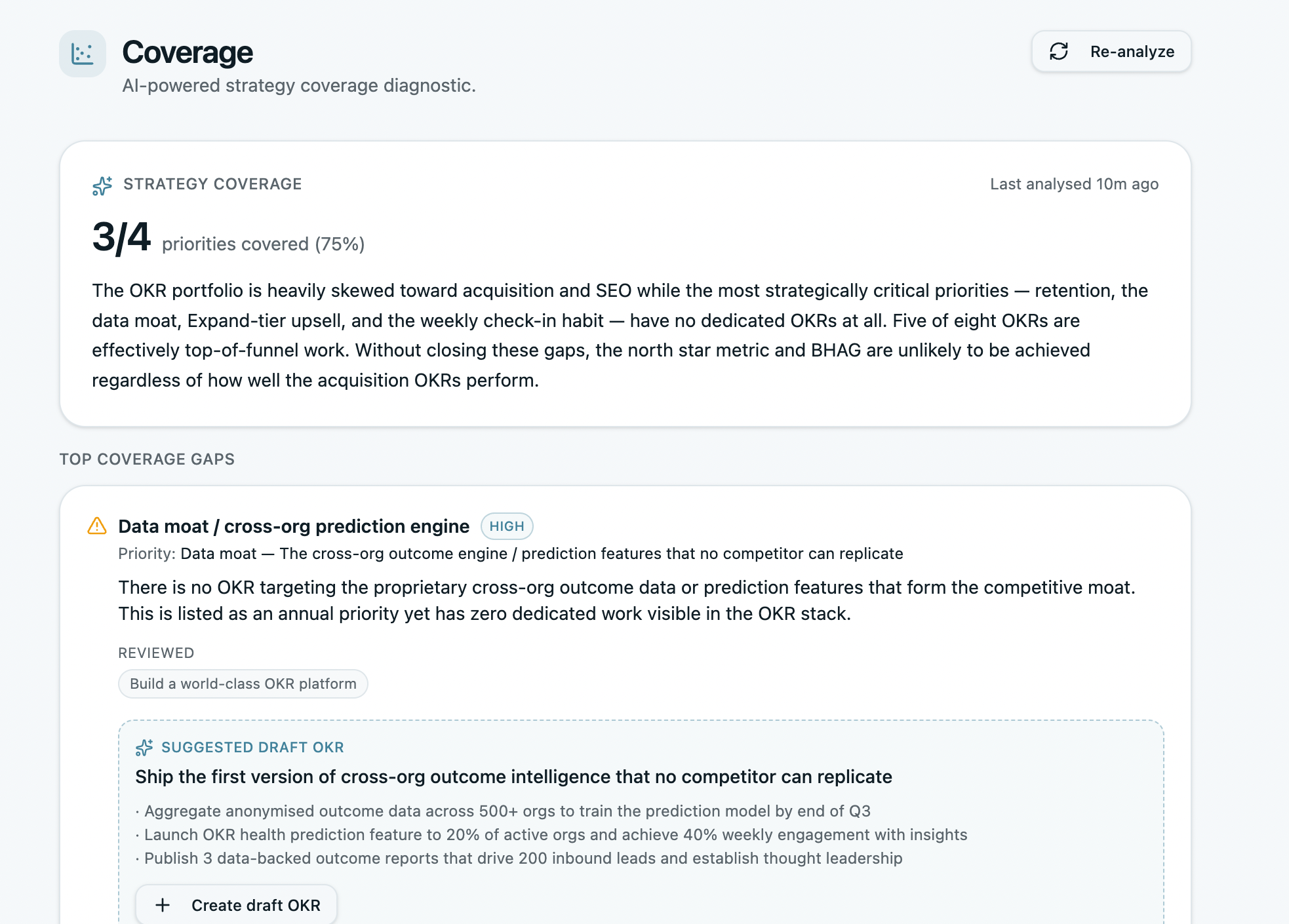
It also keeps working after planning. Because each team's OKRs stay tagged to their pillar through the cycle, a weekly check-in rolls up not just to a team's goals but to the pillar they serve — so a drifting priority surfaces in week 3, not at quarter-end. The pillar stops being a static heading and becomes something with live progress underneath it.
Pillars Are Only as Real as Their Coverage
Strategic pillars are worth the work of naming — they give a company a through-line that individual quarterly goals can't, and they force the tradeoffs that separate a real strategy from a wish list.
But the naming is the easy half, and it's the half most companies stop at. A pillar on a slide with no goals beneath it organizes nothing; it just describes an intention the work never has to honor — the difference between objectives and key results that move and ones that decorate a deck.
The pillars that shape a year are the ones wired into the work: specific enough to guide a decision, few enough to force a choice, memorable enough to recall, and — the part that decides it — connected to the OKRs that actually advance them, with the gaps visible before the quarter rather than after.
A strategic pillar's whole job is to make some work matter more than other work. It can only do that job when you can see which work is laddering up to it, and which pillars have no work at all.
Data: The 2026 Strategy Execution Benchmark, an independent survey of 180 strategy and operations leaders at 50–200 person companies.