Across 876 organizations, only 35% of high-performing teams ran an OKR approval workflow — versus 62% of struggling teams. Heavy top-down control correlated with worse outcomes, not better. The debate over who sets OKRs matters less than one thing the platform data identifies clearly: whether the teams doing the work own their goals.
The top-down versus bottom-up question is usually framed as a strategic choice between two philosophies. In practice, it's a false binary. The evidence points to a specific answer — direction should come from the top, ownership should sit with the team — and the failure modes at both extremes are predictable and measurable.
Pure top-down produces goals nobody internalized. Pure bottom-up produces misalignment with company strategy. The structure that works combines the strengths of both, and the platform data shows why it outperforms either extreme.
What the Top-Down Approach Gets Right — and Wrong
A top-down approach has leadership set company Objectives and distribute them to teams. Its genuine strength is alignment: when direction comes from the top, teams work toward the same strategic priorities without fragmentation, and decisions get made quickly without needing consensus from every corner of the organization.
The failure mode is ownership. When OKRs are dictated without team input, they feel imposed, and imposed goals don't get internalized. This is not a soft concern — it's the mechanism behind a measurable pattern. Goal-setting research is direct that difficulty only raises performance for a goal the person has genuinely accepted, and a goal handed down without buy-in fails that condition before the cycle even starts.
The platform data makes the cost concrete. Heavy sign-off process — the most top-down control mechanism there is — correlated negatively with success. Only 35% of high-performing organizations ran an approval workflow, versus 62% of struggling ones.

What the Bottom-Up Approach Gets Right — and Wrong
A bottom-up approach lets teams define their own Key Results in response to company objectives. Its strength is the mirror image of top-down's weakness: teams that set their own goals own them. Ownership is the operational form of the commitment condition, and commitment is what makes an ambitious goal actually get pursued.
The platform data is direct on why this matters. Roughly 50% of all Key Results across the dataset had no named owner at all — and Key Results with a single named owner were completed at materially higher rates than those with shared or absent ownership. The 2026 OKR Benchmark Report puts a number on it: required single ownership drives 26% higher completion.
The failure mode is alignment. Without clear strategic direction from leadership, teams set goals that don't ladder up to the company's priorities, and effort fragments. The benchmark data shows 65% of teams admit their goals aren't clearly linked to company strategy — a gap that pure bottom-up goal-setting widens rather than closes.
The Structure That Works: Direction Down, Ownership Up
The approach the data supports isn't a compromise between top-down and bottom-up — it's a division of labor. Leadership sets the direction; teams own the execution. Neither extreme wins because each solves only half the problem.
In practice this means leadership defines two or three company Objectives that set the strategic direction for the quarter — growth, retention, product, whatever the priorities are. Teams then define the Key Results and execution plans that ladder up to those Objectives, with a single named owner on each. This gives teams genuine ownership of how they contribute while keeping the whole organization pointed in the same direction.
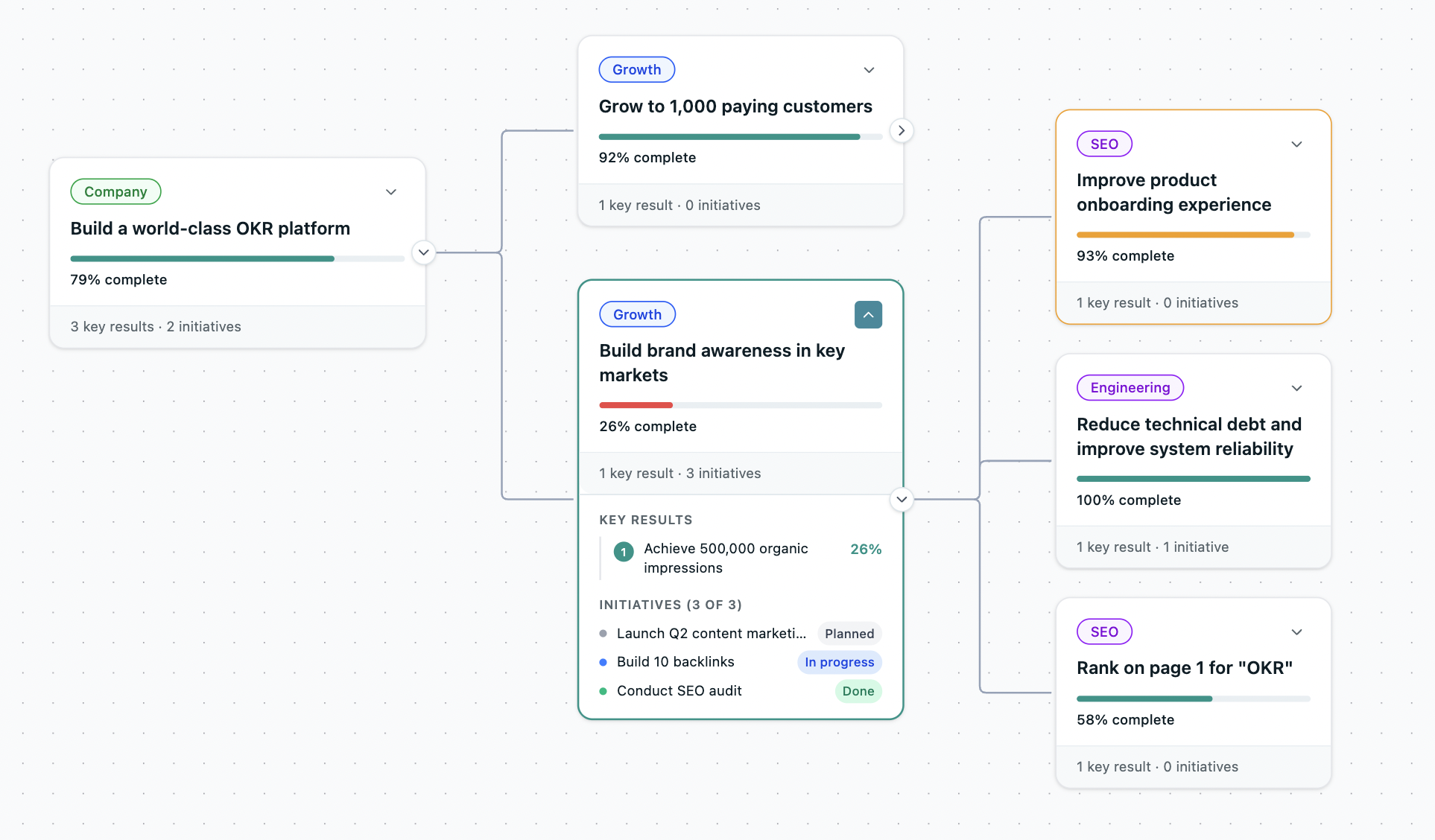
The cascade makes the connection visible: every team's Key Results connect to a company Objective, so alignment is structural rather than assumed. And a weekly check-in keeps both the direction and the ownership honest — teams that check in weekly complete 43% more OKRs than those reviewing monthly or ad hoc.
Why "It Depends on Your Stage" Is the Wrong Frame
The common advice is that the right approach depends on company size — top-down when small, bottom-up when large. The platform data doesn't support that framing. Whether a Key Result had a named owner and got updated weekly predicted success in the platform data far more reliably than any measure of company size or maturity.
A 60-person company and a 200-person company both fail for the same reason when they run pure top-down: the teams doing the work never accepted the goals. They both succeed for the same reason when direction comes from the top and ownership sits with the team. The variable that matters isn't headcount — it's whether the ownership structure is in place.
What does change with scale is the number of cascade levels, not the underlying principle. A larger organization has more layers between company Objective and individual Key Result, which makes visibility more important, not less. But the rule stays constant: direction from the top, ownership with the team, at every level.
Direction and Ownership Are Not a Trade-Off
The premise of the top-down versus bottom-up debate is that alignment and ownership pull against each other — that more of one means less of the other. The data says otherwise. The teams that perform best have both: clear strategic direction that everyone can see, and genuine ownership at the point where the work happens.
The structure that delivers both is a company-level Objective set by leadership, team-level Key Results owned by the people executing them, a visible cascade connecting the two, and a weekly check-in that keeps everything moving. See how OKRs Tool implements direction-down, ownership-up cascade — free for up to 5 users.
Data: OKRs Tool platform data (876 organizations, 7,419 objectives, 20,952 key results), The 2026 OKR Benchmark Report (330 organizations).