A quarterly business review is supposed to change what happens next quarter, and most don't — they report the past and adjourn. The gap is structural: 60% of failing priorities never get a clean decision, they just fade. A QBR built to decide rather than present is how you close that gap.
A quarterly business review usually answers the wrong question. It asks what happened last quarter — leadership walks the revenue, pipeline, and delivery numbers, teams present their results, the meeting ends, and everyone returns to doing roughly what they did before. The slides changed. The behaviour didn't.
The question that changes execution is the next one: why did it happen, and what will we do differently? That shift from reporting to deciding is the entire difference between a quarterly business review that consumes three hours of leadership time and one that reshapes the quarter ahead. This guide covers what a QBR is, the four-phase structure that produces real decisions, a copy-paste agenda, and how to wire the review directly into your next OKR cycle.
What Is a Quarterly Business Review?
A quarterly business review is a structured meeting at the end of each quarter to evaluate performance, assess progress against goals, and set direction for the period ahead. Some are internal — the senior team judging how the company did against its strategic priorities. Others are customer-facing, with account teams reviewing outcomes and resetting expectations. Both run the same loop: look back, draw conclusions, look forward.
Done well, a quarterly business review does three things. It creates shared accountability, so everyone sees the same picture of what happened and why. It surfaces strategic decisions — what needs to change, stop, or start before the next quarter opens. And it sets up the next cycle by connecting the review directly to goal-setting. Run without that, it's a status update wearing a strategy costume.
Why Most QBRs Fail to Change Anything
The structural flaw in the average quarterly business review is that it's built to inform, not to decide. Presentations are designed to show results. Metrics get chosen to make the presenting team look good. Discussion is short and dominated by the most senior voice, and the meeting rarely ends with a concrete commitment to change anything.
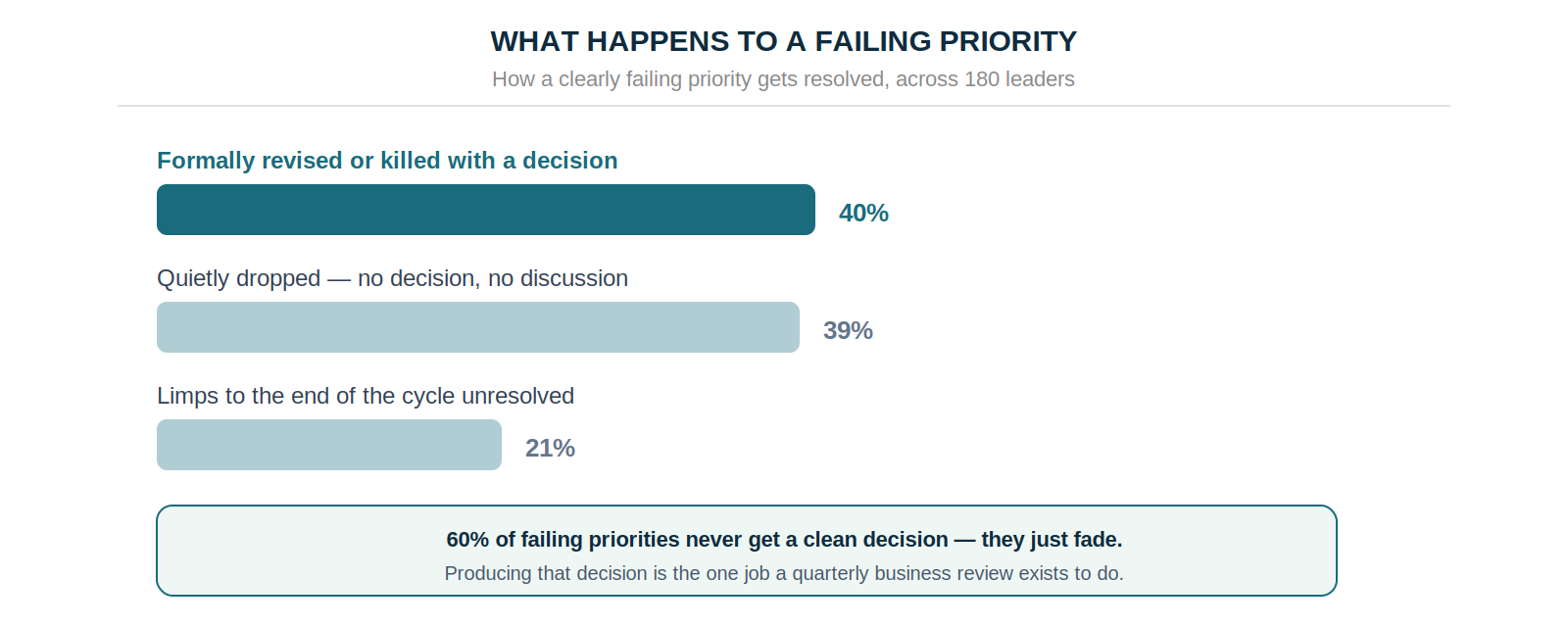
The benchmark data shows the consequence. When the Strategy Execution Benchmark 2026 asked 180 leaders what happens to a clearly failing priority, 60% said it never gets cleanly resolved — 39% watch it get quietly dropped and 21% watch it limp to the end of the cycle. Only 40% see a real decision to revise or kill it. A review that documents a failing priority without deciding its fate is the mechanism that produces that 60%.
It compounds with what comes before it. Only 7% of leaders say most daily work ladders up to strategy, and 65% of teams admit their goals aren't linked to company strategy. The average quarterly review doesn't fix those gaps — it documents them, the numbers move on the deck, and the behaviour holds. No slide template solves that. What does is a structure where the review's whole purpose is to produce decisions.
The Anatomy of an Effective QBR
An effective quarterly business review runs in four phases, each building on the last.
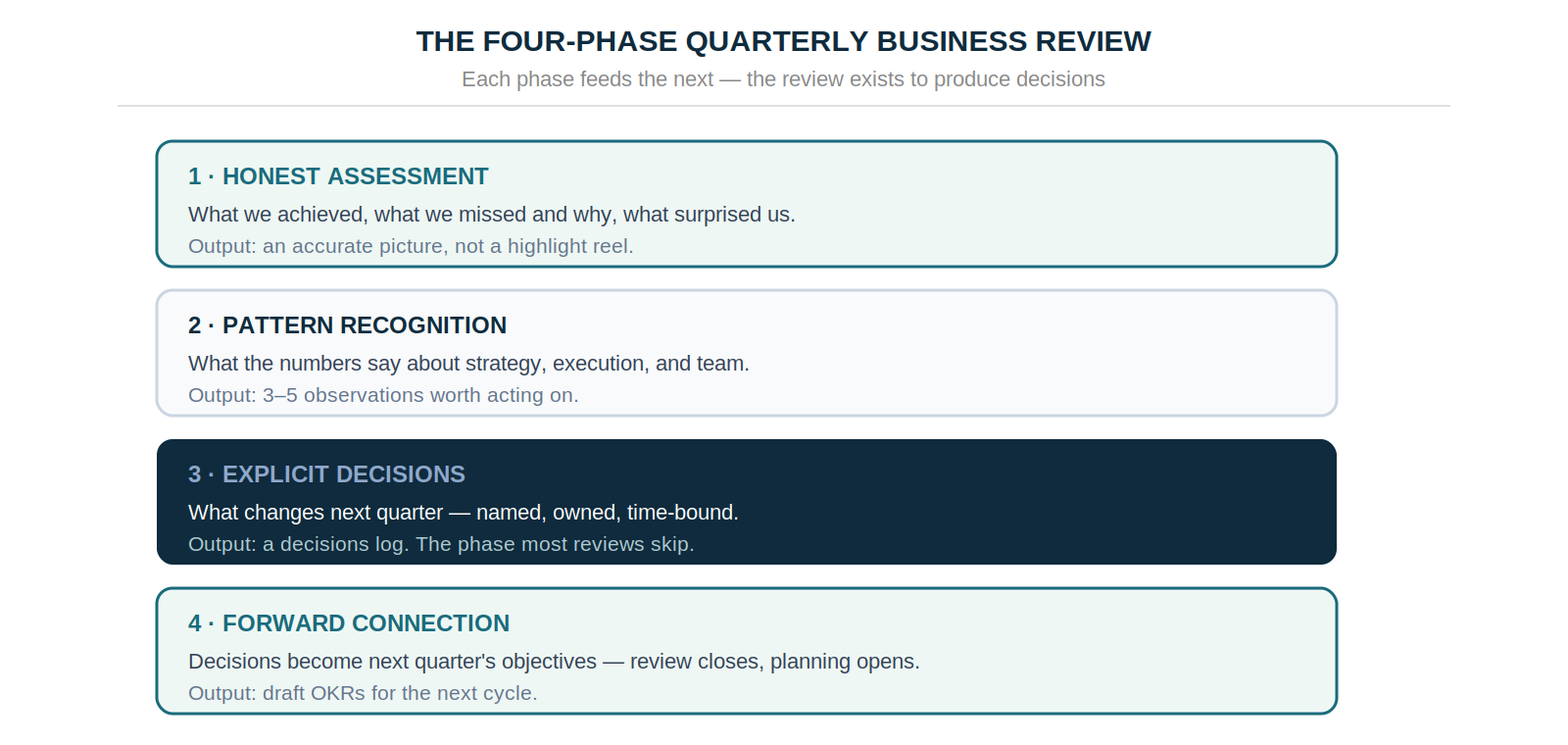
Phase 1 — Honest assessment, not a highlight reel
Before any decision can be made, the team needs an accurate picture of what actually happened, not a version curated to protect reputations. That means three things: what we achieved (which objectives were met, whether completion lands in the healthy 70–80% range that signals genuine stretch), what we missed and why, and what surprised us.
The "why" matters more than the number. A miss from an unrealistic goal is a planning problem; a miss where the right actions weren't taken is an execution problem; a miss from a market shift is neither. Each needs a different response, and lumping them together as "missed" loses the signal. This phase either builds or destroys the safety that makes next quarter's goals honest: a review treating every miss as a failure to explain teaches people to sandbag, while treating a watermelon status as normal, while a review treating misses as data teaches better goal-setting.
Phase 2 — Strategic pattern recognition
Individual metrics tell you what happened; patterns tell you why. Once the performance data is on the table, the review moves up an altitude: where did we consistently underperform, and is that a priority, resource, or capability problem? Which teams generated the most alignment between their work and company goals, and what did they do differently? Are the metrics we track measuring outcomes, or activity that just feels productive?
This is where reviews stall, because it asks leaders to judge strategy quality rather than read numbers. It works far better when OKR data has been visible all quarter rather than assembled at the end — the 43% completion lift from weekly check-ins comes precisely because this pattern recognition happens in real time, not retroactively.
Phase 3 — Explicit decisions, not implied ones
This is the phase most reviews skip. After performance and patterns, the meeting should produce a short list of explicit decisions — things the organization will do differently next quarter as a direct result of what it learned. Not observations. Not recommendations. Decisions.
The distinction is the whole game. "We probably need to fix onboarding" changes nothing. "We're pausing the partnership initiative and moving that capacity to onboarding; Sarah owns it by end of week two" changes the quarter. A good quarterly business review ends with a decisions log — what was decided, who owns it, when the outcome will show — and that log is the direct input to next cycle's planning. It's the answer to the 60% resolution gap: a failing priority in the room gets a named decision instead of a quiet death.
Phase 4 — Forward connection to the next cycle
The most valuable function of a quarterly business review is the one most teams underuse: it's the launch point for next quarter's goals. The decisions from phase three should drive the objectives set in the next cycle. If cross-functional execution broke down, that becomes an objective. If an unanticipated opportunity appeared, that becomes new key results rather than sitting in a parking lot for three months.
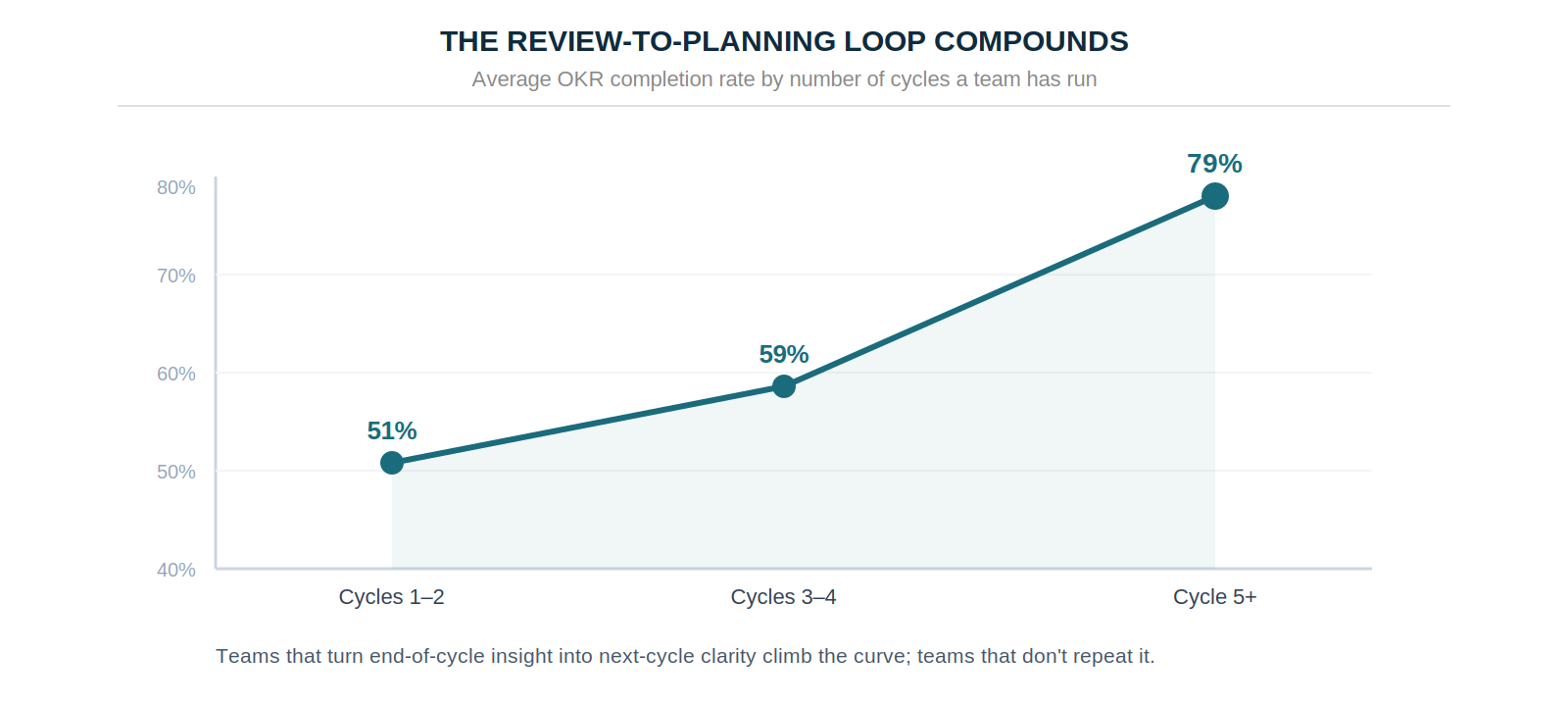
When the review and the planning session are separate events, the learning from one rarely reaches the other. When they're a single transition — review closes, planning opens — the loop compounds, which is exactly what the maturity data captures further down.
QBR Structure: A Practical Template
This structure works for an internal leadership quarterly business review at a 50–200 person company. Total time 2.5–3 hours.
One structural note: the performance phase works far better when OKR data is visible before the meeting rather than assembled for it. When leadership can see the completion picture in advance, the time goes to discussion and decisions instead of data presentation — which matters more than it sounds, since 83% of leaders otherwise get no signal a priority has drifted until someone surfaces it.

The QBR–OKR Connection
The quarterly business review and the OKR cycle are built to work together. The QBR is the retrospective — what happened and what it means. OKRs are the prospective — what we'll do about it and how we'll know it worked. Treat them as separate processes and you lose the most valuable connection: last cycle's learning shaping next cycle's ambition. In practice, each review output maps to a planning input.
That handoff is what compounds. Average completion climbs from 51% in a team's first two cycles to 79% by the fifth — and that isn't purely mechanical. It reflects teams that learned to turn end-of-cycle insight into beginning-of-cycle clarity, cycle after cycle. The ROI of OKRs research puts the return at 1:25 across 330 organizations, and it runs highest in exactly these mature programmes. The QBR-to-planning handoff is one of the primary mechanisms that builds that maturity.
Common QBR Mistakes and How to Fix Them
QBR vs Other Business Reviews
Terminology varies, so it's worth placing the quarterly business review against the other review formats.
Each operates at a different altitude. The weekly check-in keeps execution on track in real time, the mid-quarter review catches drift before it becomes a miss, the quarterly business review closes one cycle and opens the next, and the annual review sets multi-year direction. The QBR is the hinge — the moment short-term execution and long-term strategy get reconciled.
The Review Is Only Worth What Changes Because of It
A quarterly business review earns its three hours only through what changes as a result. The teams generating the highest returns aren't running better-looking reviews; they're running reviews that produce better decisions, then executing those decisions with a weekly rhythm that holds people accountable until the next quarter begins.
The 60% resolution gap and the 7% laddering figure describe the same underlying failure — priorities that drift and fade because no structured moment forces a decision about them. The quarterly business review is that moment, if you build it to decide. Use the first half to be honest about what happened and the second half to commit to what will be different, wire it straight into planning, and each cycle gets sharper than the last.
If your QBR reports OKR progress up to a board, showing OKR progress in board meetings covers presenting the data in a way that earns trust rather than filling a slide.
Data: Strategy Execution Benchmark 2026 (180 strategy and operations leaders), OKRs Tool platform data (876 organizations, 20,952 key results), The ROI of OKRs 2026 Benchmark Report (330 organizations), The 2026 OKR Benchmark Report (200 organizations).