
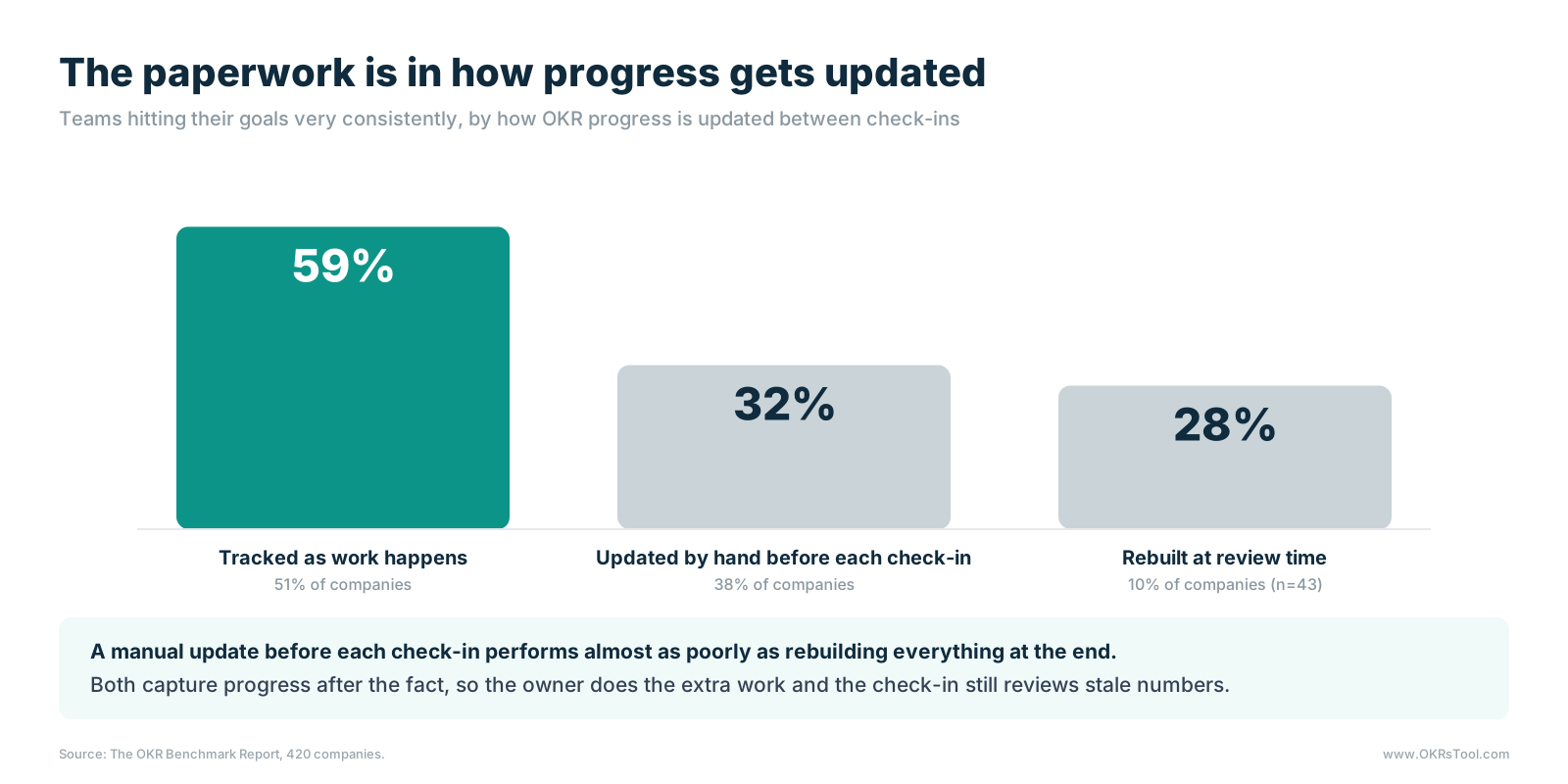
Teams that track OKR progress as the work happens hit their goals very consistently 59% of the time. Teams that update progress by hand before each check-in hit 32%, barely ahead of the 28% that rebuild it at review time. The paperwork leaders complain about mostly comes from that manual update step, and it's the part of OKRs that can be removed.
"It feels like extra paperwork on top of our real jobs." That was one survey respondent's answer when we asked 420 operations and strategy leaders what has been hardest about getting OKRs to stick, and versions of it came up again and again. People set goals in planning week, then spend the quarter copying numbers into a spreadsheet so someone can review them, and the OKRs start to feel like a reporting exercise running alongside the work.
The complaint deserves a straight answer, because the data behind it is clear. The extra work is concentrated in one place: the step where an owner finds the latest numbers in the tools where the work happens and types them into the place where the OKRs live. Teams that remove that step hit their goals far more often, and the time they spend on OKRs goes on decisions.
What Leaders Say About the Workload
The paperwork complaint shows up across our research. In the OKR Benchmark Report, leaders described the hardest part of making OKRs stick in their own words:
- "Everyone sets them at the start of the quarter and then forgets about them until the end."
- "It feels like extra paperwork on top of our real jobs."
- "Getting people to stop treating OKRs like a to-do list and keep them focused on outcomes."
Their answers on what would help pointed the same way: "Automating progress tracking through our daily project management tools, so nobody has to enter it by hand," and "Tying them to our actual work instead of a separate spreadsheet nobody checks." In The Death of OKRs, better or more regular tracking was the most requested fix, named in 18% of answers and three times as often as any other.
The cost is measurable too. In the Goal-Setting Benchmark, 59% of leaders lose an hour or more each month chasing goal status, and the teams that chase most have 51% of their priorities on track, against 67% for teams that chase least.
Where the Extra Work Sits
The benchmark asked how OKR progress gets updated between check-ins, and the answer splits teams into three groups.
Half of companies track progress as the work happens, and their teams hit goals very consistently 59% of the time. The other half do the paperwork: 38% update progress by hand before each check-in, and 10% rebuild it at review time. Those two groups hit their goals at almost the same low rate, 32% and 28%, so the weekly manual update adds work without adding much value.
The reason is double entry. The work behind a key result already leaves a record somewhere: deals in the CRM, tickets in the support desk, releases in the project tool, revenue in the billing system. 55% of companies in the benchmark use a project management tool alongside their OKRs and 56% use spreadsheets, so for many owners the weekly update means opening those systems, finding the numbers and copying them into a separate sheet. It's manual OKR reporting in its purest form, and by the time the check-in reviews the numbers, they're already a week old.
Time Spent Is a Weak Signal
If OKRs feel like paperwork, the obvious fix seems to be spending less time on them. The data doesn't support that.
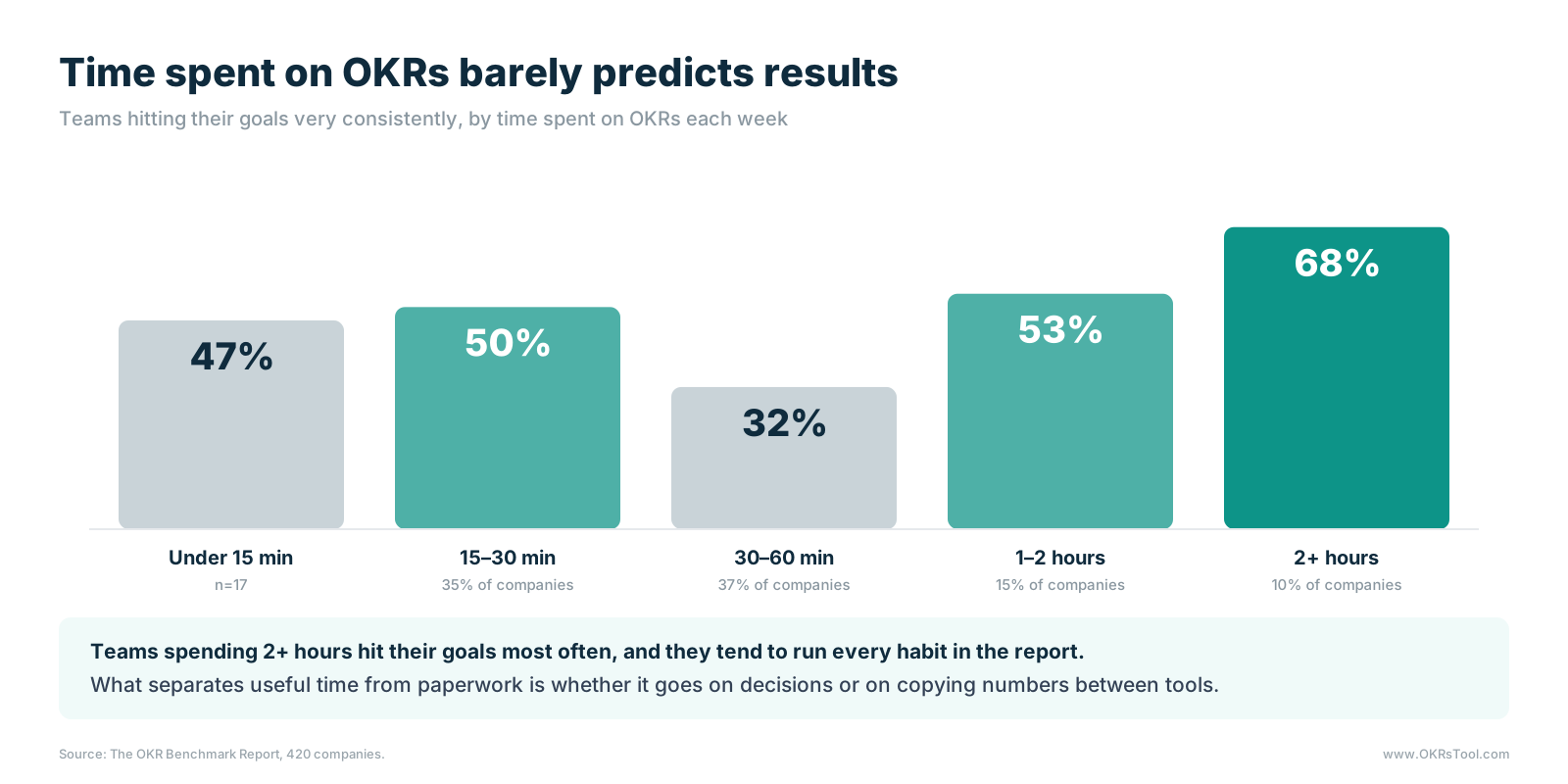
Teams spending two or more hours a week on OKRs hit their goals very consistently 68% of the time, the best result of any group, and they tend to run every habit in the report. Teams spending 30 to 60 minutes did worst, at 32%. Time on its own is a weak signal, and what matters is what the time goes on.
An hour spent finding and copying numbers produces a stale spreadsheet, while an hour spent on a check-in where the numbers are already current goes on what's at risk and who can help.
What OKR Work Looks Like Without the Paperwork
The benchmark describes the same owner's week two ways. In the first, the owner updates a spreadsheet the night before the review, copying numbers out of three other tools, and the meeting opens on figures that are already a week old. In the second, progress updates as the work moves in the systems the team already uses, so the review opens on today's numbers and the time goes on decisions.
For an owner, the weekly OKR work in the second version comes down to three things that take a few minutes:
- Check the number. Progress arrives from the source system through an integration, so the owner only has to confirm it.
- Set a confidence score. A confidence score from 1 (off track) to 5 (certain) on each key result tells the team where help is needed. Teams scoring every key result hit their goals very consistently 66% of the time, against 22% for teams scoring only some.
- Write one line on what's blocked. The weekly check-in then spends its 15 minutes on the key results scored 1 or 2, with owners leading and every request leaving with a name and a date.
Everything above those three steps is the paperwork, and it's the part software should do. Companies running OKRs on OKR software hit their goals very consistently 55% of the time, against 32% without it, while spreadsheets used as the only system post the lowest result of any setup, at 29%, because every update and reminder depends on one person remembering.
A spreadsheet still has a place for analysis and reporting on top of that, and the benchmark found teams using both had the best results of all.
The Paperwork Is the Fixable Part
The complaint that OKRs feel like extra paperwork is accurate for half the companies running them, and the data points to exactly where the extra work sits: the weekly step of copying progress from the tools where work happens into the place where goals are tracked. Teams that remove it hit their goals about twice as often, and the time they keep spending on OKRs goes on the check-in conversation and the decisions that come out of it.
For the person running OKRs, that changes the response to the complaint. Cutting the number of goals or skipping check-ins removes the habits that make OKRs work. Connecting OKRs to the tools where the work is recorded removes the copying. A platform that pulls progress in from those tools, asks each owner for a score and a line each week in Slack or Microsoft Teams and shows everything on one live OKR dashboard leaves owners with the few minutes of OKR work that's worth doing.
Data: The OKR Benchmark Report, The Death of OKRs (and How to Revive Them) and The Goal-Setting Benchmark.