
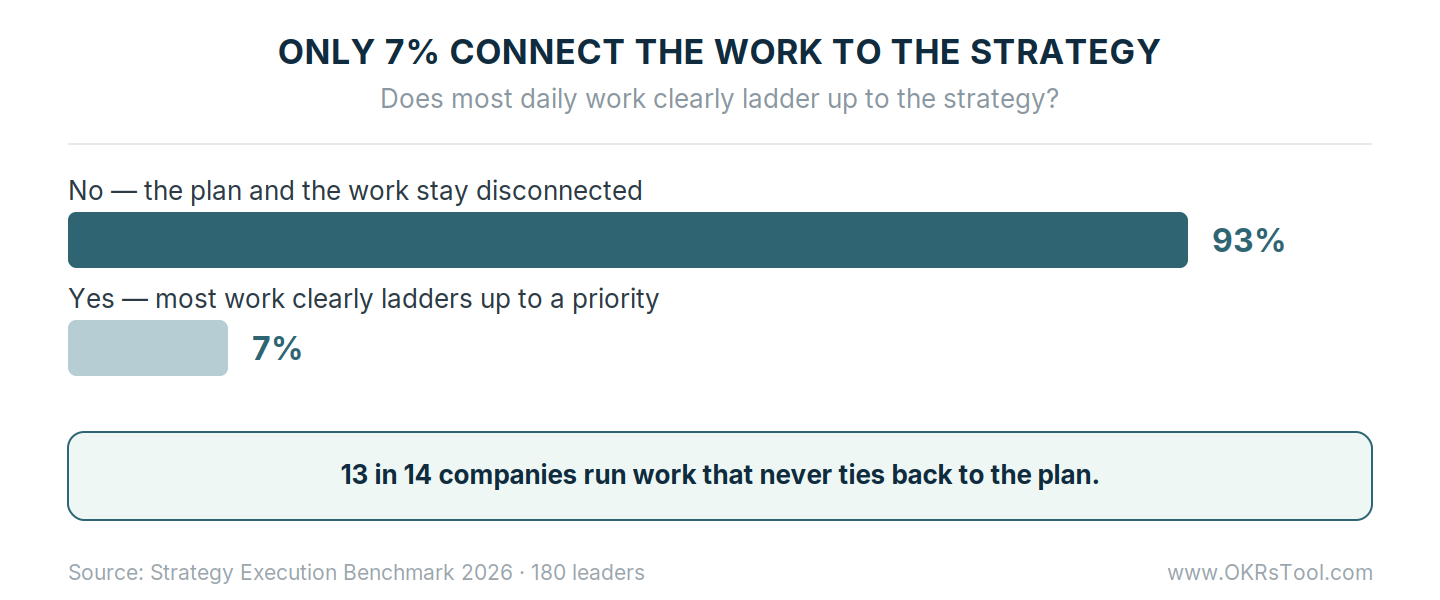
Turning strategy into execution means building the layer that connects a plan to daily work — so every priority maps to a goal someone owns, stays visible, and gets corrected when it drifts. Across 180 companies, only 7% of leaders say their daily work clearly ladders up to the strategy. The plan is rarely what's missing. The system that carries it into the work is.
Every company leaves its annual offsite with a strategy and loses it by the third week of the quarter. The deck gets presented, the priorities get nodded at, and then the work reverts to whatever was already on everyone's list. Across 180 companies, only 7% of leaders say their daily work clearly ladders up to the strategy, which means in almost every company the plan and the work drift into two separate things.
That separation is fixable, and it doesn't take a better strategist. It takes the layer that ties a priority to the goals a team actually works on, keeps that connection visible, and flags a priority the moment it starts to slip. The reasons execution fails come down to four specific breaks in that layer, and each one has a counter.
Those four counters form a single operating loop: connect the work to priorities, make the strategy something a team can name, catch drift while there's still quarter left, and resolve a priority that isn't working instead of letting it linger. Each step below closes one of the four gaps, and they only hold as a set.
Step 1: Connect Every Priority to Owned Goals
The largest gap is that daily work doesn't ladder up to the strategy. In 93% of companies, effort and priorities run on separate tracks, so the first move is to wire them together explicitly.
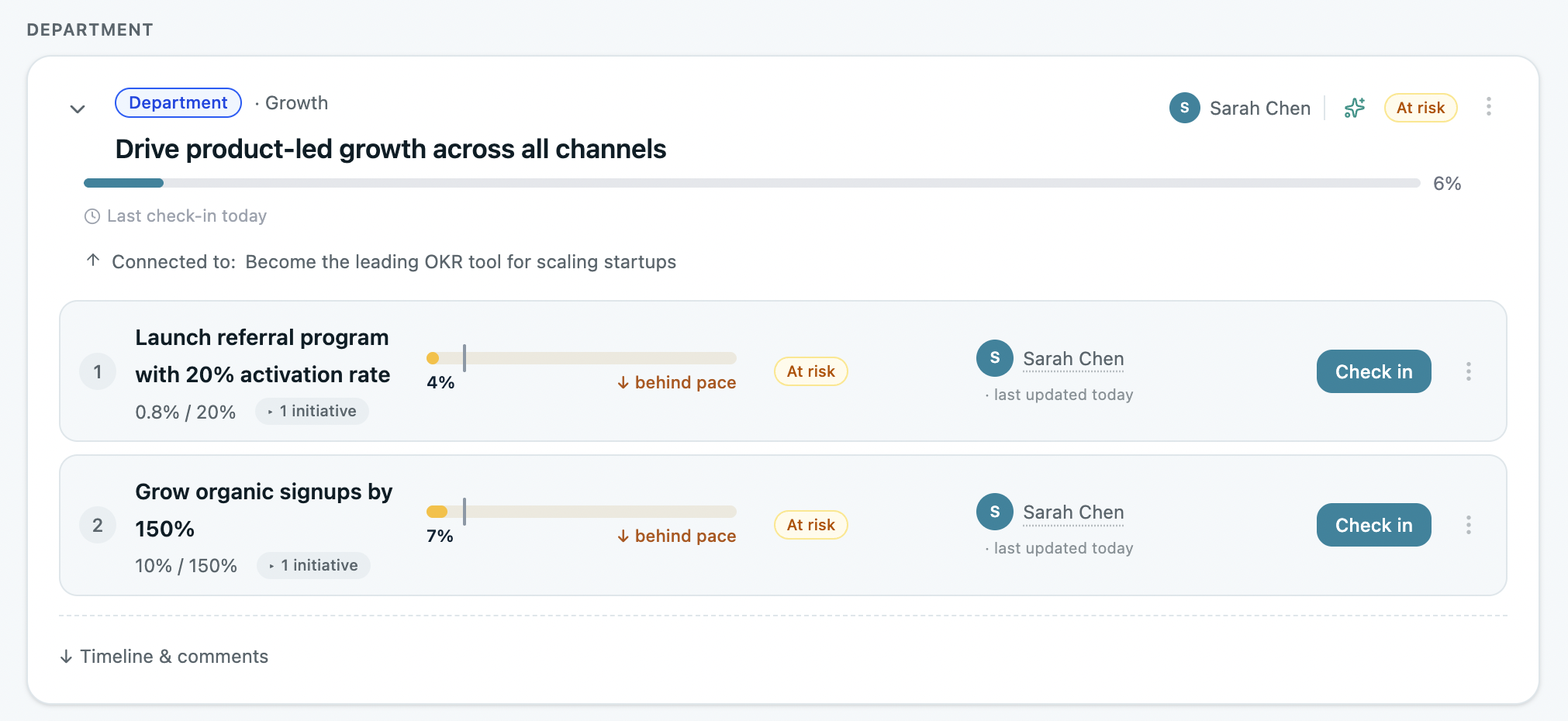
Each strategic priority gets translated into one or more OKRs: an objective a team owns, and the key results that measure progress toward it. A priority with no goal beneath it produces nothing. The test is concrete — for every item on the strategy, you should be able to name the team and the goal advancing it, and for every team goal, you should be able to name the priority it serves. A missing link in either direction is work that won't compound or strategy that won't happen.
This is the job cascading goals does: a company priority becomes a set of team objectives, which become the individual goals people work on. When it holds, anyone can trace their week's work up to a company priority, and leadership can trace a priority down to the specific work moving it.
Step 2: Make the Strategy Known
Connecting the work is worth little if the people doing it can't remember the strategy. In 86% of companies, the workforce can't name the top priorities, so for most of the quarter the strategy guides no one's decisions.
The counter is repetition, not a better deck. A strategy has to be stated often enough, and plainly enough, that a team recalls it without looking it up. Companies that manage this compress the strategy into a handful of strategic pillars — three to five durable themes concrete enough to guide a decision — and keep those pillars attached to the goals beneath them, so they appear in the weekly flow of work rather than only at the quarterly review.
A team that sees its goals tagged to a named pillar every week operates inside the strategy instead of being told it once.
Visible strategic alignment does the reinforcing. An alignment map showing every goal rolling up to a priority means nobody memorizes the strategy from a slide — they see their place in it whenever they check their goals.
Step 3: Build a Signal for Drift
The third gap is that 83% of teams get no signal when a priority slips until the end-of-quarter review. Acting on a drifting priority requires knowing it's drifting while there's still quarter left, which means a rhythm faster than quarterly.
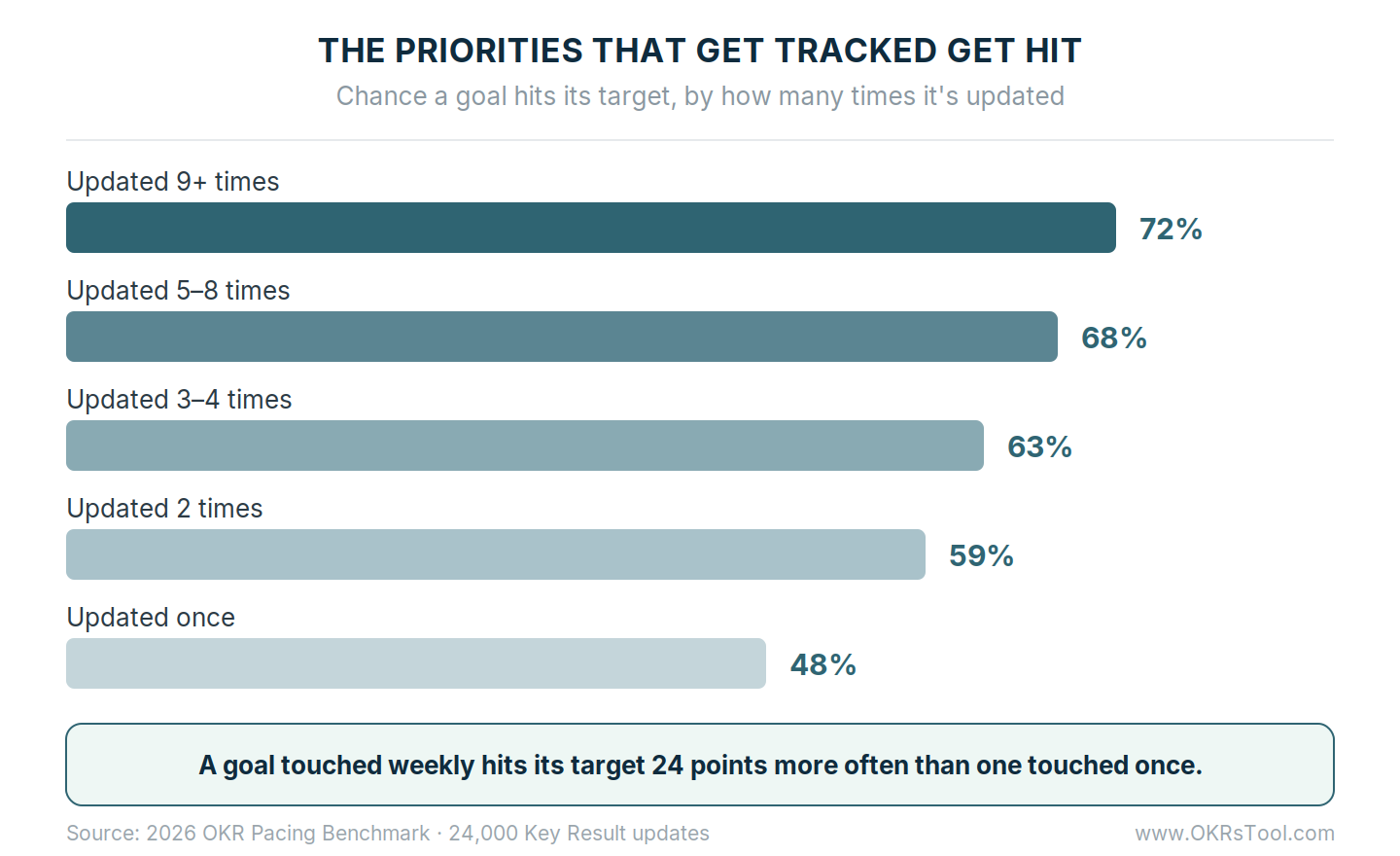
The signal is a weekly check-in, and the data on it is direct: a goal updated once across the cycle hits its target 48% of the time, one updated repeatedly hits 72%. Touching each goal weekly surfaces a stall early — a number that hasn't moved in two weeks, a confidence rating dropping from green to red.
That early read separates correcting a priority mid-quarter from finding out it failed at the post-mortem. A weekly check-in cadence makes drift legible, and a mid-quarter review gives it a formal moment to be acted on.
Step 4: Resolve What's Failing
The last gap compounds the rest: 60% of failing priorities are never cleanly resolved. A signal is wasted if no one acts on it, so the final step is a standing expectation that a failing priority gets reworked or cut, never left to linger.
When the weekly signal shows a priority is off track, the honest options are to re-resource it, re-scope it, or update the goal — and if none of those will save it, to cut it and redirect the effort. What breaks execution is the option most companies default to instead: leaving it half-alive, consuming resources while returning nothing.
A read of OKR completion across the quarter shows which priorities are recoverable and which are draining the ones that are. Making that call every cycle, on every failing priority, is what keeps the strategy pointed at what can still work.
The Four Steps Are One Loop
The steps aren't independent tactics. Connecting work to priorities does nothing if nobody can name the priorities. A drift signal is useless if failing priorities never get resolved. Resolution can't happen without a signal to trigger it.
Run all four and they hold each other up: the connection makes the strategy visible, visibility makes drift legible, the signal prompts resolution, and resolution keeps the connection honest. That loop is what an OKR cycle runs, across a whole company rather than one team, and it's the core of any working approach to strategy execution.
None of it requires a better strategist. It requires the operating layer between a plan and the work, which is the part most companies never build. Run the four steps in one connected platform rather than across decks and spreadsheets, and the strategy already on the page starts to move. The plan was rarely what stood between the company and results. The system underneath it was.
Data: The 2026 Strategy Execution Benchmark (180 leaders) and The 2026 OKR Pacing Benchmark (24,000 Key Result updates).