
A key result that reaches 50% by week four hits its target 84% of the time. One that sits below halfway lands 55% of the time. Across 24,000 key result updates, the quarter gives away its ending far earlier than teams tend to look for it, and the person running OKRs can read that ending in week four instead of discovering it in week twelve.
If you're running OKRs, the moment you dread arrives in the quarterly review. A leadership team asks why a key result everyone signed off on finished at 40%, and you realise the warning signs were there in the first month. The OKR Pacing Benchmark Report says they were. Progress in the first four weeks predicts the finish with uncomfortable accuracy, and two readings taken early in the quarter separate the goals that will land from the ones that need help.
This piece turns those readings into a test you can run every quarter: what to check at the first check-in, what to check at week four, what each result means, and what to do with a key result that fails. It draws on an analysis of 24,000 key result updates.
Week Four Is the Quarter's Best Early Read
The strongest predictor in the pacing data is where a key result stands a third of the way through the quarter.
At week four, a key result at or past halfway hits its target 84% of the time. Below halfway, the hit rate drops to 55%. That 29-point gap comes from a single reading, taken with eight weeks still left on the clock.
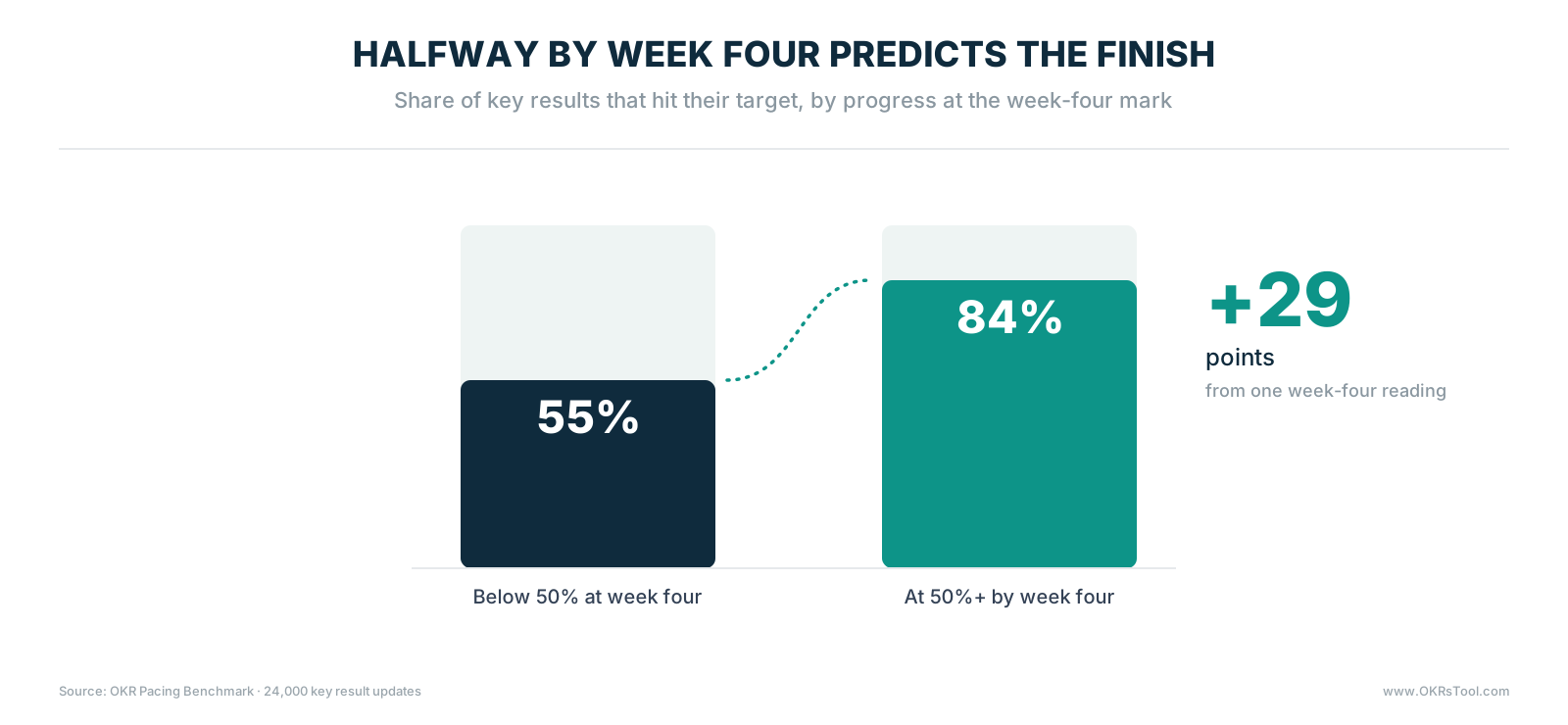
The threshold is more demanding than it looks. A straight-line pace would put a key result at a third of its target by week four, so the goals that land are running ahead of schedule.
The teams behind them front-load the work: initiatives start in week one, blockers get cleared in week two, and the early momentum carries through the back half of the quarter when other priorities start competing for attention. A key result below halfway at week four can still land, and plenty do. It has stopped being a safe bet, though, and it needs a decision rather than hope.
The Earlier Signal: Did It Move at the First Check-In?
There's an even earlier reading, available at the very first check-in of the cycle. A key result that shows any movement at that point goes on to land 62% of the time. One still sitting at zero lands 27% of the time.
Zero at the first check-in usually means nothing has started. Nobody has taken ownership of it, no initiative is attached, or the target depends on something that hasn't happened yet. Each of those is cheap to fix in week one and expensive to fix in week eight. The first check-in is the point to catch a goal that was written down but never picked up, and it's the earliest moment a champion can act on real evidence instead of assumptions.
Key Results Left Alone Finish Short
The third signal plays out across the whole quarter. Key results updated only once all quarter finish around 48% of target. Key results tended through the quarter finish above 70%.
Updating a key result moves nothing by itself. What it does is force the owner to look. A weekly update means someone checks the number, notices when it stalls, and asks why while there's still time to respond.
A key result reviewed once a quarter has nobody steering it for eleven weeks. This is why the weekly check-in carries so much weight in the data: the rhythm of updating OKRs is what turns a target into something actively managed, and a steady cadence is what makes the week-four reading possible at all.
Three Signals Across One Timeline
Put the three readings on a quarter and the pattern is plain: every one of them is available long before the review where teams usually take their first hard look.
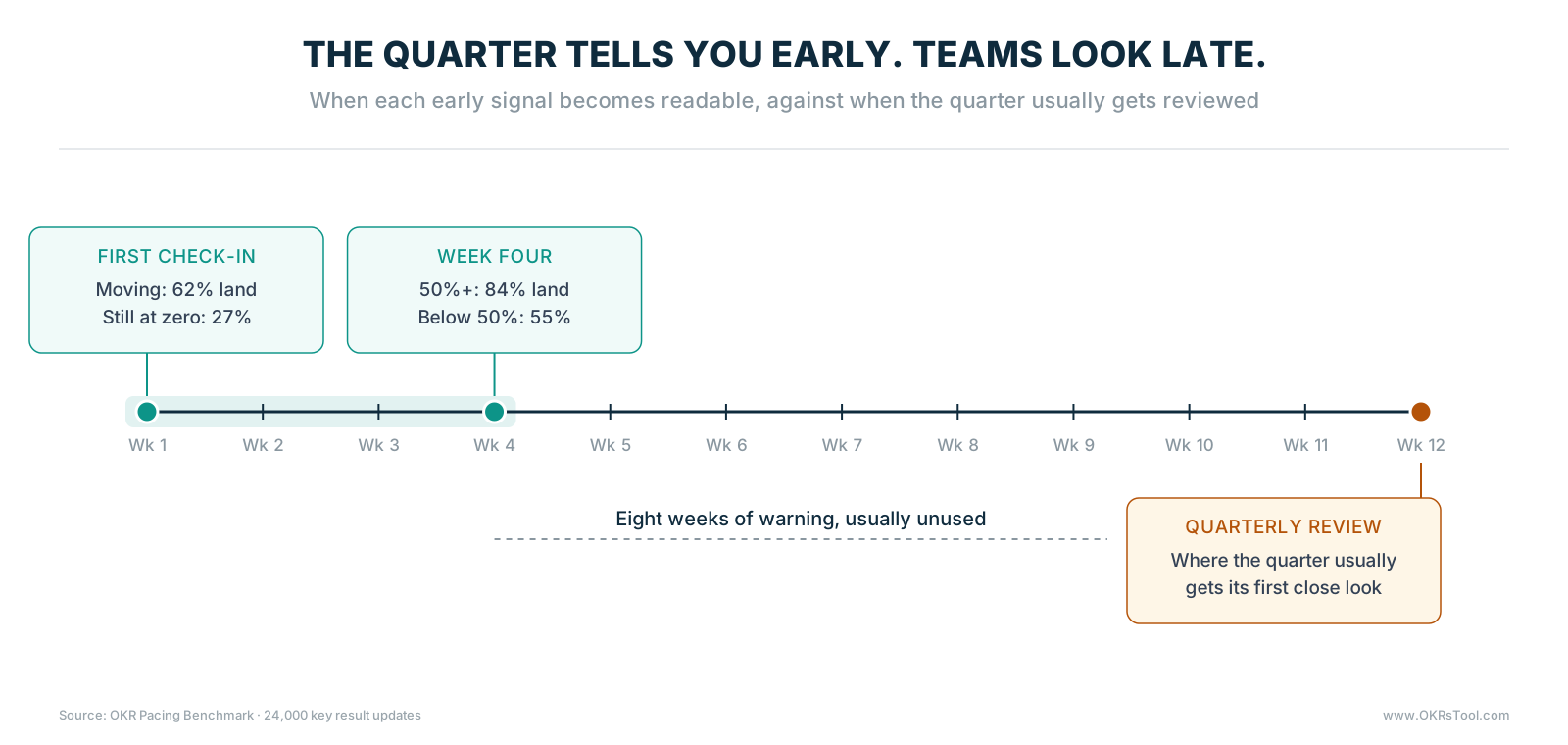
Each signal comes with a specific response. The table below is the test in one place.
What to Do When a Key Result Fails the Test
A key result that fails the week-four test tells you where to spend attention. There are three useful responses, and the right one depends on why it's behind.
Unblock it. If the key result is behind because something is stuck, such as a dependency on another team, a missing resource, or a decision nobody has made, name the blocker in this week's check-in and escalate it. Behind-because-blocked is the most recoverable state there is, provided someone acts in week four rather than week nine.
Revise it. If the target was wrong from the start, because the baseline was off or priorities shifted after planning, change it formally at the mid-quarter review. A documented revision keeps the goal honest. Knowing how to adjust OKRs when priorities change is part of running them well.
Reallocate or close it. If the key result still matters and is falling behind, move effort toward it now. If it no longer matters, close it with a written reason so it stops consuming attention.
The costly option is the default one: carry on, hope it recovers, and record a 0.3 score in week twelve. A close relative is the watermelon OKR, reported green in status updates while it sits at 20% in week four. Both are failures of timing. The information was there, and nobody used it while it could still change the outcome, which is one of the most common reasons OKRs fail.
Read the Quarter in Week Four
For the person accountable for OKRs, the week-four test changes the job. Instead of explaining misses in the quarterly review, you catch them in the first month and walk into the review with decisions already made. Leadership sees the drift alongside what was done about it, which is a far stronger position than a list of red key results and no story.
The test does depend on current data. If updates are manual and sporadic, the week-four reading is stale or missing, and the signal never arrives. That's the practical case for tracking on a platform that prompts owners every week and keeps progress live on an OKR dashboard, so the numbers you read in week four are this week's numbers.
Get that rhythm in place, run the test every quarter, and the completion rate starts to reflect the decisions you made in week four rather than the surprises you found in week twelve.
Data: the OKR Pacing Benchmark, an analysis of 24,000 key result updates.