
A key result still at zero at its first check-in hits its target 27% of the time, against 62% for one already moving. That makes the first check-in an early warning. The rescue window runs longer: flat key results still being worked on recover 66% of the time if they start moving before the mid-cycle review. Once the review passes with them still at zero, recovery falls to 47%.
Week two, first check-in. Three key results on the board still read 0%. Each owner says the work starts next week, the meeting moves on, and twelve weeks later all three come back red at the quarterly review, where the person running OKRs has to explain a miss that showed up in week two.
To find out when goals like those can still be saved, we followed 1,121 key results that were at zero at their first check-in through to the end of their cycle. The first check-in tells you which key results are in trouble. The mid-cycle review is your last good chance to fix them. The sections below show the data behind both and what to do at each checkpoint.
The First Check-In Shows Which Key Results Are in Trouble
The first check-in is the earliest read you get on a quarter. A key result that has already moved by then goes on to hit its target 62% of the time. One still at zero hits 27% of the time.
A zero that early usually means nothing has started. The owner hasn't picked it up, the first piece of work is waiting on another team, or the target depends on something that hasn't happened yet. None of that is fatal in week one. What the first check-in gives you is a list: the key results that need help, with most of the quarter still ahead.
The first check-in diagnoses. Its job ends once that list exists and every flat key result has an owner and a date for its next update.
The Mid-Cycle Review Is the Last Good Chance to Fix Them
The more useful question is what happens to the key results on that list. Among flat key results that stayed in play for eight weeks or more, the week they first moved off zero decided most of the outcome.
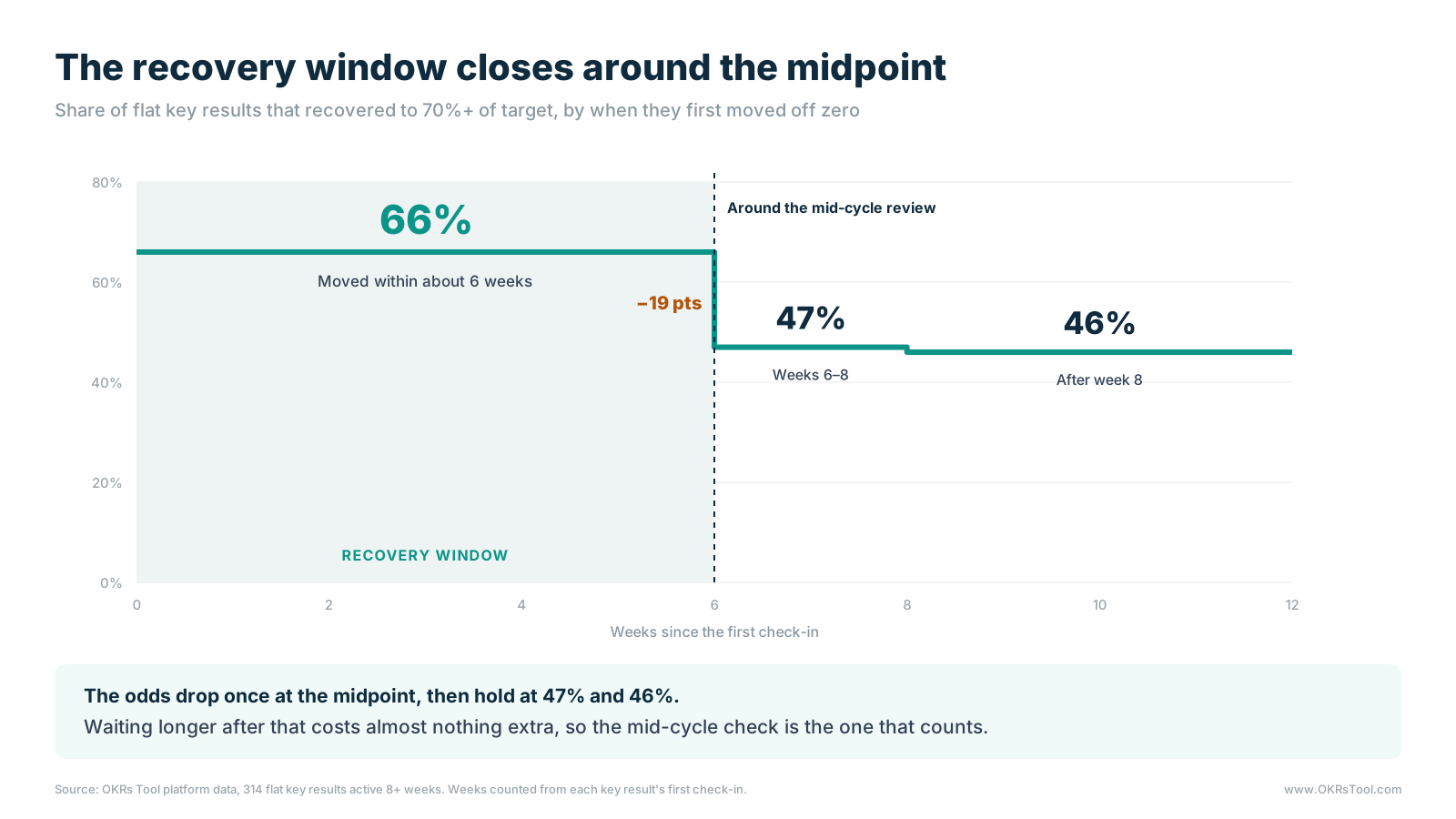
Flat key results that started moving within about six weeks of their first check-in recovered 66% of the time, meaning they reached 70% or more of their target by cycle end. Those that first moved after that point recovered 47% of the time, and waiting longer barely changed it. The odds drop once, around the middle of the quarter, and then hold.
Six weeks after the first check-in lands around the midpoint of a 12-week quarter, where a mid-quarter review usually sits. The data can't prove the review causes the recoveries, and the clock here starts at each key result's first check-in, so the line is approximate. The pattern fits a simple explanation.
The mid-cycle review is the last scheduled moment in the quarter where someone looks at every goal and acts. A flat key result that gets moving before it has the back half of the quarter to catch up. One still at zero after it has no second scheduled chance and usually drifts to the end.
A Third of Flat Key Results Never Reach the Review
A rescue only works on a key result someone is still looking at, and a large share of flat key results drop out long before the midpoint.
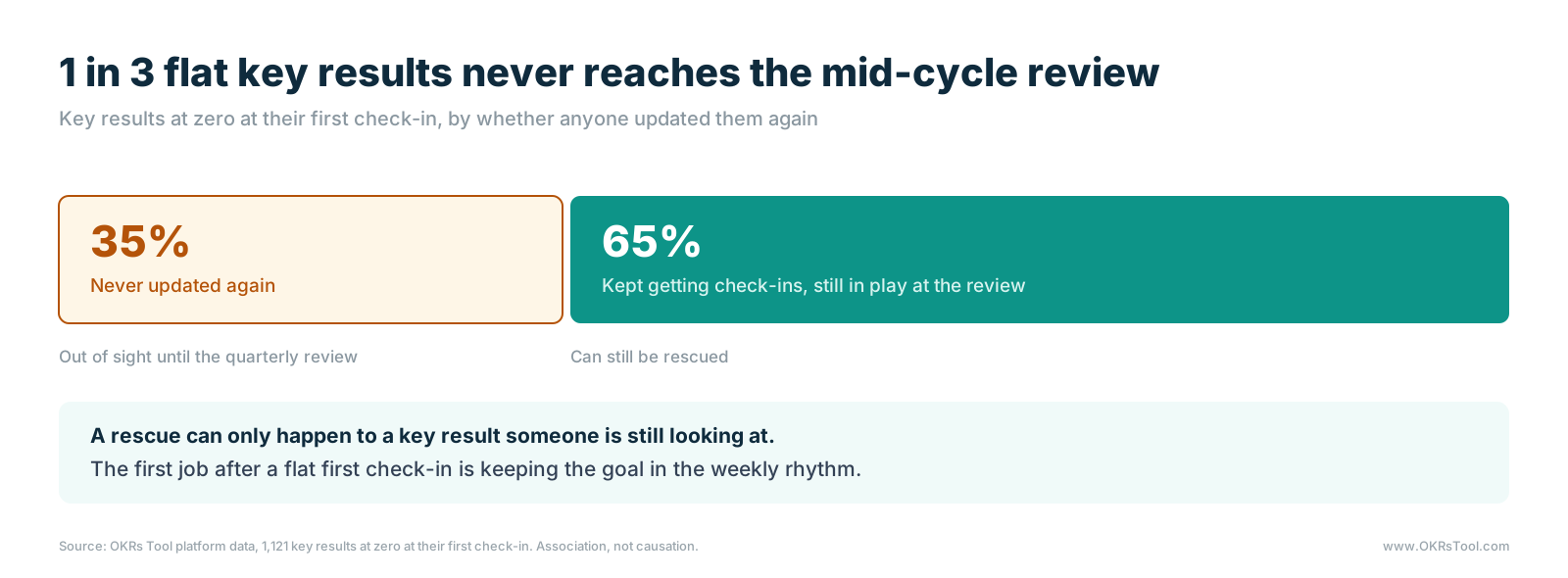
35% of key results at zero at their first check-in never received another update. They stayed on the board, untouched, until they turned up red at the quarterly review. The data shows that they went silent and doesn't show why, though the usual causes are ordinary: an owner who never felt the goal was theirs, a quarter that filled with other work, or a target that stopped mattering after planning without anyone saying so.
This is where the first check-in and the mid-cycle review connect. The first check-in has to keep every flat key result in the weekly rhythm, so it's still visible when the review comes round. A key result with no clear owner is the likeliest to go silent, which is why naming one at the first check-in matters more than any other step.
What the Rescue Has to Do
The data also tested which actions showed up in the recoveries. Neither of the two it could measure made the difference.
Flat key results with a comment thread recovered at almost the same rate as those without one, 52% against 50%. Talking about a stuck goal, in a thread or a progress update, didn't move the odds on its own. Flat key results with an initiative attached recovered less often, 35% against 54%, most likely because teams attach initiatives to the goals that are already hardest. Owner changes and target edits weren't recorded, so they couldn't be tested.
What the recoveries had in common was movement, early. So a rescue at the mid-cycle review has one aim: get the number off zero this week, or decide the goal is finished. In practice that means one of three moves:
- Restart it with a first milestone small enough to hit before the next check-in, and a named owner for it.
- Re-scope it if the original target no longer fits the quarter, using a documented change that follows a clear process for adjusting OKRs.
- Close it with a written reason, so it stops sitting on the board as a miss nobody chose.
Two Checkpoints, Two Jobs
The table puts the first check-in and the mid-cycle review side by side.
Run the Mid-Cycle Review as a Rescue
For the person accountable for OKRs, the change is to the agenda. If your team holds a mid-quarter review, it often runs as a progress report: green goals get a sentence and red goals get an explanation. Run it as a rescue instead. Start with one list, every key result still at zero, and leave with a decision on each one. A standard approach to underperforming OKRs makes those decisions faster, because the options are agreed before the meeting.
The harder part is the weeks between the two checkpoints, when a third of flat key results go silent. Keeping them visible means someone has to notice each missing update, and in a spreadsheet that someone is the champion. The Key Result Formula makes the case for stepping in the first week a goal doesn't move. This data adds the deadline for that rescue: the mid-cycle review.
A platform that asks every owner for a weekly update and lists the key results still at zero on an OKR dashboard keeps flat goals in view without anyone chasing them. They reach the mid-cycle review already flagged, and the meeting is spent on decisions. That's how a team protects its completion rate and keeps its OKRs alive past the first few cycles.
Data: OKRs Tool platform data, drawn from 24,000 key result updates. 1,121 key results were at zero at their first check-in; the recovery-window figures cover the 314 of those still in play after eight weeks. Weeks are counted from each key result's first check-in. A key result "hit" or "recovered" when it reached 70% or more of target by cycle end.