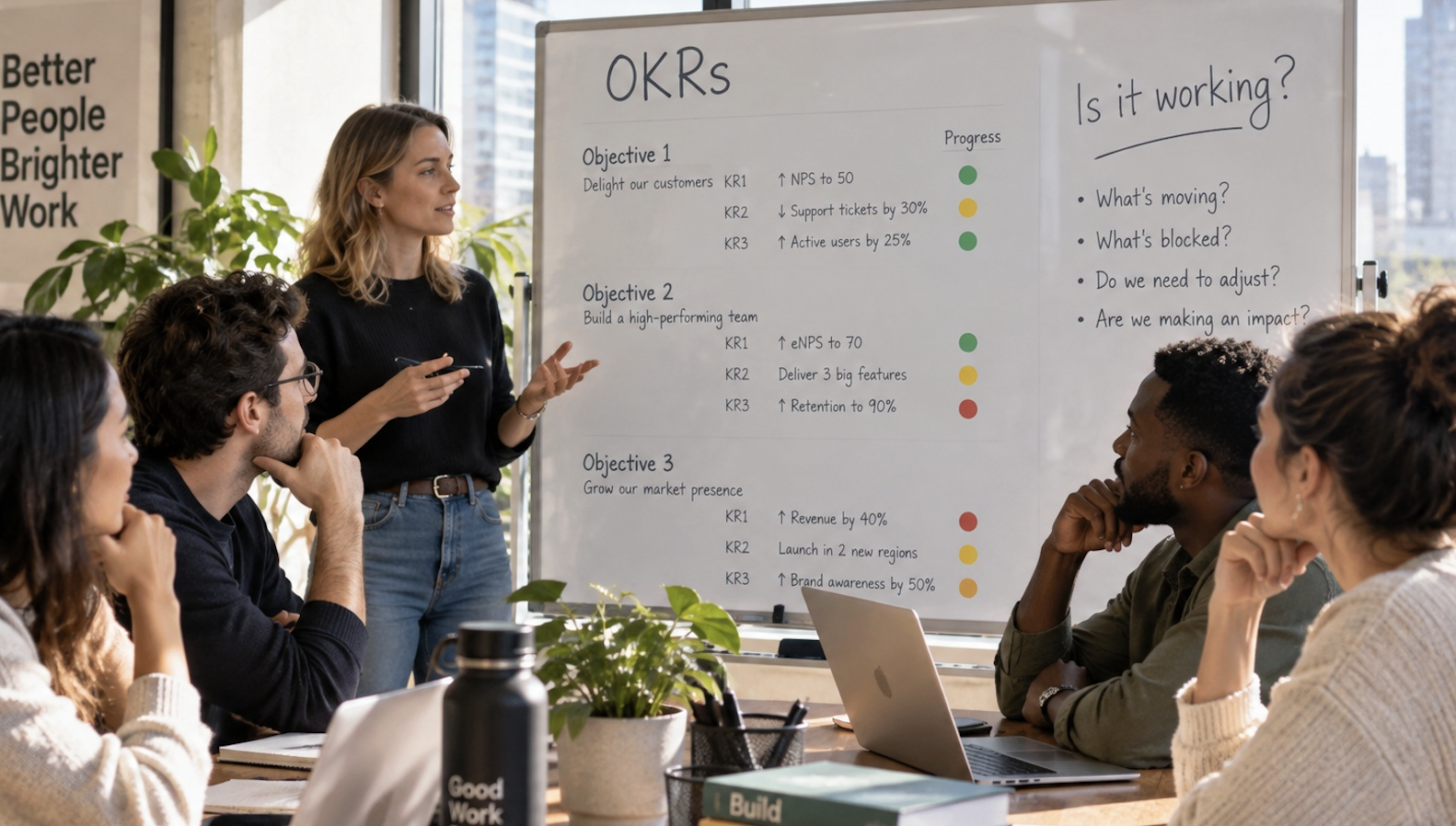
Cascading goals is the process of translating company-level priorities into department objectives, so every person can draw a direct line from their weekly work to what the organization is trying to achieve. When it works, alignment is structural. When it doesn't, 65% of teams end up working on things that have no explicit connection to company strategy.
Only 16% of organizations complete the full goal cascade — from company priorities finalized to every team's goals set — within the same week. 26% take 3–4 weeks. By the time some organizations finish cascading, the quarter is already a third over.
That finding, from the OKR Intelligence Report 2026 across 222 organizations, captures the central failure of cascading goals: it's treated as a process to complete rather than a structure to maintain. Teams rush it at the start of the quarter, produce imperfect connections, and then discover mid-cycle that their work and their company's priorities are pointing in different directions.
This guide covers how cascading goals actually work — the structure, the common failure modes, and the habits that make alignment last beyond the planning session.
What Are Cascading Goals?
Cascading goals is the process of translating high-level organizational priorities into progressively more specific goals at each level of the company — from company strategy, to department objectives, to team Key Results, to individual work.
The cascade answers one question at each level: "Given what the company needs to achieve this quarter, what is our specific contribution?"
Each level translates the level above it. The company goal doesn't become the team's goal — it becomes the context within which the team sets their own, specific contribution.
Cascading Goals vs Cascading OKRs
The terms are often used interchangeably. In practice, cascading OKRs is the most structured implementation of cascading goals — using the OKR framework to make the connection between levels explicit, measurable, and trackable.
Cascading goals is the broader concept. Cascading OKRs is the implementation methodology most growing organizations use to operationalize it.
The distinction matters because the failure modes are different. Generic cascading goals programmes often produce alignment on paper — teams have goals that reference company priorities — but no mechanism for tracking whether the connection holds through the quarter.
OKRs add the Key Result layer that makes progress measurable, the ownership layer that makes it accountable, and the weekly check-in that makes it visible.
Why Cascading Goals Fail
The cascade failure data from the OKR Intelligence Report 2026 is precise: only 16% complete it within the same week, 26% take 3–4 weeks, and a significant portion never complete a clean cascade at all.
The reasons are consistent:
Top-down without translation. The most common cascade error: company goals get announced and teams are told to "align their goals" — without guidance on what alignment means structurally. Teams write goals that reference company language without making the contribution specific.
A marketing team that writes "support the enterprise pipeline" hasn't cascaded — they've acknowledged the priority without committing to a measurable contribution.
Simultaneous vs sequential. Many organizations run the cascade sequentially — company goals first, then department goals, then team goals. This produces a 3–4 week lag before the first team is aligned. High-performing organizations run company and department goal-setting in parallel in a single half-day session, completing the cascade in days rather than weeks.
No alignment visibility. 65% of teams admit their goals aren't linked to company strategy — not because they didn't try, but because there's no system making the connection visible. When alignment exists only in planning documents, it dissolves within weeks as priorities shift and work takes over.
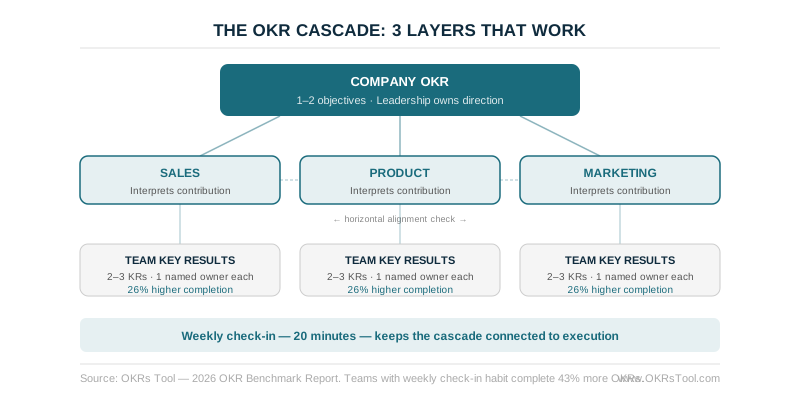
Cascade without ownership. A team goal with no named owner isn't a cascade — it's a statement of intent. Teams with clear single ownership per goal see 26% higher completion rates than those with shared or vague accountability. The cascade must assign ownership at each level before it can function as an execution system.
How to Cascade Goals Correctly
Step 1: Set Company Goals Before the Cycle Starts
The cascade starts with 1–2 company-level priorities for the quarter. These need to be set and agreed before any team begins writing their goals — otherwise teams are aligning to a moving target.
Keep the number small. Teams running 1–2 company objectives are twice as likely to achieve them as those running three or more. The discipline of choosing the most important 1–2 priorities is itself a form of alignment — it signals clearly what the company is and isn't focusing on this quarter.
Step 2: Run Department and Team Goal-Setting in Parallel
Rather than sequentially cascading from company to department to team over several weeks, run company and department goal-setting in a single half-day session with all department heads. Each team then has 2–3 days to set their Key Results within that context.
This compresses the cascade from 3–4 weeks to 3–5 days — the difference between starting the quarter aligned and spending the first month catching up.
Step 3: Make the Connection Explicit
For every team-level goal, the connection to the company priority should be explicit — not implied. The question to ask: "If we hit this Key Result, how does it specifically advance the company objective above it?"
A team that can answer that question in one sentence has a genuine cascade. A team that needs a paragraph to explain the connection has a loose one.
Step 4: Build the Alignment Map
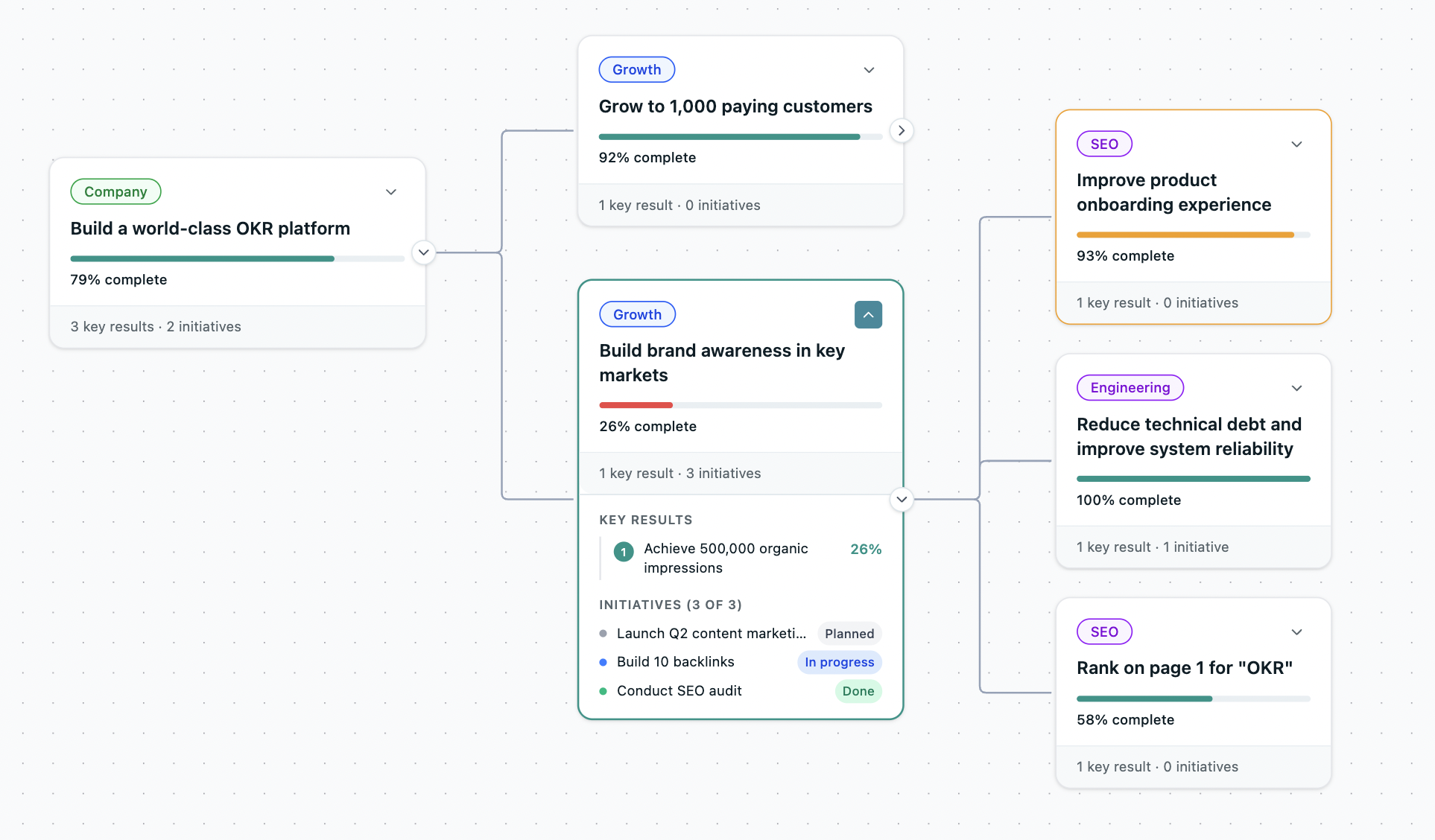
The alignment map is the visual representation of the cascade — showing every team's goals connected to company priorities in a single view. When the alignment map exists and is kept current, misalignment becomes visible before it becomes a missed quarter.
Step 5: Review the Cascade at Mid-Cycle
A cascade set in week one can drift by week six. The mid-cycle review should explicitly ask: are all team goals still connected to the company priority they were set against? Have any strategic assumptions shifted that make the connection obsolete?
93% of organizations modify their goals at least occasionally after the cycle starts. A standing mid-cycle review that checks cascade integrity prevents quiet misalignment from compounding into a missed quarter.
Cascading Goals Examples
Example 1: Revenue Growth
Company goal: Build the enterprise pipeline that funds next year's growth
Sales team: Increase enterprise MQL-to-SQL conversion from 18% to 32%
Marketing team: Grow enterprise organic MQLs from 90 to 180 per month
Product team: Reduce time-to-first-value from 6 days to 2 for enterprise accounts
Each team is doing different work — but every Key Result has a direct, specific connection to the company priority above it.
Example 2: Product Quality
Company goal: Make the product fast enough that speed becomes a differentiator
Engineering team: Reduce p95 page load time from 3.2s to under 1.5s
Product team: Reduce onboarding drop-off at the loading step from 28% to under 10%
Customer Success team: Reduce support tickets related to performance from 45/week to under 15
Example 3: Team and Culture
Company goal: Build a culture people choose to stay in
People team: Improve employee eNPS from 28 to 45 by next survey cycle
Engineering team: Reduce unplanned overtime from 22% of weeks to under 8%
Leadership team: Complete structured 1:1s with all direct reports every week for 10 consecutive weeks
The Cascade Visualizer
Before building the cascade in your OKR software, it helps to map it visually first — to see where the connections are strong, where they're loose, and where teams are missing a meaningful contribution to the company priority.
How OKRs Tool Makes the Cascade Structural
Most goal-setting tools support cascading as a feature. OKRs Tool makes it structural — meaning the cascade isn't optional, manual, or dependent on discipline to maintain.
Every Key Result requires a named owner before it goes live. Every team goal connects explicitly to a company or department priority in the alignment map. Weekly check-in nudges keep every level of the cascade updated automatically — so alignment isn't just set at the start of the quarter but maintained through it.
The 2026 OKR Benchmark Report across 200 organizations: teams with a weekly check-in habit complete 43% more goals than those reviewing monthly or ad hoc. The cascade that gets maintained every week is the one that produces results. The cascade that gets set and forgotten produces the 65% misalignment stat.
The Cascade Is Infrastructure, Not a Planning Tas
Cascading goals is not a planning exercise. It's an execution infrastructure — the system that keeps company strategy connected to daily work through a full quarter, not just the week it was set.
The organizations generating the highest returns from their goal programs aren't writing better goals. They're completing the cascade faster, making the connections explicit, assigning ownership at every level, and reviewing alignment mid-cycle before drift compounds.
Only 16% of organizations do all of this within the first week of a quarter. For the 84% who don't — the gap between where they are and where the high performers operate is entirely closable. It starts with a clean cascade before the cycle begins.
Data: OKR Intelligence Report 2026 (222 organizations, technology sector), The ROI of OKRs: 2026 Benchmark Report (330 respondents), The 2026 OKR Benchmark Report (200+ organizations).