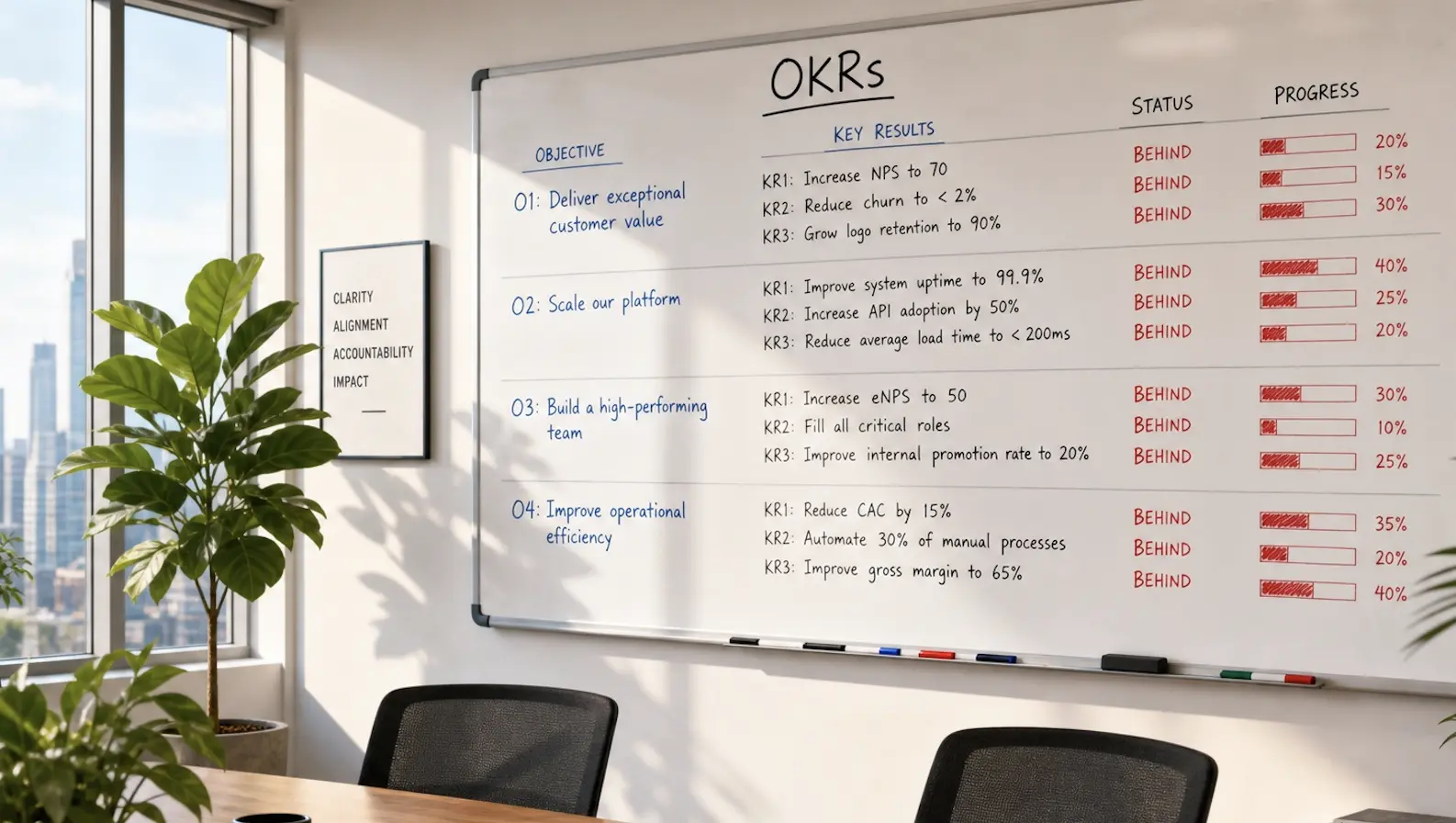
An OKR that's going to fail tells you weeks before it does — and almost nobody is looking. 20% of all key results finish at exactly 0%, having never moved once. The failure was legible the whole time. Reading it is a skill.
When an OKR program falls apart, the explanation is almost always the quarter: things got busy, priorities shifted, the goals were too ambitious. That story treats failure as something that arrives at the end, unpredictably — but why OKRs die is rarely a surprise if you know the signals, and most reasons OKRs don't work are visible early. The data says the opposite. A failing OKR broadcasts a specific, catchable signal — often in the first two weeks — and the reason it dies anyway is that no one is reading the signal.
There are five of these signals, tied to five distinct ways an OKR fails: it can be un-hittable from the day it's written, it can never start, it can go quiet mid-cycle, it can be a company goal nobody owns, or it can be one person's goal with no team behind it. Each has a tell that appears well before the miss. Learn the five and the mid-quarter review stops being a status update and becomes triage — which goals are showing which sign, and which need intervention now.
Why OKRs Die: Failure Is Legible Before It Happens
The useful thing about knowing why OKRs die is that the deaths aren't random. Each of the five maps to a distinct moment in a goal's life, and each leaves a mark you can see early if you know where to look.
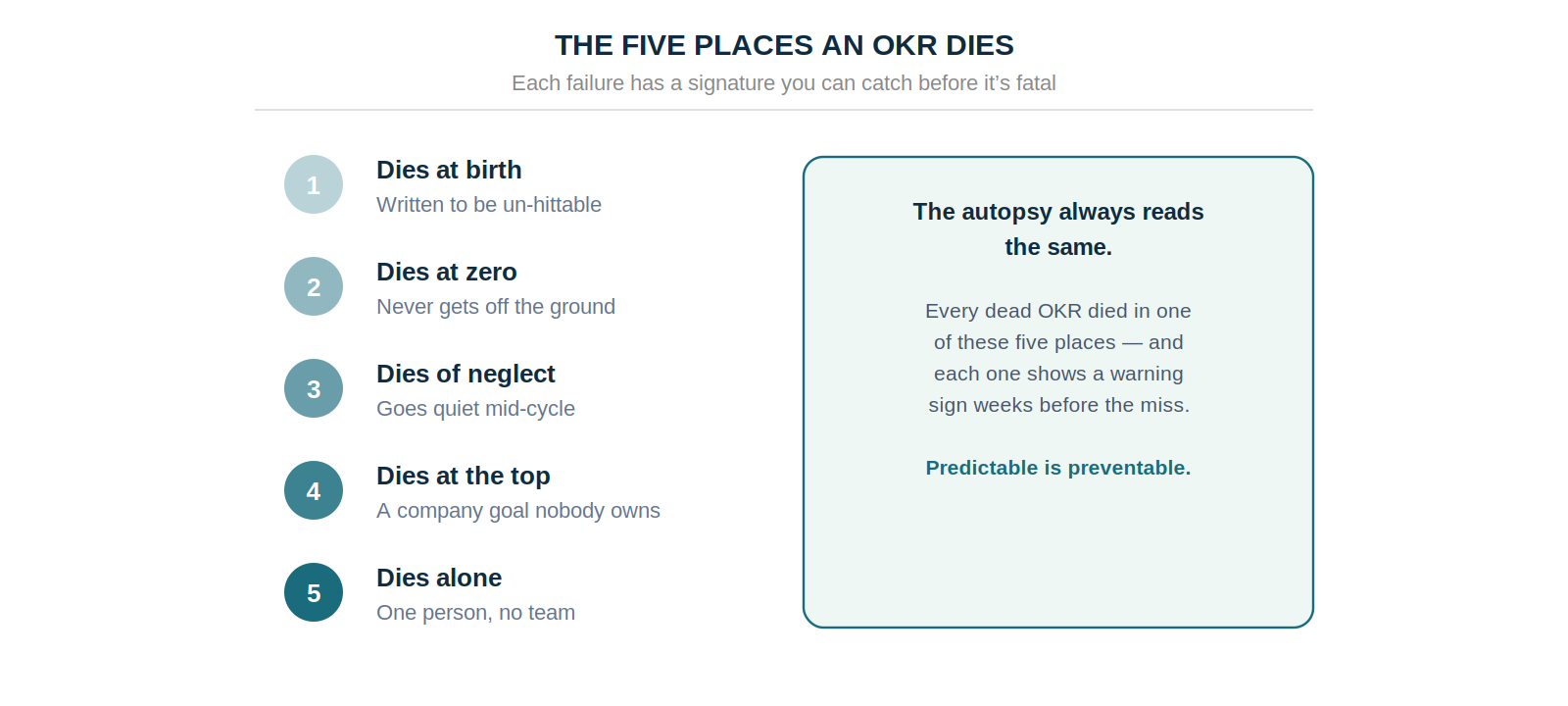
The rest of this piece takes the five one at a time: the failure, the evidence behind it, and — the part that matters — the specific signal that lets you catch it while there's still a quarter left to save.
Written to Be Un-Hittable
The first failure is baked in before the cycle starts. The key result has a vague target with no clear finish line, or the objective carries so many key results that none gets real attention. It was never going to be hit, because it was never really trackable.
The evidence here is directional rather than hard, and worth stating that way: at the organization level, leaning heavily on raw numeric targets correlates modestly with worse outcomes, key results starting from a clean zero baseline tend to finish better than those that don't, and objectives loaded with more key results tend to do worse than lean ones. Three soft signals pointing the same direction, not one firm number — but they agree.
The tell shows up at planning, before any work happens. Apply one test to every key result: can it come out wrong even if the team tries hard? A well-formed key result has a baseline, a target, and a single finish line, and an objective has no more than two or three of them. A goal that can't fail, or can't be tracked to a number, is already lost — and this is the one failure you can erase entirely with a red pen, before the quarter even opens. Getting the structure right is most of what writing good OKRs comes down to.
Created, Then Never Touched
The second failure is the most common and the plainest to see: the key result is entered during planning and then never updated. It doesn't decline over the quarter. It sits at zero from the first day to the last.
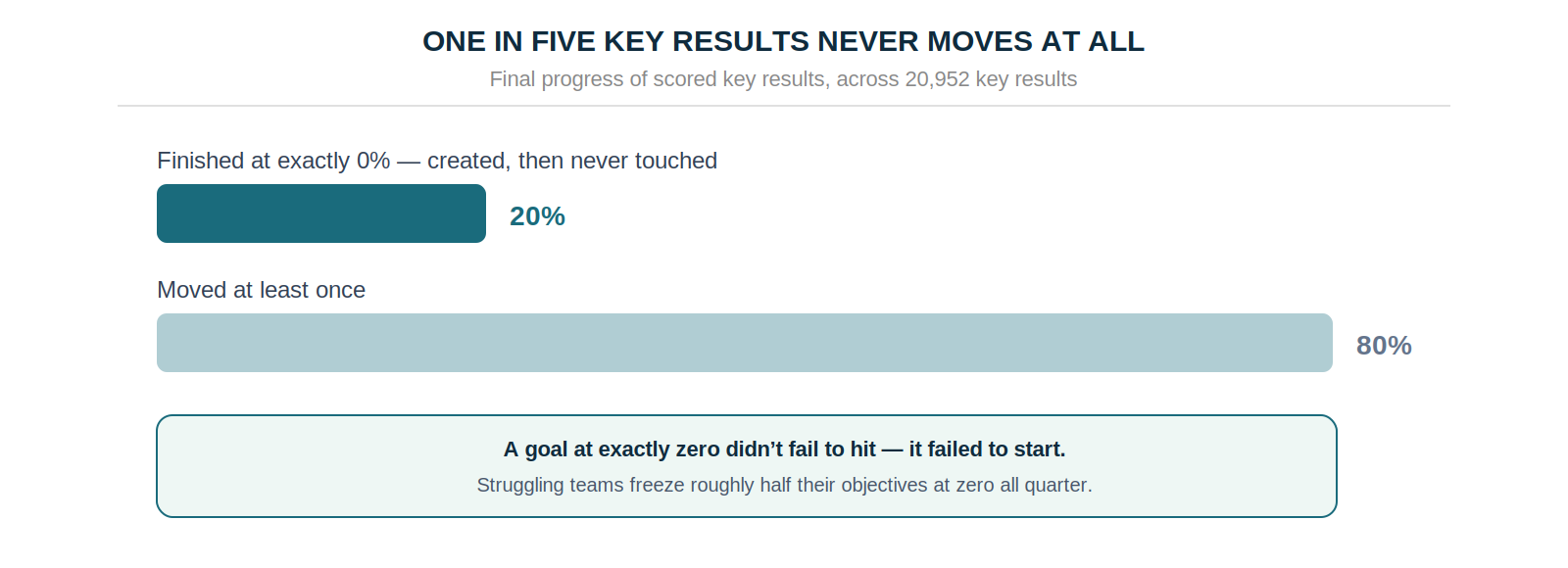
This one isn't soft at all. Across more than 20,000 scored key results, 20% finished at exactly 0% — one in five never moved a single time. And it clusters: struggling teams freeze roughly half their objectives at zero for the whole quarter, while healthy teams have almost none. A goal sitting at precisely zero never started — which usually means it was created as an artifact of the planning meeting and abandoned the moment the meeting ended.
The tell is visible by week two. Any key result still at 0% after the first fortnight is either mis-scoped or orphaned, and both are cheap to fix early and fatal to ignore. A check-in rhythm that surfaces zero-movement goals in the first two weeks turns the most common failure into a rare one.
The Updates Stop
The third failure is quieter, because the goal starts out healthy. It moves in week one, maybe week two, and then the updates trail off. The work might continue, but the goal drops out of the conversation — and a goal nobody is watching drifts until the review makes it official.
The evidence is strong and comes from two directions. Benchmark data shows teams with a consistent weekly check-in cadence complete 43% more of their goals than those reviewing monthly or ad hoc. Platform data shows the mechanism underneath: teams that hit their targets kept 71% of their key results moving through the cycle, while teams that missed kept only 25% moving. The line between the two groups sits around a 30% update rate — below it, goals go quiet and slip; above it, they stay live.
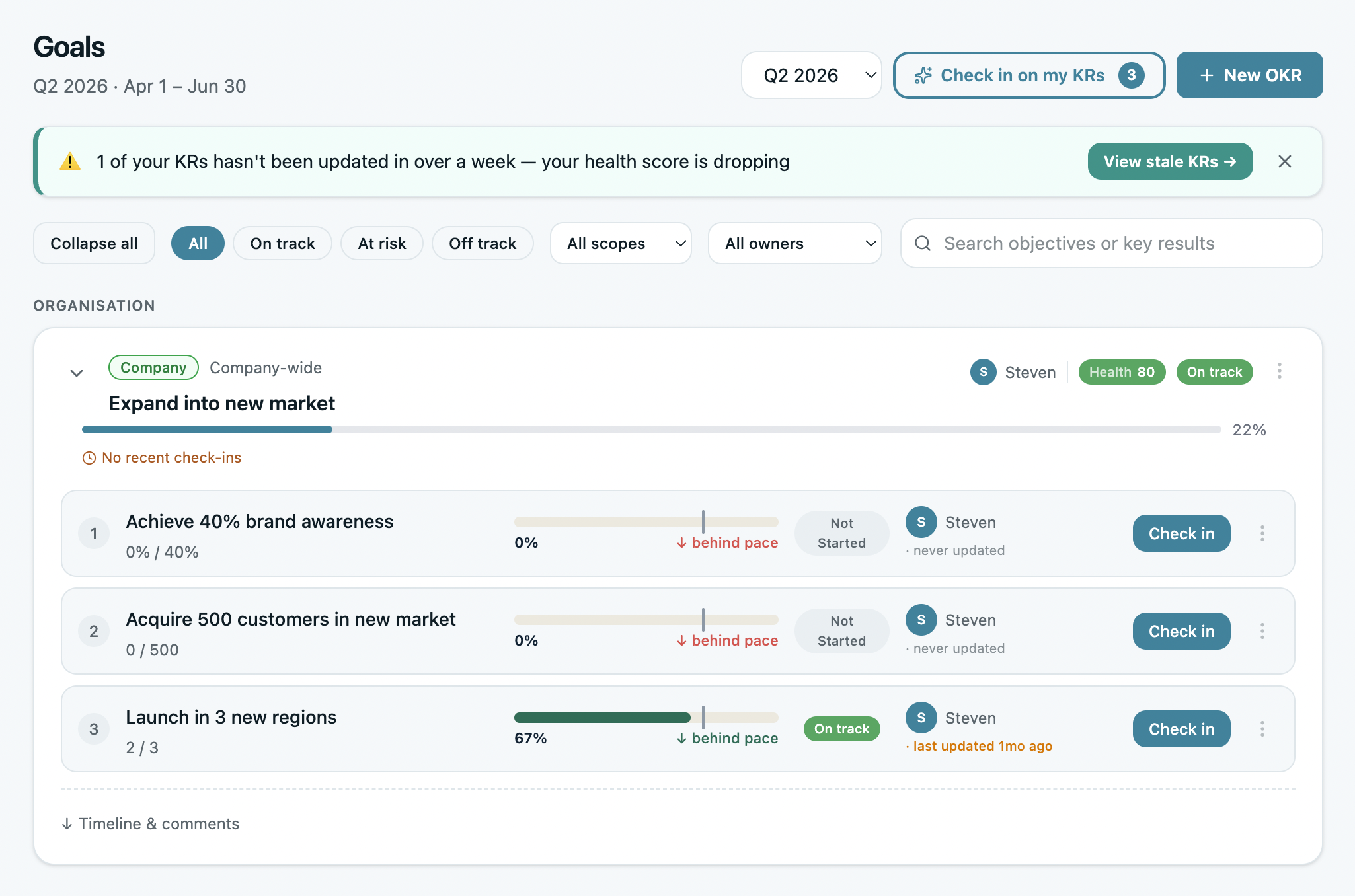
The tell is a goal that hasn't moved, regardless of what its status field says. A key result still marked "on track" whose number hasn't changed in three weeks is already slipping, and that absence of movement is the earliest signal there is — earlier than the score, earlier than the miss. A weekly review that asks only "what moved and what didn't" catches it while there's still time to act.
A Company Goal Nobody Owns
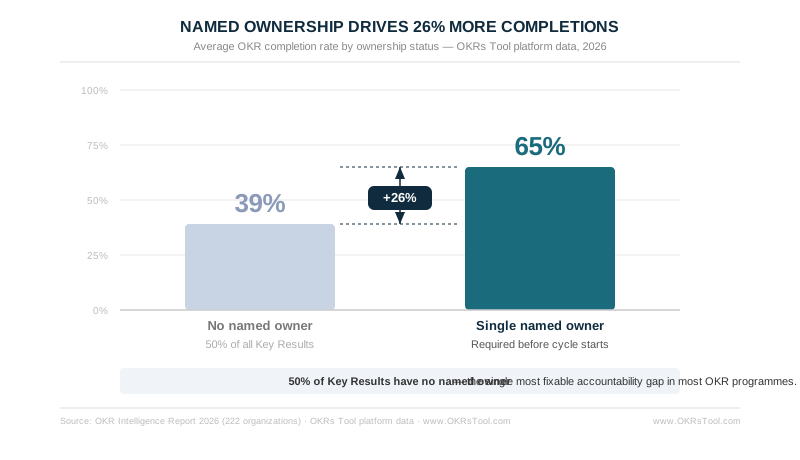
The fourth failure is the most counterintuitive, because it hits the goals that matter most. A company-level OKR is set by leadership, meant for everyone, and therefore owned by no one in particular — held diffusely, disconnected from anyone's daily work, and left to slip at exactly the altitude where slipping is most expensive.
The gradient is clean. Company-level OKRs reach 70% or better only 11.6% of the time; individual OKRs — the ones with a single clear owner — clear that bar 57.3% of the time. Company goals fail about five times as often. The cause isn't that company goals are intrinsically harder; it's that "owned by the company" resolves in practice to "owned by nobody," and a goal with no specific owner has no one who feels the weekly pull to move it.
The tell is a question you can ask at planning: who is the one person accountable for this? If you can't name them for a company goal, you've already found the reason it will slip. The fix is to cascade — connect the company priority down to team and individual goals with a real owner at every level, so the top-line objective has owned work beneath it across the cycle instead of collective good intentions. Ownership isn't a nicety on a company goal; it's the difference between 12% and 57%.
One Person, No Team
The fifth failure is the easiest to miss. The OKR lives in a solo workspace — one person tracking their own goals, no team around them. It survives on that individual's attention alone, so the first busy week ends it, and with no one else in the workspace, the whole program goes quiet at once.
The evidence here is moderate, and it's worth being straight about why: some of the effect is a team-size proxy, since solo workspaces are small by definition. With that caveat, the numbers are still stark — solo workspaces update just 17% of their key results and only 30% ever update anything at all, against 57% and 91% for team workspaces. The churn analysis pointed the same way: thin-footprint solo and very small orgs are the ones that quietly abandon the program and leave. It's a real, distinct failure with real numbers, even where it overlaps with simply being small.
The tell is the workspace itself: one name, and a goal that only moves when that name has a quiet week. Shared visibility is what keeps the habit alive — when a goal lives somewhere a team can see it, one person's busy week doesn't end it, because the rhythm belongs to the group. Run OKRs solo and the program's lifespan is exactly your spare attention, which is the most fragile thing to hang it on.
Learn to Read the Signal
The five failures share the property that makes this whole thing tractable: every one is visible before it's final. Un-hittable shows up as a key result that can't fail, at planning. Never-started shows up as no movement by week two. Gone-quiet shows up as a number unchanged for three weeks. Unowned shows up as a goal you can't name a person for. Alone shows up as a workspace with one name in it.
None of that takes a sophisticated read. It takes looking at the right signal at the right time — which a weekly rhythm, a clear owner per goal, and a live shared home make automatic rather than effortful.
That's the real answer to why OKRs die: the teams whose OKRs survive aren't luckier or more ambitious than the teams whose OKRs fail. They just read the signal early and did something about it while there was still a quarter left to change the outcome.
Data: OKRs Tool platform data (876 organizations, 20,952 key results), The 2026 OKR Benchmark Report (200 organizations).