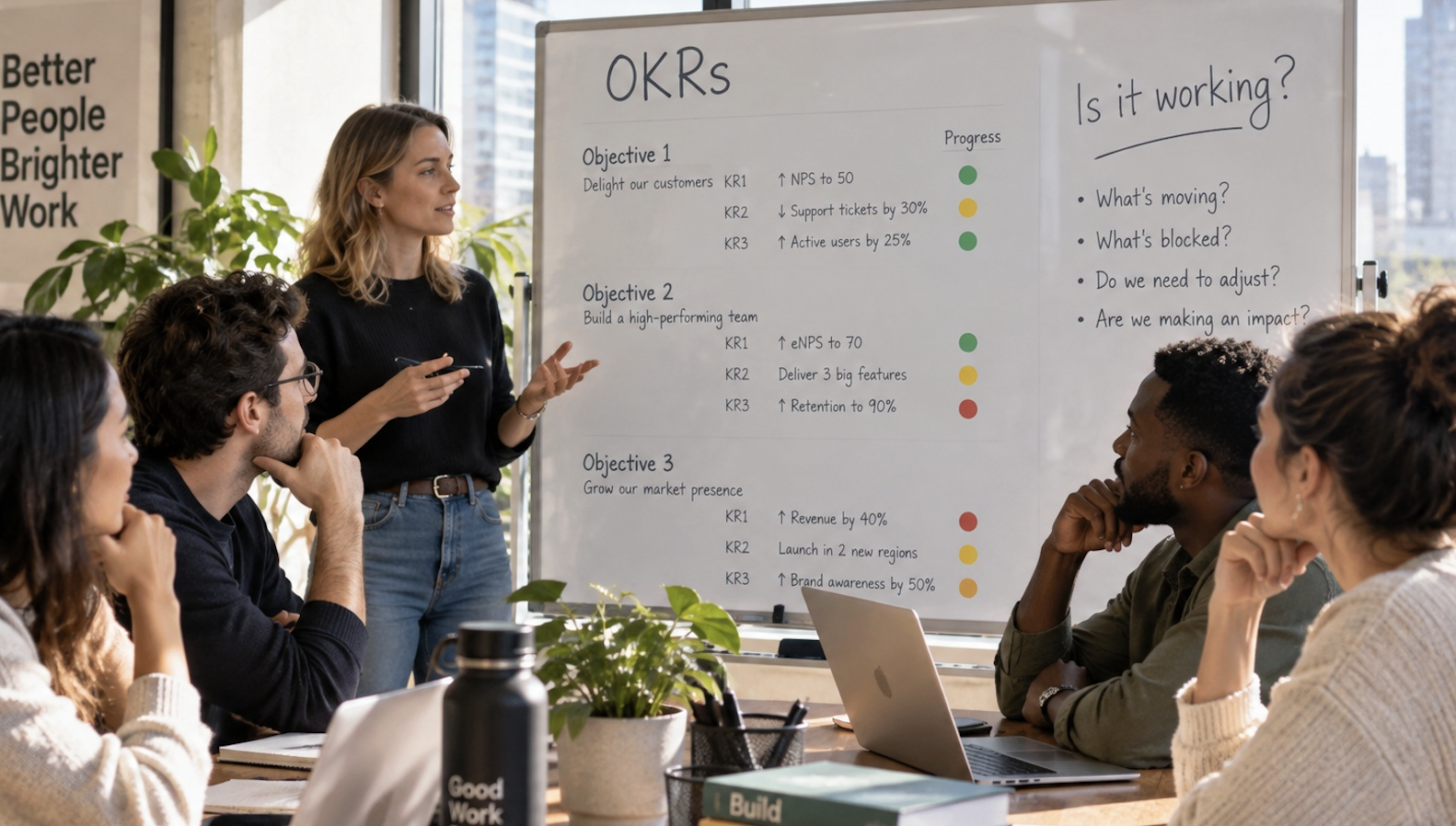
KPI tracking answers a question OKRs can't: whether the business can sustain the change you're chasing. The two get confused constantly — 52% of key results analysed across 876 organizations turn out to be tasks or KPIs wearing a goal label. Separating the layers, then running them together, is what keeps ambition grounded.
In most organizations KPI tracking happens in a dashboard somebody opens occasionally, while OKRs live in a planning document somebody else opens quarterly. The two never meet, and the cost of that separation is a team pushing hard toward an ambitious target with no visibility of the strain building underneath it.
The distinction is simple enough to state. OKRs define the change you want; KPIs reveal the conditions you're operating in. Getting them mixed up is among the most common structural errors in goal programmes — platform analysis of 20,952 key results found 52% were tasks or KPIs in disguise, filed as goals when they were really health metrics. This guide covers what KPI tracking adds to an OKR system, how to keep the layers distinct, and how to run both in one weekly rhythm.
Why KPI Tracking Belongs in an OKR System
Track only OKRs and you see progress without risk. Track only KPIs and you see trends without impact. Running both gives a fuller operating picture in three specific ways.
Progress gets easier to judge, because outcomes and health signals sit side by side rather than in separate tools. Risk surfaces earlier, because a KPI usually registers strain well before it shows up as a missed key result. And decisions get sharper, because the trade-offs between growth, speed, and quality become visible while they're still choices rather than consequences.
KPIs don't compete with OKRs — they establish whether the foundation can support the change you're trying to create.
The Confusion That Costs Most
The most expensive mistake in this area isn't neglecting KPIs. It's filing them as key results.
Across 20,952 key results, 52% were health metrics or tasks in a goal's clothing, against 34% describing an actual change. The practical consequence is a goal that can never be finished. "Maintain 99.9% uptime" is a perfectly good KPI and a terrible key result — you'll track it forever, it will never be complete, and at cycle end you'll score it against a target that was really a standing commitment.
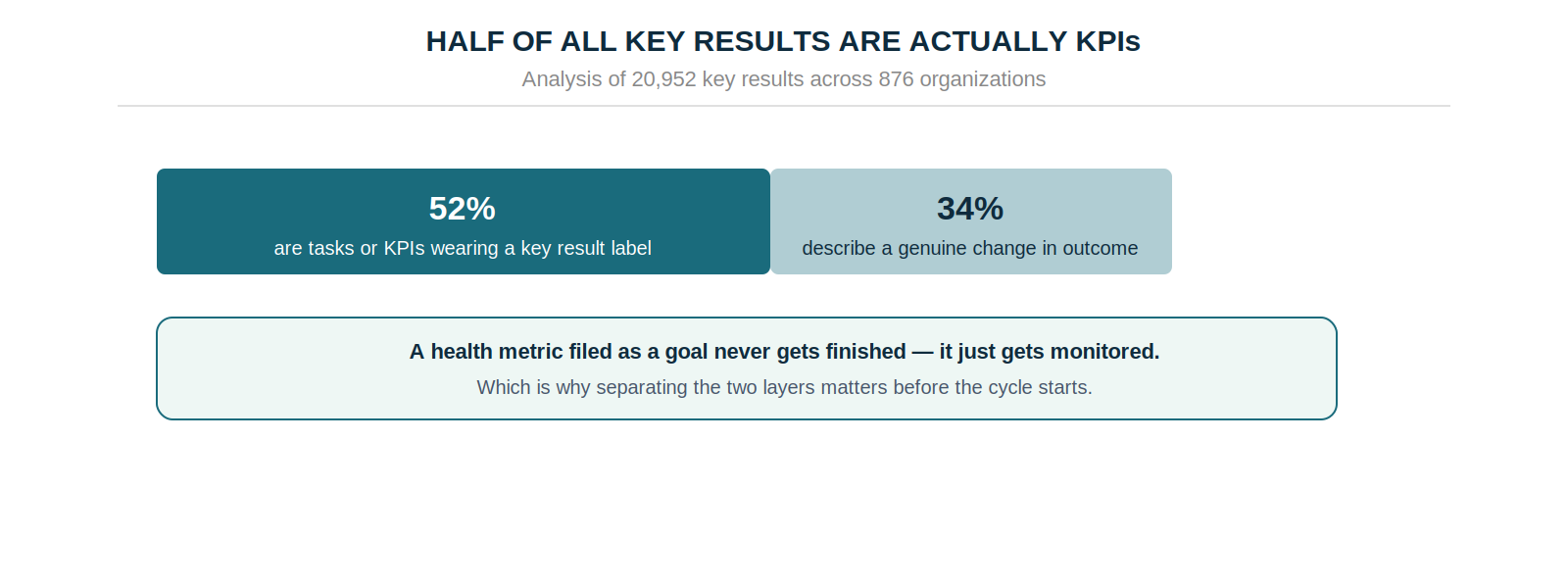
The test takes a second: can this metric be tracked indefinitely without ever being done? If yes, it's a KPI. File it in the health layer, and let the key results describe what you're changing this quarter.
The Two Layers, Kept Distinct
Once the separation is clear, the relationship becomes straightforward: KPIs describe the conditions, OKRs describe the intervention.
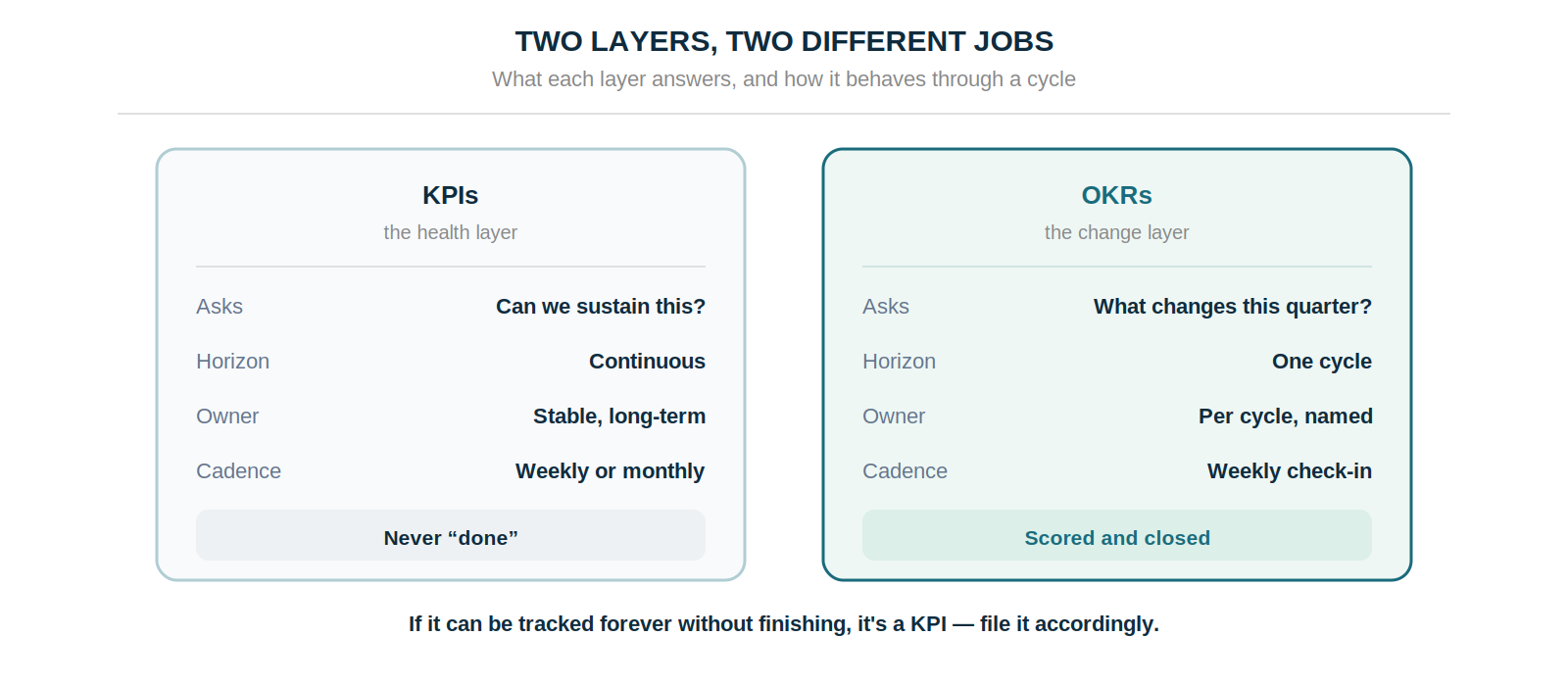
Keeping them distinct but visible together is what gives a team the full picture — what's changing, and whether the system can sustain it — without turning goal-setting into a reporting exercise.
What Strong KPI Tracking Looks Like
High-performing teams treat KPIs as part of the operating rhythm rather than a reporting artefact, and they tend to share five habits.
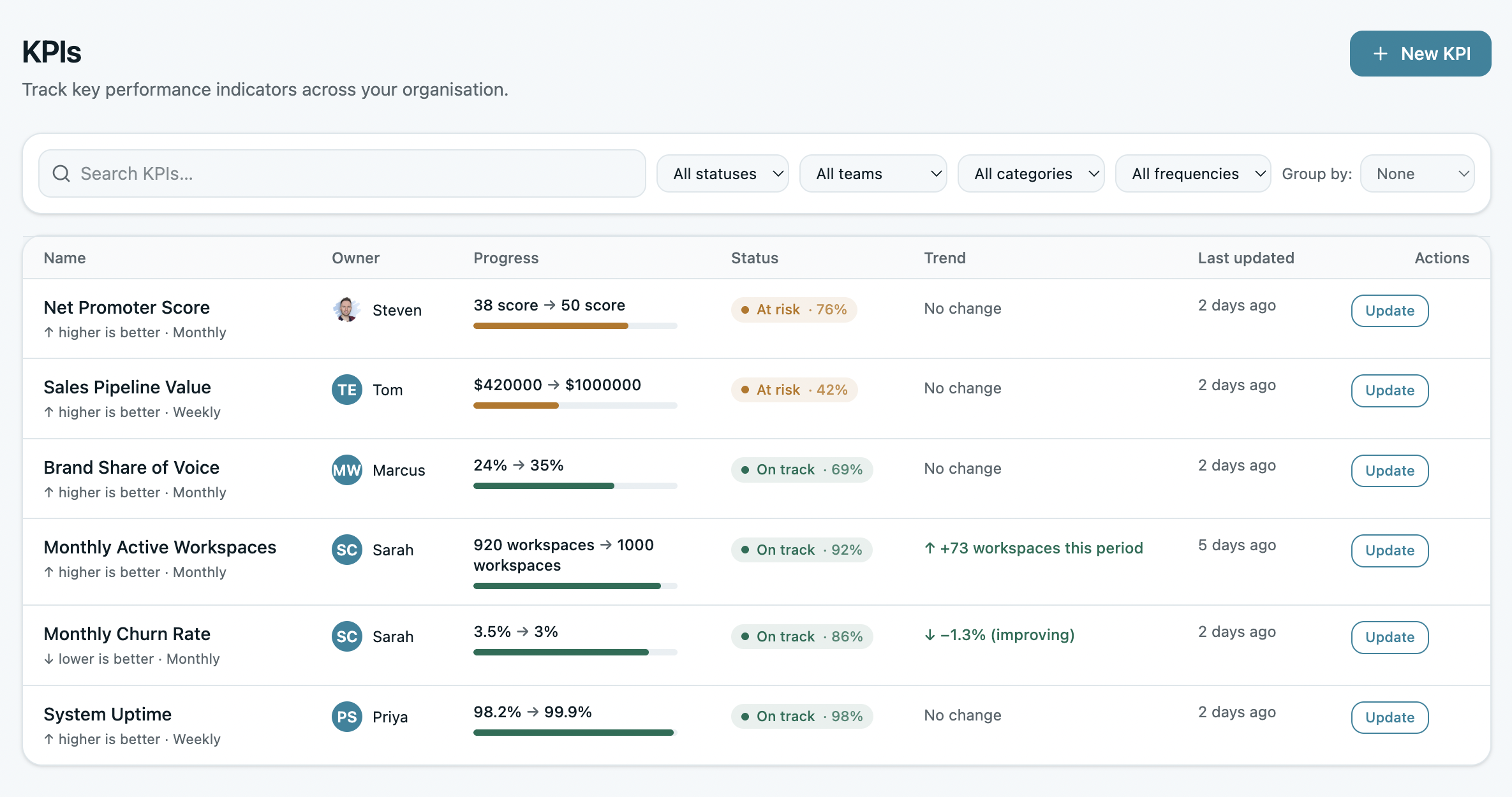
They track only what matters. Rather than accumulating dozens of metrics, they hold to the handful that genuinely reveal business health: acquisition, activation, retention, revenue efficiency, reliability, satisfaction — the same discipline behind limiting how many goals a team runs.
They keep a predictable update cadence. Weekly for fast-moving metrics, monthly for slower ones. Cadence is what produces trendlines, and trendlines are what support decisions — a number updated erratically is just a number.
They discuss KPIs before OKRs in reviews. Health signals should shape improvement priorities, not the other way round. Taking the KPIs first means the team understands the current state before deciding where to spend effort.
They pair numbers with context. A metric without commentary is a value; a metric with two lines of context is a story — what moved, why, and whether it's noise or structural.
They let the list evolve. The metrics that matter at ten people aren't the ones that matter at a hundred. Mature teams refine continuously rather than annually.
How to Introduce KPI Tracking
Seven steps, in order, and none of them takes long.
1. Start with 8–12 company-wide KPIs. Enough to give leadership a clear read on performance without creating noise or maintenance burden. Fewer than eight and you're missing signal; more than twelve and nobody reads them.
2. Assign explicit ownership. Every KPI needs one accountable person to keep it current and interpret the trend. This doesn't mean they control the metric — it means the data doesn't rot.
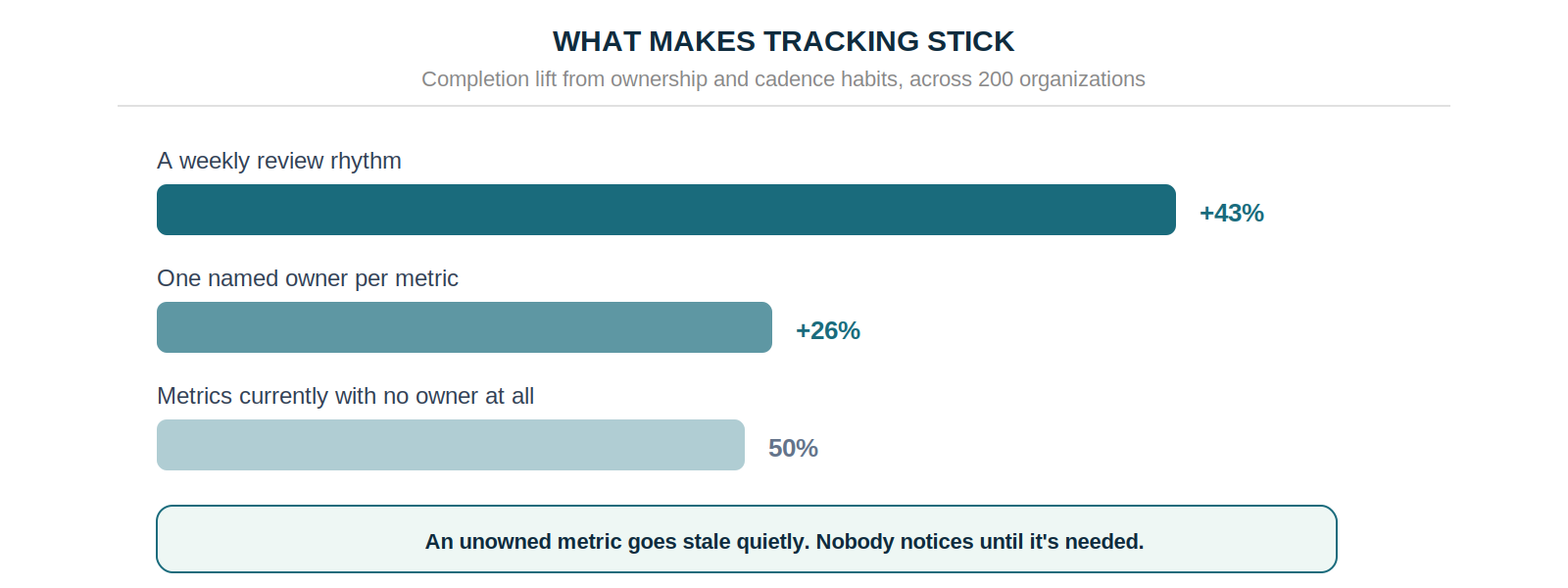
Half of all key results across growing organizations already have nobody's name against them, and the same neglect hits KPIs faster because nothing forces a review. Teams that enforce single ownership complete 26% more of their goals, and the mechanism is identical for health metrics: an owned number gets updated, an unowned one goes stale quietly.
3. Establish the rhythm early. Make updates predictable so they're part of the operating cadence rather than a scramble before a review. Consistency matters more than frequency — a metric revisited on schedule becomes useful for spotting problems early.
4. Use comments to capture context. Encourage owners to note why a metric moved and whether the shift is temporary or structural. This builds institutional memory that survives people changing roles.
5. Bring KPIs into the weekly OKR review. Discussing them in the same meeting, KPIs first, grounds priorities in reality rather than aspiration — and it reduces the risk of driving one number up while quietly degrading another. Teams with a consistent weekly check-in complete 43% more of their goals, and folding KPIs into that existing meeting costs nothing extra.
6. Link KPIs to OKRs only where it's real. Not every metric needs attaching to an objective, and forcing the links creates clutter. Connect only the KPIs that genuinely contextualise a team's goals.
7. Revisit the list each quarter. Review at cycle close: remove what's stopped being meaningful, sharpen definitions that have drifted, add what the strategy now demands. A healthy KPI set grows with the organization rather than lagging it.
Ambition Needs a Foundation
Strong OKRs set direction, but direction alone can't tell you whether the business is holding up underneath. Without a read on operating health, even carefully written goals get pursued in a vacuum — and teams end up celebrating progress that isn't actually strengthening anything, which is how watermelon reporting starts.
That's the whole function of the health layer: signals showing whether growth is sustainable, whether operational load is manageable, and whether the customer experience is intact while teams push for improvement. Run KPI tracking alongside OKRs, updated consistently and owned deliberately, and a team operates with full context rather than half of it — catching problems earlier and choosing priorities with the trade-offs visible.
Handled this way, KPI tracking doesn't add complexity to a goal system. It completes it, which is what turns an ambitious quarter into a sustainable one.
Data: OKRs Tool platform data (876 organizations, 20,952 key results), The 2026 OKR Benchmark Report (200 organizations).