Corporate strategy is the set of choices about where a company competes and how it wins — but 93% of daily work never connects to those choices. The strategy that survives is the one built to be executed after the offsite ends, not the one argued most persuasively in the room.
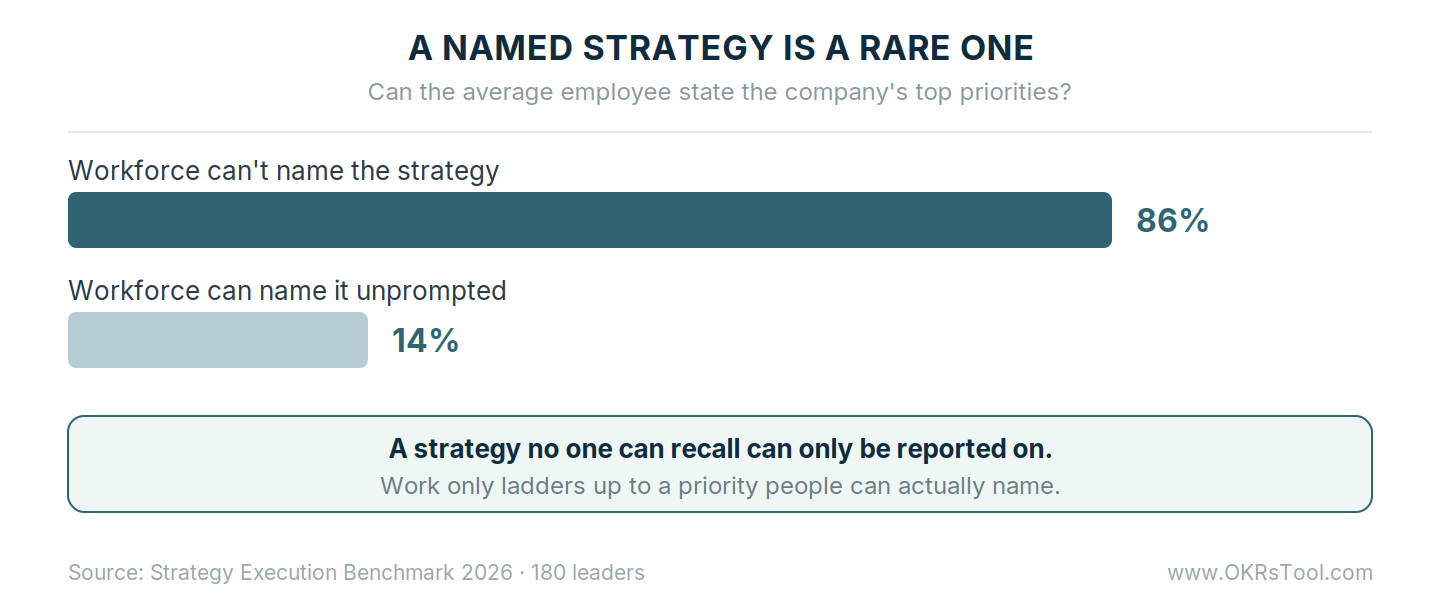
Ask ten executives to define corporate strategy and you'll get ten different answers: a plan, a vision, a set of goals, a deck. The confusion is the first problem. A strategy that can't be stated cleanly can't be executed, delegated, or defended — and most can't be stated at all. In the 2026 Strategy Execution Benchmark, 86% of workforces couldn't name their company's top priorities unprompted.
This piece defines corporate strategy in plain terms, separates it from the three things people confuse it with, and then spends most of its length on the part that actually decides outcomes: why a sound strategy decays in the months after it's set, and what closes that gap. Strategy is where most companies think their problem lives. The data says the problem lives one step later.
What Corporate Strategy Actually Is
Corporate strategy is the set of deliberate choices a company makes about where it will compete and how it will win there. The word doing the work in that sentence is choices. A strategy that tries to win everywhere, please everyone, and pursue every opportunity is a wish list wearing a strategy's clothes. Real strategy is defined as much by what a company chooses not to do as by what it pursues.
At the corporate level specifically, those choices sit above any single product or team. They cover which markets to enter or exit, how to allocate capital and attention across business units, and what advantage the whole company is built to compress into. A company-level objective is the visible expression of a strategic choice — the point where an abstract intent becomes something a team can act on, and where the objective and its key results give that intent a measurable shape.
The test of whether something is a strategy is simple: can a person one or two levels down use it to decide what to work on this week. If the answer is no, what you have is a statement of ambition, not a strategy. Ambition motivates. Strategy directs. The same discipline that separates a sharp written OKR from a vague one applies here — specificity is what makes a choice usable downstream.
The Three Things Corporate Strategy Is Not
Strategy confusion usually comes from collapsing four distinct things into one. Separating them is the fastest way to sharpen a fuzzy strategy.
A vision without a strategy is a hope. A goal without a strategy is a number nobody knows how to hit. A plan without a strategy is a list of activities that may all be individually reasonable and collectively pointless. Strategy is the connective logic underneath all three — the argument for why this particular set of choices wins. Skip that logic and you get goals with no theory behind them, one of the quieter reasons OKRs fail even when every individual target looks sound.
This is why "what is your strategy" is a harder question than it sounds. Answering it forces a company to name the choices it's actually betting on, and naming those choices is uncomfortable precisely because it rules things out.
Why Sound Strategy Decays After the Offsite
Here is the part almost every article on corporate strategy skips. The hard problem is not formulating strategy. Consultancies, frameworks, and two-day offsites are good at producing defensible strategies. The hard problem is that a strategy which looked sharp in October is unrecognizable by March — not because it was wrong, but because it was never wired into how the company actually works.
The benchmark surveyed 180 strategy and operations leaders and found decay showing up in four measurable places.

The single starkest number: in only 7% of companies do leaders say most daily work clearly ladders up to strategy. Put the other way, in 93% of companies, a meaningful share of what people do all day isn't visibly connected to the strategic choices leadership made. The strategy exists. The work exists. The wire between them was never run.
The other three failures compound it. When 86% of workforces can't name the top priorities, the strategy can't guide daily decisions — you can't work toward a goal you can't recall. When 83% of teams get no automatic signal that a priority is drifting off track, decay stays invisible until a quarterly review makes it undeniable; steady progress tracking is exactly what surfaces it sooner.
And when 60% never cleanly resolve a failing priority — no retro, no reallocation, no decision — a strategy that's quietly failing simply keeps occupying the plan while nothing happens.
A Strategy No One Can Name Is One No One Executes
Of the four failures, the naming problem comes first, because everything downstream depends on it. A strategy the workforce can't recall is one they can only report on after the fact, never one they can execute in the moment.
Recall is the precondition for alignment. If a team lead can't state the company's top three priorities without checking a document, there's no way for that lead to judge whether this week's work advances them or wanders from them.
This is why the strongest execution cultures obsess over a small, memorable set of priorities rather than a comprehensive one. A company with three top priorities everyone can name will out-execute a company with fifteen that live in a slide deck, even if the fifteen are individually smarter. Nameability is a property of a strategy that can actually be run, not a communications nicety layered on top of one. It's also what makes clear ownership possible: you can't hold anyone accountable for advancing a priority they can't state.
How to Make Corporate Strategy Hold
The fix for strategic decay is connective tissue, not a better formulation process — building the wiring the benchmark shows is missing, so the strategy stays load-bearing between reviews rather than only at them. Four moves, in order of impact.
Start by making the strategy nameable and visible. Compress it to a small set of company objectives that a person can recall unprompted, and put them somewhere everyone works, not in a deck reopened once a quarter. This directly attacks the 86% naming gap, and it's the cheapest of the four to fix — a guided setup gets the first cycle live in an afternoon, no consultant required.
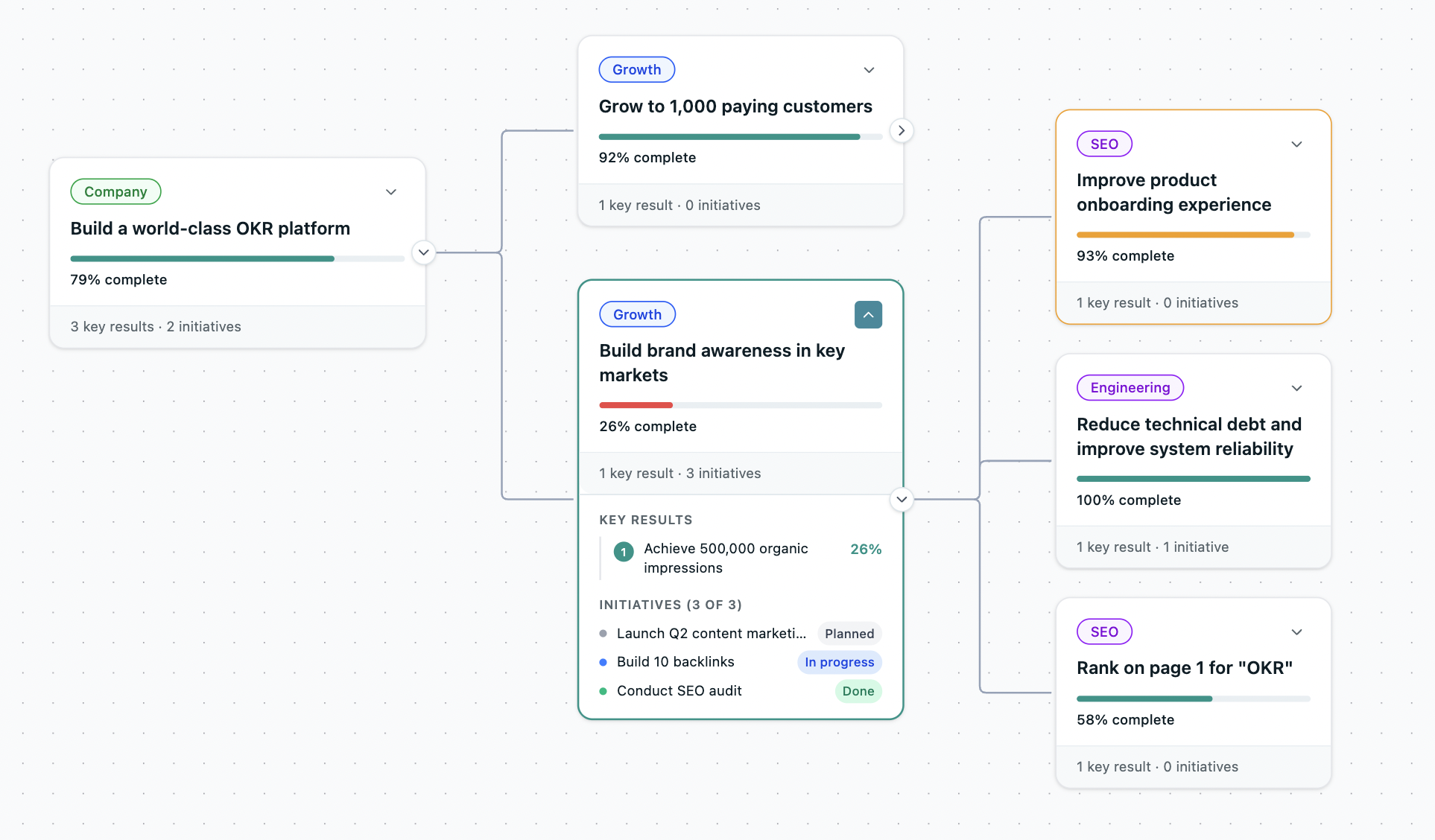
Then connect daily work to those objectives explicitly. This is where OKR software earns its place: it cascades each company priority into team-level goals and shows how every goal rolls up in one platform, so the 93% disconnect becomes visible and closeable rather than assumed away. The alignment map is the artifact that makes "does this work ladder up" a question with an answer, and a free cascade visualizer lets you sketch that map before committing to anything.
Third, install an early-warning signal. The 83% who get no automatic notice of drift are relying on a scheduled review to surface problems that started weeks earlier. A weekly check-in on the goals under each priority turns drift into something you catch in week three, well before quarter-end — the practical line between strategy execution and strategy autopsy. Building that cadence keeps the signal live between reviews.
Finally, give every failing priority a real ending. The 60% who never cleanly resolve a struggling priority let it rot in place. Name what happens when a priority is off track — a mid-quarter review, a reallocation, an explicit decision to cut it — and make it happen every cycle. A strategy that can be quietly abandoned without consequence, the pattern behind most cases of why OKRs die, was never load-bearing.
None of these is a formulation improvement. They're execution infrastructure — the wiring between the choices on the whiteboard and the work in the calendar. That wiring is what separates a corporate strategy that shapes a year from one that decorates a planning deck.
Strategy Is a Set of Choices You Have to Keep Making
The clean definition is worth holding onto: corporate strategy is the set of choices about where a company competes and how it wins, expressed clearly enough that someone two levels down can use it to decide what to do this week. But the definition is the easy half.
The benchmark's numbers are a warning about the hard half. A strategy formulated in a room and never wired into daily work doesn't survive contact with the quarter — it decays quietly, in the 93% of work that never connected to it, the priorities no one can name, the drift no one is warned about, and the failures no one resolves.
Where does your strategy stop being something people can name and start being something they can only report on? That gap is where the year is won or lost — and it opens long before anyone would call the strategy wrong.
Data: 2026 Strategy Execution Benchmark (180 strategy and operations leaders). The 2026 OKR Benchmark Report and OKR Platform Data. Explore all reports on the research hub.