V2MOM aligns a company for the year; it has no mechanism to keep that alignment alive week to week — no owner per measure, no check-in, no at-risk flag. That gap is measurable: 65% of teams say their goals aren't clearly linked to strategy, and the ones that are still stall without the weekly rhythm that lifts completion 43%.
Marc Benioff created V2MOM on the back of an envelope in 1999, in Salesforce's earliest days, to solve one problem: how do you keep a fast-scaling company aligned around the founder's intent without the founder becoming a bottleneck to every decision?
The framework is deceptively simple. Five components, written as a document, cascaded from the CEO down to every team:
- Vision — where the company is going. The strategic destination for the year.
- Values — the principles that guide decisions when priorities conflict. An operating manual for judgment calls, not a mission statement.
- Methods — the specific initiatives the organization will pursue to reach the Vision. The how.
- Obstacles — the known barriers that stand in the way. The honest acknowledgment of what's hard.
- Measures — the metrics that will signal whether the Vision was achieved.
When it works — and at Salesforce it worked spectacularly — V2MOM creates something most goal-setting frameworks don't touch: a shared cultural context. Every person in the company understands not just what the priorities are but why they exist, what values should govern trade-offs, and what barriers are expected. The public cascading of V2MOMs from CEO to team builds radical transparency that compounds over time.
Where it runs into trouble is execution — and this piece covers where V2MOM breaks down, how OKRs fill exactly that gap, and why the strongest setup runs both together rather than choosing between them.
Where V2MOM Breaks Down
V2MOM's elegance is also its limitation: it is an annual document, not a weekly system.
The Measures component is the clearest example. A well-written V2MOM will specify what success looks like by year end — revenue targets, customer satisfaction benchmarks, product milestones. But the V2MOM doesn't assign a named owner to each measure, doesn't require weekly updates, and doesn't surface which measures are drifting until the annual review. By the time the document is revisited, the team has been operating without accountability to it for months.
The Methods component drifts even faster. What starts as a strategic initiative list becomes a project tracker as the year progresses — and then quietly gets deprioritized when the quarter gets busy, with no formal mechanism to catch it. Nobody abandons the V2MOM explicitly. It just stops being referenced.
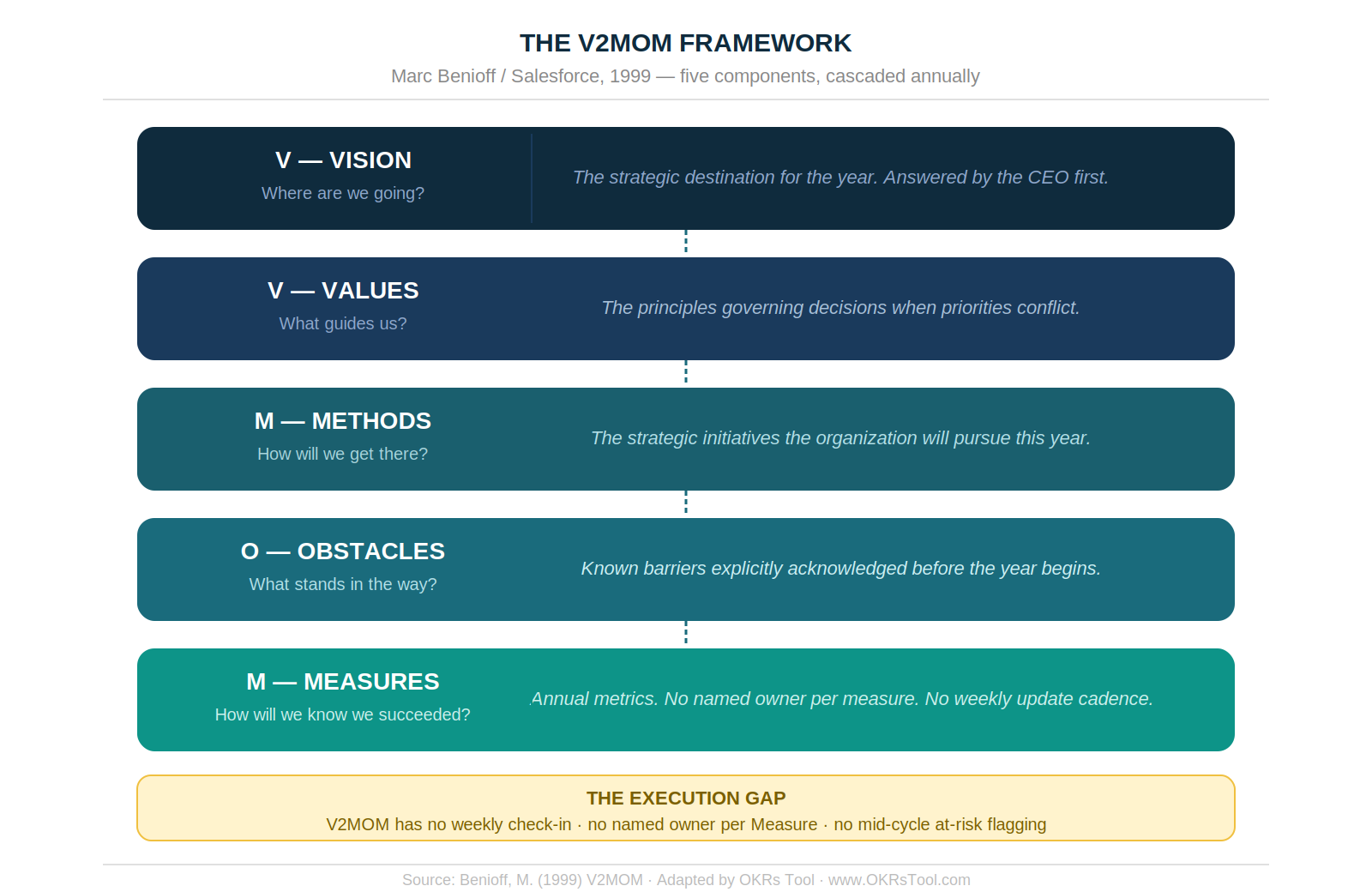
The 2026 OKR Benchmark Report found that 65% of teams admit their goals aren't clearly linked to company strategy. V2MOM solves the strategic alignment problem — the Vision and Methods are published and cascaded. What it doesn't solve is the execution accountability problem: who is doing what about which measure this week, and what happens when they're not.
What the Critical Failure Mode Looks Like
A mid-size company runs V2MOM well. The CEO's document is thoughtful. The cascade is complete by the end of January. The whole organization knows the Vision, the Values, and the five Methods they'll pursue this year.
By April, the Methods have become background context. The teams are executing against sprint plans and quarterly business targets — but without a named owner per Measure updating progress weekly, nobody is explicitly accountable for whether the V2MOM is being executed. The Obstacles section identified the right barriers in January; nobody has formally reviewed whether they've been addressed.
By Q3, the annual review reveals the Measures are behind. The discussion is about why they're behind rather than what changed in week fourteen that could have been caught and corrected.
This isn't a failure of the framework. It's a structural gap: V2MOM creates alignment and context; it does not create the weekly execution rhythm that keeps priorities alive between annual reviews. The OKR process — quarterly cycles, named ownership per Key Result, automated weekly check-ins — fills exactly that gap. Teams with weekly check-ins complete 43% more OKRs than those without. Teams with required single ownership see 26% higher completion rates. Those numbers don't come from writing better goals — they come from the accountability infrastructure V2MOM doesn't provide.

How They Compare
The quickest way to see the relationship is side by side. V2MOM is an annual alignment document; the OKR process is a quarterly execution system. They're often framed as competing frameworks, but they were built to solve different halves of the same problem — which is why the comparison below reads less like a contest and more like a division of labour.
The Right Architecture: V2MOM + OKRs
V2MOM and OKRs are not alternatives. They operate at different layers and solve different problems. The organizations that get the most out of both treat them as complementary: V2MOM sets the annual strategic and cultural context; OKRs operationalize that context into quarterly, owned, weekly-reviewed execution.
The connection is direct. The V2MOM's Methods become the inputs to each quarter's OKR planning session: which Methods are we executing this quarter, what specific outcome would prove we moved them, and who owns each Key Result? The V2MOM's Measures become the destination the quarterly cascade is pointed at.
Without the OKR execution layer underneath, the V2MOM is a strategy document. With it, the V2MOM becomes a strategy that actually runs.
Which to Start With
For organizations without an existing framework: start with OKRs. The quarterly cadence and weekly accountability produce immediate results — the 2026 OKR Benchmark Report found that organizations using purpose-built OKR software generate a 1:88 return on investment versus 1:25 on spreadsheets. The cultural alignment V2MOM provides can be layered in once the execution habit is established.
For organizations already running V2MOM: add OKRs as the execution mechanism underneath the Methods and Measures components. Don't replace the V2MOM — add the weekly accountability layer it structurally lacks. See how OKRs Tool implements the full execution cycle and try it free for up to 5 users with no credit card required.
Data: The ROI of OKRs: 2026 Benchmark Report (330 respondents), The 2026 OKR Benchmark Report (200+ organizations).