
Companies running none of the core OKR habits hit their goals very consistently 10% of the time. Companies running all four reach 80%. Across 420 companies of 50–200 people, five habits did most of the separating, and each is cheap to put in place. They're ranked below by how far each one moves the odds, followed by three things that draw plenty of attention and barely register in the data.
If you've been handed responsibility for OKRs, every piece of advice arrives with the same weight. Pick the right framework, bring in a coach, block out more time, write sharper objectives, score everything, run retros. With a quarter to plan and a leadership team waiting on the rollout, nobody can do all of it well, and the advice gives no sense of which parts the outcome depends on.
The Growing Pains of OKRs study gives a ranked answer. It surveyed leaders at 420 technology companies of 50–200 employees and compared the teams that hit their goals very consistently with the teams that miss. Five habits opened the widest gaps. This piece takes them in order of impact, shows what happens when they stack, and names three popular investments that made little difference.
The Scorecard: All Five Ranked by Impact
Each habit is ranked by how much more likely companies running it in full are to hit their goals very consistently, compared with companies running it partially or more slowly.

Ranking by multiplier settles a near-tie at the top. Ownership and laddering finish within a point of each other on the raw gap, and ownership's 3.8× edges laddering's 3.6×. Every habit on the list at least doubles the odds, so the ranking sets the order of attention for a rollout, and all five belong in it.
1. A Single Named Owner on Every OKR
Companies with an owner on every objective and key result hit their goals very consistently 65% of the time. Where only some OKRs have an owner, 17% do. At 3.8×, ownership is the biggest multiplier in the study.
Shared ownership behaves like no ownership. A key result with two names on it has two people who each assume the other is updating it, and the week it stalls, nobody raises it. For the champion, unowned goals carry a personal cost: you become the default owner of everything without a name, chasing updates on goals you don't run. The ownership rule takes one meeting to apply and removes that job for the rest of the quarter.
The standard: one name per objective, one name per key result, decided at creation. Teams can contribute to a goal, but one person answers for it. The accountability follows from the name, and so does the habit of updating. When a key result has no owner, progress slips week by week, and the first sign is often a red score at quarter end.
2. Goals That Ladder Up to the Company's
Where OKRs clearly link to company goals, 68% of companies hit theirs very consistently. Where only some link up, 19% do. And among companies where very few OKRs link up, 93% report abandoning OKRs.
That last number is the one a champion should keep in view. Unlinked goals drift, because a team can't defend a goal in a planning trade-off when nobody can say which company priority it serves. Once a few teams start treating OKRs as optional paperwork, the program unravels from the edges in. Linking each team objective to a company one gives every goal a reason to survive the quarter, and gives leadership a view of alignment they can check without asking around.
The standard: every team objective names the company objective it serves, and anything that can't name one gets cut or rewritten. Rolling OKRs up works best when company-level OKRs are published first and teams draft against them. Teams can draft bottom-up or follow a top-down cascade, as long as each objective names its parent.
3. A Confidence Score on Every Key Result
Companies that score progress or confidence on every key result hit their goals very consistently 66% of the time. Companies that score only some sit at 22%, a 3.0× gap.
Scoring is the easiest habit on this list to let slide, because skipping it breaks nothing visible. The key result still sits on the board, and the dashboard still shows a percentage. What disappears is a current read from the person closest to the work. A key result without one has nobody managing it, and that's how a watermelon OKR survives a whole quarter: green on the status report, red underneath.
The standard: every key result gets a confidence score at every check-in, on one shared scale. Partial scoring defeats the purpose, since the unscored key results are usually the ones in trouble. Agree on the scoring method before the quarter starts and hold every team to it.
4. Progress Tracked as It Happens
Teams that update progress continuously hit their goals very consistently 59% of the time. Teams that rebuild the picture the night before a review hit 28%.
Reconstruction is the clearest warning sign in the data that a program is fading. It means progress lives in people's heads and inboxes between reviews, and someone (usually the champion) spends the evening before each one pulling numbers into a slide. The manual reporting burden lands on the person who can least afford it, and the numbers it produces are already out of date when leadership sees them.
The standard: owners update key results when the number moves, and the progress view is always current. If assembling a review deck takes longer than opening a dashboard, tracking is running on reconstruction.
5. A Weekly Check-In
Companies with weekly check-ins hit their goals very consistently 60% of the time. Companies checking in monthly hit 30%. A weekly rhythm doubles the odds on its own.
The cadence matters because attention is the scarce resource. Anything slower than fortnightly and a goal drops out of view between touchpoints, so a stalled key result can lose a month before anyone notices. A weekly touch keeps every owner looking at their number while there's still time to act on it. The check-in itself can be short: three or four questions, answered in writing, with a meeting only for what's blocked.
The standard: a weekly check-in for every owner, every week of the quarter, including the busy ones. Fortnightly is the slowest pace the data supports.
The Five at a Glance
The table puts each non-negotiable next to its result and the minimum standard to hold teams to.
"With it" and "Without it" show the share of companies hitting goals very consistently.
The Habits Compound
The study also looked at four core habits together: a weekly check-in, real-time tracking, full ownership and consistent retros. Run them as a set and the effect stacks.
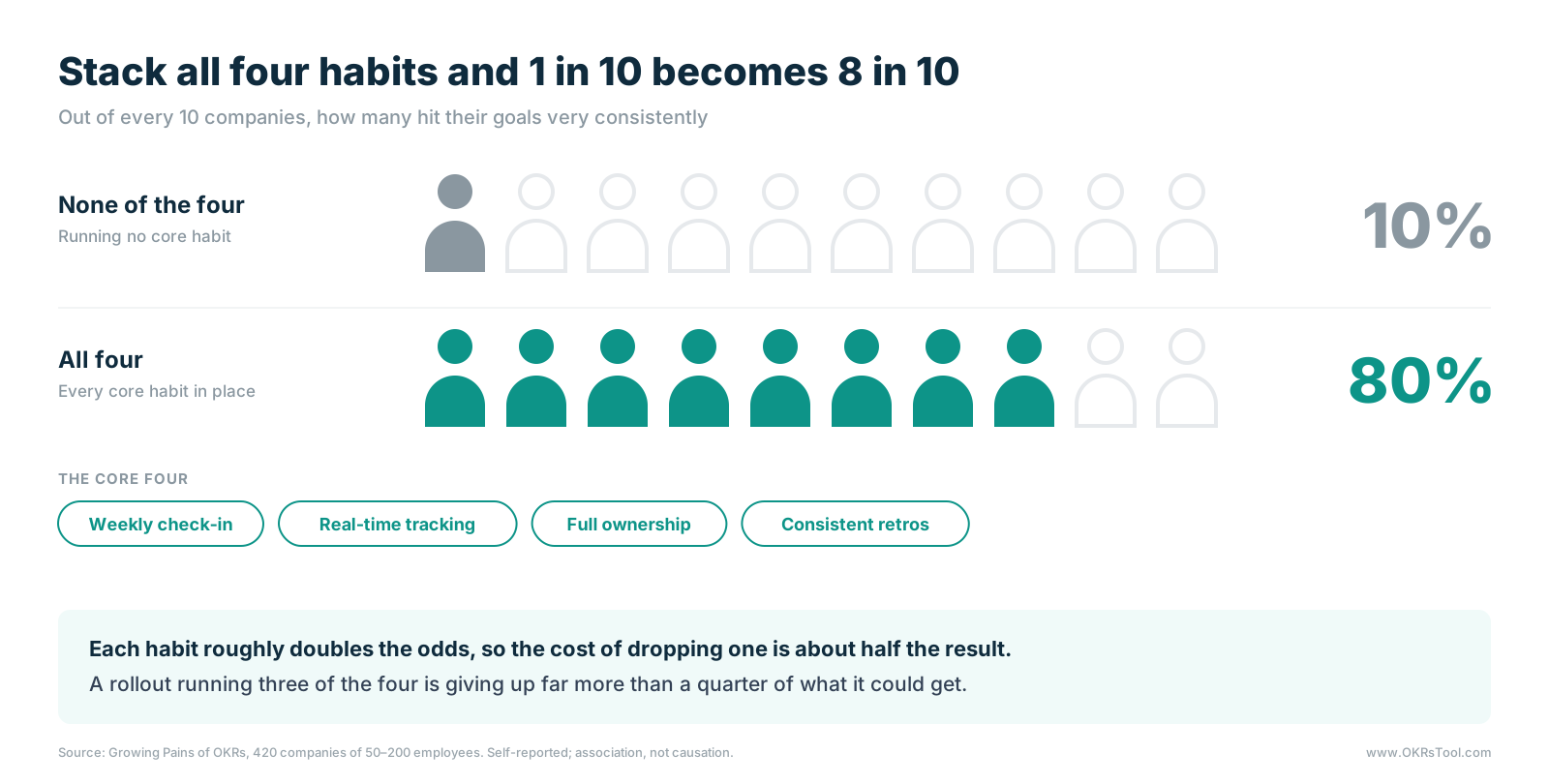
Each habit roughly doubles the odds, and stacked, the four compound to about 8×. The practical consequence for a rollout is that dropping one habit costs about half the result. A program that runs check-ins and tracking but skips retros gives up far more than a quarter of what it could get, because the end-of-cycle reflection is where the next quarter's targets get calibrated against what actually happened.
This changes how to sequence a rollout. The data favours running the full set from the first cycle. The OKR habits that last are the ones built into the quarter's structure from day one, and a first cycle run with all four in place gives leadership a fair test of the framework.
Three Things That Barely Moved the Numbers
Plenty of OKR effort goes into decisions that showed little relationship with results in this study. For a champion with limited time, these are the places to spend less of it.
The framework you pick. Choice of goal framework barely moved the needle next to the habits. Settle on the OKR format quickly and put the saved weeks into the five habits above.
How much time you spend. More hours on OKRs did not, on their own, buy more success. Teams that do invest heavily tend to be the teams running the habits, so the hours and the results travel together. The time pays off when it goes into check-ins, scoring and retros. Long OKR meetings without those habits add hours and leave the odds where they were.
Having a consultant. Bringing in outside help didn't correlate with better outcomes. A consultant can run a strong kickoff workshop. The habits that drive results happen every week after the engagement ends. The comparison of OKR consultants and OKR software comes down to who keeps the weekly rhythm going in week seven, and a platform can be set up in an afternoon without one.
Make the Non-Negotiables Automatic
For the person accountable for OKRs, the ranking narrows the job. Two decisions in planning week (an owner on every goal, a link to a company goal on every team objective) capture the biggest gains. Three weekly rhythms (scoring, live tracking, check-ins) hold them through the quarter. Everything else is optional.
The weekly rhythms are where programs break, because they depend on someone remembering, every week, for twelve weeks. That someone is usually the OKR champion, and it's a common reason OKRs die after a strong launch. A platform that sends each owner a weekly update request, asks for a confidence score each time and keeps progress live takes that remembering off your plate, so the habits run whether or not you chase them.
Data: the Growing Pains of OKRs study, leaders at 420 technology companies of 50–200 employees. No OKRs Tool customers were included.